AI Tools
Doubao vs DeepSeek: Who's Actually Winning China's AI Race in 2026?
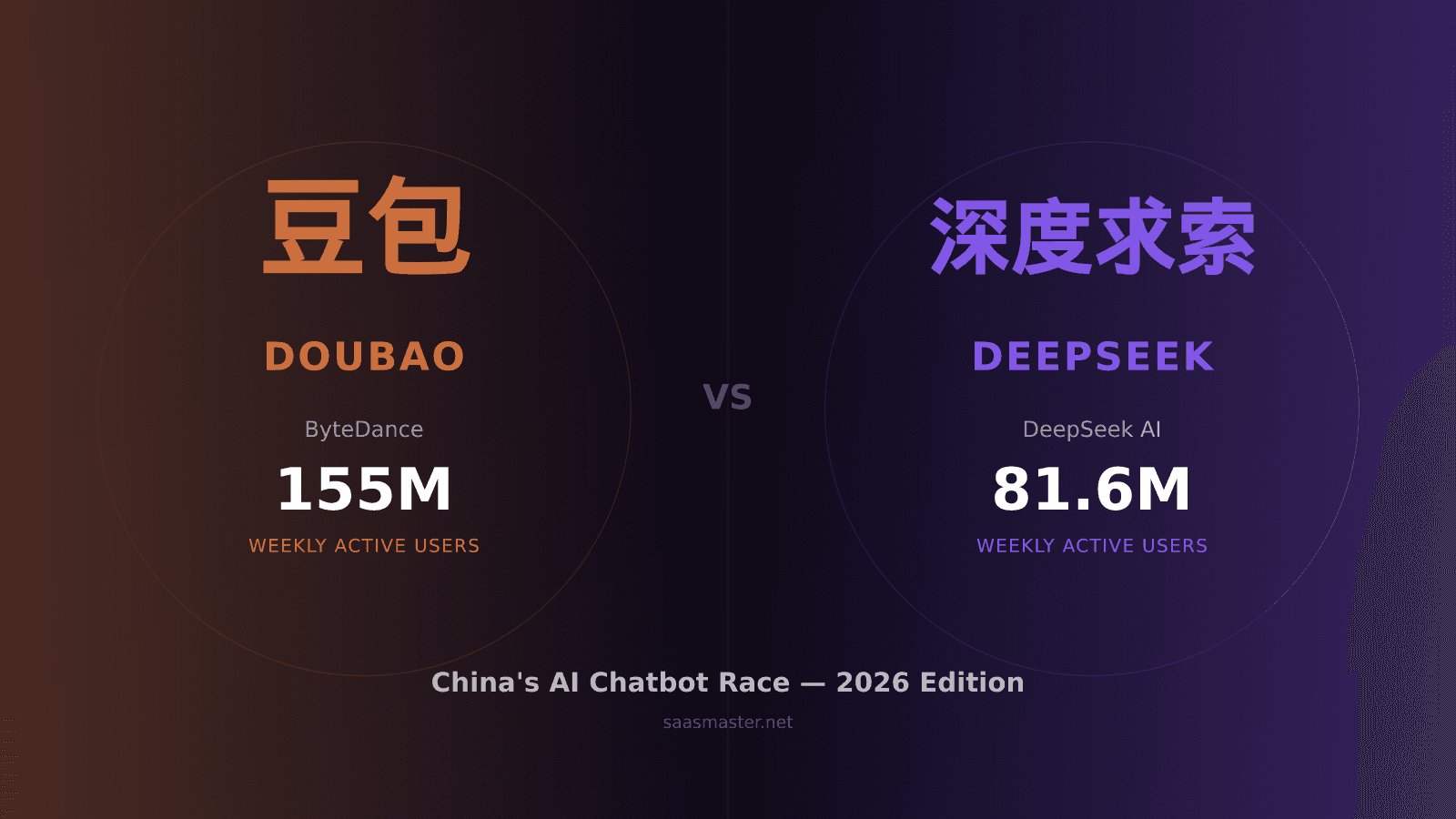
Doubao just crossed 155 million weekly active users. DeepSeek sits at 81.6 million. If you read only that number, you'd think ByteDance has already won China's AI race — and you'd be missing the part of the story that actually matters to people who build with these tools.
These are the two most important AI products out of China right now. They compete, but not quite in the same way that, say, ChatGPT and Gemini compete in the US. Doubao and DeepSeek have different audiences, different strengths, and different strategies — and understanding where each wins tells you a lot about where AI is going globally.
I've been watching both products closely through 2026. Here's how I actually see them.
Key takeaways
- Doubao leads China's consumer AI market with 155M weekly active users — nearly double DeepSeek's 81.6M
- DeepSeek's open-weight models are the preferred foundation for developers and researchers globally
- Doubao Seed 1.6 is approximately 5x cheaper than DeepSeek R1 at the API level
- Doubao added native video reasoning in 2026, understanding up to 1,280 frames per video
- The Chinese AI market in 2026 has divided neatly: Doubao owns consumers, DeepSeek owns developers, Qwen owns enterprise
The numbers everyone is talking about — and what they miss
Doubao's 155 million weekly active users is a real number and it's genuinely impressive. ByteDance built TikTok — they know how to acquire and keep users. Doubao benefits from deep integration with ByteDance's existing products, a well-designed consumer app, and the kind of consumer distribution that takes most AI companies years to build.
DeepSeek's 81.6 million WAU is not a consolation prize. DeepSeek doesn't really try to win on consumer counts. Its strategy has always been to release high-capability models with transparent architectures and aggressive pricing, then let developers and researchers do the distribution work. That strategy has made DeepSeek a global name in ways that Doubao simply isn't — yet.
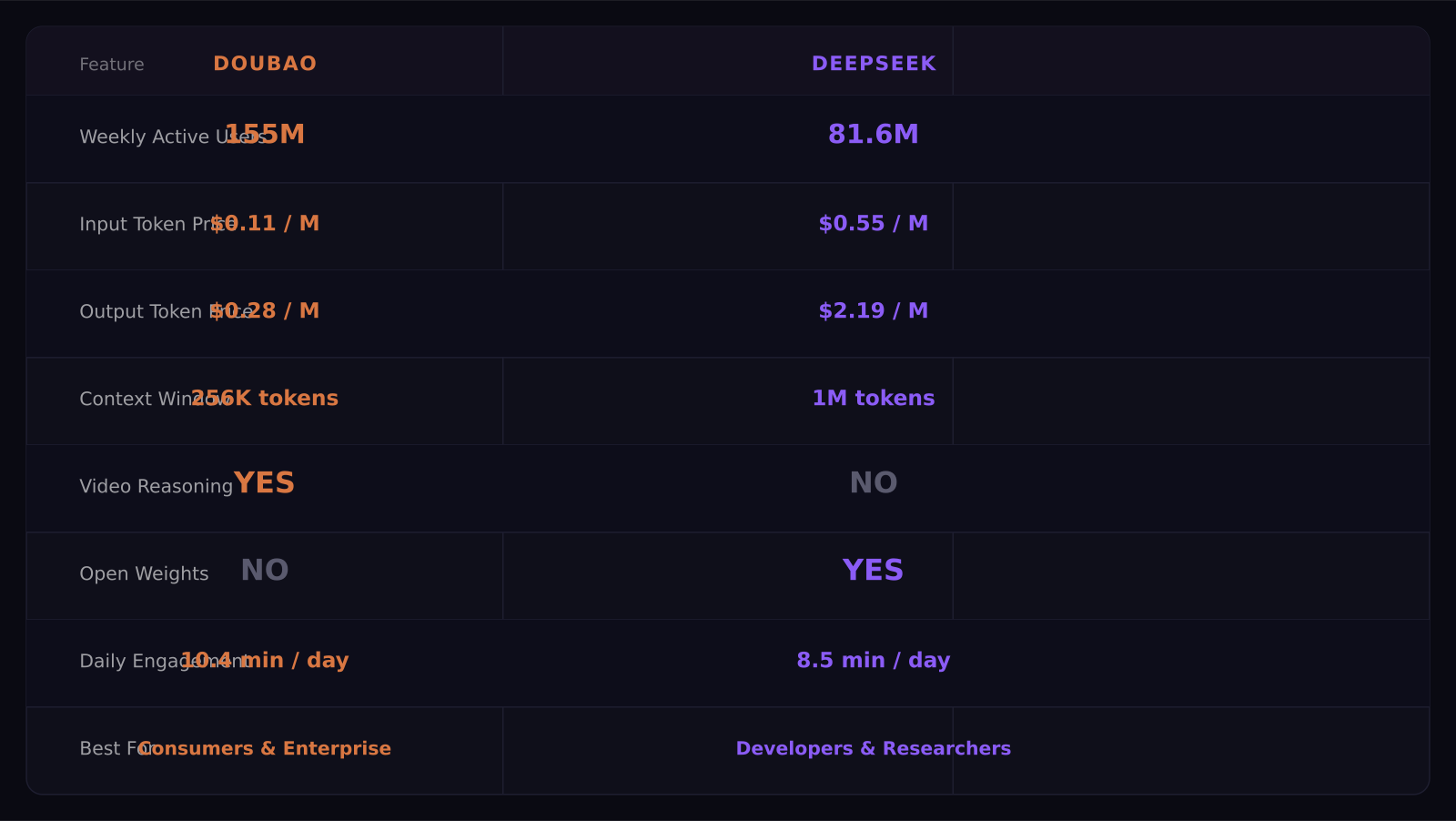
The metric that actually reflects this difference in engagement: Doubao users spend about 10.4 minutes per day in the app. DeepSeek users spend 8.5 minutes. Neither number is bad, but the gap tells you something about who's using each product and how. Doubao users are chatting, searching, creating — it's a consumer product. DeepSeek users are often running deeper sessions, longer prompts, more complex tasks.
What Doubao does better
The headline capability that Doubao has and DeepSeek doesn't is native video reasoning. Doubao Seed 1.6, ByteDance's current flagship model, can process up to 1,280 frames per video — up from 640 in the previous version. That jump matters for anyone doing quality inspection, online education review, or content moderation where you need the model to actually track what's happening across a full video clip, not just sample a few frames.
The multimodal package more broadly is Doubao's strongest card: text, images, video, and voice in one interface. In April 2026, Doubao added Full-Duplex Speech — near-instant voice responses that don't wait for you to finish speaking before generating a reply. For consumer applications and voice-first workflows, that's meaningfully better than what most AI products ship.
Doubao is also considerably cheaper for high-volume API use. Doubao-1.5 Pro comes in at $0.11 per million input tokens and $0.28 per million output tokens. That's about 5x cheaper on input and nearly 8x cheaper on output versus DeepSeek-R1. For teams processing large volumes of text at the API level and not needing DeepSeek's specific reasoning strengths, Doubao's economics are hard to ignore.
What DeepSeek does better
DeepSeek's defining advantage is openness and architectural transparency. DeepSeek-V3 and DeepSeek-R1 are released under permissive licenses that let developers download the weights, fine-tune on their own data, and run the models on their own hardware. That's something Doubao simply doesn't offer — Doubao is a closed API product.
For the developer community, open weights aren't a nice-to-have. They're the whole point. Being able to audit the model, customize it, and host it without sending data to a ByteDance API is a requirement for a significant portion of enterprise use cases, particularly outside China.
DeepSeek V4 Pro, released April 24, 2026, is a 1.6-trillion parameter Mixture-of-Experts model with a 1 million token context window. That's twice the context of Doubao Seed 1.6's 256K. For long-document analysis, complex multi-turn agent work, or tasks that need to hold large codebases in context, DeepSeek V4 Pro operates at a different scale.
DeepSeek also has a more credible international developer reputation. DeepSeek-R1's benchmark release in early 2025 caused a genuine shift in how the global AI community thinks about Chinese models. That trust took time to earn and it compounds — every month, more developers default to DeepSeek as their open-source baseline.
Which is cheaper: Doubao vs DeepSeek pricing
At the API level, Doubao wins on price — and it's not close.
Doubao Seed 1.6: $0.11 per million input tokens, $0.28 per million output tokens. DeepSeek-R1: $0.55 per million input tokens, $2.19 per million output tokens.
On input, Doubao is 5x cheaper. On output, it's nearly 8x cheaper. For consumer-facing applications that need fast, cheap text generation at scale, Doubao is the more economical choice if you don't have strong requirements around open weights or DeepSeek-specific reasoning quality.
One note: for individual users in China, both products are essentially free. The pricing distinction matters mainly for developers building on top of the APIs.
The product experience in 2026
I've used both, and the honest take is that they feel designed for different people.
Doubao feels like an AI app built by a company that makes consumer social products. The interface is polished, the onboarding is smooth, the voice and video features are well-integrated. ByteDance knows what makes users come back daily, and it shows. Doubao Seed 1.6 also handles the adaptive thinking mode well — it can switch between quick answers and extended reasoning without you having to configure anything.
DeepSeek feels like it was built by engineers for engineers. That's not a criticism — it's a design choice. The interface is clean and functional rather than polished and engaging. The models are well-documented. The pricing is transparent. For a developer who wants to understand exactly what they're getting and why it costs what it costs, DeepSeek's philosophy is refreshing.
Who should use which
Choose Doubao if you need video reasoning in a single API, want the cheapest multimodal option available from China, or are building consumer-facing products where ByteDance's track record with engagement matters.
Choose DeepSeek if you need open-weight models you can fine-tune and host yourself, want the longest available context window from a Chinese model, or are in a use case where architectural transparency and community-verified benchmarks are important.
And if you're watching this space for what comes next: the clear pattern of 2026 is that Chinese AI has stopped trying to catch up with a single product and started segmenting. Doubao owns the consumer layer. DeepSeek owns the developer layer. Alibaba's Qwen owns the enterprise layer. That specialization is a sign of a maturing market — and it makes the comparison less about who's "winning" and more about which layer of the stack you're building on.
Frequently asked questions
Is Doubao better than DeepSeek?
Neither is universally better — they're optimized for different use cases. Doubao leads on consumer features (video reasoning, voice, lower API pricing) and user count. DeepSeek leads on open-weight availability, longer context windows, and developer community trust. Which is better depends entirely on what you're building.
Is Doubao available outside China?
Doubao is primarily available through the Doubao app, which is China-focused, and through ByteDance's Volcano Engine API for developers. Access from outside China is limited and the consumer app is not designed for international users. DeepSeek, by contrast, has broad global availability and its models run on international infrastructure.
Which Chinese AI model is most popular globally?
DeepSeek has the largest international developer following of any Chinese AI model. Doubao leads in China itself by active users. Qwen from Alibaba has the strongest enterprise footprint across Asia. Globally among developers, DeepSeek remains the reference point for Chinese open-source AI.
Was this article helpful?
SaaS Master
Creator behind SaaS Master — tutorials, walkthroughs, reviews, and explainers that help SaaS, AI, and WordPress products get understood and chosen. Writing here about the tools, trends, and tactics that actually move the needle. Work with me →
Want your product explained this clearly — in video?
Tutorials, walkthroughs, reviews, and shorts for SaaS, AI, and WordPress products.
Work With SaaS Master