AI & SaaS
n8n vs Make vs Zapier: Which AI Automation Platform Should SaaS Teams Use in 2026?
The right automation platform for your SaaS team comes down to one question: are your workflows simple and broad, visually complex, or technically deep? Zapier handles simple at scale across the widest app catalog. Make handles complex multi-step visual workflows at a price point that beats Zapier by a wide margin. n8n handles everything that needs to run on your own infrastructure with native AI agents built in from the ground up.
All three platforms launched serious AI agent capabilities in the last 12 months, which changes the calculus entirely. This is no longer a comparison of which tool connects your apps — it is a comparison of which tool can run autonomous workflows that think, decide, and execute without human input on each step.
Key takeaways
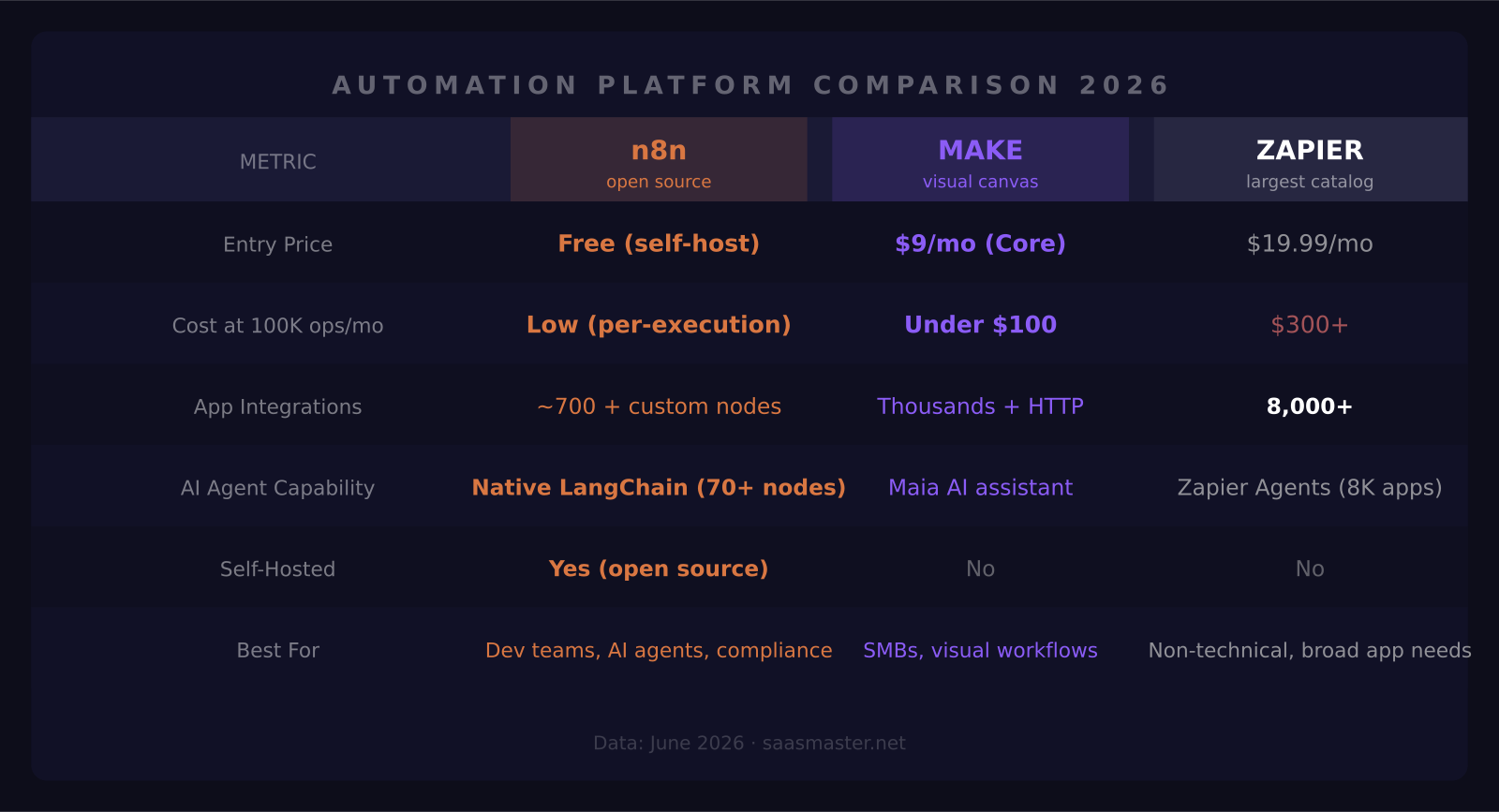
- Zapier is the most expensive at volume: $300 or more per month at 100,000 tasks, compared to Make at under $100 for the same volume.
- Make's Core plan at $9/month includes 10,000 operations — enough for most small to mid-size SaaS automation needs.
- n8n 2.0 ships with native LangChain integration and 70 or more AI nodes, making it the strongest platform in this category for building custom multi-model AI agents.
- Zapier has more than 8,000 app integrations — the widest catalog in the market by a significant margin.
- If your data cannot leave your servers, n8n self-hosted is the only real option in this category.
Why this comparison is different in 2026
A year ago, the evaluation was about which tool connected your apps most easily. Today, the conversation has shifted to which tool can run autonomous AI workers — agents that read emails, classify intent, look up records, draft responses, and take action without someone managing each step.
Zapier launched Zapier Agents: autonomous AI workers that execute tasks across 8,000 or more apps without human oversight, configured by describing in plain language what you want the agent to do. Make introduced Maia, an AI assistant that builds complete automation scenarios from a text prompt. n8n shipped version 2.0 with native LangChain integration and more than 70 AI nodes for building custom multi-model agent chains.
The right platform depends on which dimension matters most: integration breadth (Zapier), visual workflow design at low cost (Make), or developer-grade AI agent customization (n8n).
How the pricing actually stacks up at scale
This is where most teams are surprised, because Zapier's starting price looks reasonable but the per-task model becomes expensive fast.
Zapier charges per task, where each action in a workflow counts as one unit. A three-step workflow — trigger, condition check, CRM update — consumes three tasks per execution. At the Professional plan level, you get 2,000 tasks per month. Scaling to 100,000 tasks per month pushes costs above $300.
Make charges per operation, which works similarly to a Zapier task, but the Core plan at $9 per month includes 10,000 operations. At 100,000 operations per month, Make stays comfortably under $100. The visual multi-branch editor also allows significantly more complex logic than Zapier's linear model at any given price point, which means you accomplish more per operation.
n8n uses per-execution pricing: a single workflow execution counts as one unit regardless of how many operations it contains. A 50-step workflow that runs 200 times per day is priced as 200 executions, not 10,000 operations. Self-hosted n8n is fully open source and free to run on your own server — you pay for infrastructure, not for the software. n8n Cloud starts at $20 per month for managed hosting. For teams running complex workflows at high frequency, this model can represent savings of 80 to 90 percent compared to Zapier.
Which platform has the best AI capabilities in 2026?
n8n 2.0 is the clearest leader for teams building custom AI agents from the ground up. The native LangChain integration means you can chain AI models, vector databases, memory stores, and custom function tools in a visual node editor — without writing orchestration code yourself. The 70 or more AI nodes include support for OpenAI, Anthropic, Mistral, Ollama for local model deployment, Pinecone, Weaviate, and more. If you want an AI agent that reads your inbound support emails, classifies urgency, looks up customer account status, drafts a personalized response, and routes to a human only when confidence is below a threshold — n8n is the fastest path to building that without a dedicated AI engineer.
Zapier Agents is the easiest entry point for non-technical teams. You describe the agent's task in plain language, Zapier maps it to integrations, and the agent runs against 8,000 or more connected apps. The strength is breadth and accessibility. The limitation is customization: Zapier Agents perform well on well-defined, repeatable tasks within Zapier's connector ecosystem, but struggle with complex conditional logic, multi-model chains, or workflows that require custom code execution.
Make's Maia AI assistant is genuinely useful for scenario creation — you can describe a workflow in natural language and Maia builds the initial scenario structure. But Make is primarily a workflow automation tool that added AI assistance as a layer. It is better at automating human-designed processes than at building truly autonomous agents that reason and decide.
Integration depth: where each platform wins
Zapier's more than 8,000 app integrations are the main reason it remains the largest platform by user count despite its higher pricing. If you need to connect a niche B2B SaaS tool to your workflow, Zapier almost certainly has a connector. For teams where integration breadth is the primary constraint, this is a meaningful advantage.
Make's integration catalog is strong across thousands of popular apps, and its HTTP module allows connection to any API with a JSON request — which covers most technical gaps for teams with developer resources. The visual canvas makes it easier to design and debug complex multi-branch logic compared to Zapier's linear interface.
n8n has roughly 700 native integrations, which is a real gap in breadth. But its code-native philosophy means you can write a custom node in JavaScript or Python for any API, internal database, or proprietary system. For SaaS teams with internal tools and custom backends, this extensibility is often more valuable than a larger catalog of pre-built connectors.
Which platform should your SaaS team actually use?
For non-technical founders and early-stage teams: Make. The Core plan at $9 per month is genuine value, the visual editor is intuitive without developer knowledge, and 10,000 monthly operations covers most early-stage automation needs. Maia significantly lowers the setup learning curve and Zapier's pricing is hard to justify against Make's at the same volume.
For product and engineering teams with developer resources: n8n Cloud or self-hosted. The native LangChain support combined with per-execution pricing rewards complexity and high frequency. Your developers will appreciate the code-native approach and the ability to build custom AI workflows without hitting platform walls. Self-hosted deployment eliminates the cost entirely for teams comfortable managing infrastructure.
For enterprise teams with compliance requirements: n8n self-hosted for internal workflows where data residency matters, paired with Zapier Enterprise for external app connectivity where integration breadth is the priority. The combination covers both dimensions without compromising on either.
Frequently asked questions
Is n8n really free?
The self-hosted version of n8n is open source and free to run on your own server. You pay server costs, not software licensing. n8n Cloud — managed hosting operated by the n8n team — starts at $20 per month for the Starter plan and includes automatic updates, managed infrastructure, and support.
Can Zapier build real AI agents in 2026?
Yes, with meaningful limitations. Zapier Agents execute multi-step autonomous workflows across 8,000 or more apps without human oversight. The strength is breadth of connected apps and ease of setup for non-technical users. The limitation is that Zapier Agents are constrained to Zapier's connector ecosystem and are not designed for custom multi-model AI chains, code execution, or complex conditional reasoning.
Which automation tool is easiest for non-developers?
Zapier's linear trigger-action model is the simplest starting point — most basic workflows can be set up in under 10 minutes with no prior automation experience. Make's visual canvas is slightly more complex but more capable for branching logic. n8n has the highest learning curve of the three but is significantly more approachable than writing custom integration code, and the AI-assisted setup in version 2.0 substantially lowers the onboarding barrier.
Was this article helpful?
SaaS Master
Creator behind SaaS Master — tutorials, walkthroughs, reviews, and explainers that help SaaS, AI, and WordPress products get understood and chosen. Writing here about the tools, trends, and tactics that actually move the needle. Work with me →
Want your product explained this clearly — in video?
Tutorials, walkthroughs, reviews, and shorts for SaaS, AI, and WordPress products.
Work With SaaS Master