AI Tools
Sora 2 vs Veo 3.1 vs Kling 3.0: Best AI Video Generator for Content Creators in 2026
The short verdict in June 2026: Veo 3.1 is the safest overall pick for quality and ecosystem stability. Kling 3.0 is the best value at scale, especially for creators who need long clips and multilingual audio. Sora 2's API remains active until September 24, 2026, but OpenAI discontinued the consumer-facing Sora web and app on April 26, 2026 — meaning it is a tool on a timer, not a long-term investment.
This comparison matters right now because the video generation market reshuffled dramatically in the first half of 2026. Runway Gen-4.5 dropped out of the Artificial Analysis top 10. Kling 3.0 launched in February with native 4K and 15-second clips. Veo 3.1 Lite dropped to $0.05/second in April. And Sora pivoted away from consumers entirely. If you made a tool decision six months ago, it is worth revisiting.
Key takeaways
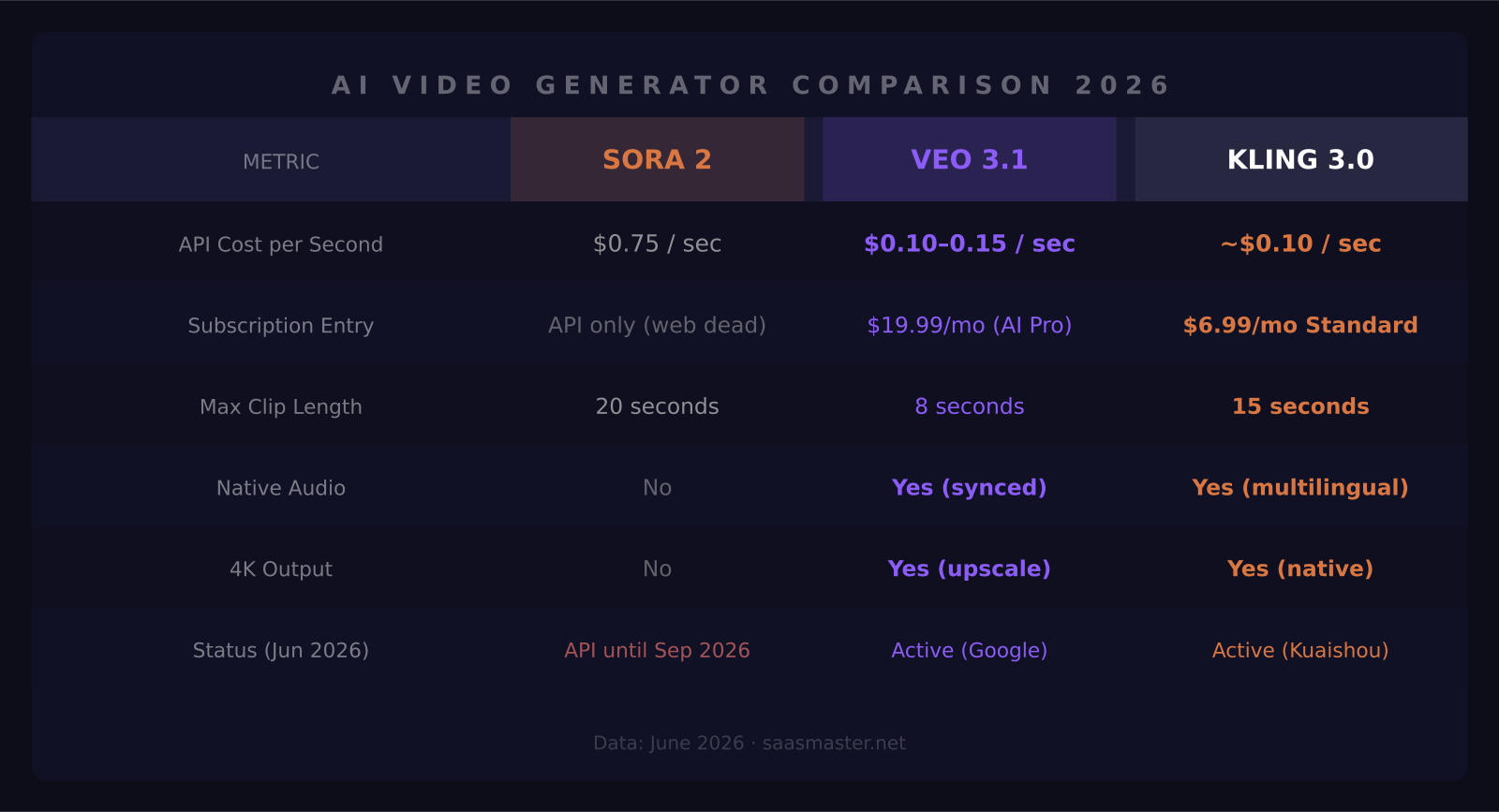
- Sora 2's consumer web and app shut down April 26, 2026; its API runs until September 24, 2026, but at $0.75/second it is the most expensive option and has no long-term roadmap for creators.
- Veo 3.1 Fast costs $0.10 to $0.15 per second via API, includes native synchronized audio, and 4K upscaling — the most complete single package for professional output.
- Kling 3.0 launched February 7, 2026, with native 4K, 15-second clips, and multilingual lip-sync at the lowest consumer subscription price in the category starting at $6.99/month.
- For creators who need creative camera control — motion brushes, scene consistency, character reference — Runway Gen-4.5 is still the professional pick despite its recent leaderboard drop.
- The safest infrastructure bet for a content business right now is Veo 3.1 (Google-backed, active development) or Kling 3.0 (Kuaishou, fastest growing creator base globally).
Why Sora 2 is effectively off the table for new projects
OpenAI built Sora 2 as a consumer product and a developer API. The consumer product is gone — the web and mobile experiences went dark on April 26, 2026. The API is alive but has a hard end date of September 24, 2026.
The pricing reflects the shutdown trajectory. Sora 2 API costs $0.75 per second of video. At that rate, a single 20-second clip costs $15. For a creator producing 10 pieces of content per week, that is $600 to $800 per month in API costs alone — before editing, narration, or distribution.
The architecture is also showing its age. Sora 2 generates up to 20-second clips but without native audio, without 4K output, and with an image-to-video quality that has been consistently outranked by both Veo 3.1 and Kling 3.0 on the Artificial Analysis leaderboard since January. If you are starting a video generation workflow today, build it on a tool with a living roadmap.
Veo 3.1: Google's serious bet on AI video
Google has been more consistent with Veo's development cadence than almost any other player in this market. Veo 3.1 Lite launched March 31, 2026, at $0.05 per second — the lowest API price in the premium tier. Veo 3.1 Fast received a significant price cut on April 7, dropping from its original launch pricing to the $0.10 to $0.15 per second range.
The features that set Veo 3.1 apart are audio and motion quality. When you generate a clip with a person speaking, the audio is synchronized and the lip movement is aligned — not bolted on in post-processing. Background sounds, ambient noise, and sound effects generate alongside the video frame. This is native audio, not a separate model stitched together afterward, and it is meaningfully better than what Runway or Kling deliver by default.
For subscription users, Google AI Pro at $19.99/month includes 90 fast clips per month. Google AI Ultra at $249.99/month gives substantially higher volume for teams producing at scale. The Google ecosystem integration — Gemini, Workspace, Vertex AI — is a real advantage if your content workflow already runs through Google.
The limitation is clip length: 8 seconds per generation. For social short-form (Instagram Reels, TikTok hooks, YouTube Shorts intros), 8 seconds is workable. For long-form narrative content, you will be stitching clips together, which adds editing time.
Kling 3.0: the creator's value pick
Kuaishou released Kling 3.0 on February 7, 2026, and it immediately became the go-to tool for creators who need more footage at lower cost. Two features separate it from the field: 15-second clip length and multilingual native audio.
Fifteen seconds is a meaningful generation length for content creators. Where Veo 3.1 gives you 8 seconds and Sora 2 gives you 20 but at prohibitive cost, Kling 3.0 hits the sweet spot for social-native content. A 15-second clip can be a complete TikTok hook, a product close-up, or a B-roll insert — usable without editing.
The multilingual audio sync is the technical differentiator that gets less attention than it deserves. Kling 3.0 supports native audio generation in Chinese, Japanese, Spanish, and English, with lip-sync matching the spoken language. For global brands creating localized video content, this eliminates an entire post-production step.
Chain-of-Thought reasoning is Kling 3.0's most unusual capability. Before generating a complex scene, the model explicitly "thinks through" the physics, character placement, and motion vectors. In practice, this produces more coherent multi-subject scenes with realistic gravity and balance — the kind of physically accurate motion that earlier models reliably got wrong.
Pricing is genuinely accessible. The Standard plan runs $6.99/month. The Pro plan is approximately $32.56/month after the first month ($25.99 introductory). The Ultra plan at $128/month gives more than three times the credit volume for high-frequency creators.
How should SaaS creators choose between these tools?
If you are producing SaaS product demos, explainers, or tutorial supplementary footage — Veo 3.1 is the better fit. The native audio sync and motion quality make it easier to produce professional-looking product showcase clips that sit alongside voiceover naturally. Google's infrastructure reliability and the active development roadmap make it the safer long-term platform investment.
If you are producing high-volume social content — TikTok, Instagram, YouTube Shorts — where quantity and cost-per-clip matter more than absolute quality ceiling, Kling 3.0 is the stronger choice. The 15-second clip length, multilingual support, and entry price of $6.99/month mean you can produce more content for less, and the quality gap with Veo 3.1 is narrower than the price gap on subscriptions.
If you need granular creative control — camera movement, motion brush, reference-consistent characters across multiple shots — Runway Gen-4.5 is still the choice, despite its Artificial Analysis ranking drop. No other tool currently matches its camera control surface for directors who know what they want.
Frequently asked questions
Is Sora 2 shutting down completely?
The consumer Sora web and mobile app shut down on April 26, 2026. The OpenAI Sora API will continue running until September 24, 2026, after which it is discontinued. OpenAI has not announced a Sora 3 or a replacement. If you are building a workflow that depends on Sora, migrate before September.
Which AI video generator has the best audio quality?
Veo 3.1 leads on synchronized dialogue and ambient audio in June 2026. Its native audio generation produces clips where speech, sound effects, and background noise are generated together rather than layered afterward. Kling 3.0 is competitive on multilingual audio sync and is the only tool that generates correctly lip-synced audio in Spanish, Japanese, and Chinese as first-class outputs.
Can I use AI video for SaaS product demos?
Yes, but with the right use cases in mind. AI video generation works well for B-roll footage, UI animation overlays, illustrative scenarios, and social short-form content. It does not replace real product screen recordings for tutorial walkthroughs — viewers can tell the difference and authenticity matters in that context. The best SaaS video workflows use AI-generated footage for supplementary visuals and real screen capture for product demonstrations.
Was this article helpful?
SaaS Master
Creator behind SaaS Master — tutorials, walkthroughs, reviews, and explainers that help SaaS, AI, and WordPress products get understood and chosen. Writing here about the tools, trends, and tactics that actually move the needle. Work with me →
Want your product explained this clearly — in video?
Tutorials, walkthroughs, reviews, and shorts for SaaS, AI, and WordPress products.
Work With SaaS Master