AI & SaaS
Fable vs Mythos: Why Anthropic Gave the Same AI Two Different Names
Here's a puzzle from Anthropic's latest launch: Claude Fable 5 and Claude Mythos 5 are the exact same underlying AI model, yet they have different names. Why? The answer is safeguards. Fable 5 is the version with safety guardrails switched on for the general public; Mythos 5 is the same model with some of those guardrails lifted, available only to a small, vetted group of cyber defenders. Same brain, different rules — and that distinction is the whole point.
I find this one genuinely clarifying about how frontier AI is being released in 2026, so let me unpack what the two names actually mean for you.
Key takeaways
- Fable 5 and Mythos 5 share one underlying Mythos-class model; only the safeguards differ.
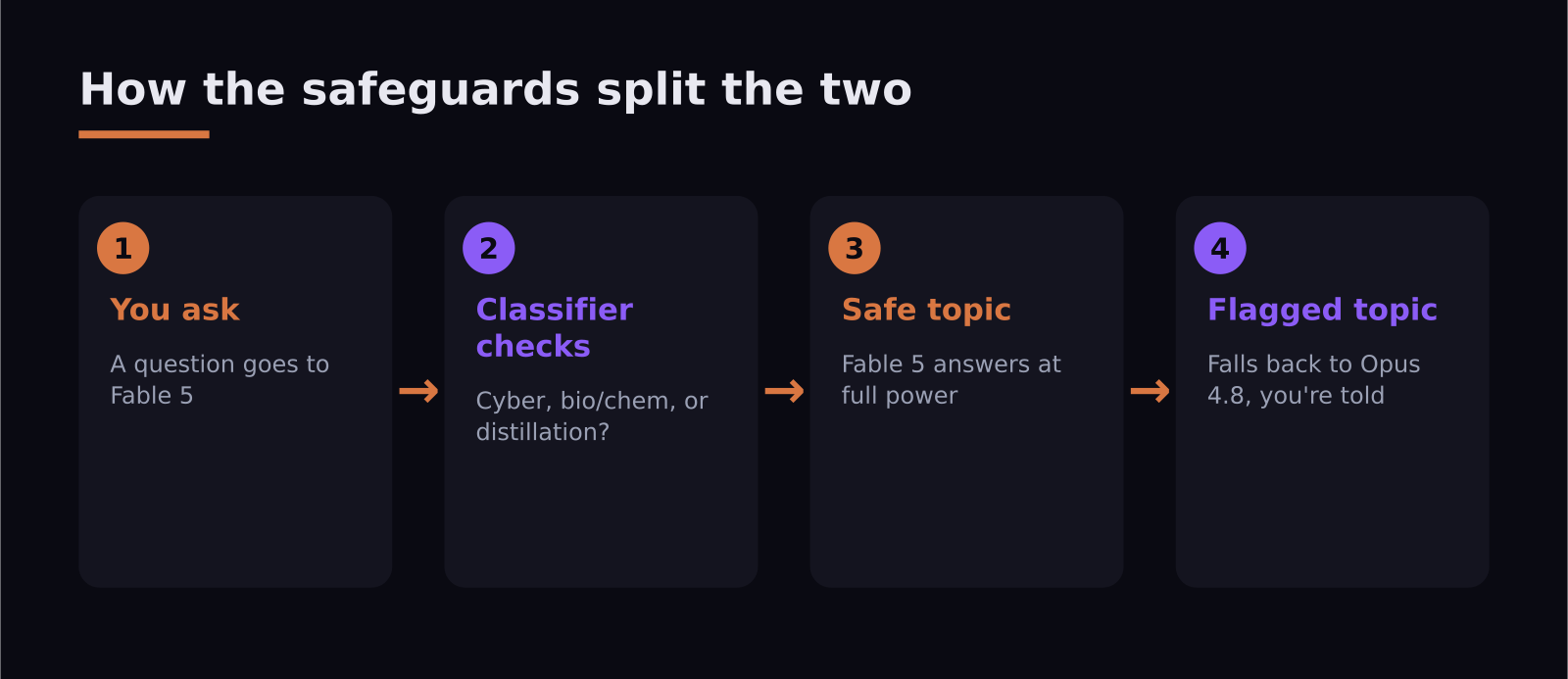
- Fable 5 (public) routes sensitive queries — cyber, biology/chemistry, distillation — to Opus 4.8 instead of answering directly.
- Mythos 5 (restricted) has cyber safeguards lifted and is deployed through Project Glasswing with the US government.
- The names come from language: "Fable" (Latin fabula, "that which is told") is a cousin of the Greek "mythos."
- It's a model for how powerful AI gets released: one safe public version, one guarded high-trust version.
The names are about safety, not capability
It's tempting to assume Mythos is the "pro" version and Fable the "lite" one. That's not it. On capability they are identical — same weights, same intelligence. What separates them is what they're allowed to do. Fable 5 ships with a set of classifiers that watch for high-risk requests and hand those off to Anthropic's next-most-capable model, Opus 4.8. Mythos 5 has some of those classifiers removed, so it can engage directly with topics Fable won't.
Anthropic even chose the names to signal this. "Fable" comes from the Latin fabula — "that which is told" — which is linguistically related to the Greek mythos. Two words for story, one carrying guardrails and one not. It's a tidy way to name two builds of the same model.
What Fable 5 holds back, and where it goes instead
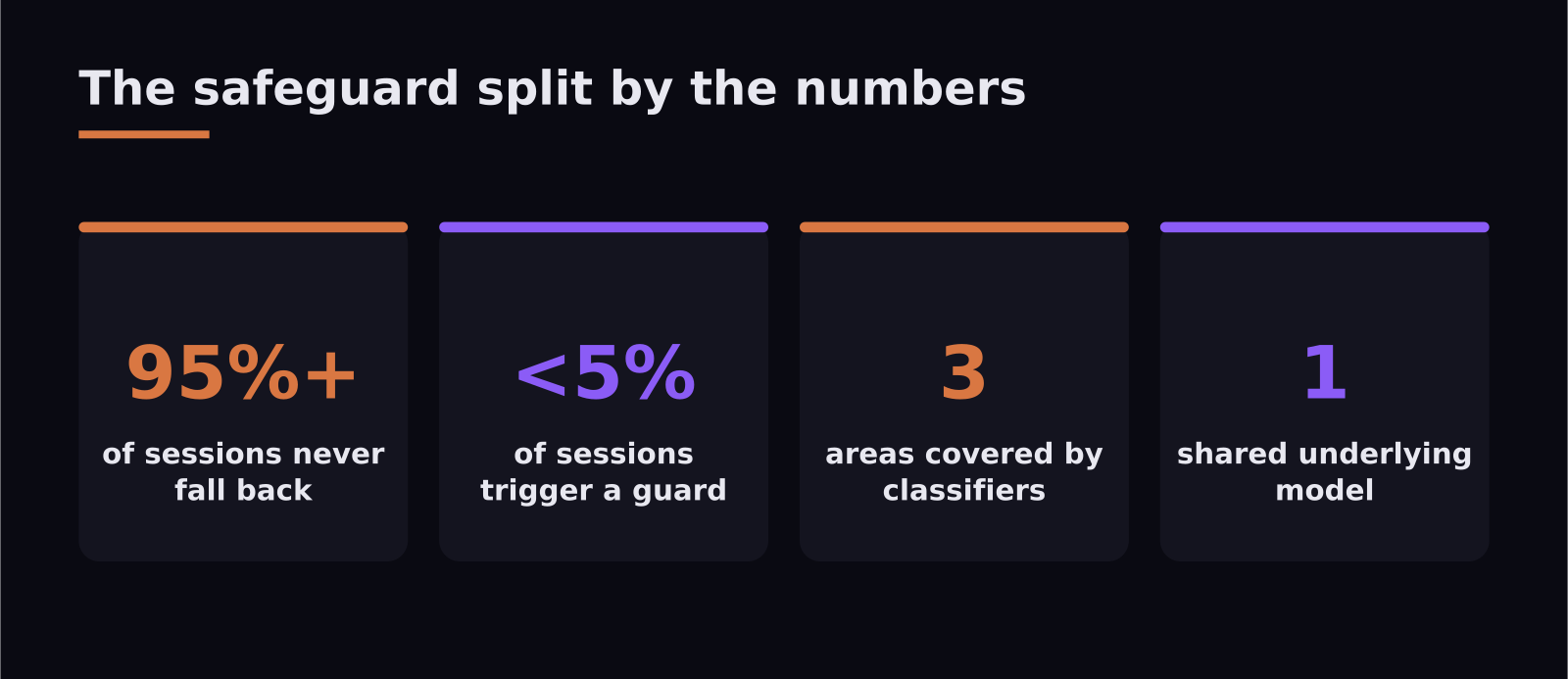
Fable 5's safeguards cover three areas: cybersecurity, biology and chemistry, and "distillation" (attempts to copy the model's abilities to train rival models). When its classifiers flag a request in those areas, Fable doesn't refuse outright — it routes the answer to Opus 4.8, and tells you that's happening. Anthropic argues this is a far better experience than a flat refusal, since Opus 4.8 is itself a highly capable model.
The company tuned these guardrails conservatively on purpose, to ship safely and fast. The trade-off is that they sometimes catch harmless requests — but across all usage they trigger in under 5% of sessions, and more than 95% of Fable sessions involve no fallback at all. For the vast majority of users, Fable behaves exactly like the unrestricted Mythos model.
Who gets Mythos 5, and why it's restricted
Mythos 5 is not a consumer product. It has the strongest cybersecurity capabilities of any model in the world, which is precisely why access is tightly controlled. It launches through Project Glasswing, Anthropic's program — run in collaboration with the US government — that gives select cyber defenders and critical-infrastructure providers access to Mythos-class power to protect important software. Anyone who had Mythos Preview can upgrade to Mythos 5, and Anthropic plans a broader "trusted access" application program over time, including a separate track for biology researchers.
The logic is dual-use: the same skills that let a defender find and fix a software vulnerability could help an attacker exploit it. So Anthropic gives the unguarded version only to people whose job is defense, and gives everyone else the guarded Fable.
Why this naming approach matters
This two-name structure is a template for how the most powerful AI may be released going forward: a safe, public model for general use, and a restricted, unguarded version for vetted experts where the upside is high and the users are trusted. It lets Anthropic put near-frontier capability in everyone's hands while keeping the riskiest applications behind a gate. Whether you ever touch Mythos 5 or not, understanding the split helps you read the next wave of AI launches.
Frequently asked questions
Are Fable 5 and Mythos 5 the same model?
Yes. They share the same underlying Mythos-class model. The only difference is safeguards: Fable 5 (public) has them on, Mythos 5 (restricted) has some of them lifted.
Can I get access to Mythos 5?
Not as a general user. Mythos 5 is limited to vetted cyber defenders and infrastructure providers through Project Glasswing, with a broader trusted-access program planned. Most people will use Fable 5.
Does Fable 5 refuse sensitive questions?
It doesn't refuse outright — it routes flagged requests in cybersecurity, biology/chemistry, or distillation to Opus 4.8 and tells you. This happens in under 5% of sessions.
SaaS Master
Creator behind SaaS Master — tutorials, walkthroughs, reviews, and explainers that help SaaS, AI, and WordPress products get understood and chosen. Writing here about the tools, trends, and tactics that actually move the needle. Work with me →
Want your product explained this clearly — in video?
Tutorials, walkthroughs, reviews, and shorts for SaaS, AI, and WordPress products.
Work With SaaS Master