AI Tools
Gemini 2.5 Pro Deep Think: A Practical Guide for SaaS Teams in 2026
In short
Gemini 2.5 Pro launched June 22 with Deep Think mode. Here is what the reasoning toggle actually does, when to use it, and what SaaS teams should know.
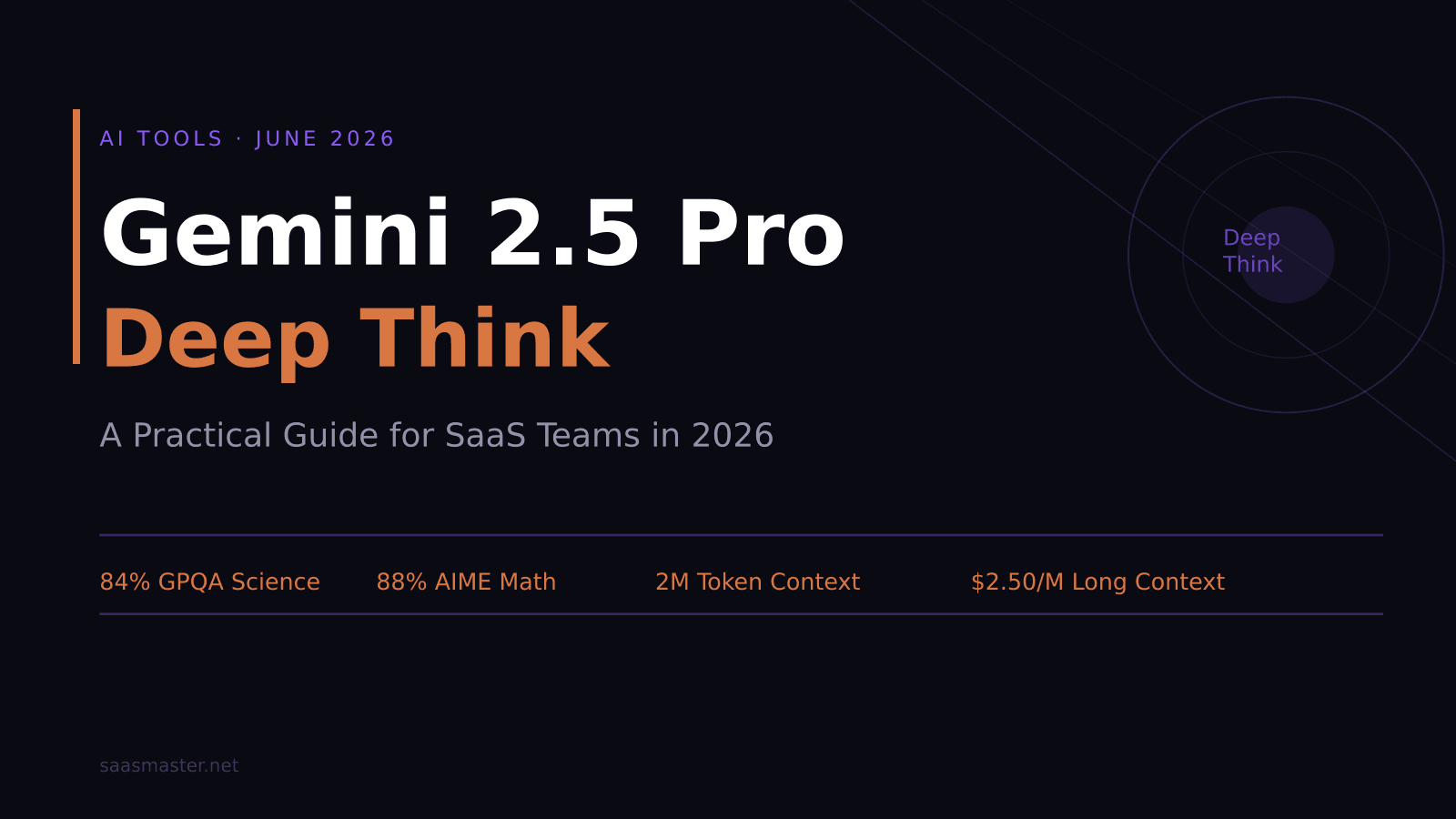
Google's Gemini 2.5 Pro landed on June 22, 2026, with something most frontier models still do not have: a native reasoning toggle. Deep Think is not a separate model — it is a mode you switch on when a problem is hard enough to justify the compute. For SaaS teams choosing AI tools right now, understanding exactly what this mode changes and when it does not help is worth a few minutes of your time.
Key takeaways
- Deep Think is a toggleable reasoning mode on Gemini 2.5 Pro, not a separate model or product
- It improves performance by 5-15% on hard math, science, and multi-step coding problems
- Gemini 2.5 Pro has the largest context window of any frontier model at 2 million tokens
- For long-context workloads over 200K tokens, it is the cheapest Western frontier model at $2.50 per million tokens
- It leads benchmarks in science (84% GPQA Diamond) and math (88% AIME), but trails Claude Sonnet 5 on software engineering
What is Deep Think, actually?
Most AI models take a question and generate a response in a single forward pass. The answer is good or bad based on what the model knows and how well it predicts the next token. Deep Think breaks that pattern.
When you enable it, Gemini 2.5 Pro generates internal reasoning steps before committing to a final answer. It explores multiple solution paths, runs self-checks, and then produces a response that reflects that deliberation. Think of it as the model arguing with itself before it writes.
Google calls the visible output of that process a thought summary — a trace of the reasoning chain that shows up alongside the answer. For developers and researchers, this is genuinely useful: you can audit how the model reached a conclusion, which matters when the stakes of being wrong are real.
The performance gains are targeted rather than universal. Deep Think improves results by roughly 5-15% on hard math, complex logic, and multi-step code problems. On simpler tasks — summarizing a document, drafting an email, generating ad copy — it adds latency without meaningfully changing the result. Turning it on for everything is like hiring a consultant to help you decide what to have for lunch.
What are the actual benchmark numbers?
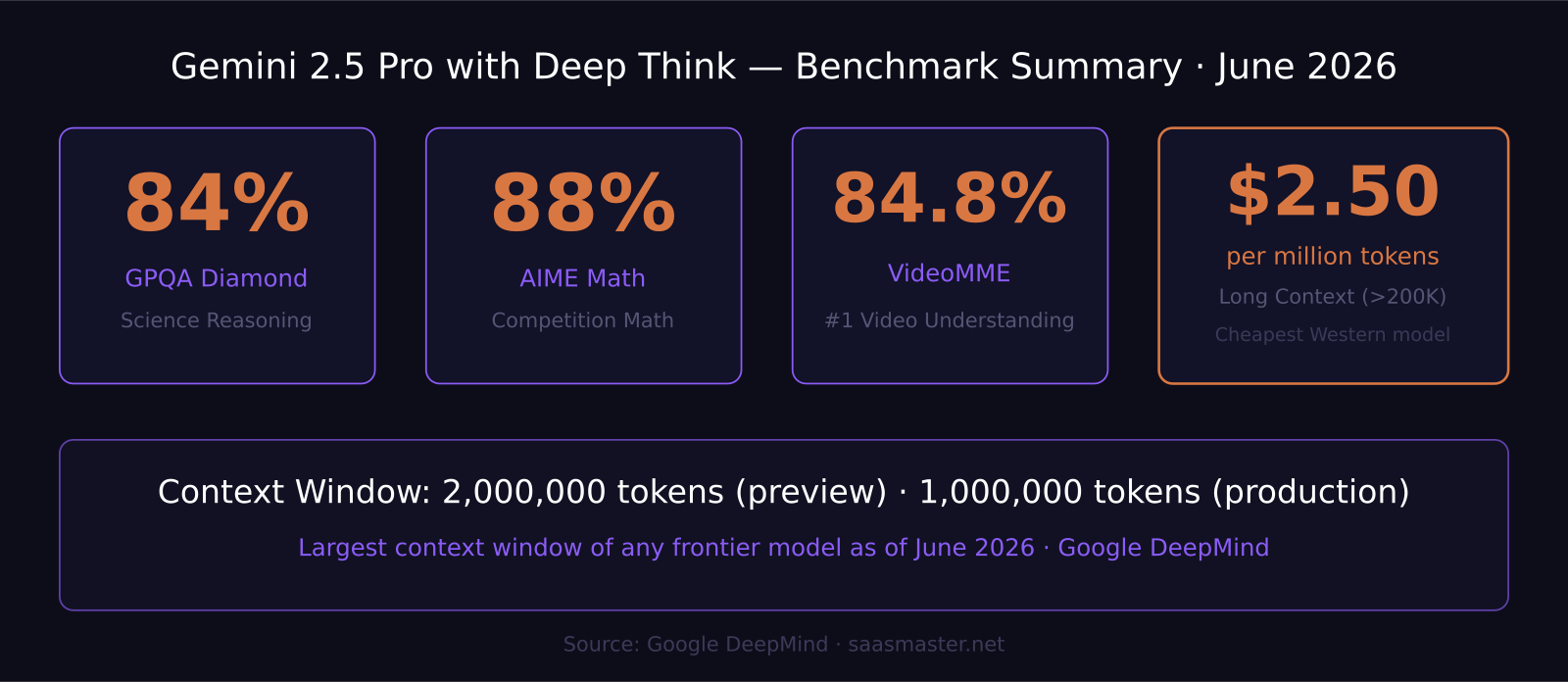
Gemini 2.5 Pro with Deep Think scored approximately 84% on GPQA Diamond — the science reasoning benchmark where questions are explicitly designed to fool generalist models — and roughly 88% on AIME, a competition math benchmark that most frontier models still struggle with. As of June 2026, those numbers put it at or near the top for science and math.
Where it trails: software engineering. Claude Sonnet 5, released June 30, 2026, leads SWE-bench at 92.4%. If your SaaS product lives in production code, Claude still has the edge on that specific dimension.
For video understanding, Gemini 2.5 Pro scored 84.8% on VideoMME — the strongest result of any frontier model as of this writing. It processes videos up to 60 minutes long, reading both visual frames and audio, and extracts structured data from them. No other frontier model currently matches this natively at that length.
How does the 2 million token context work in practice?
The 2M context window is in extended preview as of June 2026, with 1M available in production. To put 1 million tokens in perspective: that is roughly 750,000 words — about the entire Harry Potter series. Your full codebase, months of customer support transcripts, and your entire product documentation in a single session.
Box, the enterprise document management company, is using Gemini 2.5 Pro for document extraction and reporting over 90% accuracy on complex PDFs. The model reads the entire document rather than a retrieval-selected chunk. For SaaS teams wrestling with RAG pipeline complexity, this is directly relevant: in some cases, a large enough context window makes retrieval-augmented generation unnecessary. You send everything and let the model find what it needs.
Is Gemini 2.5 Pro actually cheaper than the alternatives?
For most workloads under 200K tokens, Gemini 2.5 Pro costs approximately $3.50 per million input tokens and $10.50 per million output tokens. That is comparable to Claude Sonnet 5's intro pricing of $3 per million input and $15 per million output.
For long-context workloads above 200K tokens, Gemini 2.5 Pro drops to $2.50 per million input — the cheapest Western frontier model for large-document processing. Claude Sonnet 5 at the same context range costs $6 per million input tokens. For teams doing high-volume long-document work, that gap compounds quickly across thousands of requests.
When should you use Deep Think versus standard mode?
Not every request benefits from extended reasoning. Here is how I think about it after running both modes regularly.
Turn Deep Think on when: the task requires genuine step-by-step logic such as financial modeling, debugging a multi-layer system error, or writing a complex SQL pipeline; the consequences of a wrong answer are significant; or you are presenting a recommendation to a stakeholder who needs to see the reasoning laid out.
Leave it off when: you need speed, the task is creative or conversational, or the question has a clear answer that does not require deliberation. The practical toggle means you only pay for extended reasoning compute when it actually earns its cost.
Which SaaS teams should be using Gemini 2.5 Pro right now?
Based on where the benchmarks and the cost structure intersect, three SaaS scenarios stand out as clear wins in 2026.
First, teams deep in the Google ecosystem. If your SaaS product runs on Google Cloud, uses BigQuery, or integrates with Google Workspace, Gemini 2.5 Pro is the lowest-friction AI layer to add. Native integration consistently beats a patched-together API connection, and Google's tooling around Gemini inside its cloud suite is mature.
Second, high-volume long-document workflows. Contracts, research reports, lengthy user interviews, compliance documents — anything where you regularly exceed 200K tokens per request. At $2.50 per million tokens for long context, the economics strongly favor Gemini over every Western competitor.
Third, SaaS products where video is the data. If your platform processes user-submitted videos, screen recordings, tutorial uploads, or sales call recordings, Gemini 2.5 Pro's 60-minute video understanding and 84.8% VideoMME score make it the only frontier model that handles this natively at scale. Every other option requires workarounds that add complexity and cost.
Where it is not the first choice: production software agents and automated code pipelines. Claude Sonnet 5's 92.4% SWE-bench benchmark still beats Gemini on the specific task of writing and fixing code autonomously. For agentic coding infrastructure, that benchmark gap is decisive.
How to try Deep Think today
Deep Think is available in Gemini Advanced, which comes with the Google One AI Premium plan at $19.99 per month. In the consumer interface, you toggle it per conversation. Via the Gemini API, you set a thinking_budget parameter that controls how many tokens the model allocates to internal reasoning before producing a final response.
For SaaS teams evaluating it, the fastest path is to take your three or four most demanding prompts — the ones that currently return inconsistent or mediocre results — and run them with Deep Think enabled. The thought summary output alone tends to clarify quickly whether the reasoning mode is helping your specific use case.
Frequently asked questions
Is Gemini 2.5 Pro Deep Think available for free?
No. Deep Think is available in Gemini Advanced, which is part of the Google One AI Premium plan at $19.99 per month. It is also accessible via the Gemini API at token-based pricing starting at $3.50 per million input tokens for standard context.
How does Gemini 2.5 Pro Deep Think compare to OpenAI o3?
Both use extended reasoning, but they are structured differently. OpenAI o3 is a separate model you switch to. Gemini 2.5 Pro's Deep Think is a mode on the same base model. On AIME math benchmarks, results are competitive. On video understanding, Gemini 2.5 Pro leads significantly — o3 does not have native 60-minute video processing capability.
Is the 2 million token context window available right now?
The 2 million token context window is in extended preview as of June 2026. Production access defaults to 1 million tokens, which is still the largest production context window among Western frontier models. Google has not announced a general availability date for the full 2M window, but API preview access is available to developers who apply.
Was this article helpful?
SaaS Master
Creator behind SaaS Master — tutorials, walkthroughs, reviews, and explainers that help SaaS, AI, and WordPress products get understood and chosen. Writing here about the tools, trends, and tactics that actually move the needle. Work with me →
Want your product explained this clearly — in video?
Tutorials, walkthroughs, reviews, and shorts for SaaS, AI, and WordPress products.
Work With SaaS Master