AI Tools
GitHub Copilot's Billing Shock Is Real: What the First Metered Month Actually Cost Developers
In short
GitHub Copilot's first AI Credits billing cycle closes June 30, 2026. Agentic users report 10x to 50x higher costs. Here is what to do before July 1.
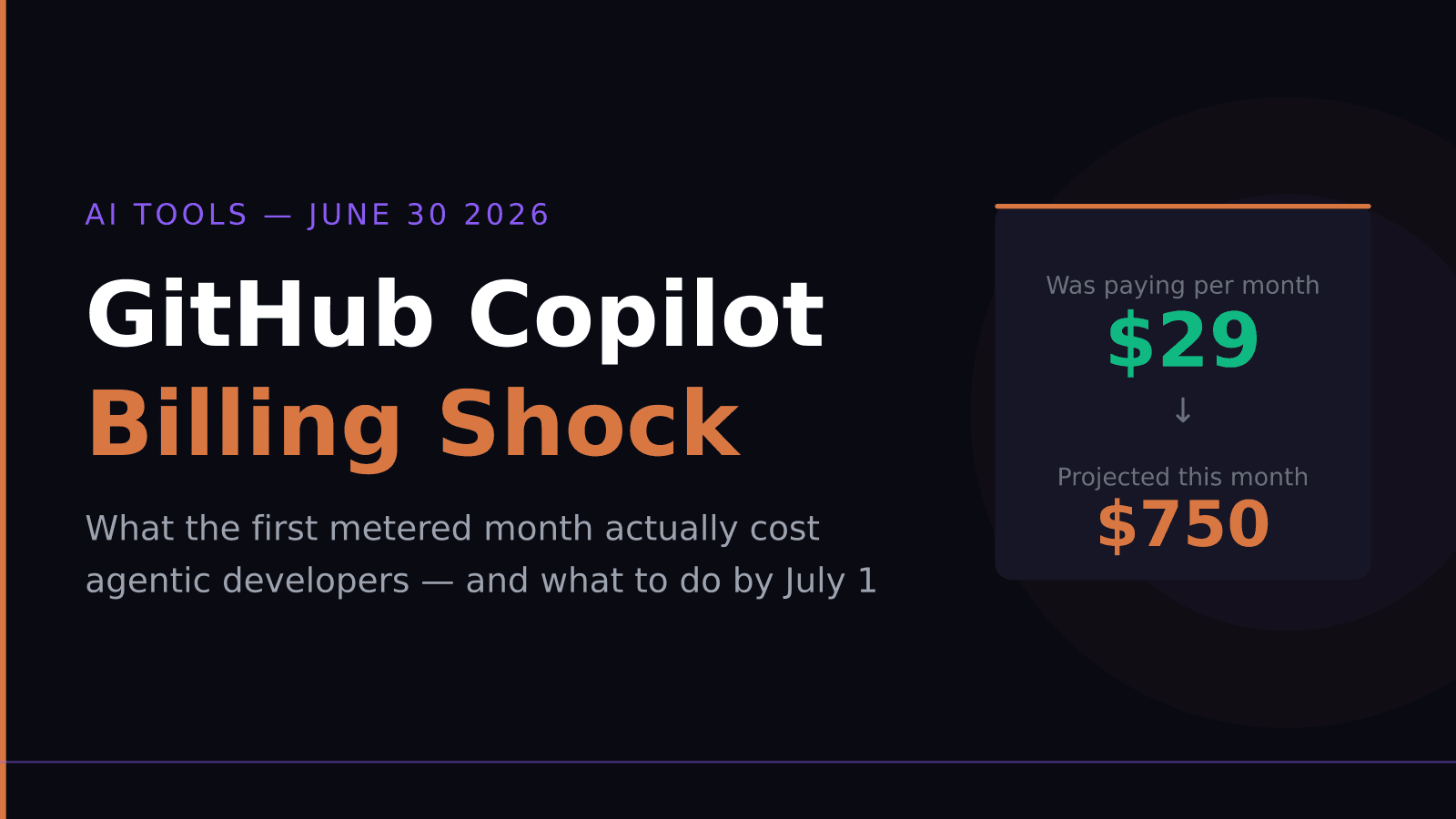
June 30, 2026 is the day GitHub Copilot's first complete metered billing cycle closes. Agentic developers who spent June running autonomous coding sessions are now looking at projected invoices that are 10 to 50 times higher than what their old flat subscriptions cost. The second billing cycle starts tomorrow, July 1 — and without a hard spending cap in place, there is no limit on what can be charged.
The most urgent action right now: go to Settings, then Billing, then GitHub Copilot in your GitHub account and enable a hard spending limit before midnight tonight.
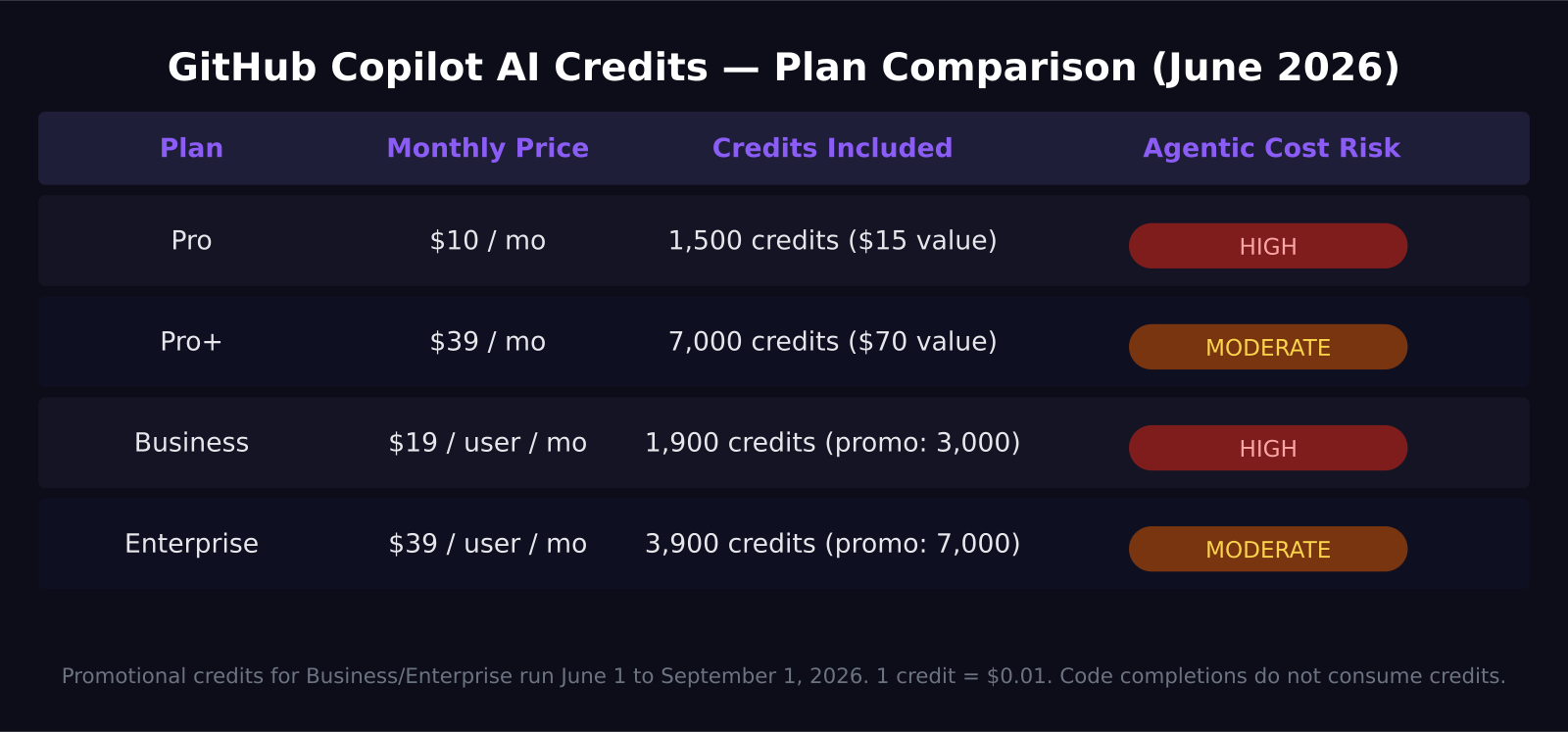
Key takeaways: - GitHub Copilot switched all plans to AI Credits billing on June 1, 2026 — 1 credit equals $0.01 - Included monthly credits: Pro 1,500, Pro+ 7,000, Business 1,900 (promo 3,000 until Sept 1), Enterprise 3,900 (promo 7,000 until Sept 1) - Code completions do not consume credits and remain unlimited for paid plans - Agentic mode sessions consume 1,000 times more tokens than standard single-turn queries - Without a hard spending cap enabled, there is no automatic stop when credits run out
What changed on June 1
GitHub CPO Mario Rodriguez announced in April 2026 that all Copilot plans would move from Premium Request Units to GitHub AI Credits effective June 1. The subscription prices did not change: Copilot Pro remains $10 per month, Pro+ is $39, Business is $19 per user, Enterprise is $39 per user.
What changed is what those prices buy. Each plan now includes a monthly credit allowance. One credit equals $0.01. Every interaction involving Copilot chat, agent mode, code review, or the Copilot CLI draws from that balance at the published per-model API rate — input tokens, output tokens, and cached tokens all count. When the balance hits zero, usage stops unless an additional-usage budget is configured — and that budget defaults to unbounded.
Two safety features disappeared on June 1. Annual plan subscribers were retired to the old premium-request system until expiration. The fallback model was removed. Before June 1, exhausting premium requests triggered an automatic downgrade to a lighter, cheaper model. Under the new system, no fallback exists — either credits are available, or the request is rejected.
One thing that survived unchanged: code completions and Next Edit Suggestions remain free and unlimited under all paid plans. The billing change does not affect the autocomplete experience most developers use most often.
Why agentic sessions drain credits so fast
The core of the billing shock is a technical mechanism that flat-rate pricing completely obscured: agentic AI billing scales non-linearly in a way that no prior form of metered billing has matched.
When a developer asks Copilot's agent mode to refactor a module, the agent does not execute one model call — it executes many. It reads relevant files, each becoming input tokens. It plans the approach, generating more tokens. It produces proposed changes as output. If results are unsatisfactory, it loops. On the next iteration, the full conversation history re-enters the context window as input tokens again. A 20-turn agentic session where each turn carries 10,000 tokens of context does not consume 200,000 input tokens total — it processes approximately 200,000 input tokens on the 20th turn alone, because the model processes the full conversation at each step.
GitHub's own research found that agentic coding tasks consume roughly 1,000 times more tokens than standard single-turn queries. Model Context Protocol tool schemas compound the problem: when an agent has 30 tools registered, every request includes schema definitions for all 30 in the system prompt — thousands of tokens per request that add cost even when the agent uses only two of them.
Real accounts from the GitHub community forum illustrate this plainly. One Pro+ subscriber burned through roughly 8 percent of their 7,000-credit monthly allotment in two hours. Another spent more than $6 on a single change request. A session using Claude Opus 4.8 to fix website issues consumed 1,180 credits — 16 percent of a Pro+ monthly allowance — for results the developer described as mediocre. One user watched a file review with no code changes consume 20 percent of their monthly allowance. By early June, the announcement thread had accumulated more than 400 comments and approximately 900 downvotes.
Who is actually paying more
Not every developer faces a bill change. The impact divides cleanly along workflow lines.
Developers whose Copilot use consists primarily of code completions — the inline ghost-text suggestions that appear while typing — see little to no change. Completions remain free and unlimited. The bill stays at the flat plan price.
The billing change only affects credits consumed by chat conversations, agent mode, multi-step agentic sessions, code review, and Copilot CLI interactions. For developers who built daily routines around those features — particularly agent mode, which Copilot actively promoted for two years — the economics have changed materially.
GitHub has not reversed the change in response to community backlash. The argument for the change is consistent: a pricing model that treated a one-line chat query and a six-hour agentic session identically was subsidizing the most compute-intensive workflows at every other user's expense.
This pattern is not unique to Copilot. Uber burned through its entire 2026 AI coding tools budget by April — four months into the fiscal year — after deploying Claude Code to thousands of engineers. The company subsequently capped employee spending at $1,500 per month per agentic coding tool. Microsoft, the company behind Copilot, separately canceled most internal Claude Code licenses with a deadline of June 30 — today — apparently timed to its own fiscal year end. The cost reckoning with agentic AI is industry-wide.
Where developers are going instead
Three platforms are absorbing the bulk of displaced agentic Copilot users.
Claude Code offers flat-rate plans: Pro at $20 per month, Max 5x at $100, Max 20x at $200. For agentic work — long multi-file refactors, autonomous code review, complex debugging — the flat fee provides cost predictability that Copilot's metered model does not. The split many developers are settling on: Claude Code for autonomous agentic work, Copilot for inline completions.
Cursor at $20 per month operates with a generous token allotment for its Composer agent within a flat monthly fee. For developers running regular agentic sessions, Cursor's pricing beats Copilot's metered model decisively once token usage exceeds included credits.
Windsurf Pro at $20 per month also operates on a largely flat-fee basis for most developers, with expanded frontier model options. For teams, per-seat economics compare favorably to Copilot Business once overages are factored in.
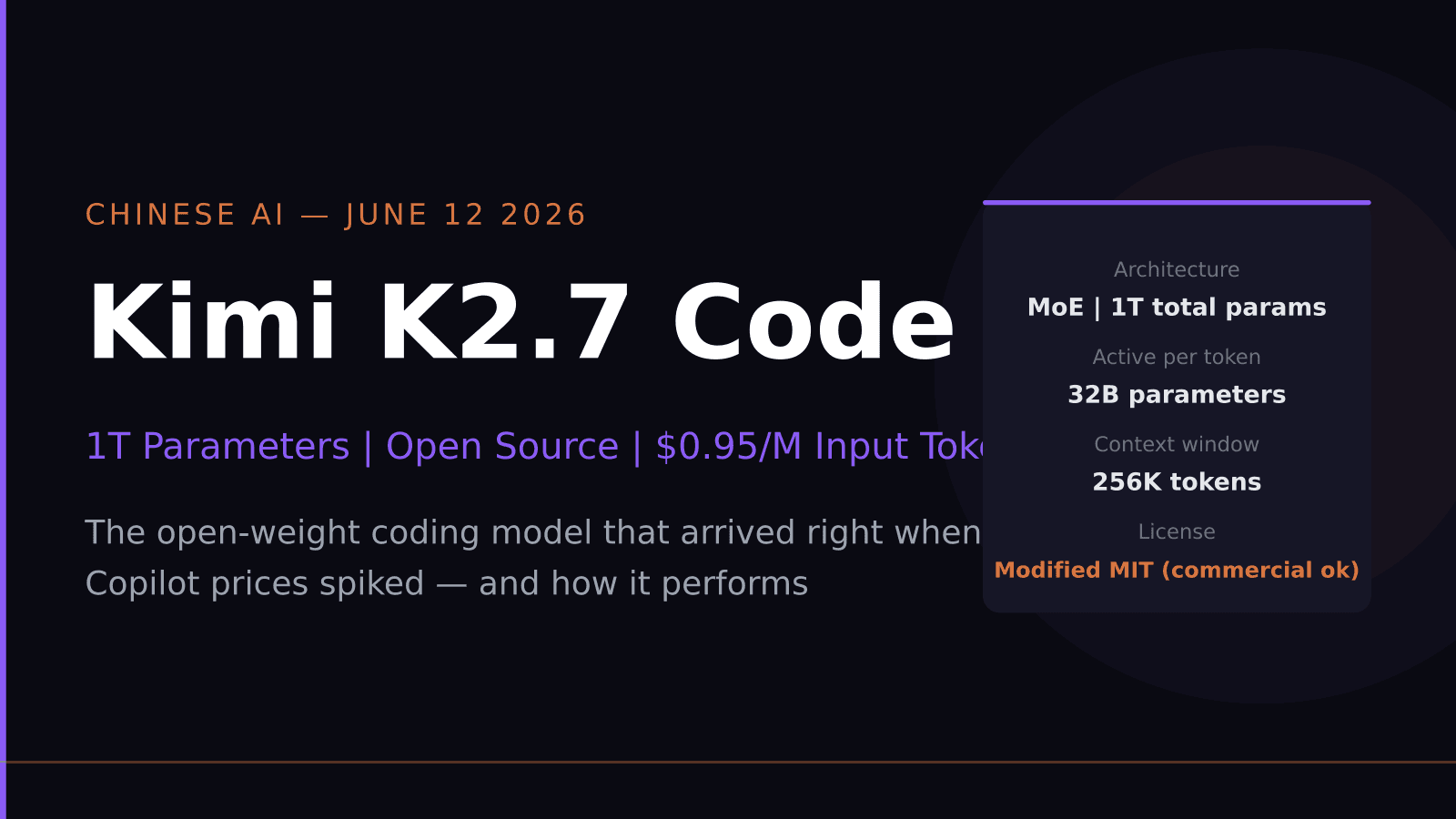
A cost-efficient open-source alternative that has attracted attention this month is Kimi K2.7 Code from Moonshot AI, which landed on June 12 at $0.95 per million input tokens with a commercial-friendly Modified MIT license. At roughly one-third the input cost of Claude Sonnet 5 and accessible through any OpenAI-compatible client, it is worth evaluating for high-volume agentic coding workflows where predictable token pricing matters.
Three things to do before July 1
Set a hard spending cap immediately. In GitHub billing settings under Settings, then Billing, then GitHub Copilot, enable a hard-stop spending limit. Without it, agentic overruns bill silently. Setting the additional-usage budget to $0 creates a hard stop at the monthly included allowance.
Audit which workflows consume the most credits. GitHub's billing dashboard shows per-model token consumption. Reviewing it reveals where costs concentrate — typically in a small number of heavy agentic sessions, not routine use.
Consider separating the workflow tiers. Autocomplete remains free. Agent mode is where the cost lives. A hybrid stack — Copilot for inline completions, a flat-rate tool for autonomous tasks — may deliver better economics than either alone.
Frequently asked questions
What is a GitHub AI Credit and how much does it cost
One GitHub AI Credit equals $0.01. Credits are consumed based on the tokens an interaction processes — input tokens, output tokens, and cached tokens. Monthly allowances per plan: Pro 1,500 credits, Pro+ 7,000 credits, Business 1,900 per user (promo 3,000 until September 1, 2026), Enterprise 3,900 per user (promo 7,000 until September 1). Additional usage is billed at the same per-credit rate unless a hard spending cap is set.
Why do agentic coding sessions consume so many tokens
When an AI agent runs a multi-step task, it makes many model calls in sequence. Each iteration re-feeds the full conversation history as input tokens, so context accumulates across turns. A 20-turn agentic session where each turn carries 10,000 tokens does not cost 200,000 total input tokens — the 20th turn alone costs approximately 200,000. Tool schemas, file reads, and sub-agent calls each add their own overhead on top.
Is GitHub Copilot still worth keeping after the billing change
For developers who primarily use completions and occasional single-turn chat, costs are likely unchanged. For developers who run daily agentic sessions — autonomous refactors, code review, multi-file debugging — projected cost increases of 10x to 50x make a hybrid approach more practical: keep Copilot for completions, move heavy agentic work to a flat-rate tool like Claude Code or Cursor.
Was this article helpful?
SaaS Master
Creator behind SaaS Master — tutorials, walkthroughs, reviews, and explainers that help SaaS, AI, and WordPress products get understood and chosen. Writing here about the tools, trends, and tactics that actually move the needle. Work with me →
Want your product explained this clearly — in video?
Tutorials, walkthroughs, reviews, and shorts for SaaS, AI, and WordPress products.
Work With SaaS Master