AI Tools
Kimi K2.7 Code Review: The Open-Source 1T Parameter Model That Arrived Right When Copilot Prices Spiked
In short
Moonshot AI's Kimi K2.7 Code arrived June 12, 2026 with 1T parameters, 30% fewer reasoning tokens, and $0.95/M input pricing. Here is the full review.
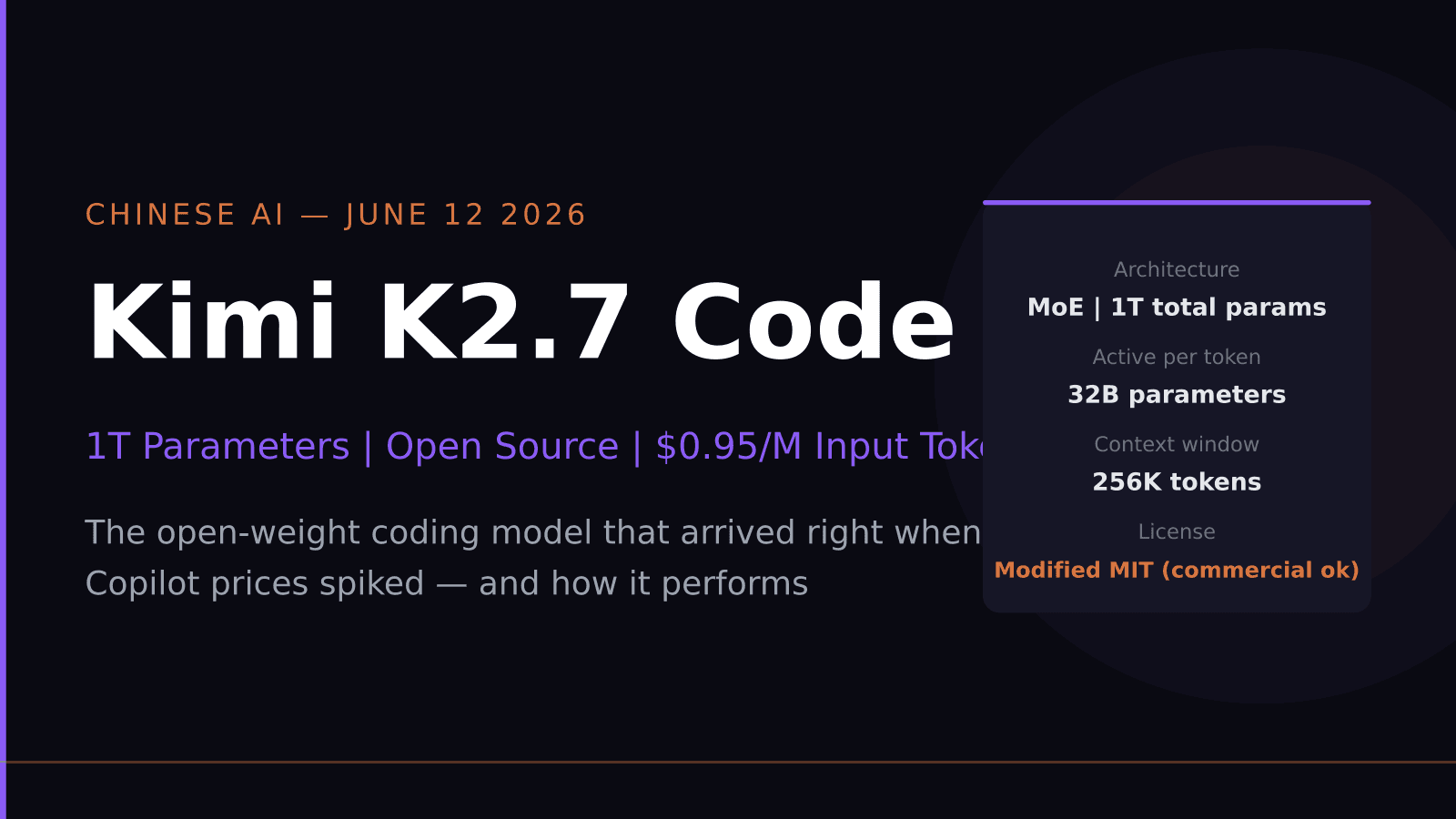
Moonshot AI released Kimi K2.7 Code on June 12, 2026 — a 1 trillion parameter open-source coding model that runs agentic software engineering workflows on a 256K token context window and costs $0.95 per million input tokens. The timing was not accidental: it landed two weeks into GitHub Copilot's new usage-based billing cycle, right as agentic developers were getting their first look at what AI coding actually costs when the meter is running. For anyone evaluating their coding AI stack in June 2026, Kimi K2.7 Code is the model that immediately entered the conversation.
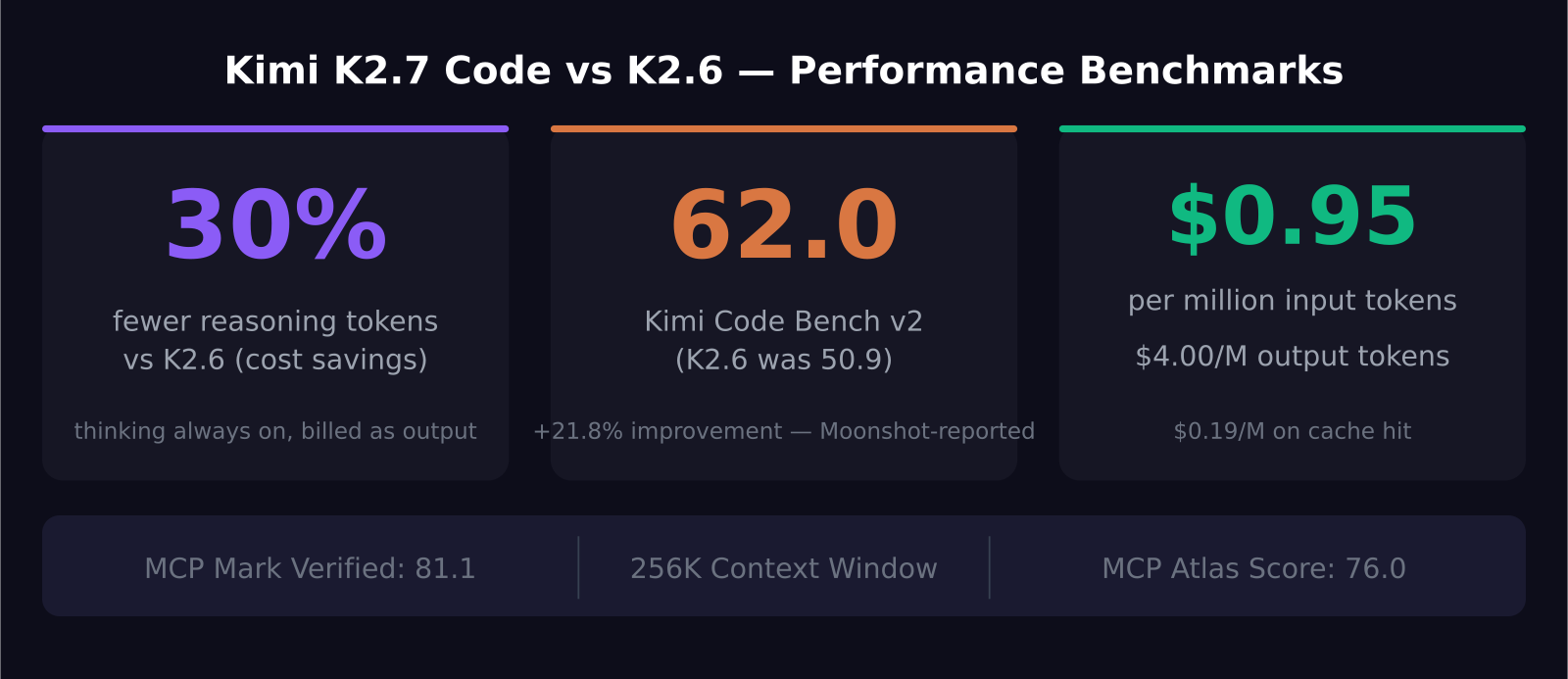
Key takeaways: - Released June 12, 2026 by Moonshot AI as open-weight under a Modified MIT license (commercial use allowed) - 1 trillion total parameters, 32 billion active per token via Mixture-of-Experts architecture, 256K context window - Approximately 30% fewer reasoning tokens than K2.6, which reduces cost per task at the same per-token rate - Pricing: $0.95 per million input tokens (cache miss), $0.19 per million on cache hit, $4.00 per million output - Strong MCP tool-use scores: 81.1 on MCP Mark Verified, 76.0 on MCP Atlas — designed for agentic coding pipelines
What makes K2.7 different from K2.6
Moonshot has been on a fast iteration cycle with the K2 family. K2.5 brought multi-step planning. K2.6 refined tool use and brought the model to what Moonshot called production-ready performance for enterprise coding pipelines.
K2.7 is not an architecture change — it is an efficiency upgrade. The same 1 trillion parameter Mixture-of-Experts base with 32 billion active parameters per token, the same 256K context window, the same 384 experts with 8 selected plus 1 shared per token. What changed: a training approach that reduces the number of reasoning tokens the model generates to reach an answer by roughly 30%.
That 30% reduction matters more than it sounds on a model like this. K2.7 Code forces thinking on — the model always reasons before answering, and it retains its reasoning chain across multi-turn conversations. Reasoning tokens are billed as output tokens at $4.00 per million. Fewer thinking tokens per task means each agentic session costs less, even at identical per-token pricing. Moonshot's efficiency work is effectively a price cut without changing the price list.
The preserve-thinking behavior — where the full reasoning chain carries over between turns — is also why K2.7 works well in coding agents running long sessions. The model does not re-derive context at each step; it builds on what it reasoned in prior turns, which is how complex multi-file refactors stay coherent over dozens of iterations.
What the benchmarks actually show
Moonshot published benchmark deltas comparing K2.7 Code to K2.6 across its own suite. On Kimi Code Bench v2, the score rose from 50.9 to 62.0 — a 21.8% jump. Program Bench went from 48.3 to 53.6. MLS Bench Lite improved from 26.7 to 35.1, a 31.5% gain. On the MCP benchmarks that measure tool-calling and Model Context Protocol workflows — the domain where coding agents actually operate — MCP Atlas went from 69.4 to 76.0 and MCP Mark Verified from 72.8 to 81.1.
The honest caveat: every benchmark published for K2.7 as of June 2026 is from Moonshot's own proprietary suite. There are no independent third-party numbers on the standard public leaderboards — SWE-bench Verified, SWE-bench Pro, Terminal-Bench, LiveCodeBench — yet. That is not unusual for a model this new, but it is the right frame for the numbers above: directional and vendor-reported, not independently confirmed.
For reference, K2.6 — the prior version — performed competitively with mid-tier closed-source models on standard coding benchmarks before third-party validation landed. K2.7 is positioned to improve on that baseline, particularly on agentic and tool-use tasks. The community benchmark results will appear in the weeks ahead.
How K2.7 compares to Claude Sonnet 5 and GPT-5.5
Without standard third-party benchmarks, a precise head-to-head is not possible yet. Here is the honest qualitative picture based on confirmed specs and Moonshot's reported results.
Claude Sonnet 5 scores 92.4% on SWE-bench and costs $3 per million input tokens. It has a 1 million token context window versus K2.7's 256K, has extensive community-verified benchmark scores, and a deep ecosystem of integration guides and tooling. For hard reasoning, ambiguous architecture decisions, and tasks where benchmark-proven capability at the frontier matters, Sonnet 5 leads.
K2.7 Code costs roughly one-third the input token price of Sonnet 5 on a cache miss and one-sixteenth the price on a cache hit. It is open-weight, which means self-hosting is an option for teams with data-residency requirements. Its MCP tool-use scores are strong, which is the benchmark category most relevant to agentic coding pipelines. For SaaS teams processing high volumes of routine engineering tasks — test generation, code review, repetitive refactoring — K2.7's pricing makes it compelling for the tasks that do not require frontier reasoning depth.
The practical architecture many teams are moving toward: K2.7 Code as the workhorse model for file edits, test generation, and routine refactoring; Sonnet 5 or Claude Opus 4.8 for the harder architectural decisions and complex debugging sessions that actually need the extra capability. OpenAI-compatible APIs mean routing between models is a configuration change, not a rewrite.
GPT-5.5, for comparison, is a closed general-purpose frontier model. K2.7 is an open, coding-specialized one. GPT-5.5 leads on broad reasoning; K2.7's pitch is open weights, lower cost, and a tuned agentic-coding profile.
What it is actually like to use
Moonshot exposes K2.7 through a standard OpenAI-compatible API and an Anthropic-compatible endpoint. For coding agents like Claude Code, Cline, and Roo Code, three environment variable changes point the agent at Kimi instead of Claude: set ANTHROPIC_BASE_URL to the Moonshot Anthropic endpoint, set ANTHROPIC_MODEL to kimi-k2.7-code, and update the API key. That is the full integration.
The 256K context window handles large codebases without the chunking overhead that smaller context models require. On a codebase in the 100,000 to 150,000 token range, K2.7 maintained coherent awareness of dependencies across files in a refactoring session without hallucinating function signatures.
The forced-thinking behavior does add latency. Every response begins with a reasoning chain before the answer appears. For interactive use where developers are waiting on responses, this is noticeable on shorter queries where the reasoning overhead is disproportionate to the task. For long agentic sessions running autonomously, the latency impact is less significant relative to total session time.
The ecosystem is still thin compared to Sonnet 5 or GPT. Integration guides, community evaluations, and troubleshooting resources for K2.7 specifically are sparse as of mid-June 2026. Early adopters are building more of the workflow themselves. That will change quickly as benchmark results and community usage accumulate — the K2.6 community grew fast after launch.
Who should be looking at Kimi K2.7 Code right now
Solo developers and small teams building on top of AI coding tools who need cost-predictable agentic workflows. The pricing floor is low enough for meaningful experiments without significant budget exposure, and the model quality is sufficient for production use on standard engineering tasks.
SaaS teams running high-volume automated pipelines — CI/CD code review, test generation, automated refactoring at scale — where token costs accumulate fast and the economics of per-token pricing compound across thousands of daily tasks.
Developers who need self-hosting for compliance or data-residency reasons. The Modified MIT license and Hugging Face availability make K2.7 one of the few 1 trillion parameter models that is genuinely deployable in private infrastructure with commercial use rights.
Teams currently evaluating their agentic coding stack in light of GitHub Copilot's billing change. K2.7's direct API pricing gives exactly the cost predictability and transparency that the new Copilot model does not.
Frequently asked questions
Can you run Kimi K2.7 Code locally
The model weights are available on Hugging Face under the Modified MIT license and work with vLLM, SGLang, and KTransformers. Hardware requirements are significant: full-precision weights run approximately 600 gigabytes, and even aggressive INT4 quantization lands around 240 gigabytes. This is multi-GPU server territory. No official GGUF or Ollama build existed as of June 12, 2026, though community quantizations for the K2.6 generation appeared quickly after that model launched.
How does Kimi K2.7 compare to DeepSeek V4 for coding
Both are open-weight Chinese MoE models designed for coding and agentic tasks, which makes them the closest comparison. DeepSeek V4 Pro holds a broader advantage on general reasoning benchmarks, including the top position on BenchLM's Chinese model leaderboard at a score of 87. K2.7 Code's training focus and MCP tool-use benchmarks give it a specific edge on agentic software engineering workflows. For pure coding pipelines, both are worth evaluating against your actual codebase before committing.
Is the Modified MIT license actually commercial-friendly
Yes, with one condition: large-scale commercial deployments require attribution. Moonshot defines large-scale as products that distribute the model directly or run it as a core feature of a platform with a significant user base. For most SaaS teams integrating K2.7 via API into internal engineering workflows, the practical terms are effectively standard MIT. For platform products where the model is a core customer-facing feature, review Moonshot's attribution requirement and build the attribution into the product design before launch.
Was this article helpful?
SaaS Master
Creator behind SaaS Master — tutorials, walkthroughs, reviews, and explainers that help SaaS, AI, and WordPress products get understood and chosen. Writing here about the tools, trends, and tactics that actually move the needle. Work with me →
Want your product explained this clearly — in video?
Tutorials, walkthroughs, reviews, and shorts for SaaS, AI, and WordPress products.
Work With SaaS Master