AI & SaaS
GitHub Copilot's Flex Billing Explained: What the June 2026 Pricing Switch Means

On June 1, 2026, GitHub Copilot quietly changed how it charges you. The plan names and prices look identical, but underneath, Copilot switched from request-based billing to usage-based "AI Credits." If you use Copilot casually, you may never notice. If you lean on agents all day, this is the most important pricing change of the year — and it can either save you money or surprise you with overage.
I watched this land while filming a Copilot tutorial, and the confusion in the comments was immediate: "Did prices go up? Did I lose unlimited usage?" The honest answer is nuanced, so here's a plain-language breakdown of what flex billing actually is, who it helps, who it hurts, and what to do about it.
Key takeaways
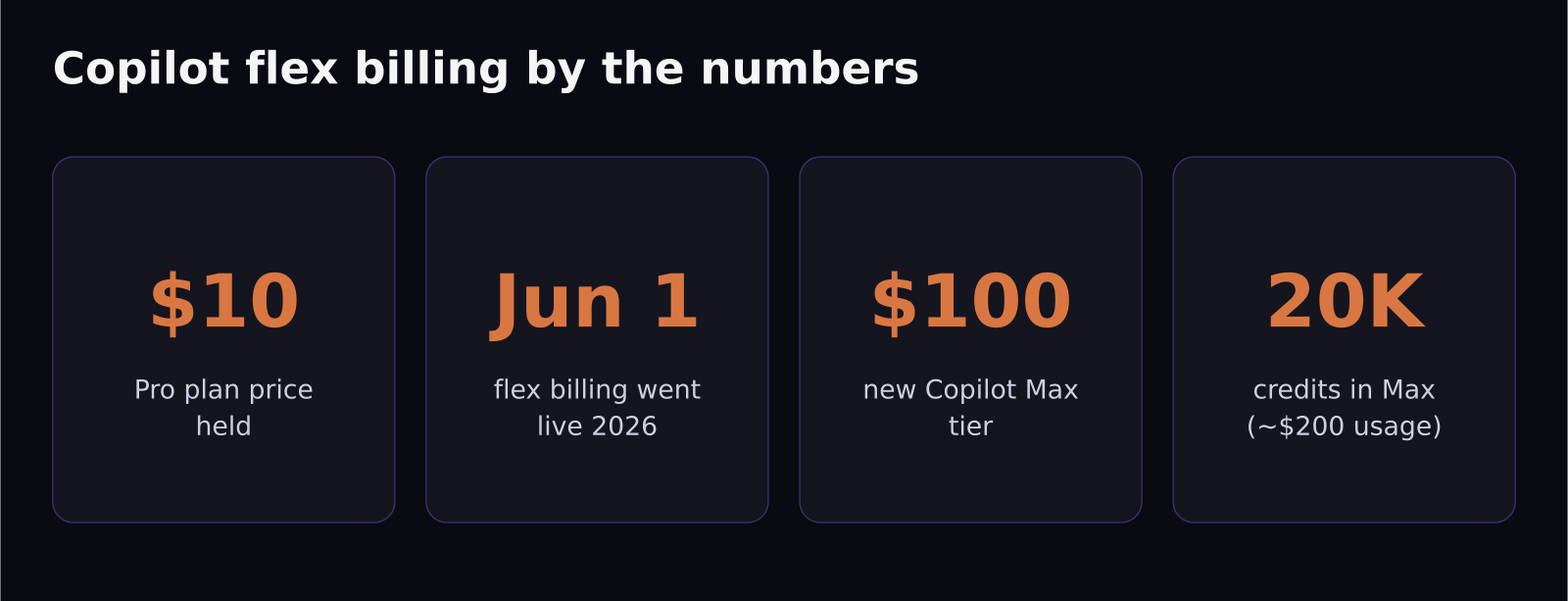
- GitHub Copilot moved to usage-based AI Credits on June 1, 2026; plan prices held but each is now a credit allowance, not unlimited usage.
- Prices that stayed the same: $10 Pro, $39 Pro+, $19/user Business, $39/user Enterprise.
- A new tier, Copilot Max, costs $100/month and includes 20,000 credits (about $200 of usage) for heavy agent users.
- Light users likely won't notice; heavy agent users need to watch their credit burn to avoid overage.
What is GitHub Copilot flex billing?
Flex billing replaces the old "you get X requests" model with a pool of AI Credits that different actions draw from at different rates. A quick autocomplete costs almost nothing; running a long agent task that reads your repo, writes code, and iterates costs far more. Instead of counting requests, GitHub now meters the actual compute behind each action.
The key mental shift: your monthly fee buys a credit allowance, not unlimited access. Under the old model, a $10 Pro plan was effectively all-you-can-eat within request caps. Now that $10 buys a defined pool of credits, and when you exhaust it, you either stop, wait for the next cycle, or pay overage.
Did Copilot prices actually go up?
No — and this is the part that confuses people. The sticker prices are unchanged: Pro is still $10/month, Pro+ is $39, Business is $19/user, and Enterprise is $39/user. What changed is what those dollars buy. They now map to a credit allowance rather than a flat usage ceiling.
For most individual developers doing normal autocomplete-and-chat work, the included credits comfortably cover a month, so the practical experience is the same. The people who feel the change are the heavy users — anyone running long agent sessions repeatedly throughout the day.
Who is Copilot Max for?
To serve those heavy users, GitHub introduced Copilot Max at $100/month with 20,000 credits, which GitHub frames as roughly $200 of usage. It's aimed squarely at developers who run agents continuously — the people who, under flex billing, would otherwise blow through a smaller plan's allowance and rack up overage.
If you're a casual user, Max is overkill. If you've ever thought "I basically have an AI agent working alongside me all day," it's probably the tier that saves you money versus paying overage on a smaller plan.
What should you do about it?
Three practical moves.
First, check your usage. GitHub exposes credit consumption, so spend a week watching how fast your pool drains. Most people discover they use far less than they feared — or far more, if they've quietly become an agent power user.
Second, match your tier to reality. If you're consistently near your limit, Copilot Max or a higher plan is cheaper than overage. If you're barely touching your credits, stay on Pro and pocket the difference.
Third, treat credits like any other cloud cost. The teams that handle usage-based AI billing well are the ones that monitor spend by feature and adjust, rather than setting a plan once and forgetting it. This is the same discipline you'd apply to any metered cloud service.
Why is the whole industry moving this way?
Copilot isn't an outlier. Across 2026, AI tools have been shifting from flat subscriptions to usage-based models, because the underlying cost of running powerful agents varies wildly from one user to the next. A flat fee either overcharges light users or bankrupts the provider on heavy ones. Usage-based billing aligns what you pay with what you actually consume.
For users, the trade is fairness for predictability. You stop subsidizing power users, but you also lose the comfort of a fixed bill. The winners under this model are the people who pay attention; the losers are the ones who assume "unlimited" and get a surprise.
How does this compare to Cursor and Devin Desktop?
It's worth noting Copilot is taking the opposite path from some competitors. Cursor and the newly rebranded Devin Desktop both still lead with flat monthly tiers — $20/month entry points with higher tiers for heavy users — which feels simpler on the surface. But those flat tiers carry their own quotas under the hood, and the gap between "flat" and "usage-based" is narrowing across the whole category. Copilot is just being more explicit about it.
If predictability is your top priority, a flat-tier competitor may feel safer today. But don't mistake a flat price for unlimited usage — read what each plan's quota actually covers before assuming you've escaped metering. The entire industry is converging on "you pay for what the compute costs," and the tools that haven't said so plainly yet are mostly just earlier in the same journey.
A quick checklist before your next billing cycle
Three things to do this week: open Copilot's usage view and note your current credit burn rate; estimate whether you're a light, moderate, or heavy user based on how often you run agents; and pick the tier that matches, leaving a little headroom rather than running at the edge of your allowance. Do that once and you'll never be surprised by an AI bill again — which, for a tool you rely on daily, is worth the ten minutes it takes.
The bottom line
GitHub Copilot's flex billing isn't a price hike — it's a change in how value is measured. Light users keep the same experience at the same price. Heavy users get a clearer path (Copilot Max) and a clearer signal to monitor their consumption. The single best habit you can build is checking your credit usage for one billing cycle, then picking the tier that matches what you genuinely do. Set-it-and-forget-it is the only way to get burned.
Frequently asked questions
Did GitHub Copilot raise its prices in June 2026? No. The plan prices stayed the same — $10 Pro, $39 Pro+, $19/user Business, $39/user Enterprise. What changed on June 1, 2026 is that each plan now provides a monthly pool of AI Credits instead of unlimited usage.
What is Copilot Max? Copilot Max is a new $100/month tier introduced with flex billing. It includes 20,000 AI Credits, which GitHub describes as roughly $200 of usage, and targets developers who run AI agents heavily throughout the day.
Will flex billing cost me more? Probably not if you're a light or moderate user — the included credits cover normal autocomplete and chat use. You're most at risk of overage if you run long agent tasks repeatedly, in which case monitoring usage and choosing the right tier protects you.
SaaS Master
Creator behind SaaS Master — tutorials, walkthroughs, reviews, and explainers that help SaaS, AI, and WordPress products get understood and chosen. Writing here about the tools, trends, and tactics that actually move the needle. Work with me →
Want your product explained this clearly — in video?
Tutorials, walkthroughs, reviews, and shorts for SaaS, AI, and WordPress products.
Work With SaaS Master