GitHub Copilot vs. Claude Code vs. Cursor vs. Windsurf: What Coding Agents Cost After the 2026 Pricing Shakeup
In short
GitHub Copilot moved to usage-based AI credit billing on June 1, 2026. Here's what Claude Code, Cursor, and Windsurf now cost by comparison, plan by plan.
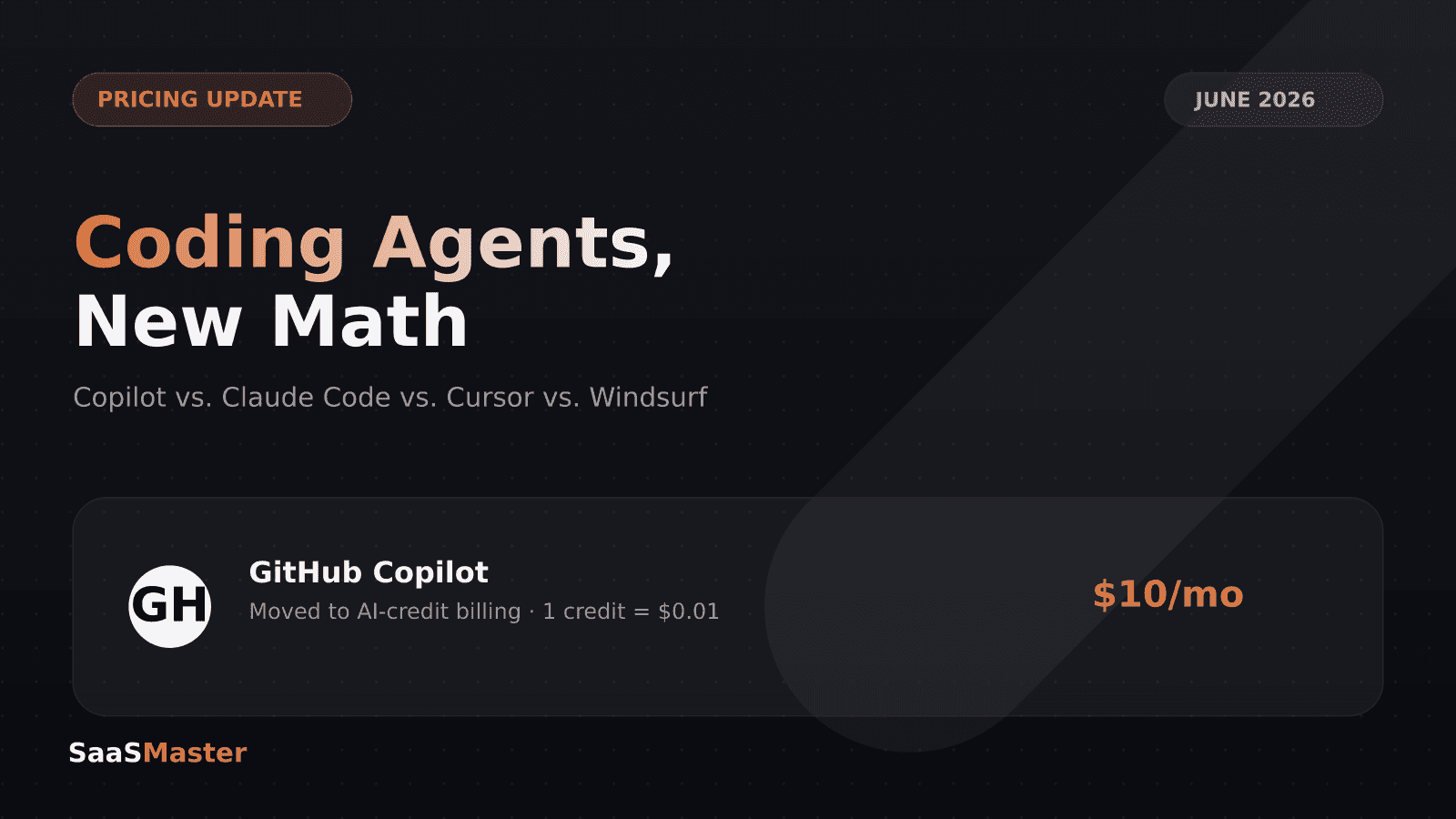
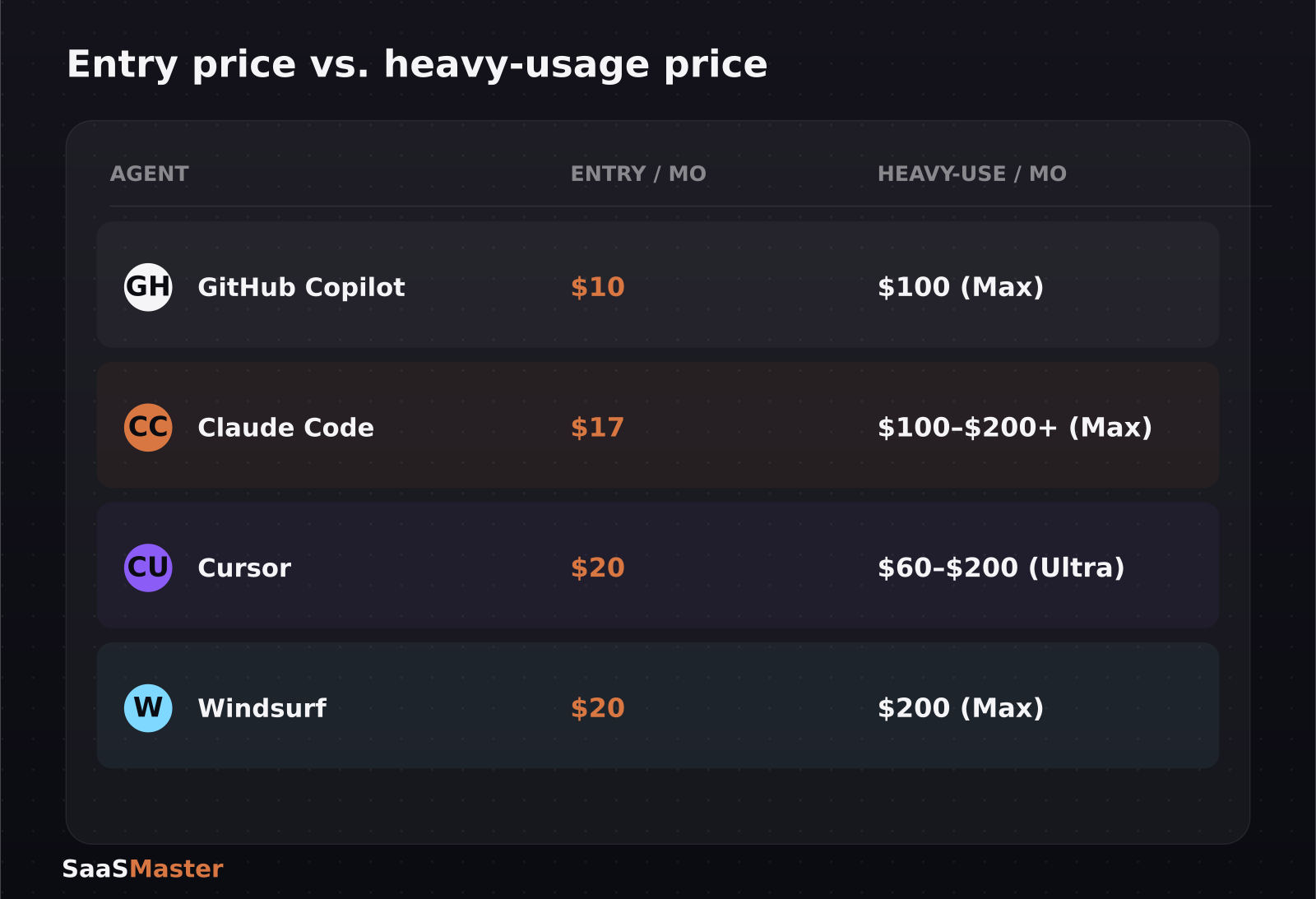
GitHub Copilot switched every plan to usage-based "AI credit" billing on June 1, 2026, which quietly changed the math on every coding-agent comparison written before that date. Copilot Pro is still $10 a month and now includes $15 of credits; Claude Code Pro is $17 a month; Cursor Pro is $20 a month; Windsurf Pro is $20 a month after being raised from $15 in May 2026. Entry-level pricing has converged around $10 to $20 — the real differences show up in what a credit actually buys and what happens once you're a heavy user.
Key takeaways
- GitHub Copilot moved to usage-based billing on June 1, 2026: 1 AI credit equals $0.01, and code completions themselves stay free on every paid plan.
- Copilot's paid tiers are Pro ($10/mo, $15 in credits), Pro+ ($39/mo, $70 in credits), and Max ($100/mo, $200 in credits) — chat, agent mode, code review, and the CLI draw from that credit pool.
- Claude Code costs $17/month for Pro, scaling to $100+/month for Max tiers, or pay-per-use through the API; Teams runs $25/seat monthly or $20/seat on an annual plan.
- Cursor Pro is $20/month with unlimited Tab completions; Business is $40/user/month; Pro+ and Ultra tiers run $60 and $200/month for heavier usage.
- Windsurf's Pro plan rose from $15 to $20/month in May 2026, and it added a new $200/month Max tier to match Cursor and Claude Code at the high end.
Why did GitHub Copilot change its pricing now?
Copilot's old model counted "premium requests" per plan, which made it hard for teams to predict a monthly bill once agent mode and code review started eating into that allowance faster than plain autocomplete ever did. The June 1, 2026 switch to AI credits — $1 of credit for every $0.01 spent internally — is GitHub's attempt to make usage transparent: completions and next-edit suggestions stay unlimited and free, while chat, agent mode, code review, and the CLI draw down a visible credit balance you can track in real time.
What does each entry-level plan actually include?
Copilot Pro at $10/month is still the cheapest paid seat in this comparison and includes $15 of monthly AI credits plus unlimited free completions — genuinely good value if your team leans on autocomplete more than long agent sessions. Claude Code Pro at $17/month and Cursor Pro at $20/month both lean toward heavier agentic work: multi-file edits, longer-running tasks, and models capable of holding more context. Windsurf Pro, now $20/month after May's price increase, sits in the same bracket as Cursor, which effectively erased what used to be Windsurf's price advantage.
Where do the real cost differences show up?
The entry tier is a red herring in this comparison — the meaningful gap opens up at the "I use this all day" tier. Cursor's Pro+ is $60/month and Ultra is $200/month; Claude Code's Max plans run from roughly $100/month up past $200/month depending on usage multiplier; Windsurf's new Max tier also lands at $200/month; and Copilot's Max plan tops out at $100/month with $200 in credits included. If your team is writing code eight hours a day with an agent doing meaningful chunks of it, budget for $60–$200 per seat per month, not the $10–$20 headline price.
Which plan actually has the best free tier?
GitHub Copilot Free includes 2,000 code completions a month plus limited chat and agent-mode access, which makes it the only one of the four with a free tier that's genuinely useful for light, everyday coding rather than a stripped-down trial. Cursor's Hobby tier and Windsurf's free tier are also usable for evaluation, but both are clearly designed to convert you to Pro within a few weeks of real use. Claude Code doesn't have a comparable no-cost tier outside of limited API trial credits, so budget for at least the $17/month Pro seat if you want to test it properly.
So which one should a small SaaS team actually pick?
If your team writes a moderate amount of code and leans on autocomplete more than autonomous agents, Copilot Pro at $10/month is the best value entry point, especially paired with its now-unlimited free completions. If you're running agent-heavy workflows — generating whole features, refactors, or landing pages the way we've covered with Claude Code and MiniMax M3 — Claude Code or Cursor at $17–$20/month justify themselves quickly, and you should plan your budget around the $60+ tier once usage climbs. Windsurf is worth a look mainly if your team already prefers its interface, since its pricing no longer undercuts Cursor.
What does this actually cost a five-person engineering team?
Run the entry-tier math on a five-developer team and the gap is already real before anyone hits a heavy-usage tier: Copilot Pro at $10/seat is $50/month total, Claude Code Pro at $17/seat is $85/month, and Cursor or Windsurf Pro at $20/seat is $100/month — a $50/month spread just at the cheapest plans. Move that same team to seat-based business tiers and it widens fast: Cursor Business at $40/seat is $200/month, Claude Code Teams at $25/seat monthly (or $20/seat annual) lands between $100 and $125/month, and Copilot's Business and Enterprise seats add further per-seat costs on top of the credit pool. None of this includes the heavy-usage overage that shows up once a team leans hard on agent mode rather than plain completions, which is where Copilot's credit system in particular rewards teams that track usage instead of assuming a flat fee.
Does model choice matter more than the agent wrapper?
To an extent, yes — Copilot now gives Pro users access to Claude Opus 4.6 as one of its selectable models, meaning the interface you pay for and the model actually doing the reasoning are increasingly decoupled. That's worth knowing before assuming "Claude Code" and "Copilot using Claude" perform identically: the underlying model matters, but so does how each product's agent mode chunks a task, decides when to ask for confirmation, and handles a multi-file refactor versus a single function edit. If you're already comfortable in Copilot's interface, using it to access Claude-class models may cost less than switching your whole team to Claude Code directly — but if you want the agent mode built natively around a specific model's strengths, the purpose-built tool usually edges out the wrapper.
How does this compare to the AI model story underneath these tools?
Every one of these agents is only as good as the model doing the reasoning behind it, which is part of why the Claude Fable 5 export-control reversal mattered to developers using Claude Code specifically — model access changes ripple straight into your coding agent's day-to-day performance. If you're weighing AI subscriptions across your whole stack rather than just for code, our breakdown of Krater.ai, ChatGPT Go, Gemini AI Plus, and Claude Pro is a useful companion read, and our AI & SaaS hub tracks this kind of pricing shift as it happens.
If you're building out a product with one of these agents and need the result explained to customers clearly, that's exactly the gap a short SaaS explainer or walkthrough video is built to close.
Frequently asked questions
Did GitHub Copilot get more expensive in 2026?
Not necessarily — the sticker prices for Pro ($10), Pro+ ($39), and Max ($100) didn't change, but billing moved from counting "premium requests" to a credit system on June 1, 2026, so heavy chat and agent-mode users may see their effective cost shift depending on how they use it.
Is Claude Code cheaper than Cursor?
At the entry tier, yes — Claude Code Pro is $17/month versus Cursor Pro's $20/month — but both converge at higher usage tiers, where Claude Code's Max plans and Cursor's Pro+/Ultra tiers both run from roughly $60 to $200 a month.
Why did Windsurf raise its price in 2026?
Windsurf increased its Pro plan from $15 to $20 a month in May 2026 and introduced a $200/month Max tier, bringing its pricing in line with Cursor and Claude Code rather than competing primarily on being the cheaper option.
Was this article helpful?
Jorge Aguilar
Founder & Creator, SaaS Master
Producing SaaS and AI product videos since 2019 — 800+ videos for 200+ brands, covering tutorials, demos, walkthroughs, and explainers. Writing here about the tools, trends, and tactics that actually move the needle. LinkedIn · About · Work with me
Building an AI product that needs a clearer onboarding flow?
Client-owned videos that make your product easy to understand — demos, walkthroughs, onboarding, and explainers.
Explore AI product video production