AI Tools
Kimi K2.6 vs DeepSeek V4 Pro: Best Open-Weight Coding Model for SaaS Builders in 2026
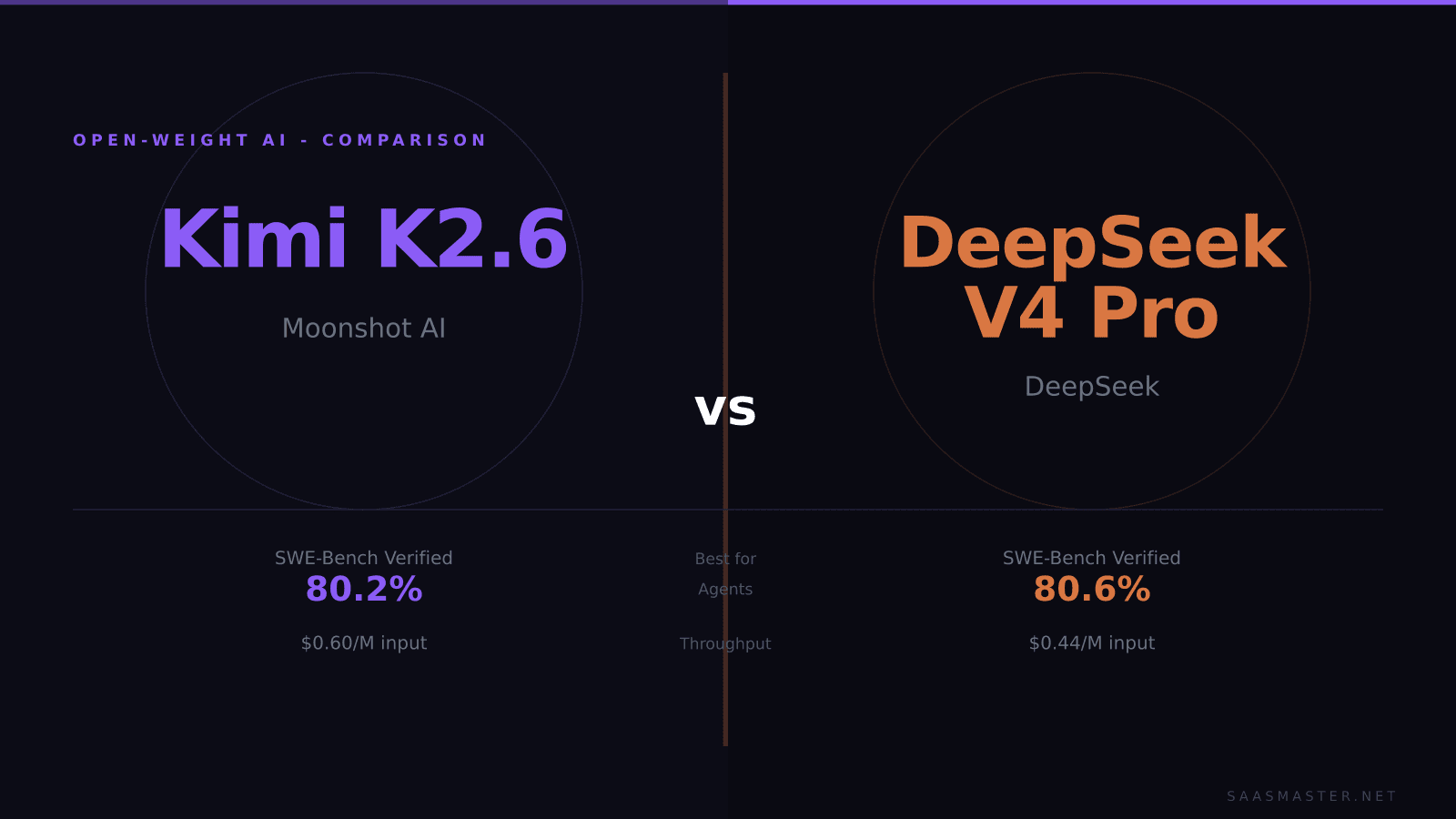
Eleven cents per million tokens separates two Chinese open-weight models that together now occupy the top of every open-source coding leaderboard. Kimi K2.6 from Moonshot AI and DeepSeek V4 Pro from DeepSeek both dropped in April 2026, both are cheaper than any Western frontier model, and both are capable enough that SaaS teams are actively rebuilding their AI stacks around them. If you are choosing an open-weight coding model for your infrastructure in 2026, the decision almost certainly comes down to these two.
Key takeaways: - Kimi K2.6 (April 20, 2026): 1 trillion parameters, 32B activated, 256K context, $0.60/$2.50 per million tokens, SWE-Bench Verified 80.2%, built for multi-agent swarm coordination. - DeepSeek V4 Pro (April 24, 2026): 1.6 trillion parameters, 49B activated, 1M context, $0.44/$0.87 per million tokens, LiveCodeBench 93.5, SWE-Bench Verified 80.6%. - On SWE-Bench Verified they are within 0.4 points of each other, effectively tied on that metric. - DeepSeek V4 Pro wins on price, context window, throughput, and direct execution speed. - Kimi K2.6 wins on multi-agent coordination, native multimodal input, and long-horizon agentic planning.
Are these models really competitive with paid frontier models?
On coding benchmarks, yes, at a fraction of the cost. Kimi K2.6 scores 80.2% on SWE-Bench Verified, essentially matching Claude Fable 5, Anthropic's newest Mythos-class model, at 80.3%. DeepSeek V4 Pro scores 80.6% on the same benchmark and posts 93.5 on LiveCodeBench, which measures competitive-style algorithmic problem solving.
For context: GPT-5.5 scored 58.6% on SWE-Bench Pro in Anthropic's June 2026 testing. Claude Opus 4.8, the previous Anthropic flagship, sits at approximately 69%. Both open-weight models clear that bar at 85 to 95 percent lower cost per token.
This does not mean they replace frontier models everywhere. Reasoning depth, safety behavior, and multi-domain professional tasks still favor Claude and GPT-class models. But for coding agents, developer tooling, code review pipelines, and agentic automation, Kimi K2.6 and DeepSeek V4 Pro are legitimate alternatives that are hard to ignore on economics alone.
How do the benchmarks compare head to head?
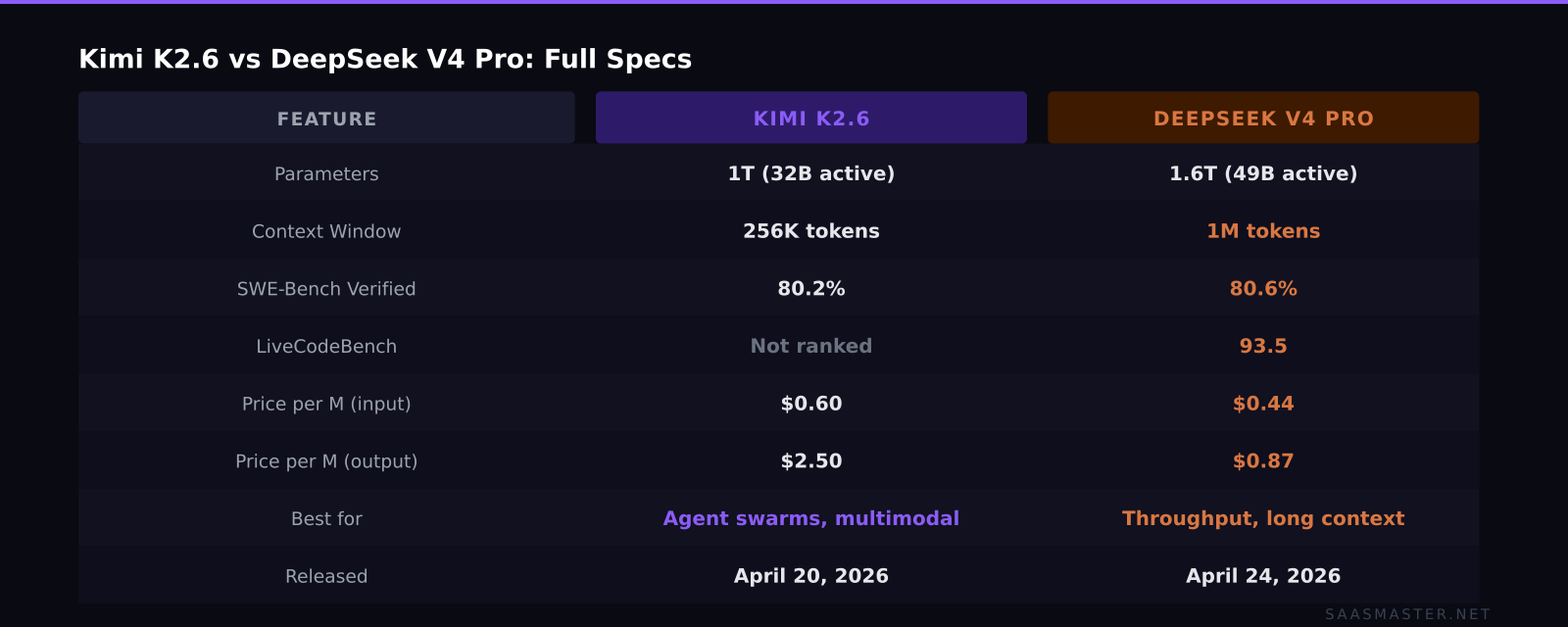
On SWE-Bench Verified, DeepSeek V4 Pro edges ahead at 80.6% versus Kimi K2.6 at 80.2%. These numbers are effectively tied, within normal test variance.
DeepSeek separates on LiveCodeBench (93.5) and Codeforces (3206 rating), both of which measure precise algorithmic coding and multi-file refactoring tasks. If raw coding throughput and execution accuracy on well-defined problems are your primary concern, DeepSeek V4 Pro has a real edge.
Kimi K2.6 improved meaningfully from K2.5's 50.7% to K2.6's 58.6% on SWE-Bench Pro, the stricter variant of the benchmark. The K2 series was explicitly designed for multi-agent coordination: K2.6 supports native spawning and coordination of up to 300 parallel agents, a capability DeepSeek V4 does not replicate at the same scale.
On generation speed, DeepSeek V4 Pro delivers 79.7 tokens per second on its own API, above the 72.8 median for models of its parameter class.
How does pricing compare?
DeepSeek V4 Pro costs $0.435 per million input tokens and $0.870 per million output tokens on DeepSeek's direct API. On third-party providers like DeepInfra and OpenRouter, blended rates cluster between $0.87 and $2.17 per million tokens depending on the provider and tier.
Kimi K2.6 runs $0.60 per million input and $2.50 per million output on the official Kimi API. On DeepInfra, blended pricing is approximately $1.44 per million tokens, with cached-input pricing at $0.15 per million.
DeepSeek is cheaper on both ends: roughly 27 percent less on input and 65 percent less on output at official API rates. For high-volume workloads where you generate significant output tokens, that gap compounds quickly. A team generating 100 million output tokens per month would pay $87 on DeepSeek versus $250 on Kimi.
Both models are MIT-licensed or equivalently open, meaning self-hosting is an option. Teams with predictable GPU capacity can run DeepSeek V4 Flash, the smaller 284B variant, at effective costs near zero.
Which is better for agentic SaaS workflows?
This is where the practical difference shows up. The models were built with different priorities and it shows under real workloads.
DeepSeek V4 Pro is the better choice when: you want fast, decisive single-pass execution on coding tasks, you are running high-throughput batch processing, your codebase or conversation history approaches or exceeds 256K tokens (DeepSeek's 1M context is the only open-weight option at that scale), or you need raw output speed with predictable token economics.
Kimi K2.6 is the better choice when: you are building multi-agent systems that require coordinating dozens or hundreds of parallel workers, your pipeline mixes code with image inputs in the same flow because K2.6 has native multimodal support, or your tasks benefit from the model producing a structured plan before executing, which K2.6 does more consistently than DeepSeek.
From a creator and SaaS tooling perspective: if you are building a product feature that automates user tasks end-to-end through an AI agent, Kimi K2.6's swarm architecture is worth the higher output cost. If you are powering a dev tool, code search, or syntax-heavy feature that needs fast reliable code generation at scale, DeepSeek V4 Pro wins on economics.
What are the real-world limitations?
Both models are accessed through third-party API providers or self-hosted infrastructure. Neither is available inside ChatGPT, Claude.ai, or consumer interfaces. For developer teams this is a non-issue: OpenRouter, DeepInfra, and direct provider APIs all carry them reliably. For non-technical teams or products where plug-and-play access matters, the setup friction is real.
Kimi K2.6's 256K context window is generous but trails DeepSeek's 1M. For most tasks this will not matter. For large codebases, multi-document pipelines, or extended agent sessions that accumulate context near or above 256K tokens, DeepSeek V4 is the only open-weight option that handles it without chunking.
DeepSeek V4 is still in preview on some providers as of late June 2026, meaning stable-release guarantees vary by provider. Teams building production systems should confirm uptime commitments before fully committing.
Which should you choose?
My recommendation for most SaaS builders starting fresh: begin with DeepSeek V4 Pro. Lower price, faster generation, larger context window, and benchmark performance that matches or beats Kimi K2.6 on standard coding tasks. Use the cost savings from switching off a frontier model to fund more testing, then run a targeted parallel evaluation against Kimi K2.6 specifically on your agentic use cases.
If you are building multi-agent systems, orchestrating AI workers across parallel tasks in a coordinated workflow, test Kimi K2.6 first. That architecture is what K2.6 was specifically designed to excel at.
Both models represent a structural shift in what open-source AI can do in 2026. Benchmark numbers that required a $15 to $20 per million token frontier model six months ago now cost under a dollar. That is not incremental progress. It changes the build-versus-buy math for the entire SaaS AI stack.
Frequently asked questions
Can I use Kimi K2.6 or DeepSeek V4 Pro in my commercial product?
Yes. Both are released under permissive open-weight licenses that allow commercial use. They are available through third-party APIs including OpenRouter and DeepInfra, or can be self-hosted. Both are operated by Chinese companies: teams with strict data governance requirements should review their policies around data sent to non-US APIs, or plan for self-hosting.
How do these models compare to Claude Opus 4.8?
On SWE-Bench Verified, Kimi K2.6 scores 80.2% and DeepSeek V4 Pro scores 80.6%, both ahead of Opus 4.8's approximately 69% on comparable benchmarks. Opus 4.8 leads on general reasoning, professional writing, safety behavior, and multi-domain knowledge tasks. For coding-specific agent workflows, both open-weight models are competitive at roughly 88 to 95 percent lower cost per token.
Is DeepSeek V4 Pro the same as DeepSeek R2?
No. DeepSeek R2 has not been officially released as of late June 2026. DeepSeek V4 Pro is the current DeepSeek flagship, released April 24, 2026 as a 1.6 trillion parameter MoE model. R2 appears to be a separate reasoning-focused project that remains unannounced. V4 Pro is the model to evaluate today.
Was this article helpful?
SaaS Master
Creator behind SaaS Master — tutorials, walkthroughs, reviews, and explainers that help SaaS, AI, and WordPress products get understood and chosen. Writing here about the tools, trends, and tactics that actually move the needle. Work with me →
Want your product explained this clearly — in video?
Tutorials, walkthroughs, reviews, and shorts for SaaS, AI, and WordPress products.
Work With SaaS Master