AI Tools
Kimi K2.6 vs Qwen3.7 Max vs DeepSeek V4 Pro: Which Chinese AI Model Should You Actually Use in 2026?
In short
Kimi K2.6, Qwen3.7 Max, and DeepSeek V4 Pro compared on real 2026 pricing, coding benchmarks, context windows, and which one actually fits your SaaS project.
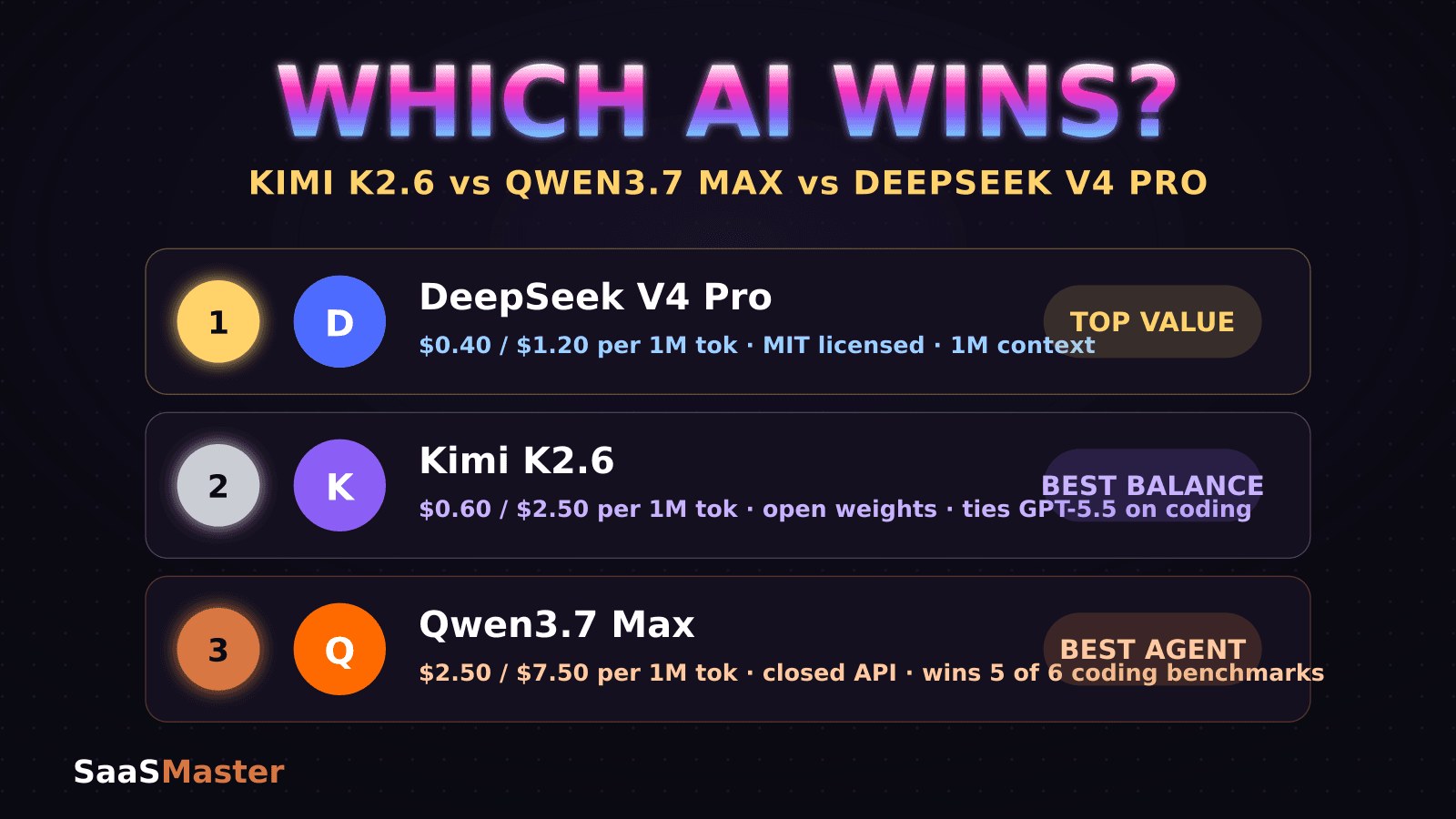
DeepSeek V4 Pro costs six times less than Qwen3.7 Max for the same million tokens, yet Qwen still wins five out of six coding benchmarks against it. That gap is the whole story of 2026's three biggest Chinese AI models: there is no universal winner here, only the right model for what you're actually building. I put Kimi K2.6, Qwen3.7 Max, and DeepSeek V4 Pro side by side on pricing, coding accuracy, and context handling so you can pick without guessing.
Key takeaways
- Kimi K2.6 ties GPT-5.5 on SWE-Bench Pro at 58.6 percent and ships as a fully open-weight 1 trillion parameter model you can download from Hugging Face.
- DeepSeek V4 Pro is MIT-licensed, self-hostable, and the cheapest of the three at $0.40 input and $1.20 output per million tokens.
- Qwen3.7 Max is closed-source and the most expensive at $2.50 input and $7.50 output per million tokens, but it leads on 5 of 6 coding benchmarks and long-horizon agent tasks.
- All three now handle serious context: Kimi K2.6 tops out at 262,144 tokens, while Qwen3.7 Max and DeepSeek V4 Pro both reach a full 1 million tokens.
- Your pick should follow your workload, not the leaderboard: self-hosting and cost control favor DeepSeek, agentic reliability favors Qwen, and open-weight flexibility favors Kimi.
Which Chinese AI model is cheapest?
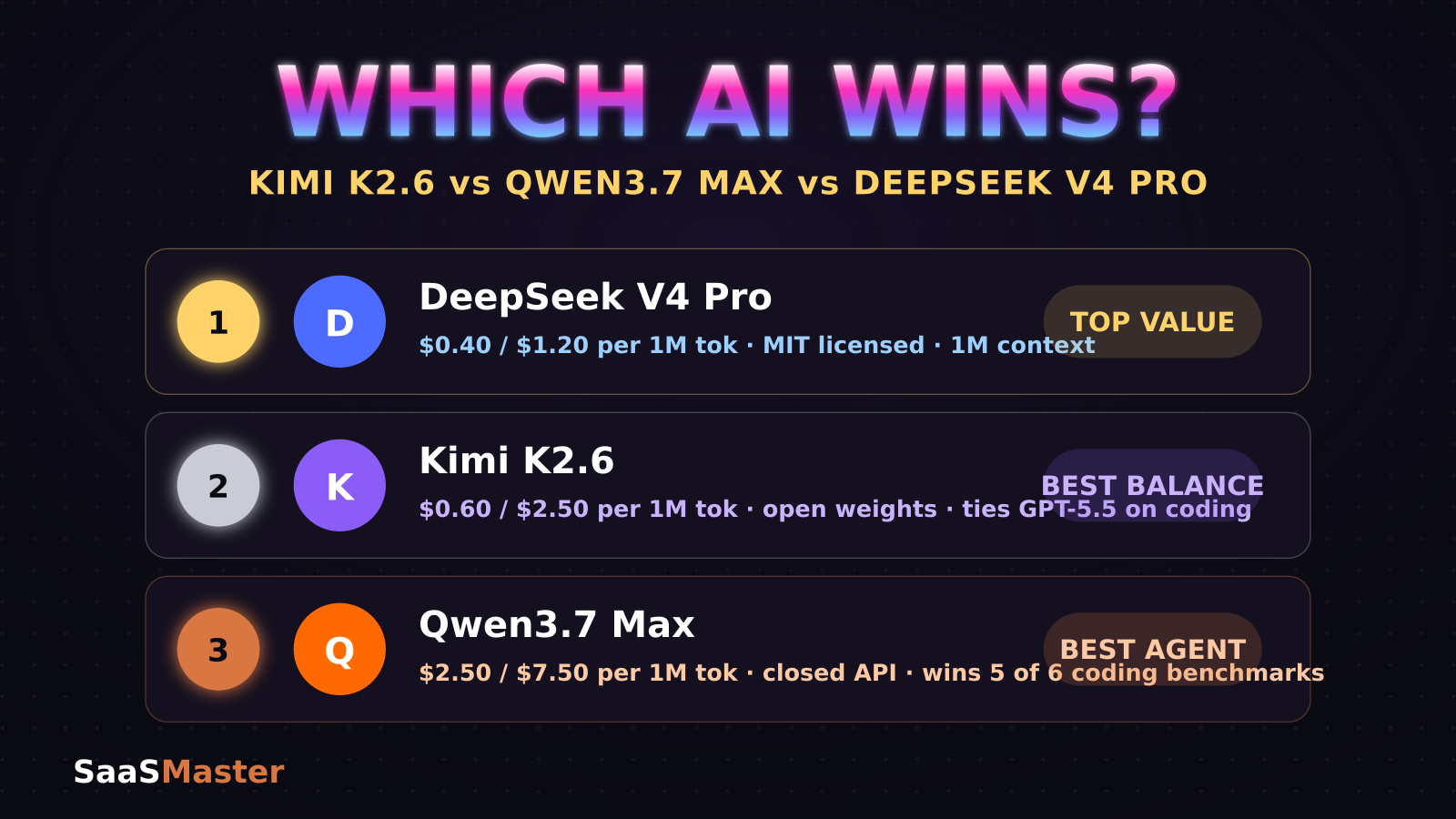
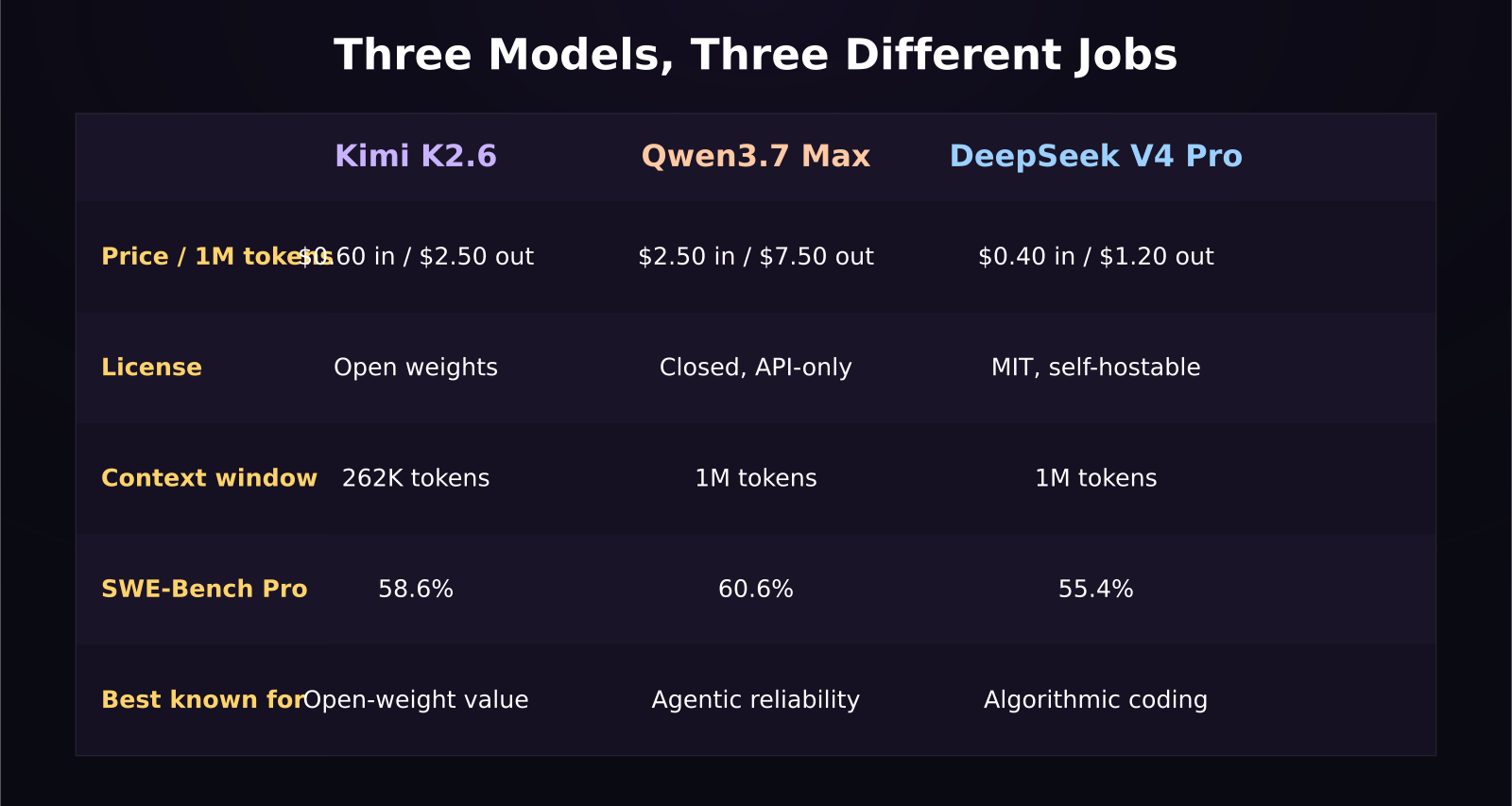
DeepSeek V4 Pro wins this one outright. At $0.40 per million input tokens and $1.20 per million output tokens, it undercuts Kimi K2.6's official API pricing of $0.60 in and $2.50 out by a wide margin, and it isn't close with Qwen3.7 Max at $2.50 in and $7.50 out. Run the math on a million tokens a day and the difference between DeepSeek and Qwen adds up to real money by the end of a month, not a rounding error.
The catch is that price alone doesn't tell you what a model is worth for your specific task. DeepSeek V4 Pro is also MIT-licensed, meaning you can download the 1.6 trillion parameter Mixture-of-Experts model (49 billion activated parameters per token) and run it on your own infrastructure if you have the GPUs for it. That option doesn't exist with Qwen3.7 Max, which is API-only and closed-source. If you need to control costs at scale or keep data fully in-house, DeepSeek is the only one of the three that lets you do both.
Which one actually codes best?
This is where the story gets more interesting than "cheapest wins." On SWE-Bench Pro, a benchmark that tests whether a model can resolve real GitHub issues end to end, Qwen3.7 Max scores 60.6 percent, Kimi K2.6 scores 58.6 percent, and DeepSeek V4 Pro scores 55.4 percent. Qwen leads 5 of the 6 coding benchmarks it was tested against, and it's especially strong on agentic and terminal-based tasks where a model has to plan, execute, and recover from errors across many steps.
DeepSeek V4 Pro flips the script on pure algorithmic coding. It posts a 93.5 percent on LiveCodeBench and a Codeforces rating around 3206, both well ahead of the other two, which makes it the strongest choice if your work leans toward competitive-programming-style problems, tight algorithms, or backend logic rather than long agent sessions. Kimi K2.6 sits in the middle: it ties GPT-5.5 on SWE-Bench Pro and leads on Humanity's Last Exam with tools at 54.0 percent, which is a good sign for research-heavy or reasoning-heavy work.
What about context window and agentic reliability?
Kimi K2.6 caps out at 262,144 tokens of context, which is still plenty for most codebases and long documents, but Qwen3.7 Max and DeepSeek V4 Pro both push to a full 1 million tokens. If your workflow involves feeding an entire monorepo or a stack of long PDFs into a single prompt, the extra headroom on Qwen and DeepSeek matters more than the benchmark percentages.
Agentic reliability is where Qwen3.7 Max separates itself. Long-horizon tasks, where a model has to hold a plan together across dozens of tool calls without losing track of what it already did, are notoriously hard, and Qwen's benchmark lead in this category lines up with what I've seen anecdotally when running longer automated coding sessions. Kimi K2.6 and DeepSeek V4 Pro are both capable agents, but neither is purpose-built for the same length of autonomous run that Qwen is tuned for.
Which should you actually pick for your SaaS project?
If you're a solo builder or small team watching every dollar, start with DeepSeek V4 Pro. The pricing is the lowest of the three, the MIT license means no vendor lock-in, and the algorithmic coding scores are strong enough for the vast majority of backend and API work most SaaS products need. I've used it for straightforward CRUD logic and data-processing scripts and it holds up well without the API bill creeping up.
If you're building something that leans on open-weight flexibility, want to fine-tune later, or care about running inference on your own terms without giving up frontier-level coding performance, Kimi K2.6 is the more balanced pick. The learning curve is low if you're already comfortable with any OpenAI-compatible API, since most providers expose it that way.
Qwen3.7 Max is worth the higher price specifically when your task is long, multi-step, and agentic, think an AI handling an entire feature build with minimal supervision, or navigating a messy legacy codebase over dozens of tool calls. That's a narrower use case than most SaaS teams need day to day, so I'd treat it as the specialist tool in the lineup rather than the default. None of these three is a bad choice; the mistake is picking based on a single leaderboard number instead of matching the model to the job in front of you.
Is one of these three actually the safest default?
If you genuinely cannot decide and just need a starting point today, default to DeepSeek V4 Pro for cost-sensitive backend work and switch to Kimi K2.6 the moment you need open weights you can inspect or fine-tune. Save Qwen3.7 Max for the specific week you're shipping a feature that needs an agent to run largely unsupervised. Treating this as a portfolio of three tools instead of a single winner is the difference between overpaying for capability you don't need and underpaying for a job that actually calls for the strongest agent on the market.
Frequently asked questions
Is Kimi K2.6 free to use?
The model weights are free to download from Hugging Face if you have the infrastructure to run a 1 trillion parameter Mixture-of-Experts model yourself. Using it through Moonshot's official API or a provider like OpenRouter costs $0.60 to $0.66 per million input tokens and $2.50 to $3.41 per million output tokens depending on the provider.
Can I self-host DeepSeek V4 Pro?
Yes. DeepSeek V4 Pro ships under the MIT license with full weights available, which is the main reason it appeals to teams that want to avoid per-token API costs entirely once they have the hardware to run a 1.6 trillion parameter MoE model with 49 billion active parameters.
Is Qwen3.7 Max worth the higher price?
It depends on your workload. Qwen3.7 Max costs roughly six times more than DeepSeek V4 Pro per million tokens, but it leads 5 of 6 coding benchmarks and is noticeably stronger on long, autonomous agent tasks. If your work is mostly short coding tasks or standard API calls, DeepSeek or Kimi will get you similar results for less money.
Was this article helpful?
Jorge Aguilar
Founder & Creator, SaaS Master
Producing SaaS and AI product videos since 2019 — 800+ videos for 200+ brands, covering tutorials, demos, walkthroughs, and explainers. Writing here about the tools, trends, and tactics that actually move the needle. LinkedIn · About · Work with me
Want your product explained this clearly — in video?
Tutorials, walkthroughs, reviews, and shorts for SaaS, AI, and WordPress products.
Work With SaaS Master