AI Tools
Lovable vs Bolt vs Replit: Which AI App Builder Should You Pick in 2026?
Here is the answer most comparison posts bury: if you are a non-developer who wants a production app with auth, a database, and payments, start with Lovable. If you are comfortable poking at code and want flexibility, including mobile apps, start with Bolt. If you want to learn to actually code alongside the AI, or you need Python and persistent servers, start with Replit.
I am not a traditional developer. I build software products by describing them to AI tools, and I make video tutorials about exactly these platforms for SaaS companies. So this comparison comes from the perspective most of you reading it actually have: you have an idea, a budget around $25 a month, and no patience for dependency errors.
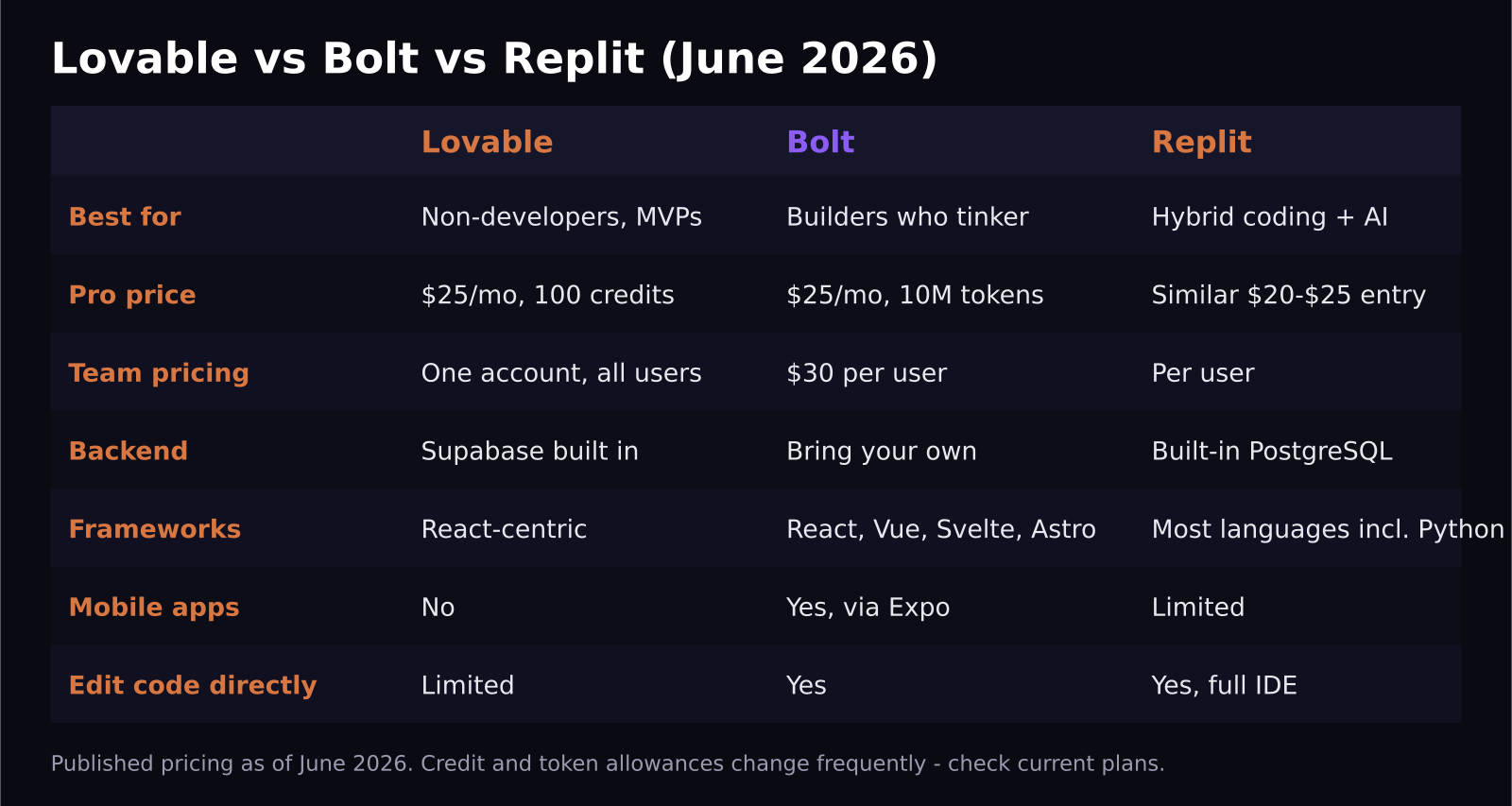
- Lovable and Bolt both charge $25 per month for their Pro tiers, but the allowances differ: Lovable gives about 100 credits shared account-wide, Bolt gives 10 million tokens per user.
- Team pricing is where they split hard: Lovable covers all users on one account, while Bolt charges around $30 per user with unshared tokens.
- Lovable's Supabase integration is the smoothest path from prompt to working app with a real database and login.
- Bolt supports React, Vue, Svelte, and Astro, plus mobile apps through Expo, which Lovable does not offer.
- Replit is the only one of the three that is a real development environment, with built-in PostgreSQL, hosting, and the option to write code yourself as you learn.
What is the real difference between these three?
All three platforms do the same magic trick: you type what you want in plain language and get a working web app. The difference is what happens after the first prompt, and that is exactly where most vibe-coding projects die.
Lovable is built for people who never want to see the code. Its onboarding is the smoothest of the three, and its tight Supabase integration means authentication, database tables, and storage get wired up almost automatically. When my prototype needs to become a real product with user accounts, Lovable gets there with the fewest detours.
Bolt sits in the middle. It runs a full development environment in your browser, so you can open any file and edit it directly when the AI gets stuck, and a fix takes ten seconds instead of ten more credits of prompting. Framework choice matters here too: Vue, Svelte, or Astro projects are possible, and Expo support means you can ship an actual mobile app.
Replit is the most complete platform and the least beginner-shaped. It is a genuine cloud IDE with an AI agent on top, plus built-in PostgreSQL and hosting. You can start by prompting and gradually take the wheel, which makes it the best choice if your real goal is to stop being a non-developer.
Which is cheaper, Lovable or Bolt?
At the entry level they look identical: both Pro plans cost $25 per month. The difference is the metering model, and it changes which one is cheaper for you specifically.
Lovable charges in credits, roughly one credit per message that changes your app, with around 100 credits on Pro. Heavy iterators burn through that fast. Bolt charges in tokens, 10 million on the $25 plan, which generally stretches further for large projects but gets consumed by every file the AI reads and writes, so big codebases eat tokens quickly too.
For teams, the comparison stops being close. Lovable's account-based pricing covers everyone working in the workspace, while Bolt charges per seat at around $30 per user with allowances that are not pooled. A three-person team pays $25 on Lovable versus roughly $90 on Bolt. If that is you, Lovable wins on price before you even open the editor. Worth noting for context: Vercel's v0, the fourth name that comes up here, lists a free tier with $5 in monthly credits and team plans at $30 per user, but it is best when you live inside the Vercel and Next.js ecosystem and accept the lock-in.
Where does each platform fall apart?
No honest comparison skips this section, and after recording hours of tutorial footage on all three, I have watched each one fail in characteristic ways.
Lovable struggles when you push past its happy path. It is React-only, mobile is off the table, and once an app grows past a certain complexity, the no-code ceiling becomes real: you can connect GitHub and edit externally, but at that point you are fighting the platform's whole premise.
Bolt's weakness is that token burn is invisible until it is not. A complex refactor can quietly consume a startling share of your monthly allowance, and beginners who cannot read the code cannot tell whether the AI is making progress or going in circles, which gets expensive.
Replit's weakness is focus. It can do almost anything, which means it does not hold your hand toward anything. Non-developers can feel lost in an interface clearly built for people who already know what a terminal is. Its agent is powerful but works best for users who can sanity-check its output.
What about Cursor, v0, and the rest of the field?
A quick word on the names I left out of the headline. Cursor and Claude Code are AI coding tools rather than app builders: enormously powerful, but they assume you are comfortable living in an editor or a terminal, which puts them one rung up the ladder from the audience of this post. v0 deserves a fuller mention: it produces the best-looking React and Next.js interfaces of any tool here, and if your app is essentially a beautiful frontend on Vercel, it is a legitimate first choice. Its weakness is the inverse of its strength, since the deeper you go, the more you are committed to the Vercel ecosystem. Base44 and Mocha round out the field for simple internal tools, but for a real product, the big three above are where I would start.
So which one should you actually pick in 2026?
My direct recommendation, the same one I give clients: if you want a real product live this month and you do not want to learn to code, pick Lovable and budget for credits. If you want maximum capability per dollar as a solo builder and you are willing to occasionally open a file and fix things, pick Bolt. If you are in this to eventually understand your own codebase, pick Replit and treat the learning curve as part of the deal.
And one piece of advice none of these platforms put on their pricing page: whichever you choose, connect GitHub and export your code from day one. The Sora shutdown this spring reminded everyone that AI products can disappear or reprice on short notice. Your app should outlive whatever tool generated it.
Frequently asked questions
Can I switch platforms after I start building?
Partially. All three let you export code or sync to GitHub, so your codebase is portable. What does not transfer is the platform glue: Lovable's Supabase wiring, Bolt's environment configuration, or Replit's hosting setup will need rebuilding. Switching mid-project costs days, not weeks, but plan for it.
Do I still need a developer if I use these tools?
For an MVP, usually no, and that is a real change from two years ago. For production apps handling payments or sensitive data, a security review by an experienced developer is still money well spent. The AI builders generate plausible code, including plausibly insecure code.
Which platform is best for client work or agencies?
Lovable, mostly because of pricing: one account covers the whole team, and the Supabase backend is easy to hand off to a client. Bolt's per-seat pricing and Replit's complexity make them better for products you keep than products you deliver.
SaaS Master
Creator behind SaaS Master — tutorials, walkthroughs, reviews, and explainers that help SaaS, AI, and WordPress products get understood and chosen. Writing here about the tools, trends, and tactics that actually move the needle. Work with me →
Want your product explained this clearly — in video?
Tutorials, walkthroughs, reviews, and shorts for SaaS, AI, and WordPress products.
Work With SaaS Master