AI Tools
MiniMax M3 Review: The Open-Weight Frontier Model That Costs Almost Nothing
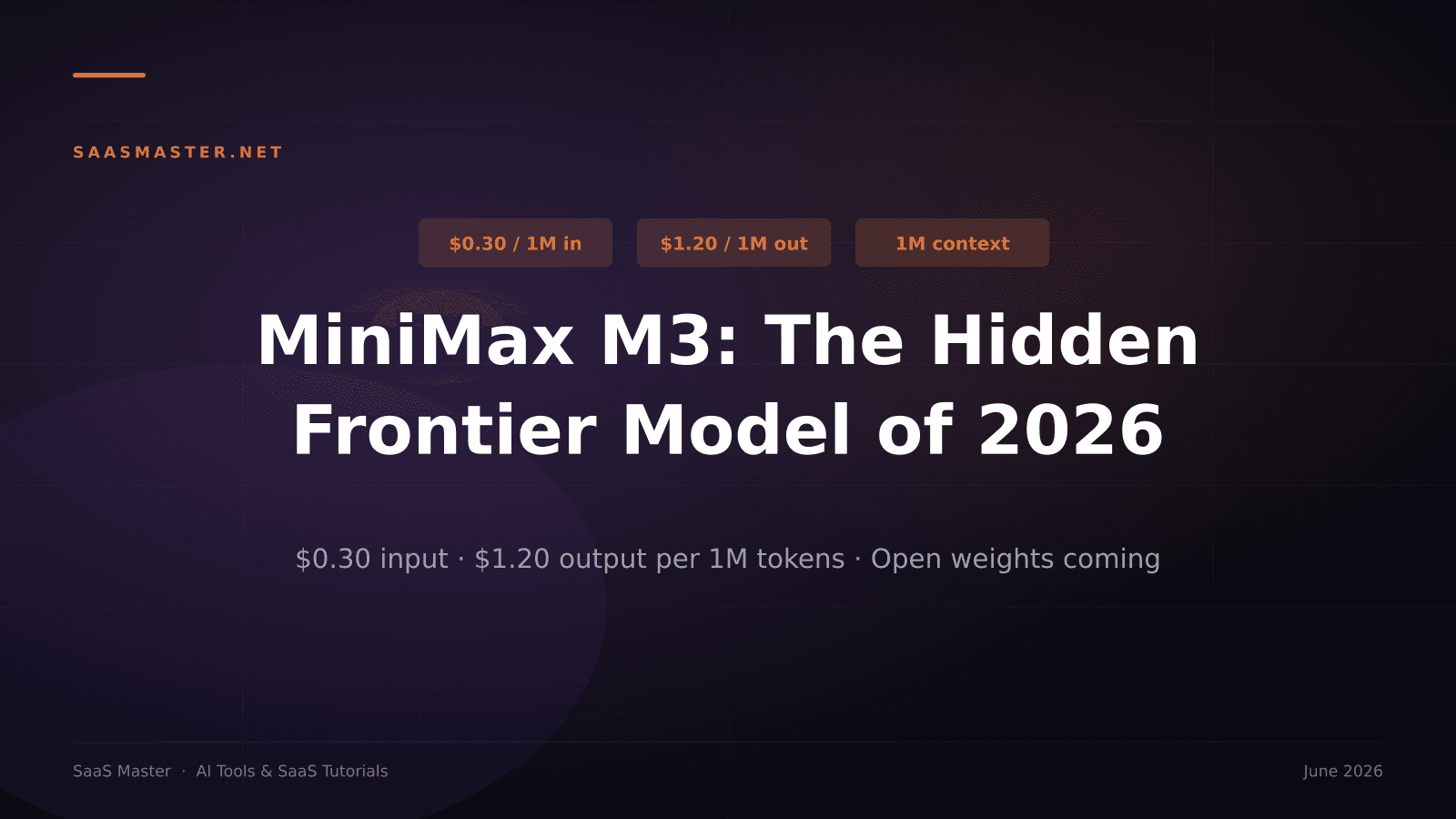
MiniMax M3 launched on June 1, 2026, with a claim that should get any cost-conscious AI builder's attention: frontier-level coding and reasoning at $0.30 per million input tokens and $1.20 per million output tokens. For context, that is roughly 4% of what GPT-5.5 charges on output. The benchmarks mostly hold up.
Key takeaways: - MiniMax M3 launched June 1, 2026 at $0.30/$1.20 per million tokens promotional, standard price $0.60/$2.40 - SWE-bench Pro score of 59.0% slightly beats GPT-5.5 at 58.6% on coding, at roughly 6% of the cost - Built on MiniMax Sparse Attention, which cuts per-token compute to about 1/20th of the previous generation at 1M context - Open weights confirmed for Hugging Face and GitHub — self-hosting is coming - Best fit: high-volume agentic pipelines, document processing, and any workload where per-token cost is a real constraint
What MiniMax M3 is
MiniMax is a Chinese AI lab that has been building foundational models since 2021. M3 is their flagship 2026 release — the first to combine frontier-level coding, native multimodal processing covering text, image, and video inputs, agentic tool use, and a 1 million token context window in a single architecture.
The key technical differentiation is MSA, or MiniMax Sparse Attention. Traditional transformer attention computes relationships between every token pair in the context window, which gets expensive fast at long contexts. MSA replaces full attention with selective KV-block attention — it only attends to the most relevant token blocks. The result is roughly 1/20th the compute cost at 1 million tokens versus their previous generation, with 9x faster prefill and 15x faster decode at that context length. These are not small numbers.
The benchmark picture
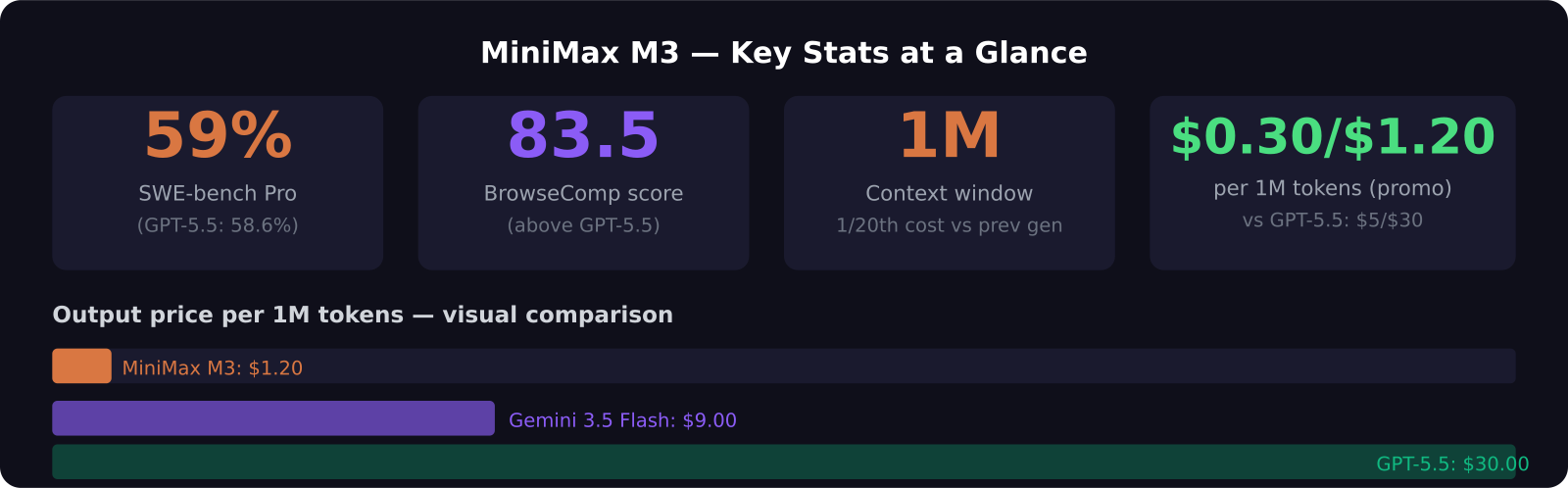
MiniMax M3 scores 55 on the Artificial Analysis Intelligence Index, placing it well above average for similarly priced models. More importantly: on SWE-bench Pro, the standard coding evaluation, M3 scores 59.0% — marginally ahead of GPT-5.5 at 58.6%, and well ahead of where you would expect a model at this price.
On BrowseComp, which tests autonomous web browsing and information retrieval, M3 scores 83.5 — which MiniMax claims surpasses both GPT-5.5 and Gemini 3.1 Pro. That is a bold claim that should be treated as directional until independently confirmed at scale, but the number is publicly verifiable via the MiniMax API.
Where the price advantage actually shows up
At standard pricing of $0.60 per million input tokens and $2.40 per million output tokens, MiniMax M3 sits at the bottom of the frontier-model pricing ladder in 2026. The promotional launch pricing of $0.30/$1.20 halves that further.
To put this in practical terms: if you are running a SaaS feature that processes 50,000 customer support tickets per month at an average of 2,000 output tokens each, the cost from GPT-5.5 would run around $3,000 per month. The same workload on MiniMax M3 at standard pricing costs around $240. That is a number that changes build-versus-buy decisions for document-heavy or high-volume use cases.
The caveat is reliability and enterprise support. MiniMax is newer to the global API market than OpenAI or Anthropic. Latency, rate limits, uptime SLAs, and data processing agreements need to be evaluated against your requirements before migrating critical production workloads.
Who should actually use M3
The clearest fit is any workload where token volume is high and tasks are well-defined. Document summarization, classification, data extraction, structured output generation, and code review pipelines all work well here. The 1M context window means you can feed an entire codebase or large document corpus in a single call — and the MSA architecture means that does not cost ten times more than a standard-length call.
For creative writing, complex reasoning, or tasks where subtle language quality differences matter, the gap between M3 and the top-tier Anthropic and OpenAI models is more noticeable. M3 is strong on coding and tool use; it is not yet at the top of the leaderboard for nuanced natural language generation.
The open-weight announcement
MiniMax has committed to releasing M3 weights on Hugging Face and GitHub. For a model at this capability tier, that is significant. Self-hosting a frontier-level coder means you can process sensitive data without sending it to any third-party API, run inference at fixed cost on your own infrastructure, and fine-tune on domain-specific data without restriction.
The weights are not yet published at the time of writing, but the public commitment is firm. For compliance-sensitive industries like healthcare, legal, or financial services, this will be worth watching closely over the next few months.
My take as a creator running AI pipelines
I tested M3 on a batch document processing task — extracting structured data from long-form product documentation. The output quality was genuinely competitive for structured extraction. Not identical to Claude Opus 4.8, but close enough for pipeline work where I am using the model as a component rather than a standalone generator.
The price difference is hard to ignore when you see it in your token logs. For any workload where the task shape is known and quality requirements are met, M3 is now on my shortlist. I would not switch a customer-facing generation pipeline without more production testing, but for internal data processing and classification, it has earned a place.
Frequently asked questions
Is MiniMax M3 available via API right now? Yes. MiniMax M3 is available via the MiniMax API and through OpenRouter at promotional pricing of $0.30/$1.20 per million tokens. Standard pricing after the promotional launch period is $0.60/$2.40.
When will the open weights be released? MiniMax committed to publishing weights on Hugging Face and GitHub but has not announced a specific release date. The promotional period suggests weights will follow once the API rollout stabilizes.
How does M3 compare to Gemini 3.5 Flash on price and performance? MiniMax M3 at standard pricing ($0.60/$2.40) is roughly 75% cheaper on output than Gemini 3.5 Flash ($9.00/M). On SWE-bench Pro, M3 scores 59.0% and Gemini 3.5 Flash scores comparable numbers on Terminal-Bench 2.1. For pure cost-per-task, M3 wins significantly. For speed and ecosystem support, Gemini 3.5 Flash has more mature infrastructure.
Was this article helpful?
SaaS Master
Creator behind SaaS Master — tutorials, walkthroughs, reviews, and explainers that help SaaS, AI, and WordPress products get understood and chosen. Writing here about the tools, trends, and tactics that actually move the needle. Work with me →
Want your product explained this clearly — in video?
Tutorials, walkthroughs, reviews, and shorts for SaaS, AI, and WordPress products.
Work With SaaS Master