AI Tools
Nano Banana 2 vs GPT Image 2 vs Midjourney v7: Best AI Image Generator in 2026
If you need an AI image generator in 2026, here's the quick verdict: pick GPT Image 2 for the best all-around quality and prompt accuracy, Nano Banana 2 for the fastest and cheapest API images, and Midjourney v7 when you want the most striking artistic look and don't need an API. I use all three for thumbnails and explainer visuals, and each earns its place for a different reason.
The reason this matters for anyone making software content is simple: image generation went from "fun toy" to "core part of the production pipeline" in about a year. A clean diagram, a thumbnail, or a hero image used to mean opening a design tool for an hour. Now it's a prompt and a few cents. But the three leading options behave very differently on quality, speed, and cost, so let's get specific.
Key takeaways
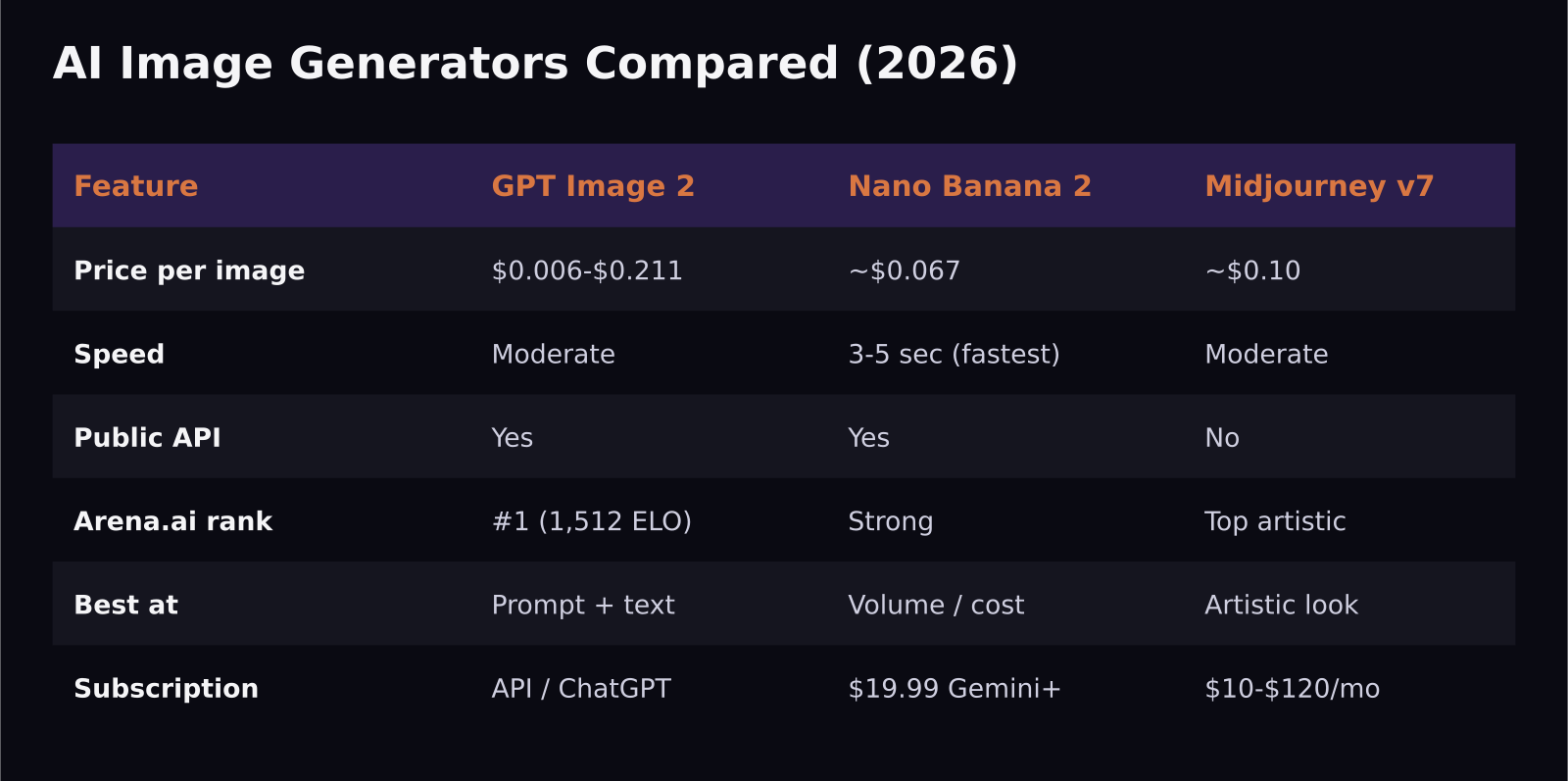
- GPT Image 2 tops the Arena.ai image leaderboard at an ELO of 1,512 — about 241 points ahead of second place as of April 2026.
- Nano Banana 2 is the speed and price champion: images in 3–5 seconds at roughly $0.067 each, with full API access.
- Midjourney v7 still wins on pure artistic feel, but costs about $0.10 per image and has no public API.
- For text-in-image and instruction-following, GPT Image 2 is the most reliable; for volume, Nano Banana 2 wins on cost.
Which AI image generator has the best quality?
By the numbers, GPT Image 2 leads. As of April 2026 it holds the top spot on the Arena.ai leaderboard with an ELO of 1,512, a commanding 241 points clear of the next model. In practice that translates into the best prompt adherence of the three — it actually puts the thing you asked for where you asked for it, and it handles text inside images better than anything else I've tested. For a product thumbnail that needs a readable label or a UI mockup, that reliability is worth a lot.
Midjourney v7 is the artist's pick. It rarely "follows instructions" as literally as GPT Image 2, but it produces images with a richer, more deliberate aesthetic — better lighting, more interesting composition, a look that feels designed rather than generated. When I want a moody hero image and I'm willing to roll the dice a few times, Midjourney still gives me the most beautiful single frame.
Nano Banana 2 isn't trying to win the beauty contest. It's tuned for speed and consistency, and at its price point the quality is genuinely impressive — more than good enough for social posts, blog headers, and quick iterations.
Which is cheapest, and which is fastest?
Cost is where the gap is widest.
Nano Banana 2 is both the cheapest with full API access and the fastest, generating images in 3–5 seconds at about $0.067 per image. It's also bundled into Gemini AI Plus at $19.99/month with a roughly 50-image-per-day quota, which is plenty for most creators.
GPT Image 2 bills by quality tier through the API: a 1024×1024 image runs about $0.006 at low quality, $0.053 at medium, and $0.211 at high, plus token charges for image input and output. That means your cost depends heavily on the quality setting you choose — low-quality drafts are nearly free, high-quality finals are the most expensive option here.
Midjourney is the priciest on a per-image basis, around $0.10, and it only comes as a subscription ($10 to $120/month) with no public API. That subscription-only model is the single biggest reason it can't slot into an automated pipeline.
Can you build an automated pipeline with these?
This is the deciding question for a lot of SaaS and content teams, and it cleanly splits the field.
GPT Image 2 and Nano Banana 2 both offer full APIs, so you can wire them into a workflow — generate blog headers on publish, batch social variants, auto-create diagram drafts. Nano Banana 2's speed makes it ideal for high-volume jobs where you're producing dozens of images; GPT Image 2 is the one I reach for when each image needs to be correct, not just pretty.
Midjourney v7, with no public API, stays a manual, in-the-loop tool. That's fine if you're crafting a handful of hero images by hand, but it rules Midjourney out for anything you want to automate.
How I actually use all three
My real workflow is a blend. I draft concepts with Nano Banana 2 because it's fast and cheap enough to try ten variations without thinking about cost. When an image needs accurate text or a specific layout — a thumbnail with a product name, a labeled diagram — I switch to GPT Image 2 for its instruction-following and text rendering. And when I want one standout, gorgeous frame for a launch and I have time to iterate, I open Midjourney v7.
The mistake I see creators make is picking one tool and forcing it to do everything. These three are specialists. Matching the tool to the job — draft, accuracy, or art — gets you better results for less money than loyalty to any single brand.
How does image quality hold up at small sizes?
Most images you make for SaaS content are viewed small — a thumbnail in a feed, a header scrolled past on a phone. That changes what "best" means. At small sizes, fine artistic detail matters less than clarity and contrast, which is part of why GPT Image 2 and Nano Banana 2 punch above their aesthetic weight for practical work: their outputs read cleanly when shrunk. Midjourney's richness is most rewarding at full resolution, where its lighting and texture have room to breathe.
There's also a consistency angle that's easy to overlook. If you're producing a series — a set of blog headers in the same style, or a batch of social cards — you want images that look like siblings, not strangers. Nano Banana 2's tuned consistency makes series work easier, while Midjourney's tendency to surprise you is a feature for one-offs and a headache for a uniform set. GPT Image 2 sits in the middle, and its strong instruction-following lets you lock a style by describing it precisely.
Will AI image tools replace designers?
Not for the work that matters most. These tools are extraordinary at volume, drafts, and filling gaps fast, but taste, brand judgment, and knowing which image actually serves the message are still human jobs. The creators getting the most out of 2026's image models treat them as a faster sketchpad, not a replacement for design thinking. The tool generates options; you still decide what's good.
Which should you choose?
If you can only pick one and you want reliability, choose GPT Image 2: it's the highest-rated, follows prompts best, and has an API. If you're cost- or volume-sensitive, choose Nano Banana 2 for its speed and $0.067 images. If you're an artist or marketer chasing a specific look and don't need automation, Midjourney v7 still delivers the most beautiful output. For most software creators, a GPT Image 2 plus Nano Banana 2 combination covers nearly every job.
Frequently asked questions
Which AI image generator is best for text inside images? GPT Image 2 is the most reliable for rendering readable text and following layout instructions, which makes it the best choice for thumbnails, mockups, and labeled diagrams.
Does Midjourney have an API in 2026? No. As of 2026 Midjourney v7 remains subscription-only ($10–$120/month) with no public API, so it can't be used in automated image pipelines. Choose GPT Image 2 or Nano Banana 2 if you need API access.
What's the cheapest way to generate lots of images? Nano Banana 2 at about $0.067 per image, or bundled into Gemini AI Plus at $19.99/month with roughly 50 images per day. It's both the fastest and the most cost-effective option with full API access.
SaaS Master
Creator behind SaaS Master — tutorials, walkthroughs, reviews, and explainers that help SaaS, AI, and WordPress products get understood and chosen. Writing here about the tools, trends, and tactics that actually move the needle. Work with me →
Want your product explained this clearly — in video?
Tutorials, walkthroughs, reviews, and shorts for SaaS, AI, and WordPress products.
Work With SaaS Master