SaaS Demo Video vs Sales Demo: What Is the Difference?
In short
A SaaS demo video and a live sales demo aren't the same tool. Here's the real difference, when to use each one, and how they work together to close deals.
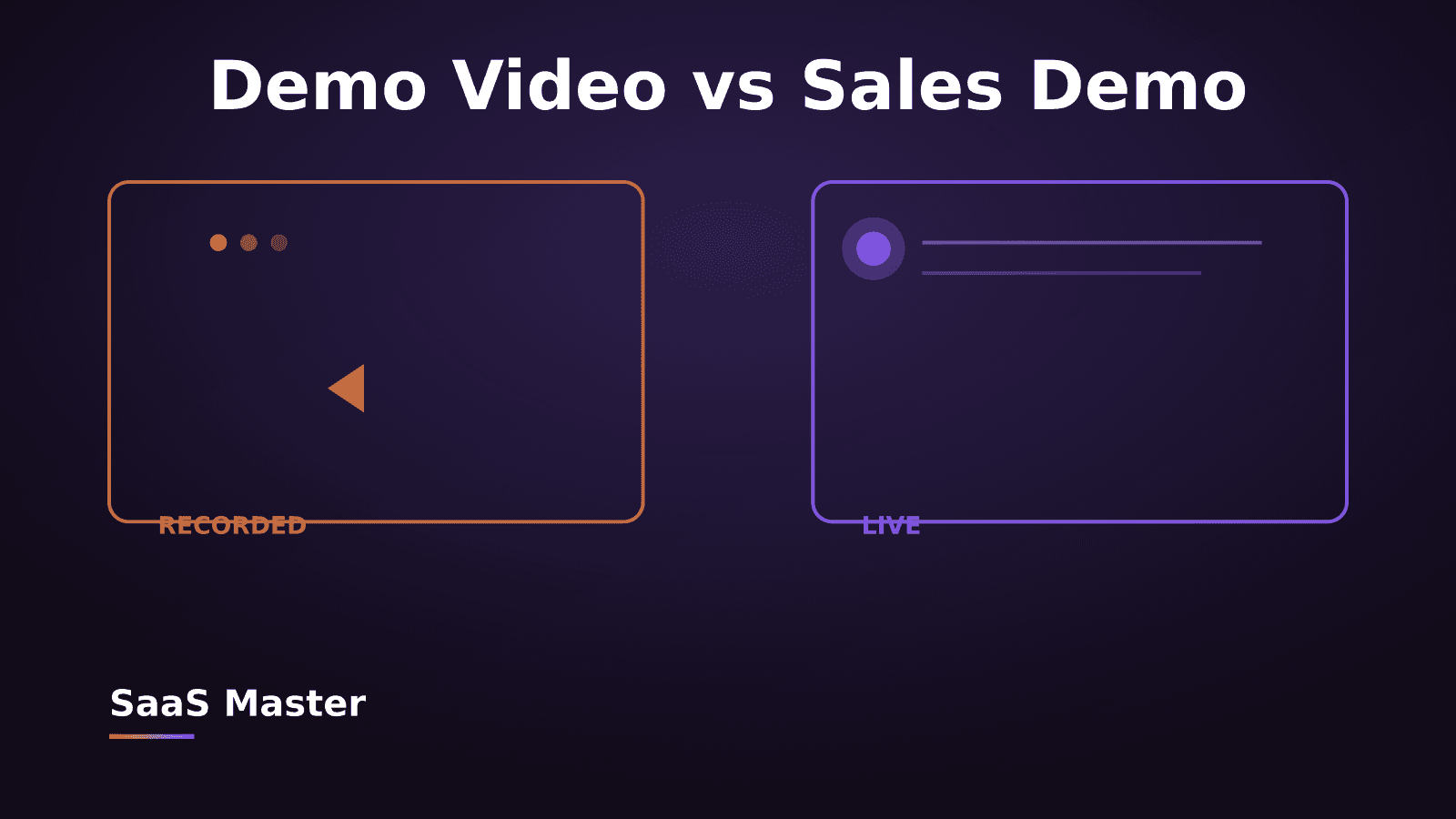
A SaaS demo video and a live sales demo solve two different problems. The video shows what your product does, on its own time, to someone who isn't ready to talk yet. The sales demo shows why your product fits this specific buyer, live, with a rep who can answer the one question that's actually blocking the deal. Confusing the two wastes both: a video stuffed with rep-only detail loses cold viewers, and a live call spent narrating features a video already covered wastes a rep's best asset, which is judgment.
Key takeaways
- A demo video is a fixed asset built for scale; a sales demo is a live conversation built for one deal.
- Videos work earlier in the funnel, before a lead is ready to talk to a human.
- Sales demos work later, once a prospect has real questions only a rep can answer.
- The best setups use a demo video to qualify and warm up leads, then a live demo to close them.
- Reusing sales-demo talking points as video script filler is one of the most common mistakes we see.
What's the core difference between a SaaS demo video and a live sales demo?
A demo video is produced once and watched thousands of times. Every viewer sees the same sequence, the same pacing, the same emphasis. That consistency is the point: it's how you make sure every prospect, no matter which page they land on or which rep they never talked to, understands what your product actually does.
A sales demo is produced once and delivered once. A rep is reading the room in real time, skipping the parts the prospect already understands, slowing down on the objection that's actually stopping the deal, and adjusting language to match the buyer's role. That flexibility is the point of having a human in the room at all.
Neither format is a lesser version of the other. They're built for opposite conditions: one for scale and consistency, one for a single high-stakes conversation.
When should you use a recorded demo video instead of a live sales call?
Use a video anywhere a prospect is evaluating you before they're willing to book time with a person. That includes the homepage, a pricing page, a comparison landing page, an email sequence, or a support article that answers "does this tool do X." At this stage, most visitors aren't ready to talk to sales, and asking them to book a call just to see the product is a wall most of them won't climb.
A good demo video answers the questions that come before trust exists: what does this look like when it's working, who is it for, and is it worth 20 more minutes of my time. It should not try to close a specific account or handle a specific objection, because it doesn't know who's watching.
What does a good SaaS demo video need that a sales demo doesn't?
A video has to work with zero context and zero interaction. There's no rep to jump in if the viewer gets confused, so the structure has to do that work: a clear opening that names the problem, a walkthrough that shows the product doing the thing the viewer came to check on, and a close that gives them an obvious next step. Pacing matters more than in a live call, because a bored viewer just closes the tab; a bored meeting attendee usually stays for social reasons.
A video also needs to be honest about what it can't control. It can't read the room, so it should lead with the most common use case, not the most impressive edge case, and it should never assume the viewer already understands your category.
If you're mapping out which of these formats to build first, our breakdown of demo, tutorial, explainer, and launch videos is a useful starting point: https://saasmaster.net/blog/how-to-choose-saas-demo-tutorial-explainer-launch-video
What does a good sales demo need that a video can't deliver?
A sales demo needs discovery before it happens. A rep who opens a call by clicking through the same static script for every prospect is just performing a worse version of the video that prospect may have already watched. The value of a live demo is entirely in the parts that change based on who's in the room: which features get more time, which objections get addressed before they're raised, and which proof points get pulled in because they match this buyer's industry or role.
A sales demo also needs room for silence and questions. The best reps we've worked with treat the demo less like a presentation and more like a working session, checking in regularly instead of narrating uninterrupted for twenty minutes.
How do demo videos and sales demos work together in the funnel?
The strongest setups use both, in sequence. A demo video does the early qualifying work: a prospect watches it, understands roughly what the product does, and decides whether it's worth their time to go further. That means the sales demo doesn't have to spend its first five minutes on the basics, because the video already covered them. The rep can walk in assuming baseline understanding and spend the whole call on the prospect's specific situation.
We build client-owned demo videos with exactly this handoff in mind, so the video and the sales team's live demo reinforce each other instead of repeating the same ground: https://saasmaster.net/software-demo-videos
This is also where a lot of teams leave value on the table. If the video and the live demo are built by different people with no shared structure, prospects notice the disconnect, and reps end up re-explaining things the video already showed. Keeping both under one narrative, even if they're produced separately, keeps the buyer's experience coherent from first click to signed contract.
Where should each format live?
A demo video belongs anywhere a prospect can arrive without a rep present: the homepage, product pages, comparison content, retargeting ads, and email nurture sequences. It should always be watchable without booking anything.
A sales demo belongs after a lead has shown real intent, whether that's requesting a demo, replying to outreach, or reaching a usage threshold in a free trial. It's a resource-intensive format, so it should be reserved for prospects worth a rep's time, not offered as the default first touch for every visitor.
Recent examples of our work across both formats are here: https://saasmaster.net/portfolio
Frequently asked questions
Can one video replace a live sales demo entirely?
For low-complexity or low-price products, sometimes yes, especially with a strong self-serve trial behind it. For anything with real implementation complexity or a longer sales cycle, a video builds understanding but rarely closes the deal on its own. Most B2B SaaS teams still need a live conversation to handle account-specific questions.
Should sales reps use the demo video during their live calls?
Occasionally, for a specific segment of the product, but not as the whole call. If a rep is playing the same video every prospect could watch on their own time, the live meeting isn't delivering anything the prospect couldn't get without booking a call. Use the video as a reference, not a script.
How long should a SaaS demo video be compared to a sales demo?
A demo video usually works best under three minutes, since it has to hold a cold viewer's attention with no other reason to stay. A live sales demo typically runs 20 to 30 minutes, because it includes discovery, questions, and next steps a video can't provide.
Need this type of video for your product? Request a client-owned SaaS video production quote: https://saasmaster.net/saas-video-production
Was this article helpful?
Jorge Aguilar
Founder & Creator, SaaS Master
Producing SaaS and AI product videos since 2019 — 800+ videos for 200+ brands, covering tutorials, demos, walkthroughs, and explainers. Writing here about the tools, trends, and tactics that actually move the needle. LinkedIn · About · Work with me
Need a product demo, walkthrough, or SaaS explainer?
Client-owned videos that make your product easy to understand — demos, walkthroughs, onboarding, and explainers.
Explore SaaS video production