AI & SaaS
Supabase Just Hit $10.5 Billion — Because AI Agents Are Now Its Biggest Customers
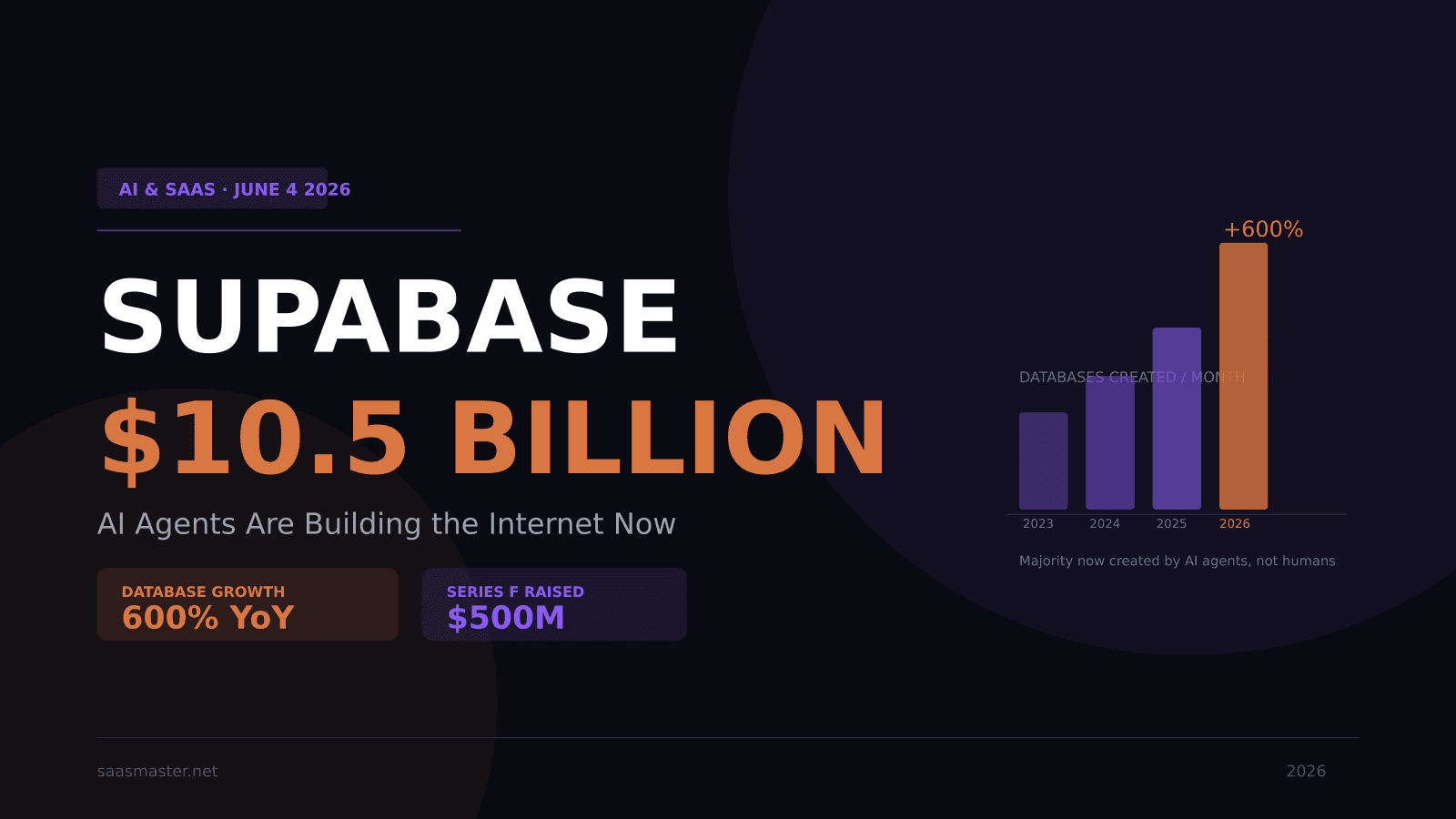
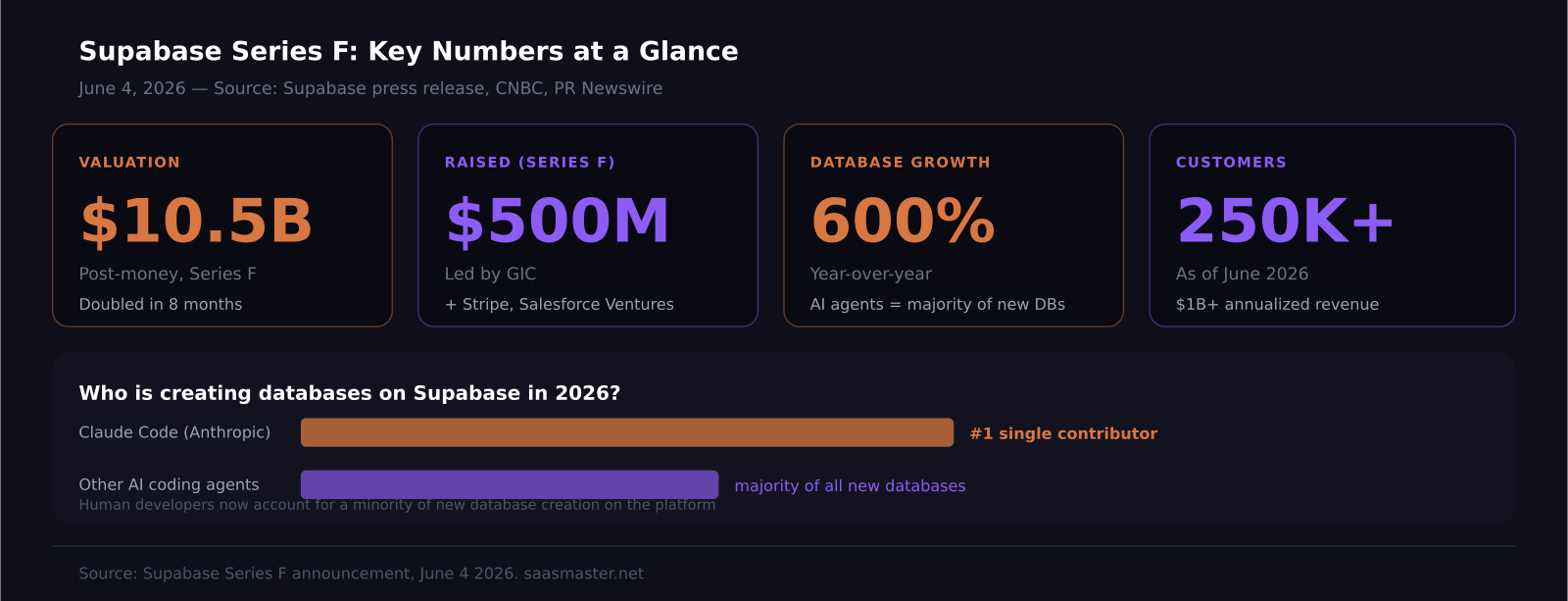
Supabase raised $500 million at a $10.5 billion valuation on June 4, 2026. That headline is remarkable on its own — but the more interesting number is buried in the announcement: AI agents, not human developers, now deploy the majority of new databases on Supabase. Claude Code from Anthropic is the single largest contributor to new database creation on the platform in 2026. A Postgres infrastructure company just became a near-decacorn because AI started doing the building.
Key takeaways
- Supabase raised $500M Series F at $10.5B valuation in June 2026, led by GIC with Stripe and Salesforce Ventures joining for the first time
- AI agents — not human developers — now create the majority of new databases on the Supabase platform
- Claude Code is the single largest source of new Supabase databases since the start of 2026
- Database creation grew 600% year-over-year; the user base more than doubled in just 8 months
- Supabase launched Multigres v0.1 alpha alongside the fundraise — an open-source horizontal scaling layer for Postgres
From developer tool to agentic infrastructure
Supabase launched in 2020 as an open-source alternative to Firebase. It gave developers a Postgres database, authentication, file storage, edge functions, and real-time subscriptions in one package — without the vendor lock-in of Google's platform.
For the first few years, growth was steady but not spectacular. Developers adopted Supabase because it was fast to set up and built on Postgres, one of the most battle-tested databases in existence. Then 2025 and early 2026 happened. Vibe coding — building software by prompting AI assistants instead of writing code directly — moved from a niche experiment to a mainstream development approach. Every vibe-coded app needs a backend. Supabase was ready for that.
The numbers are hard to argue with. The company now has more than 250,000 customers. Database creation grew 600% year-over-year. The user base more than doubled in the seven months between the Series E and Series F. The company crossed $1 billion in annualized revenue in 2026. This is not gradual SaaS growth — this is a vertical acceleration driven by a shift in how software gets built.
Why Claude Code became Supabase's biggest customer
When a developer uses Claude Code or a similar AI coding tool to build an app, the agent follows a recognizable workflow: generate the frontend, wire up the logic, provision the backend. Supabase offers a straightforward SDK that AI coding tools can call programmatically, which made it the path of least resistance for generated backends.
The compounding effect of that default is significant. Claude Code became the single largest source of new database deployments on Supabase in 2026. Other AI coding tools — Cursor, GitHub Copilot Workspace, and others — are also major contributors. The combined result: the majority of new Supabase databases are now created by software agents, not by a human clicking through a setup wizard.
This fundamentally changes the math of infrastructure growth. When humans create databases, growth is bounded by how many developers there are and how fast they work. When AI agents create databases, growth is bounded by how many apps are being generated — and that number is accelerating. The 600% growth rate reflects what an unbounded upper end looks like when the bottleneck is removed.
What Multigres is and why it matters
Alongside the fundraise, Supabase released Multigres v0.1 in alpha. Multigres is an open-source operating system for Postgres that adds horizontal scaling — the ability to distribute your database across multiple servers when a single instance reaches its limits.
The timing makes sense. A single Postgres instance has a ceiling on how much data it can handle and how many concurrent connections it can serve. With AI agents spinning up databases at this rate, Supabase's existing customers will eventually outgrow single-instance Postgres. Building the scaling layer now, while the company has $500 million and momentum, is the right move.
Multigres is led by Sugu Sougoumarane, who co-created Vitess — the system Google built to scale MySQL across hundreds of servers powering YouTube and some of the highest-traffic properties on the internet. Applying that same architecture to Postgres is technically ambitious work. The v0.1 alpha introduces advanced connection pooling, automatic failover, and a Kubernetes operator for deployment. Full sharding capabilities — the part that enables true horizontal scale — are planned for a future release.
For most teams, Multigres is not relevant today. But for products that expect significant scale, or AI-native applications where usage can spike unpredictably, it is worth tracking. It is Apache 2.0 licensed and available now on GitHub.
The investors: why this round looks the way it does
The $500M round was led by GIC, Singapore's sovereign wealth fund. GIC also led Ramp's $750 million raise at a $44 billion valuation the same week in June 2026. That one institutional investor led two of the biggest SaaS rounds of the month signals where large-scale capital is concentrating: AI-native infrastructure with real revenue.
Stripe joined as an investor for the second time. Stripe processes payments for a large fraction of the apps being built on Supabase. An investment here is partly a platform bet and partly a strategic alignment play — if Supabase powers the backend of the next generation of apps, Stripe wants that relationship to be close.
Salesforce Ventures joining is the most interesting new addition. Salesforce has been steadily building out its AI infrastructure position throughout 2025 and 2026. Their investment in Supabase reads as recognition that Postgres-backed backends are becoming the standard substrate for enterprise AI applications, and Supabase is the dominant way to provision them quickly.
What this means for SaaS builders
If you are building a SaaS product with an AI stack in 2026, Supabase is arguably the default choice for backend infrastructure. It integrates directly with AI coding tools, has a generous free tier for development, works cleanly with Next.js and edge runtimes, has a large community, and is now backed by enough capital to outlast any reasonable planning horizon.
The Multigres launch is a long-term signal worth watching. Supabase is betting that the apps being generated by AI agents today will eventually grow into products that need enterprise-grade database scaling. Building that capability now — rather than waiting until customers hit the wall — is the kind of ahead-of-the-curve infrastructure move that separates platforms from point solutions.
For evaluation purposes, the $10.5B valuation and $1B+ in total capital raised provides the kind of vendor stability that matters when you are making a five-year infrastructure bet. Supabase is not going anywhere.
The bigger picture: vibe coding is an infrastructure story
What Supabase's round really reflects is a structural change in who and what builds software. The total number of applications being created is growing faster than the developer population because AI agents are doing the building. Every one of those applications needs authentication, a database, storage, and APIs. Supabase packaged those cleanly enough that AI tools could call it without human guidance, and the market responded accordingly.
The $10.5 billion valuation is not just about Supabase's own execution, though by any measure that has been strong. It is about being the right infrastructure pick when the ground shifted beneath the entire software development industry. When Claude Code made Supabase its default backend, that was not a marketing partnership. It was a structural outcome of being the most accessible Postgres platform when AI coding tools needed somewhere reliable to put the data.
Frequently asked questions
What is Supabase and why do AI coding tools use it?
Supabase is an open-source backend platform built on Postgres. It provides a database, authentication, file storage, edge functions, and real-time subscriptions in one package with a clean SDK. AI coding tools like Claude Code and Cursor can provision Supabase projects programmatically, which is why agents now create the majority of new databases on the platform.
What is Multigres and when will it be production-ready?
Multigres is Supabase's open-source horizontal scaling layer for Postgres, led by Vitess co-creator Sugu Sougoumarane. The v0.1 alpha launched in June 2026 and includes connection pooling and automatic failover. Full horizontal sharding capabilities are planned for a future release. It is not recommended for production use in its current state.
How does Supabase's growth compare to other database companies?
Supabase reached a $10.5 billion valuation in less than four years and doubled that valuation in under eight months. The 600% year-over-year database growth rate is unusual at any scale. MongoDB, for comparison, took about seven years to reach its current roughly $30 billion public market cap. The comparison is not direct — private and public valuations are measured differently — but the trajectory shows that open-source Postgres infrastructure has become a central piece of the AI application stack.
Was this article helpful?
SaaS Master
Creator behind SaaS Master — tutorials, walkthroughs, reviews, and explainers that help SaaS, AI, and WordPress products get understood and chosen. Writing here about the tools, trends, and tactics that actually move the needle. Work with me →
Want your product explained this clearly — in video?
Tutorials, walkthroughs, reviews, and shorts for SaaS, AI, and WordPress products.
Work With SaaS Master