AI & SaaS
What Is MCP? The Open Standard Quietly Connecting AI to Everything

The Model Context Protocol (MCP) is an open standard that lets AI assistants connect to your tools, files, and data through one common interface — think of it as the USB-C port for AI. Instead of every app building a custom integration for every AI model, they build one MCP connection and any MCP-aware assistant can use it. Introduced by Anthropic in late 2024, it has become the fastest-adopted AI infrastructure standard in history, and by 2026 it is backed by Anthropic, OpenAI, Google, and Microsoft alike.
I explain software for a living, and MCP is the rare piece of plumbing worth understanding even if you never write code, because it is quietly deciding how AI assistants will plug into everything you use. Here is what it is, why it spread so fast, and why it matters for your business.
Key takeaways
- MCP is an open standard that gives AI models one universal way to read files, call tools, and pull data from external systems.
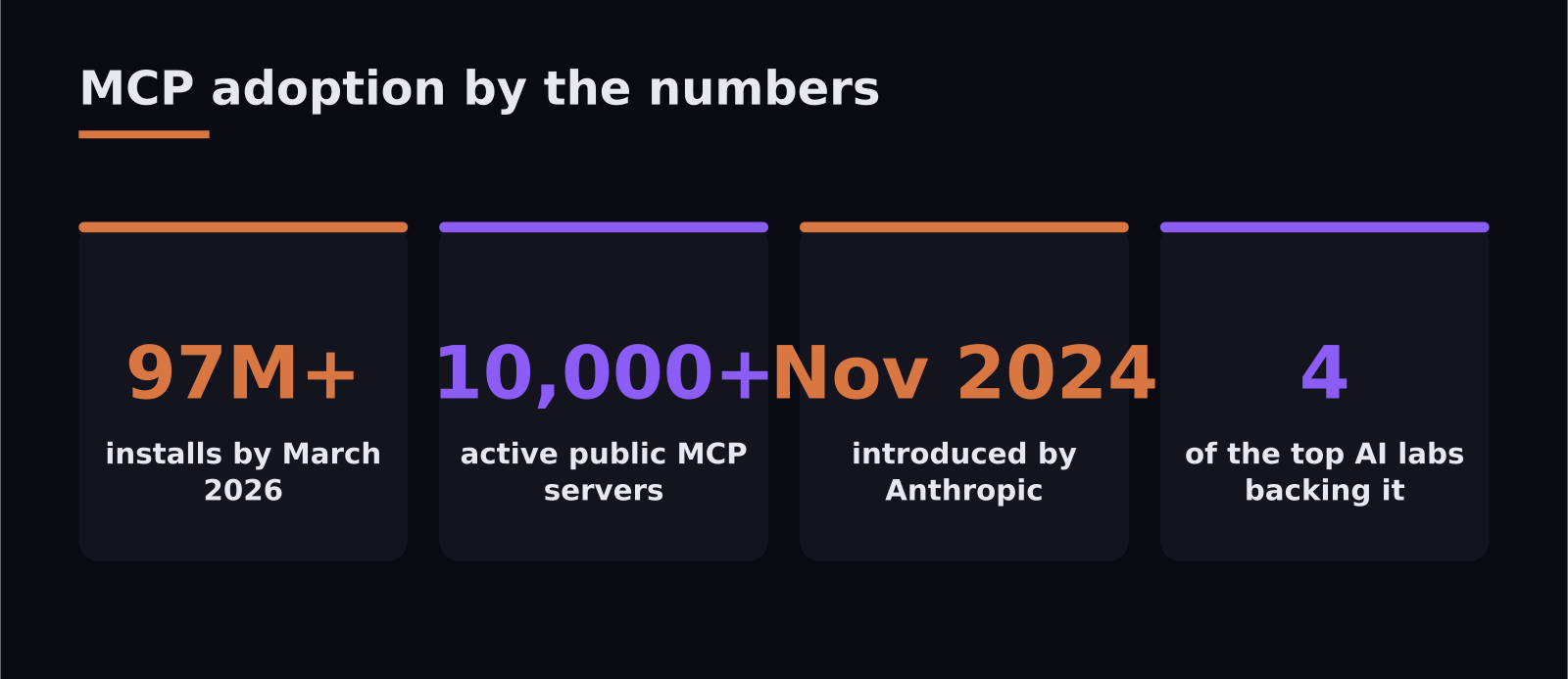
- Anthropic introduced it in November 2024; it crossed 97 million installs by March 2026 — the fastest adoption of any AI infrastructure standard.
- It is now supported by ChatGPT, Cursor, Gemini, Microsoft Copilot, and VS Code, with more than 10,000 active public MCP servers.
- In December 2025 Anthropic donated MCP to the Linux Foundation's Agentic AI Foundation, co-founded with OpenAI and Block — making it a neutral, shared standard.
- For businesses, MCP means AI assistants can safely act inside your real tools, not just chat about them.
What problem does MCP actually solve?
Before MCP, connecting an AI model to an outside tool was a custom job every single time. If you wanted ChatGPT to read your Google Drive, someone built a bespoke integration. If you wanted a different assistant to do the same thing, you built it again. Multiply that by every model and every tool and you get what engineers called the "M times N" problem — an explosion of one-off connectors that nobody could maintain.
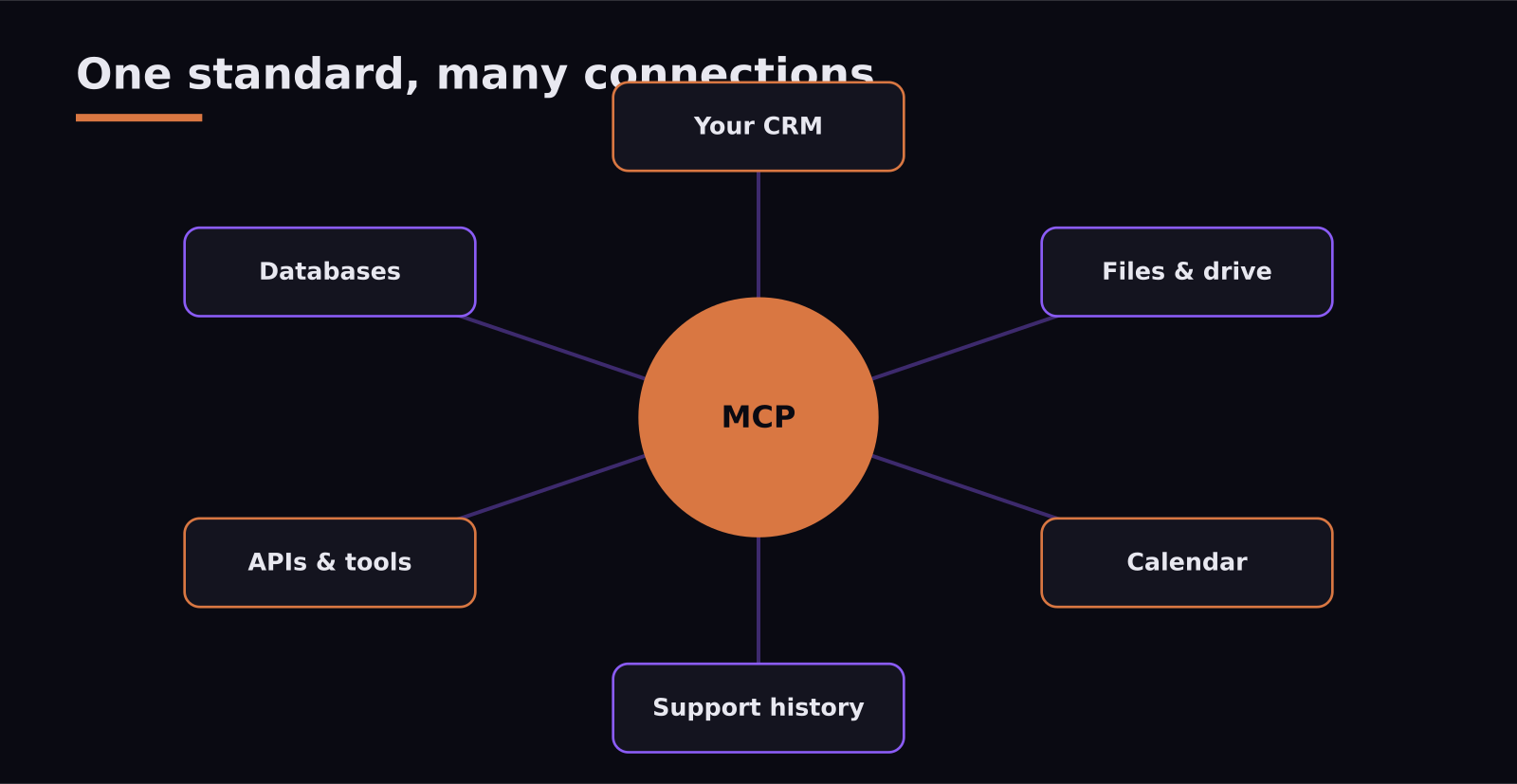
MCP collapses that into "M plus N." A tool exposes itself once as an MCP server, an AI assistant speaks MCP as a client, and the two just work together. The protocol standardizes the boring-but-essential parts: how the model discovers what a tool can do, how it reads a file, how it executes a function, and how context flows back and forth. That is exactly the kind of unglamorous standardization that, once it exists, everyone wonders how they lived without — the same way USB-C replaced a drawer full of chargers.
Why did it spread so fast?
Adoption has been genuinely extraordinary. MCP went from a developer experiment in late 2024 to roughly 97 million installs by March 25, 2026 — about sixteen months. There are now over 10,000 active public MCP servers covering everything from indie developer tools to Fortune 500 deployments.
Two things drove that. First, it solved a real, painful problem at exactly the moment AI assistants were becoming capable enough to need it. Second, the big players lined up behind it instead of fighting it. OpenAI adopted MCP across its products including the ChatGPT desktop app in March 2025, and Google DeepMind followed. When your two largest competitors adopt your standard, it stops being your standard and becomes the standard.
The capstone came in December 2025, when Anthropic donated MCP to the Agentic AI Foundation, a fund under the Linux Foundation co-founded with OpenAI and Block. That move matters more than it sounds: it took MCP out of any one company's control and made it neutral infrastructure, the way HTTP or USB belong to no single vendor. Neutral governance is what convinces cautious enterprises to build on something.
What MCP means for your business
You do not need to write an MCP server to benefit from MCP. The practical effect is that the AI assistant your team already uses can increasingly act inside your real tools — pull a customer record from your CRM, draft a reply using your actual support history, update a task, summarize a document in your drive — instead of being a clever chatbot walled off from your data. That is the difference between an assistant that talks about work and one that does work.
If you build software, the strategic implication is sharper: exposing your product as an MCP server is becoming a distribution channel. When a user asks their assistant to do something your product handles, an MCP connection is what lets the assistant reach for you instead of a competitor. It is the agent-era version of having an app in the app store — and with 10,000+ servers already live, the land grab is underway.
The honest caveat is security. Giving an AI assistant a doorway into your tools means thinking carefully about permissions, what each server is allowed to touch, and how you audit what the assistant actually did. The standard provides the connection; sensible scoping and oversight are still your job. But the direction is unmistakable: MCP is becoming the way AI connects to the world, and understanding it now is how you stay ahead of it.
How MCP fits with AI agents and agentic commerce
MCP rarely travels alone. It is one of a small family of standards that together make autonomous agents practical. MCP handles tool discovery and access — how an agent finds out what it can do and then does it. Separate protocols handle other jobs: checkout standards let agents buy things, and machine payment protocols let them pay. Think of MCP as the part that lets an agent reach into your tools, and the commerce protocols as the part that lets it act on the outside world. An agent that can both touch your systems through MCP and transact through a payment protocol is the full picture of where this is heading. Understanding MCP is the entry point to understanding that whole stack.
What to do about MCP this quarter
For most business owners the right move is awareness plus one small experiment. Find out whether the AI assistant your team already pays for supports MCP connections, and if it does, connect it to one low-risk tool — a shared drive folder, a read-only view of a project tracker — and see what your team can do when the assistant can actually reach your data. That single experiment teaches more than any article. If you build software, put "expose an MCP server" on your roadmap discussion, even if it does not make this quarter's cut, because being reachable by assistants is shaping up to be a real channel. The goal is not to overhaul anything today; it is to stop treating AI as a separate window and start treating it as something that plugs into the tools you already run.
Frequently asked questions
Is MCP free and open source?
Yes. MCP is an open standard and open-source framework. As of December 2025 it is governed by the Agentic AI Foundation under the Linux Foundation, so no single company owns or controls it.
Do I need to be a developer to use MCP?
No. If you use an AI assistant like ChatGPT, Claude, Gemini, or Microsoft Copilot, you may already be benefiting from MCP connections behind the scenes. Building your own MCP server requires development work, but using MCP-enabled tools does not.
How is MCP different from a normal API?
A regular API is a custom connection you integrate one model and one tool at a time. MCP is a shared standard, so any MCP-aware AI assistant can use any MCP server without custom work — turning many one-off integrations into one common language.
SaaS Master
Creator behind SaaS Master — tutorials, walkthroughs, reviews, and explainers that help SaaS, AI, and WordPress products get understood and chosen. Writing here about the tools, trends, and tactics that actually move the needle. Work with me →
Want your product explained this clearly — in video?
Tutorials, walkthroughs, reviews, and shorts for SaaS, AI, and WordPress products.
Work With SaaS Master