AI & SaaS
Anthropic Files for IPO at $965 Billion: What the AI Race Looks Like Right Now
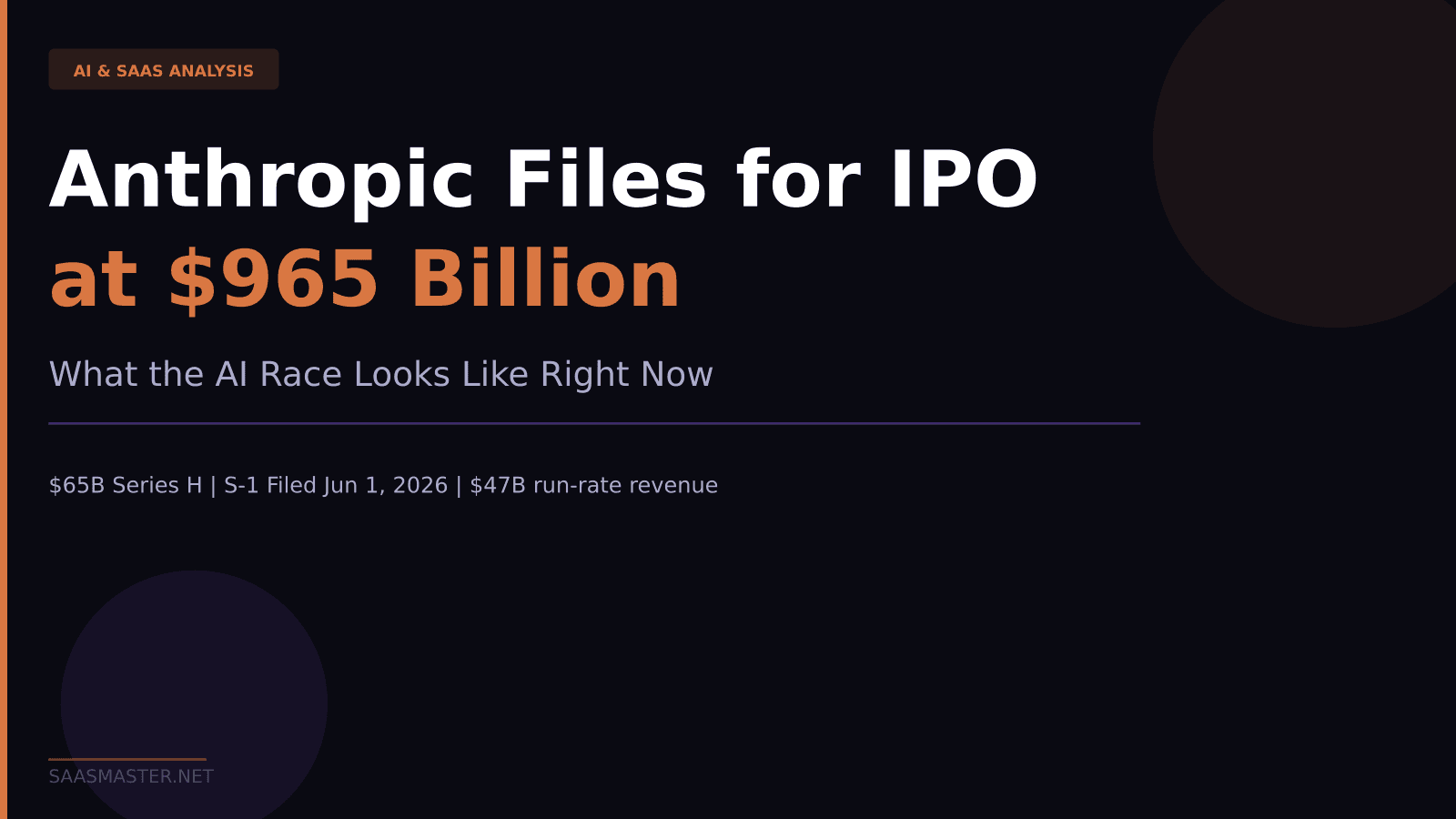
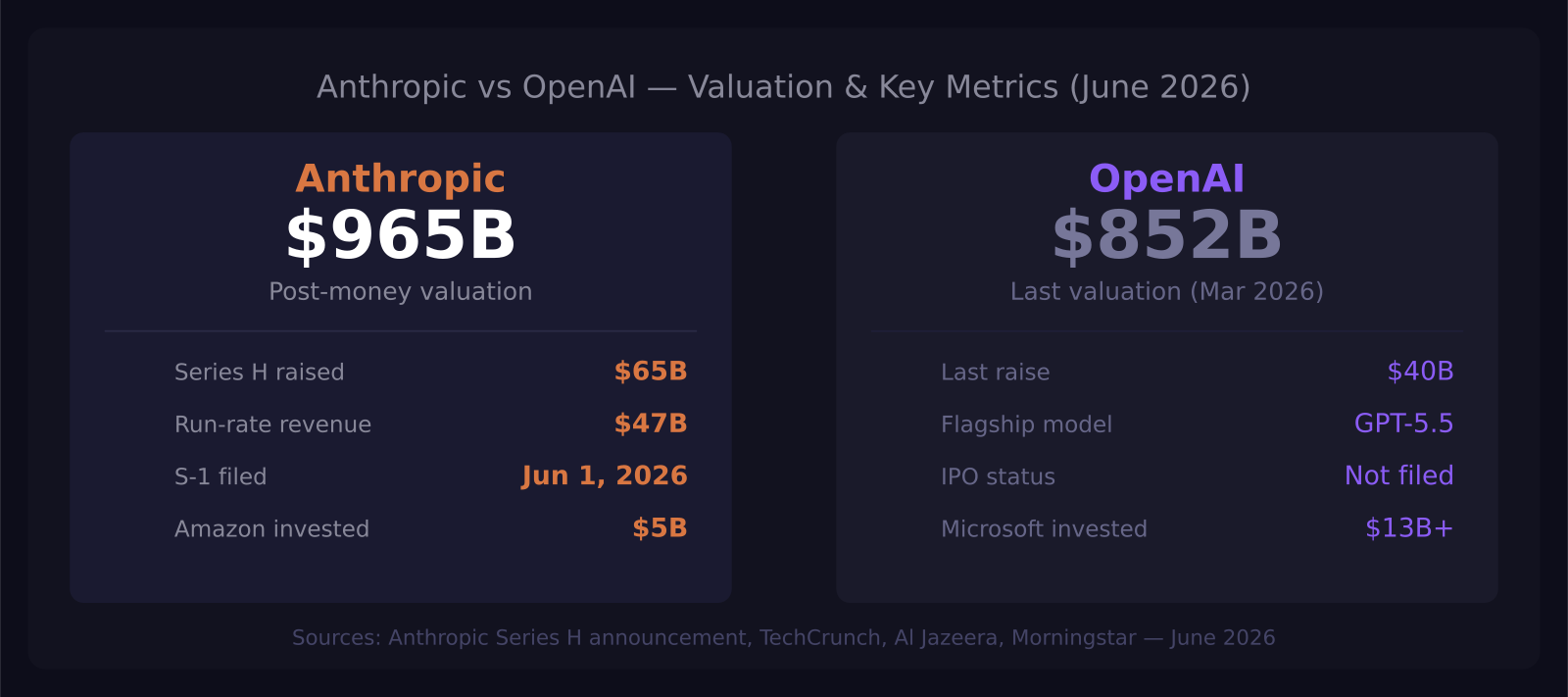
Anthropic raised $65 billion in a Series H round on May 28, 2026 at a $965 billion post-money valuation, filed its S-1 registration statement with the SEC on June 1, 2026, and is now worth more on paper than OpenAI, which was last valued at $852 billion in March. That is the fastest valuation leap by any AI company in history — and it happened in less than a year. Here is what that number actually means and what it signals about where the AI market is heading.
Key takeaways: - Anthropic's $965B valuation overtook OpenAI ($852B) making it the most valuable AI startup in the world as of June 2026 - The company's run-rate revenue crossed $47 billion, suggesting real enterprise demand rather than hype-driven valuation - The Series H was led by Altimeter Capital, Dragoneer, Greenoaks, and Sequoia, with $5 billion from Amazon as a strategic investor - Anthropic confidentially filed its S-1 on June 1, 2026 — this Series H is expected to be its last private fundraise before an IPO - Claude Opus 4.8 launched the same day as the funding announcement, setting new benchmarks on coding and mathematics
How did Anthropic get to $965 billion?
Twelve months ago Anthropic was valued at roughly $61 billion in its Series G. The leap to $965 billion in one cycle is not the result of a single breakthrough moment — it is the accumulation of several things landing at the same time.
First, Claude became the preferred model for enterprise software development. The pattern repeated across SaaS companies: teams adopted Claude for coding workflows, liked the results, and expanded usage. Run-rate revenue crossing $47 billion confirms this is not trial-stage adoption — these are committed, scaling contracts.
Second, the Claude API became deeply embedded in infrastructure. When a model powers the coding tools, the support automation, and the document processing for thousands of companies, switching has a real cost. Anthropic built the kind of stickiness that justifies paying a premium at IPO.
Third, Claude Opus 4.8 was released on the same day as the funding announcement — a deliberate signal. The model scored 88.6% on SWE-bench Verified, 96.7% on USAMO 2026 math (a 27-point jump from the previous version), and 84% on Online-Mind2Web for browser agents. Investors were not just valuing what Anthropic had built — they were valuing what the next 18 months looked like on the current trajectory.
Why did Anthropic overtake OpenAI in valuation?
OpenAI was last valued at $852 billion in March 2026 — a $113 billion gap below Anthropic's current number. That does not mean OpenAI is losing technically. GPT-5.5, released April 24, 2026, ranks second on the global coding benchmark index and leads on broad agentic professional workflows. OpenAI's ChatGPT user base dwarfs anything Anthropic has at the consumer level.
The valuation gap reflects where enterprise money is flowing. Investors in the Series H are betting that the API-first, safety-focused, enterprise-native approach to AI infrastructure will capture more of the commercial value in the next phase of deployment. Claude's reputation for instruction-following accuracy, lower hallucination rates in production, and consistent performance on professional benchmarks has made it the default choice for many teams building AI products.
There is also the IPO angle. Anthropic filing an S-1 while OpenAI has not created a timing incentive for late-stage investors who want to get in before a public debut at a potentially even higher valuation.
What does the $47 billion run rate mean?
Most AI companies at this funding stage have strong growth but thin revenue relative to valuation. Anthropic's $47 billion run-rate revenue is exceptional context. At a $965 billion valuation, the price-to-revenue multiple is roughly 20x. That is high by traditional software standards, but not unusual for a company growing as fast as Anthropic with the embedded infrastructure position it has built.
The more interesting number is the revenue growth rate. In February 2026 at the Series G, the run-rate was substantially lower. Getting to $47 billion in roughly 90 days implies adoption is accelerating, not plateauing — which is the story investors needed to write a $65 billion check.
What does this mean for the AI market in 2026?
The Anthropic funding round is a signal that the foundation model market is concentrating. Getting to $47 billion in run-rate revenue requires enterprise sales cycles, contract renewals, and platform integrations that take time to build. There are not many companies that can reach that scale in this category — and the ones that cannot are increasingly likely to specialize into narrow verticals rather than compete head-on with frontier model providers.
For SaaS builders, the practical implication is simpler: the API pricing and model quality from Anthropic, OpenAI, and Google are converging in capability while diverging in price. Claude Opus 4.8 at $5 per million input tokens, GPT-5.5 at $5 per million input, and Grok 4.3 at $1.25 per million input represent a market where you have multiple serious choices at the frontier. The funding rounds and valuations are investor scorecards — the API pricing and benchmark scores are what actually matter for what you build.
What happens next?
The S-1 filing means Anthropic is preparing for a public offering, likely in late 2026 or early 2027. An IPO at or near the current $965 billion valuation would make it one of the largest technology IPOs on record. The investor roster — Altimeter, Dragoneer, Greenoaks, Sequoia, Amazon, Micron, Samsung, and SK hynix — includes names that have navigated large technology IPOs before and have specific incentives to see one happen.
For the AI field broadly, a successful Anthropic IPO at this valuation sets a public market benchmark for what investors think frontier AI infrastructure is worth. That benchmark will shape how OpenAI, Google DeepMind, and the next tier of model companies are valued in the years that follow.
For Claude users and enterprise customers, the IPO path creates both continuity and incentive for Anthropic to maintain the safety, reliability, and API stability that drove enterprise adoption in the first place. Companies do not file S-1s and then break the product that got them there.
Frequently asked questions
Did Anthropic actually surpass OpenAI in value?
By post-money valuation, yes. Anthropic's Series H set its valuation at $965 billion. OpenAI's last disclosed valuation was $852 billion in March 2026. Valuation is not the same as revenue or market share, but it reflects what sophisticated investors are willing to pay for the equity today.
When might Anthropic's IPO happen?
Anthropic filed its S-1 confidentially on June 1, 2026, which typically precedes a public offering by roughly 6 to 12 months, subject to market conditions. A late 2026 or early 2027 IPO is the most commonly cited timeframe, though no public date has been announced.
How does this affect Claude API pricing?
There is no indication that the IPO process will change API pricing. Anthropic has maintained consistent Claude pricing through multiple funding rounds. The competitive pressure from Grok 4.3 at $1.25 per million input tokens provides a strong market incentive to keep pricing competitive regardless of what happens on the public markets.
Was this article helpful?
SaaS Master
Creator behind SaaS Master — tutorials, walkthroughs, reviews, and explainers that help SaaS, AI, and WordPress products get understood and chosen. Writing here about the tools, trends, and tactics that actually move the needle. Work with me →
Want your product explained this clearly — in video?
Tutorials, walkthroughs, reviews, and shorts for SaaS, AI, and WordPress products.
Work With SaaS Master