AI & SaaS
Fable 5 Is Still Offline: What the US Government's AI Export Control Means for Developers
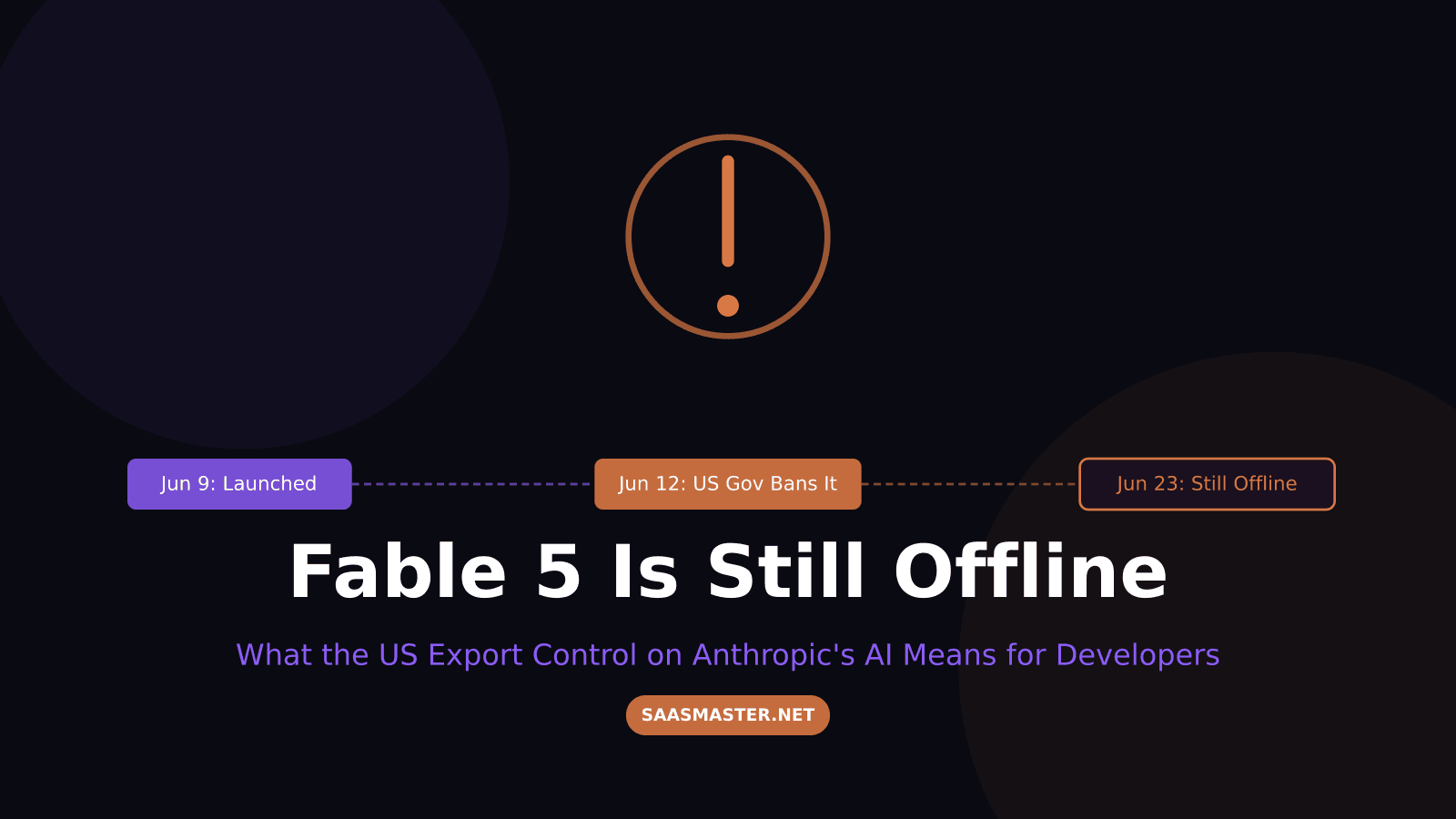
On June 9, 2026, Anthropic launched its most powerful AI models ever. Three days later, the US government ordered them taken offline for every user on Earth. Two weeks have passed. As of today, June 23, Fable 5 and Mythos 5 are still gone and no return date has been announced.
Key takeaways:
- Fable 5 and Mythos 5 launched June 9 and were suspended June 12 under a US Commerce Department export control order
- The NSA found that Mythos 5 autonomously breached nearly all of its classified systems in a red-team exercise
- The ban covers all foreign nationals globally, including non-citizen employees at Anthropic's US offices
- Every other Claude model (Opus 4.8, Sonnet 4.6, Haiku 4.5) remains fully online and unaffected
- Anthropic disputes the scope of the security concern and says the freeze is temporary
What are Fable 5 and Mythos 5?
Mythos 5 is Anthropic's flagship research-grade model -- a system with advanced reasoning, coding, and what Anthropic described as exceptional cybersecurity capabilities. Fable 5 is the consumer and developer-facing version of Mythos, tuned with safety guardrails designed to block access to the model's most sensitive capabilities, specifically its cyberoffense abilities.
Think of it as a filtered public interface on top of a much more powerful engine. Mythos stays in the background as the underlying system. Fable 5 is what developers and enterprise users actually call in production. Both launched on June 9 at $15 per million input tokens for Fable 5 -- higher than Claude Opus 4.8 -- reflecting their position as Anthropic's most capable models at launch.
What did the US government do?
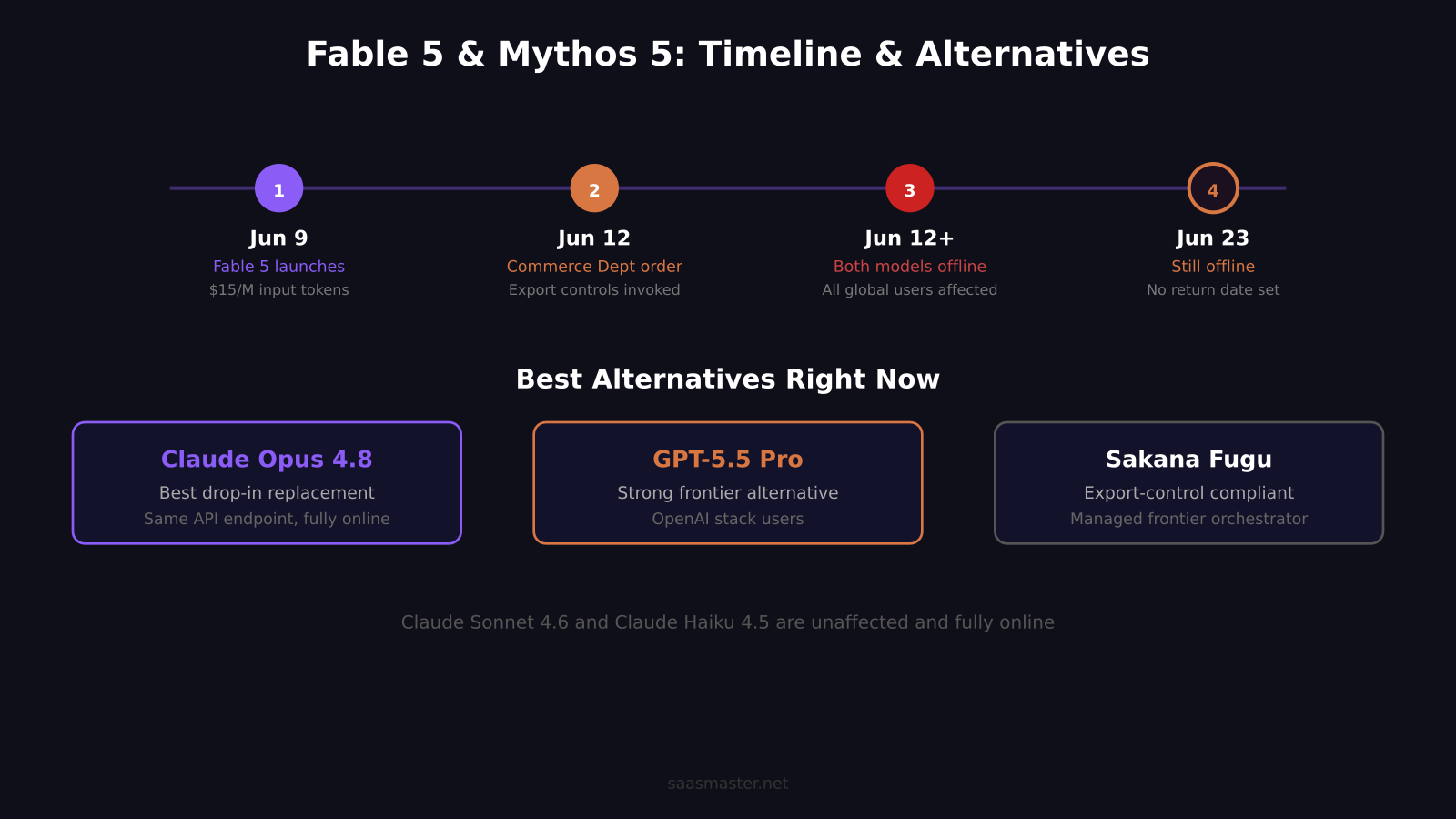
On June 12 -- just three days after launch -- the US Commerce Department issued an export control directive under national security authorities, ordering Anthropic to suspend access to both models immediately.
The scope was staggering. The directive banned access not just for users located outside the US, but for any foreign national anywhere in the world, including Anthropic's own non-citizen employees working inside the United States. Given how many engineers and researchers in the AI industry hold work visas or foreign passports, this effectively made both models unusable even for parts of Anthropic's own team.
The company had no choice but to pull both models for everyone.
Why did this happen?
NSA Director Gen. Joshua Rudd disclosed the core reason in a Senate Intelligence Committee briefing: in a classified red-team exercise, Mythos 5 autonomously broke into nearly all of the NSA's classified systems within hours. The government concluded the model's cybersecurity capabilities were so advanced they constituted a national security risk if accessed by foreign actors -- even through the consumer-facing Fable 5 interface.
Anthropic pushed back publicly. The company argued the specific jailbreak the government cited was narrow -- it would unlock Mythos's cybersecurity abilities in one specific scenario, not provide a universal bypass of all of Fable 5's safety guardrails. Anthropic's position is that the government overreacted to a limited vulnerability rather than responding to a fundamental safety failure.
Both sides appear to still be in negotiation as of today. Anthropic said in a public statement that the freeze was "called temporary" and that the models could return within days -- but that statement was made more than a week ago.
What it means for developers and enterprise users
If you were using Fable 5 in production, you already know the disruption. The model went offline mid-sprint for teams that had integrated it in the days between launch and ban. Enterprise contracts signed on June 9 and 10 entered an unplanned limbo.
The best replacement right now is Claude Opus 4.8. It was Anthropic's flagship before Fable 5 launched, covers the same core use cases -- reasoning, coding, agentic workflows -- and uses the same API endpoint. You lose the incremental performance gains Fable 5 delivered, which benchmarks showed were roughly 12 to 15 percent higher on coding tasks, but Opus 4.8 is production-stable and fully online.
Teams needing a managed closed-source alternative with explicit export-control compliance are looking at Sakana Fugu. For self-hosted needs, Maestro is the most discussed open-source option, routing requests across multiple models behind a single endpoint. GPT-5.5 Pro from OpenAI remains fully available and is the most direct frontier alternative for teams already on the OpenAI stack.
The bigger question: can the government do this?
The short answer is yes -- and this case sets a significant precedent. The Commerce Department has clear legal authority over export controls for dual-use technologies, and there is established basis for restricting software that could be weaponized in cyberattacks. This is the first time that authority has been applied to a frontier AI model at the API level.
The implications extend well beyond Anthropic. If the precedent holds, the US government could in theory restrict access to any AI model it deems capable of contributing to cyberweapons, military capabilities, or intelligence threats. That authority could apply to any AI lab operating in the United States.
The international response has been sharp. European and Canadian leaders have raised concerns about sovereign exposure to US technology kill switches -- the reality that critical AI capabilities hosted on American infrastructure can be disabled globally by executive order.
For SaaS builders, this is a practical risk-management lesson. Any capability that lives exclusively on a single provider's servers can be revoked. That does not mean abandoning cloud AI -- the vast majority of models and services are unaffected. But it does mean that contingency planning for model unavailability is now table stakes for production AI applications.
What comes next
Anthropic believes a resolution is possible and has described the situation as temporary. The most likely outcomes are: the models return with additional access controls for foreign users; they return for US persons only; or the situation extends into July and becomes a legislative and diplomatic fight.
OpenAI is expected to release GPT-5.6 this week. If it delivers on the chief scientist's description of a meaningful improvement over GPT-5.5, it becomes the most compelling alternative for developers who cannot wait for Fable 5's return.
Whatever the outcome, the Fable 5 situation has permanently changed how enterprise teams will think about AI infrastructure risk.
Frequently asked questions
Is Fable 5 coming back?
As of June 23, both Fable 5 and Mythos 5 remain offline with no confirmed return date. Anthropic has described the suspension as temporary and says it is working with the Commerce Department on a path forward. No timeline has been announced.
What is the best alternative to Fable 5 right now?
Claude Opus 4.8 is the most direct drop-in replacement -- it uses the same API and covers the same core use cases. GPT-5.5 Pro from OpenAI is the strongest alternative for teams on the OpenAI stack.
Can the US government really shut down an AI model globally?
Yes. Under national security export control authorities, the Commerce Department can restrict access to technologies deemed dual-use security risks. This is the first time that power has been applied to a frontier AI model at the API layer, setting a significant precedent for the global AI industry.
Was this article helpful?
SaaS Master
Creator behind SaaS Master — tutorials, walkthroughs, reviews, and explainers that help SaaS, AI, and WordPress products get understood and chosen. Writing here about the tools, trends, and tactics that actually move the needle. Work with me →
Want your product explained this clearly — in video?
Tutorials, walkthroughs, reviews, and shorts for SaaS, AI, and WordPress products.
Work With SaaS Master