AI & SaaS
AI Agents Are Supabase's Biggest Customers Now -- What the $500M Raise Means for SaaS Builders
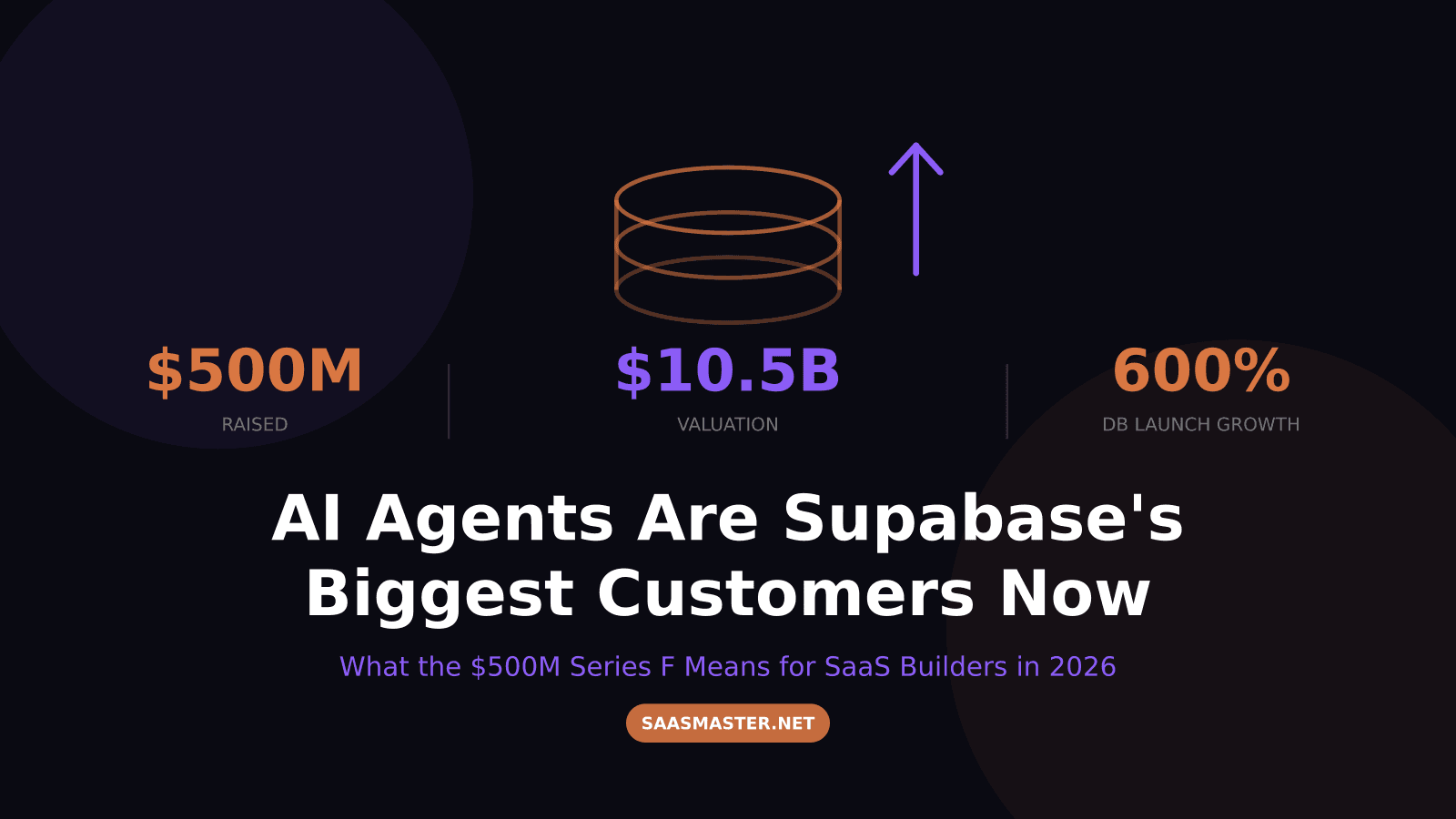
More than 60 percent of all new databases created on Supabase in 2026 are being launched by AI agents, not human developers. That single number explains everything about why the company just raised $500 million at a $10.5 billion valuation -- and why it matters to anyone building SaaS products today.
Key takeaways:
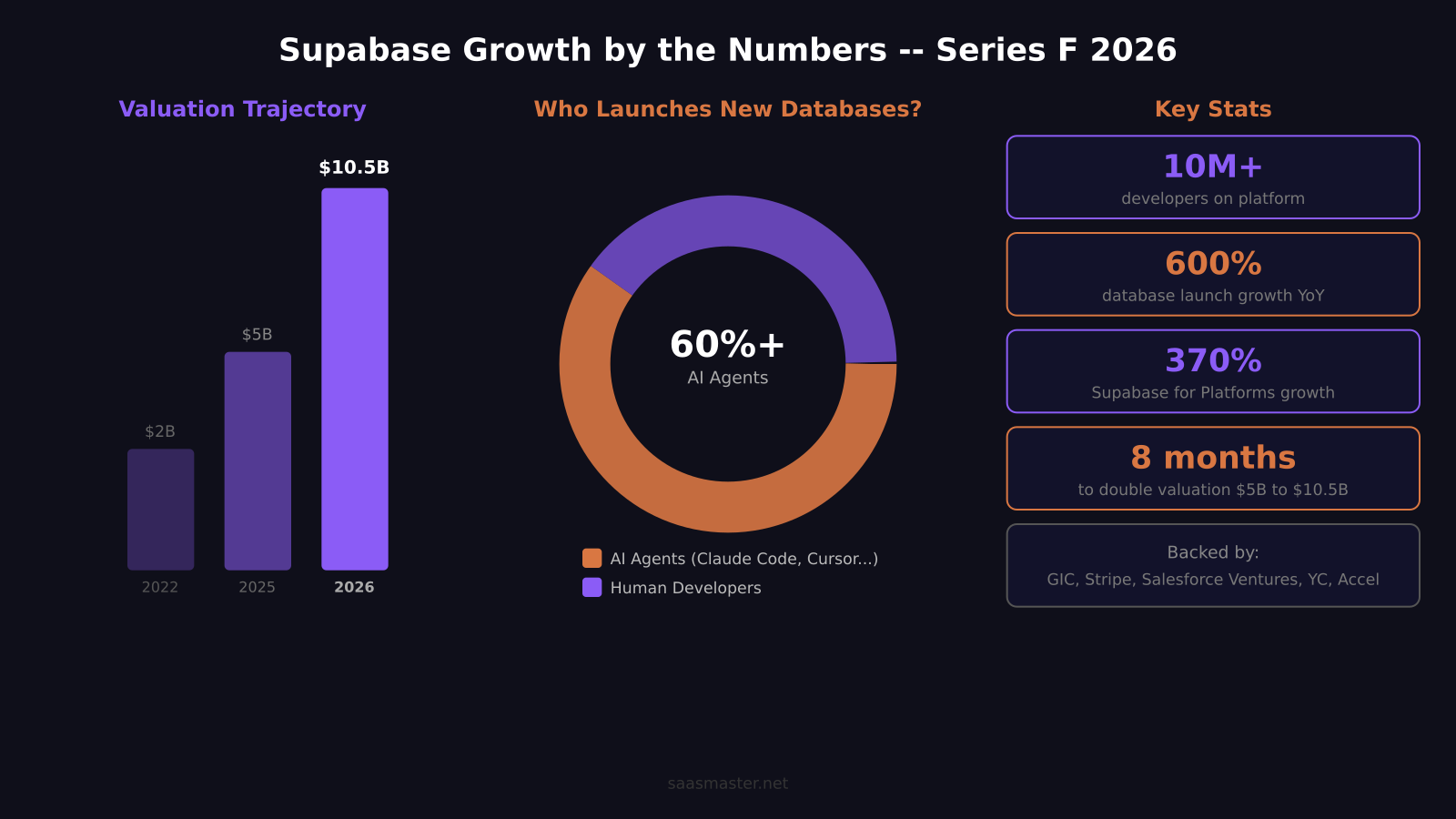
- Supabase raised $500M Series F led by GIC at a $10.5B valuation, doubling its worth in under 8 months
- AI agents -- led by Anthropic's Claude Code -- are now the single largest source of new database deployments on Supabase
- Database launches on the platform surged 600% year-over-year as AI coding tools took off
- New investors Stripe and Salesforce Ventures joined the round alongside GIC, Accel, and Y Combinator
- Supabase shipped Multigres, an open-source horizontal Postgres scaling layer, to handle agent-driven database volume
What happened
On June 4, 2026, Supabase announced a $500 million Series F led by GIC -- Singapore's sovereign wealth fund -- with participation from Accel, Y Combinator, Craft, Felicis, Peak XV, and Coatue. New investors Stripe and Salesforce Ventures also joined the round.
The post-money valuation landed at $10.5 billion, up from roughly $5 billion just eight months earlier. That is a double in under a year for a company built on open-source technology and Postgres, a database engine that has been around for 35 years.
The company now has nearly 10 million developers building on its platform. But the fastest-growing segment of those builders is not human.
Why AI agents changed the math
When AI coding tools like Claude Code, Cursor, and similar agentic platforms help people build applications, they need a backend. They need a database, an authentication system, file storage, and an API layer. And they need it to be something that can be provisioned and configured programmatically -- without a human clicking through a setup wizard.
Supabase fits that requirement almost perfectly. Its Postgres-based architecture, auth layer, storage, and edge functions are all controllable through well-documented API calls and patterns that AI agents can learn, reproduce, and debug reliably. When Claude Code generates a full-stack app, it frequently selects Supabase as the backend without being explicitly instructed to.
The numbers Supabase released with the Series F make this concrete: database launches surged more than 600% year-over-year. Anthropic's Claude Code was identified as the single largest contributor to new database deployments on the platform since the start of 2026. Supabase for Platforms, the product version designed for AI app builders, saw 370% customer growth in just six months.
What is vibe coding and why does it matter here?
Vibe coding is the informal name for a development pattern that took off in 2026: a person describes what they want to build in plain language, an AI agent writes the code, provisions the infrastructure, and deploys the app. No manual DevOps, no database migrations by hand, no configuration files written from scratch.
When millions of people use Claude Code or Cursor to build apps -- including many who never thought of themselves as developers -- every tool choice the AI makes becomes a market-share decision. Supabase's growth is partly a reflection of Claude Code choosing Supabase, repeatedly, at scale, across millions of projects.
For SaaS companies, this creates a new distribution channel: being the tool that AI agents recommend and default to. That requires building infrastructure that is easy for AI to reason about, well-documented enough for generated code to work the first time, and stable enough that agents do not have to debug configuration failures.
What Multigres solves
When AI agents create thousands of databases per day, traditional single-instance Postgres deployments hit limits quickly. A single Postgres instance scales vertically to a point, then requires horizontal sharding -- splitting data across multiple instances -- which has historically needed significant engineering investment.
Multigres is Supabase's open-source answer, released under the Apache 2.0 license. It provides sharding, zero-downtime migrations, and high availability for Postgres at scale. It is designed specifically for the scenario where an AI-driven platform is spinning up and tearing down databases at a rate no human operations team planned for.
For SaaS builders running multi-tenant applications, Multigres is worth watching. It keeps teams on Postgres -- avoiding the cost and risk of migrating to a different database -- while handling the kind of database-per-tenant architecture that AI-native products increasingly require.
What this means if you are building on Supabase
The $500M raise, with Stripe and Salesforce Ventures on the cap table, is a strong signal that Supabase is not going anywhere. For teams that have wondered about the risk of building on an open-source infrastructure provider, this round removes most of that concern.
The product roadmap will also accelerate. The Series F announcement included expanded tooling for AI agent integrations, better support for real-time data and streaming APIs, and continued investment in the MCP adapter that lets tools like Claude Desktop manage Supabase databases directly through natural language.
If you are choosing a backend for a new SaaS or AI product today, Supabase's free tier and developer experience make it the most practical starting point. The fact that leading AI coding tools default to Supabase creates a shared ecosystem of patterns and knowledge that makes building faster.
What it means for the broader SaaS infrastructure market
The Supabase raise is part of a larger pattern. In the same week, Ramp raised $750 million at a $44 billion valuation and AlphaSense raised $350 million. What connects these companies is that AI is either a core capability or the primary growth engine.
The investor thesis is becoming clear: AI is not just automating individual tasks. It is changing who the customers of software platforms are. In Supabase's case, the customer is increasingly an AI agent, not a human developer sitting at a keyboard.
That logic -- software built for AI users, not just human users -- is likely to define the next major wave of infrastructure investment. For SaaS builders watching this space, the question is not whether to use AI-friendly infrastructure. It is how quickly to orient your product and backend choices around the assumption that agents will be significant users of your platform.
Frequently asked questions
Is Supabase still free to use?
Yes. The free tier remains available. The $500M raise accelerates Supabase's enterprise product and infrastructure work, but the core open-source project and free tier are unchanged.
What is Multigres and do I need it?
Multigres is an open-source horizontal scaling layer for Postgres released under Apache 2.0. Most developers will not need it immediately -- it is designed for platforms spinning up thousands of databases. It is worth tracking for multi-tenant SaaS products planning to scale aggressively.
Why is Claude Code driving so much Supabase growth?
Claude Code defaults to Supabase when building full-stack applications because its Postgres-based architecture, auth, storage, and edge functions are well-documented and predictable for AI-generated code. As Claude Code usage grew sharply in 2026, it created a large secondary demand signal for Supabase across millions of projects.
Was this article helpful?
SaaS Master
Creator behind SaaS Master — tutorials, walkthroughs, reviews, and explainers that help SaaS, AI, and WordPress products get understood and chosen. Writing here about the tools, trends, and tactics that actually move the needle. Work with me →
Want your product explained this clearly — in video?
Tutorials, walkthroughs, reviews, and shorts for SaaS, AI, and WordPress products.
Work With SaaS Master