AI & SaaS
Apple Intelligence WWDC 2026: What SaaS Teams and Creators Need to Know
Apple spent WWDC 2026 doing something more significant than announcing new features: it turned Apple Intelligence from a single-model system into a hybrid AI platform that works with Claude, Gemini, and Apple's own models through a single Swift API. For SaaS teams building on iOS and macOS, and for video creators working on Apple hardware, the announcements change what is possible — and what is expected — from native app AI.
Key takeaways
- The Foundation Models framework now supports Claude, Gemini, and Apple's on-device model through a unified LanguageModel protocol in Swift
- A new on-device model has been rebuilt with stronger logic, tool calling, and Vision capabilities for on-device image reasoning without cloud round-trips
- Private Cloud Compute now has a 32,000 token context window and a reasoning mode — accessed through PrivateCloudComputeLanguageModel
- Developers with fewer than 2 million App Store downloads access Private Cloud Compute at no API cost under the App Store Small Business Program
- Siri gained persistent memory, cross-app task execution, and an expanded Actions API for third-party apps
What Apple actually announced for developers at WWDC 2026
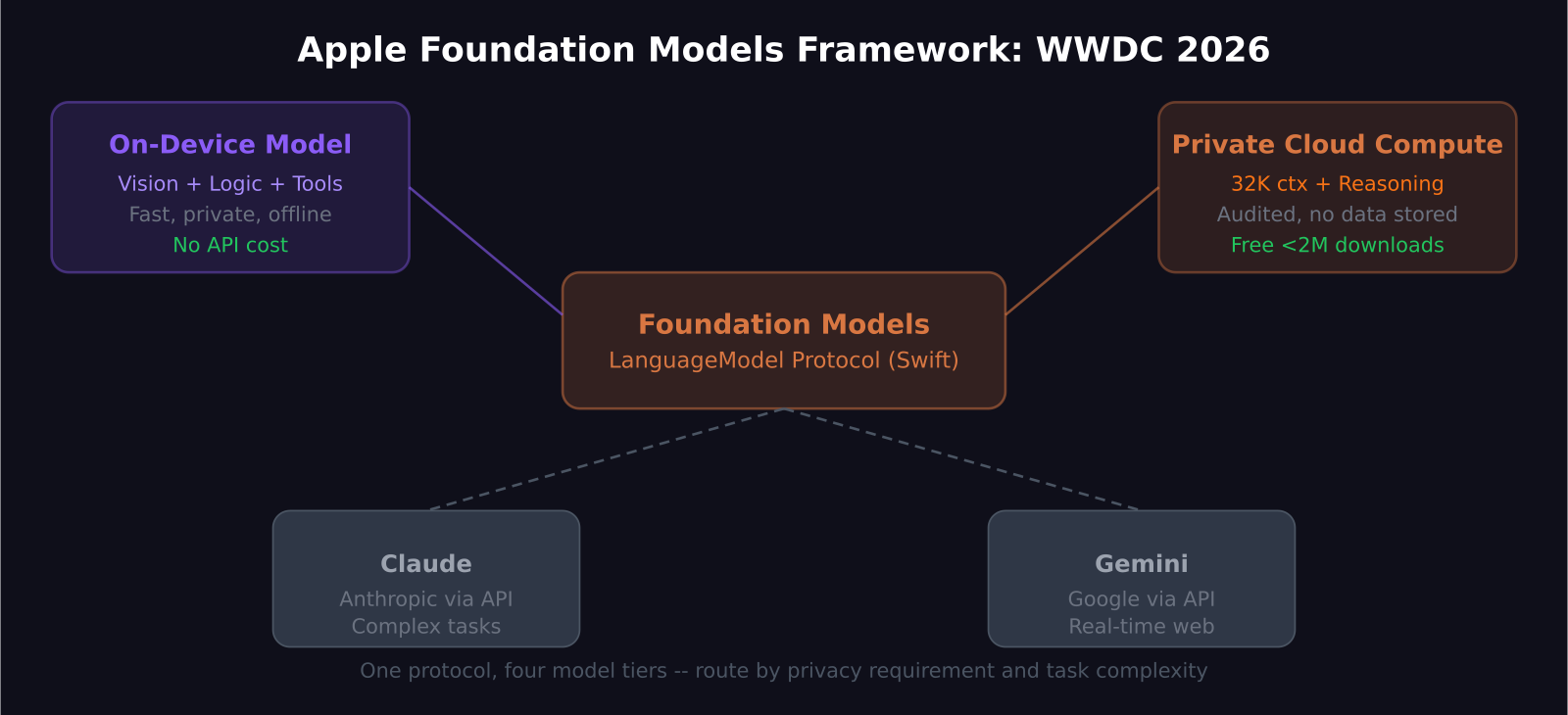
Apple's keynote positioned Apple Intelligence as a privacy-first platform, but the developer sessions told the more important story. The Foundation Models framework — previously a narrow on-device inference API — is now a hybrid platform. Developers choose between on-device processing, private cloud compute, or cloud models including Claude and Gemini, all through the same Swift interface. The LanguageModel protocol is the abstraction layer: write once, route anywhere.
The practical effect for SaaS teams building iOS or macOS companion apps is that you no longer need to integrate multiple SDKs for different AI providers. One API call, one protocol, and you route tasks to whichever model fits — on-device for low-latency privacy-sensitive work, Apple's cloud for complex reasoning, external models for tasks that genuinely need them.
What is new in the on-device model?
Apple rebuilt its on-device model from the ground up for WWDC 2026, with improvements in three areas: logic reasoning, tool calling, and Vision.
The Vision upgrade is the most immediately useful for SaaS and creator applications. Multimodal prompts now let developers pass images alongside text so the model can reason about visual content — OCR, barcode reading, UI element recognition — all on-device with no network request. For apps that handle documents, receipts, screenshots, or product interfaces, this is a meaningful capability that previously required a cloud call.
The improved tool calling means the on-device model can invoke functions and APIs more reliably, which is the foundation of agentic behavior in mobile apps. Apple is positioning the on-device model as a capable local agent, not just a text-completion endpoint.
Dynamic Profiles let developers swap models, tools, and instructions on the fly within a continuous session. A single app session could start with on-device processing for a quick query, escalate to Private Cloud Compute for something complex, and call Gemini for a task that requires real-time web context — all transparently from the same API.
Private Cloud Compute: what changed in 2026?
Private Cloud Compute has been meaningfully expanded. The model available through PrivateCloudComputeLanguageModel now has a 32,000 token context window — larger than Apple's on-device model — and adds a reasoning mode for multi-step inference. It is the same model powering Apple Intelligence features like Mail summary and Notification prioritization, now available to developers.
For developers on the App Store Small Business Program — those with fewer than 2 million total App Store downloads — access to Private Cloud Compute via the Foundation Models framework is free. For smaller SaaS teams building iOS apps, this means enterprise-class cloud inference at no incremental API cost up to that threshold.
Apple's Private Cloud Compute has been independently audited for its privacy architecture. The design ensures Apple cannot access data processed on it, and data is not retained after request completion. For SaaS products in regulated industries — healthcare, finance, legal — this is a meaningful argument for on-device and PCC over third-party cloud models.
Siri's new capabilities for professional and SaaS workflows
Siri at WWDC 2026 is meaningfully upgraded from prior versions. The key improvements for professional use:
Persistent memory means Siri retains context across sessions. Set your preferences once and they carry forward. For users relying on voice commands for workflow automation, this removes the constant need to re-establish context.
Cross-app task execution lets Siri take a single instruction — move documents from today's meeting into a project folder and send a summary to Slack — and execute it across multiple apps including third-party ones that implement the Actions API.
The expanded Actions API means third-party SaaS apps can register capabilities that Siri can invoke naturally. If you ship a project management app, your users could say a command to Siri to add a bug report to the current sprint in your app without ever opening it. For SaaS products competing in markets where workflow automation is a selling point, implementing the Actions API in your iOS app is now a real differentiator.
What this means if you are building on Apple platforms
Use the on-device model for anything privacy-sensitive, low-latency, or offline-capable. The new Vision capabilities open up document understanding, receipt processing, and UI analysis without API calls.
Use Private Cloud Compute for complex queries that exceed on-device capability but where privacy still matters. The 32K context and reasoning mode cover most professional use cases, and the free tier for small developers makes the decision straightforward.
Add Claude or Gemini through the LanguageModel protocol when you genuinely need capabilities beyond Apple's models — deep code generation, real-time web context, or documents that exceed 32K tokens.
For bootstrapped and early-stage SaaS teams on the App Store Small Business Program, the free PCC tier changes the calculus significantly: start with on-device and Private Cloud Compute, and add external models only for tasks that demonstrably require them.
Frequently asked questions
Can I use Claude or Gemini in my iOS app through Apple's API?
Yes. As of WWDC 2026, the Foundation Models framework's LanguageModel protocol supports Anthropic's Claude and Google's Gemini alongside Apple's own models. Billing for Claude or Gemini usage goes through their respective APIs — Apple provides the integration layer, not the model billing.
Is Apple Intelligence available on older iPhone models?
Apple Intelligence features require Apple Silicon — iPhone 15 Pro and later for on-device, and M-series chips for Mac and iPad. Older A-series devices route to Private Cloud Compute for supported features, with some functionality limited.
How does Private Cloud Compute protect user data?
Apple's Private Cloud Compute processes requests in an environment that Apple itself cannot access. Data is not retained after the request completes, and the security architecture has been published for independent review. Apple Developer documentation on Private Cloud Compute covers the technical privacy model in detail.
Was this article helpful?
SaaS Master
Creator behind SaaS Master — tutorials, walkthroughs, reviews, and explainers that help SaaS, AI, and WordPress products get understood and chosen. Writing here about the tools, trends, and tactics that actually move the needle. Work with me →
Want your product explained this clearly — in video?
Tutorials, walkthroughs, reviews, and shorts for SaaS, AI, and WordPress products.
Work With SaaS Master