AI Tools
Veo 3.1 vs Kling 3.0 vs Runway Gen-4.5: Best AI Video Generator for Creators in 2026
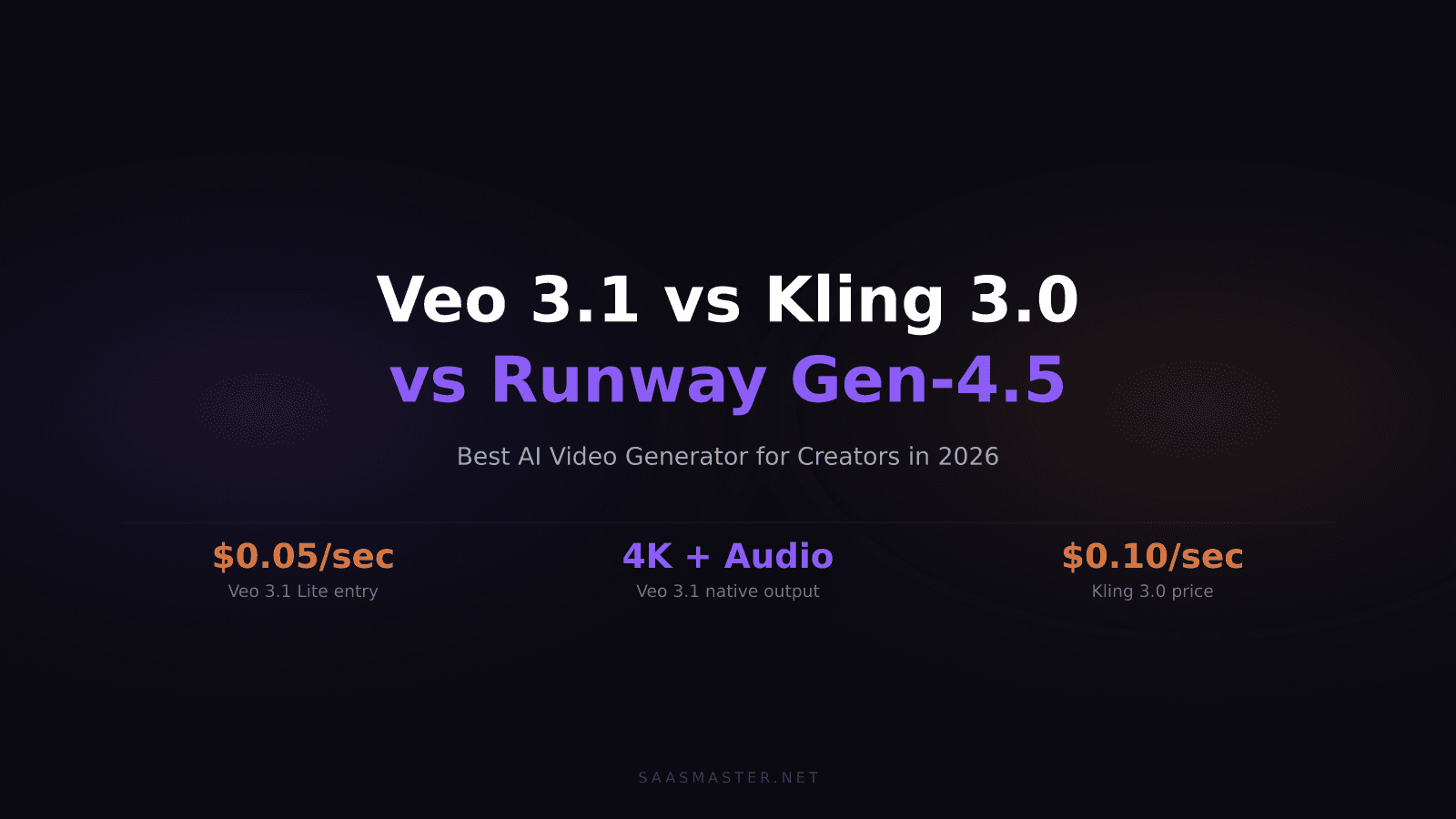
Choosing an AI video generator in June 2026 comes down to one question: do you need the best quality ceiling, the lowest cost, or the most precise creative control? Google's Veo 3.1 leads on all-around quality and native audio generation. Kling 3.0 from Kuaishou delivers comparable cinematic output at the lowest price per second of any premium model. Runway Gen-4.5 remains the professional's choice when you need frame-level directorial precision. All three are dramatically better than anything available a year ago.
One thing worth stating upfront: if your current workflow depends on Sora 2, start transitioning now. OpenAI shut down the Sora web app on April 26, 2026, and the API ends September 24, 2026.
Key takeaways
- Veo 3.1 generates up to 4K clips with natively synchronized audio — dialogue, sound effects, and ambience generated in the same pass as the video, from $0.05/sec (Lite) to $0.60/sec (4K Quality)
- Kling 3.0 prices at approximately $0.10 per second with multi-shot storyboard mode and character consistency across cuts
- Runway Gen-4.5 wins when creative control matters most: motion brush, reference-driven character consistency, precise camera moves
- Sora 2 is being discontinued — avoid building new workflows that depend on it
- For social media video at volume, Kling 3.0 is the most cost-effective premium option
What changed in AI video generation this year?
A year ago, AI video meant 4-second clips with inconsistent physics and no audio. The 2026 generation has solved most of those problems. Native audio — generated alongside the video, not added in post — is now standard in the top tier. Multi-shot character consistency is table stakes rather than a differentiator. What you are choosing between now is output ceiling, pricing model, and workflow integration.
Veo 3.1: The all-rounder with 4K and native audio
Google DeepMind's Veo 3.1 generates 8-second clips at up to 4K resolution with synchronized audio built in from generation. Dialogue, sound effects, and ambient soundscapes come in the same pass as the video — which saves significant post-production time compared to tools where audio is added separately.
Two features set Veo 3.1 apart. Scene extension lets you take an existing clip and extend it forward in time with maintained subject continuity — useful when your first generation landed the framing but felt too short. Narrative control editing lets you direct what happens at specific moments inside the clip: tell Veo when a character turns toward camera or when a product comes into focus.
Pricing runs in three tiers via the Gemini API. Veo 3.1 Lite (launched March 31, 2026) starts at $0.05 per second at 720p — less than half the cost of Veo 3.1 Fast, and the cheapest entry into the Veo ecosystem. Veo 3.1 Fast costs $0.10 to $0.40 per second depending on resolution and audio. The full-quality tier with 4K and audio runs $0.20 to $0.60 per second. Google AI Pro subscribers ($19.99/month) get 1,000 Flow credits monthly — enough for roughly 10 full-quality Veo 3.1 videos.
For SaaS teams already in the Google ecosystem, Veo 3.1 fits into existing infrastructure through the Gemini API, Vertex AI, or Google Flow without requiring new accounts or integrations.
Kling 3.0: Premium cinematic output at the lowest cost
Kling AI from Kuaishou has quietly become the cost benchmark for premium AI video in 2026. At approximately $0.10 per second, Kling 3.0 matches Veo 3.1 Fast on pricing while delivering cinematic quality that holds up in professional contexts.
Its core strengths are photorealistic human characters and complex motion — hair physics, liquid dynamics, fabric movement — all historically difficult for AI video generators. The multi-shot storyboard mode, introduced in version 3.0, lets you generate sequences of clips with character consistency and native audio synced across cuts. For social media content that needs to feel like a produced shoot rather than isolated clips, this is genuinely useful.
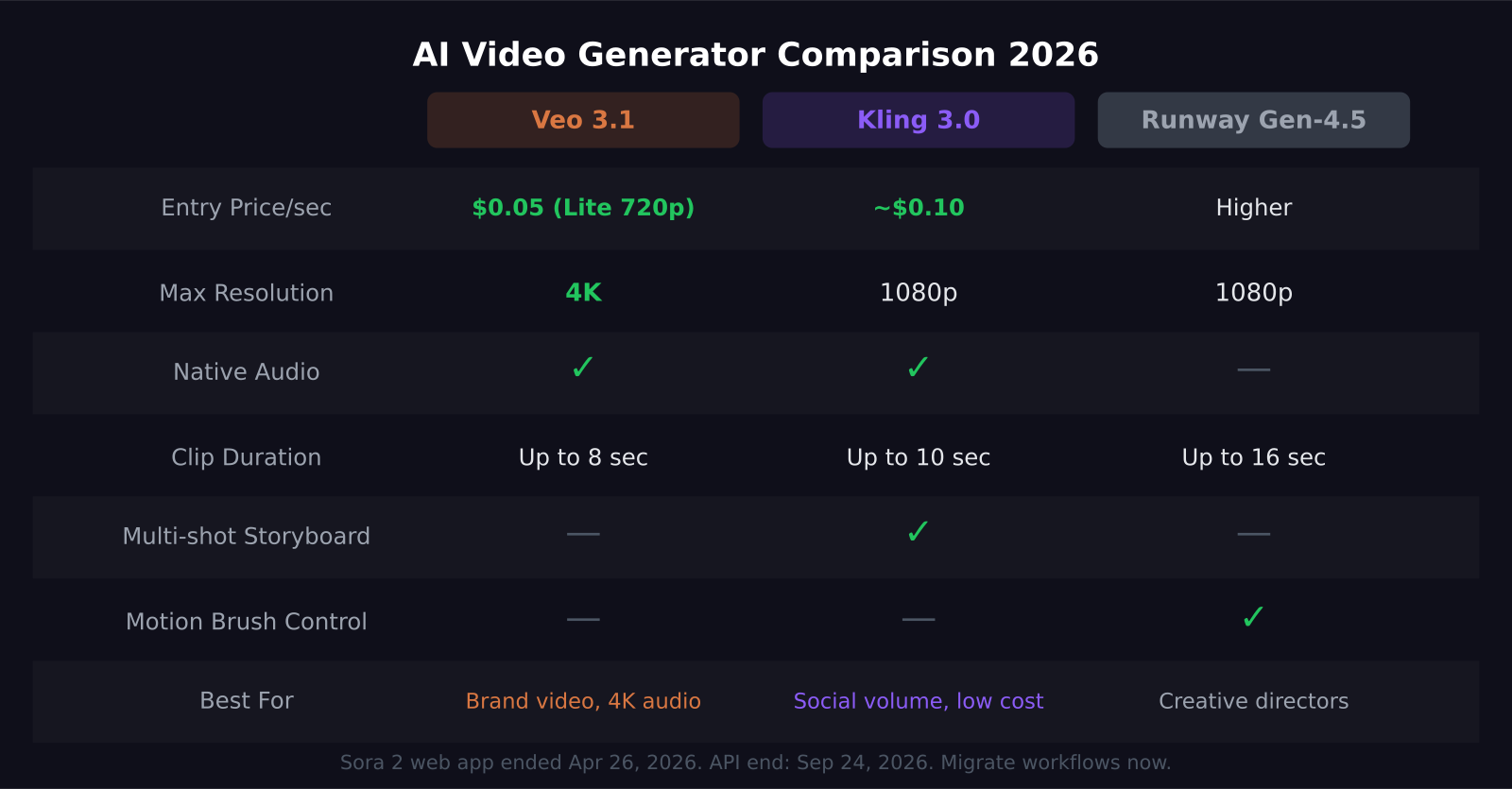
The tradeoff is creative control. Kling 3.0 makes good decisions for you. When you need to direct exactly where the camera moves or match a very specific reference look, it gives you fewer levers than Runway. For volume social media production — Instagram Reels, TikTok, YouTube Shorts — it is the most cost-effective premium option by a meaningful margin. At $0.10/sec, a 30-second video costs $3.00 in generation costs.
Runway Gen-4.5: For creators who want to direct, not just prompt
Runway Gen-4.5 occupies a different niche. It is not the cheapest or highest-resolution model on paper. It wins because it gives you more deliberate control over the output than any other tool in this comparison.
Motion brush lets you paint directional movement onto specific regions of an image, specifying exactly what moves and how. Reference-driven character consistency means you can feed Runway a reference image and it will keep that character looking the same across clips — critical for multi-clip sequences in brand campaigns. Camera move presets (dolly, pan, crane, orbit) give you filmmaking vocabulary that you apply intentionally rather than hoping the model guesses correctly.
For SaaS brands and agencies producing product explainer videos, launch campaigns, or anything where a specific visual identity needs to hold across multiple clips, Runway Gen-4.5 is still the professional's first choice. The tradeoff is that it requires more effort to get great results — you are trading prompt simplicity for directorial precision.
Which AI video tool should you actually use?
For social media content production at volume: Kling 3.0. The multi-shot storyboard mode means you can produce coherent multi-clip sequences, not just isolated clips, at the lowest premium price point available.
For brand video, product marketing, or any project where native audio quality matters from the start: Veo 3.1. The 4K output and built-in audio generation save post-production time. Start with Veo 3.1 Lite at $0.05/sec to validate your prompts before stepping up to higher tiers.
For motion designers, filmmakers, and agencies who need frame-level control: Runway Gen-4.5. If you have a specific visual outcome in mind and need a tool that will execute it precisely, Runway rewards the craft in ways that prompt-driven tools do not.
Frequently asked questions
Does Veo 3.1 require a Google subscription?
No. Veo 3.1 is available through the Gemini API with pay-per-second pricing and no subscription required. Google AI Pro ($19.99/month) includes 1,000 Flow credits and is cost-effective for moderate production volumes. Vertex AI is available for enterprise teams.
Is Kling 3.0 available internationally?
Yes. Kling AI has been available globally through its web app and API since earlier versions. Kling 3.0 is accessible internationally, with the API being the most straightforward integration path for production workflows.
Can Runway Gen-4.5 generate audio like Veo and Kling?
Runway's audio generation capabilities are more limited than Veo 3.1's native audio. Runway's strength is visual quality and creative control. For projects where synchronized dialogue and ambient sound are critical from generation, Veo 3.1 is the stronger choice. Many professional creators use Runway for the visual generation and handle audio in post-production for maximum control over both.
Was this article helpful?
SaaS Master
Creator behind SaaS Master — tutorials, walkthroughs, reviews, and explainers that help SaaS, AI, and WordPress products get understood and chosen. Writing here about the tools, trends, and tactics that actually move the needle. Work with me →
Want your product explained this clearly — in video?
Tutorials, walkthroughs, reviews, and shorts for SaaS, AI, and WordPress products.
Work With SaaS Master