AI Tools
Apple Just Chose Google to Power the New Siri — And It Is a $1B/Year Deal
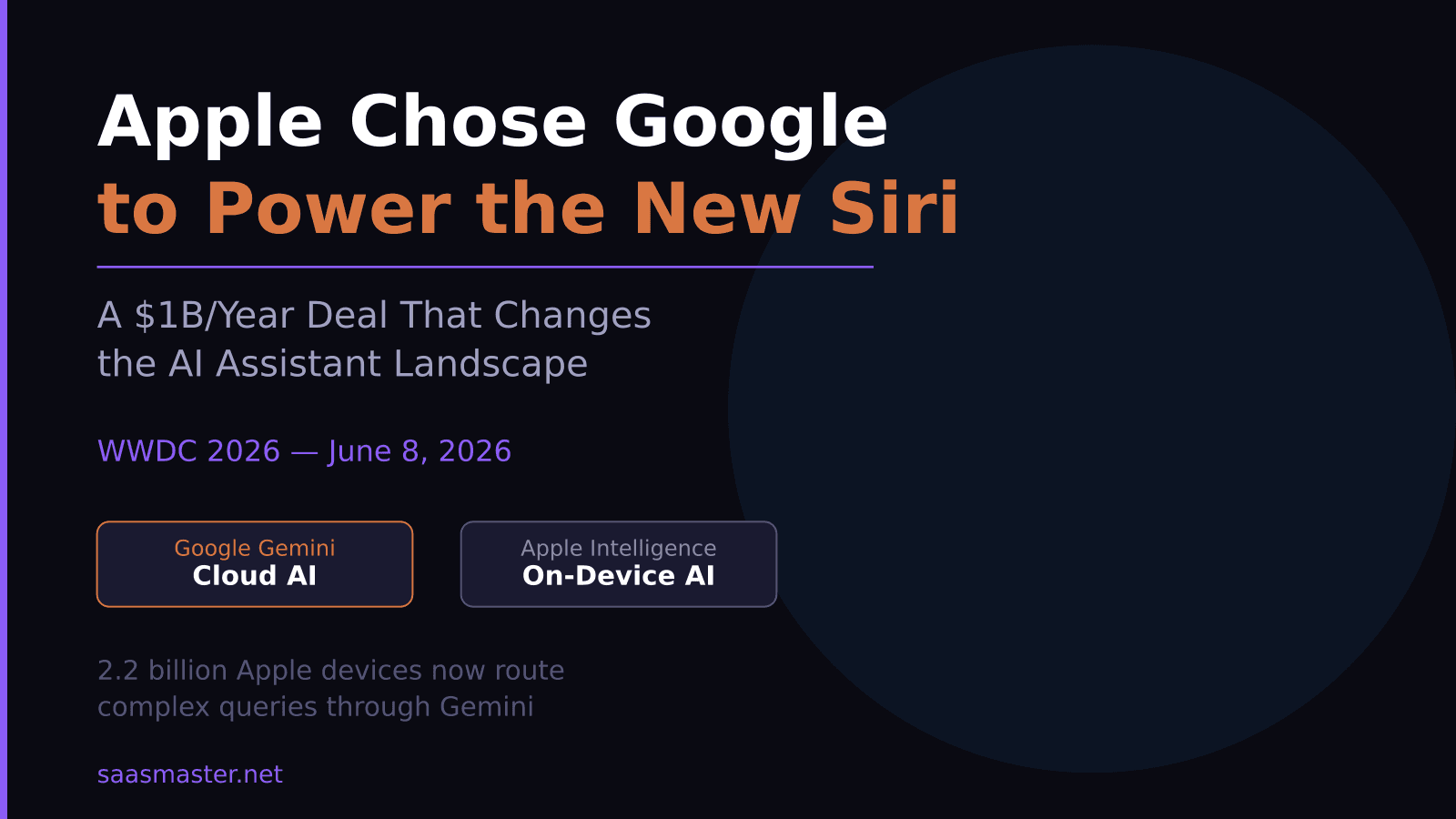
Apple spent roughly a billion dollars a year to put Google's AI inside the iPhone. That is the actual story behind Siri AI, unveiled at WWDC 2026 on June 8 — and it is stranger and more consequential than most of the coverage has acknowledged.
Key takeaways
- Apple unveiled Siri AI at WWDC 2026 on June 8, rebuilt using Google Gemini models as the cloud intelligence backbone
- The Apple-Google deal is reportedly worth approximately $1 billion per year — one of the largest AI licensing agreements ever signed
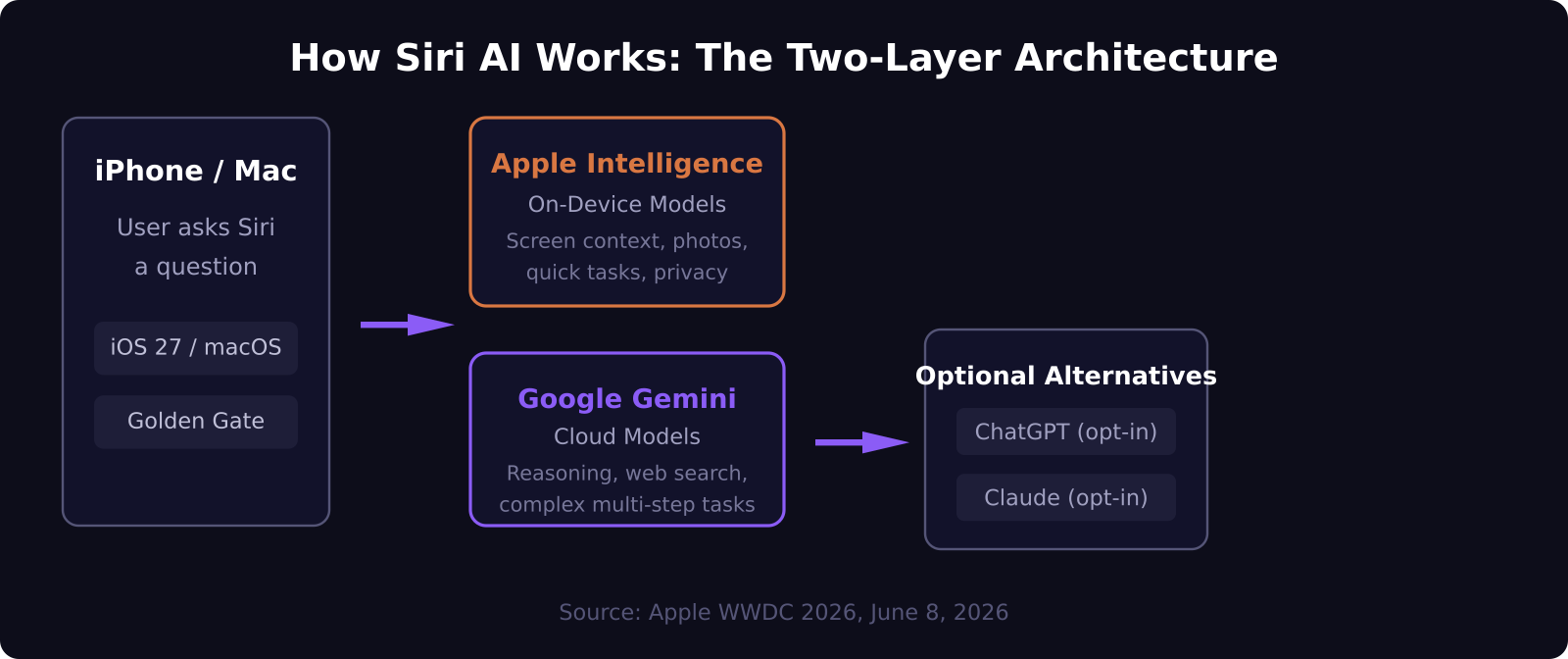
- Gemini handles complex cloud-side reasoning; Apple's own on-device models handle privacy-sensitive tasks locally
- The ChatGPT integration from 2024 is not removed — it remains as an opt-in alternative, but Gemini is now the default
- Siri AI ships as a standalone app alongside iOS 27 and macOS Golden Gate, expected Fall 2026
What Apple actually announced at WWDC 2026
Apple called the new Siri a complete reimagining. It has a new name — Siri AI — a dedicated standalone app, Dynamic Island integration on iPhone, and a positioning that puts it squarely in competition with ChatGPT, Claude, and the standalone Gemini app.
Under the hood: Google Gemini powers the cloud-side intelligence. When Siri AI needs to generate a complex response, reason through a multi-step request, search the web, or handle tasks that exceed what on-device models can do, the request routes to a custom Gemini model hosted by Google. Apple's own Apple Intelligence foundation models still run on-device — handling what is on the screen, summarizing notifications, editing photos, and any task that can stay local for privacy reasons.
The deal is reportedly structured at roughly $1 billion per year, making it one of the largest AI licensing agreements in the industry. It also makes the Apple-Google relationship uniquely layered: these two companies compete in browsers, search, and mobile platforms, while Google is now the infrastructure powering one of Apple's most prominent consumer features.
How this reshapes the AI assistant landscape
Until WWDC 2026, the AI assistant market looked like a three-way race: OpenAI with ChatGPT, Google with Gemini, and Anthropic with Claude. Apple was a wildcard — it had an OpenAI integration since 2024, its own Apple Intelligence models, and a Siri that was widely criticized for lagging behind assistants that launched years earlier.
The map now looks different. Apple has handed Google default access to 2.2 billion active Apple devices. Every iPhone, iPad, and Mac user who asks Siri a question complex enough to require cloud processing is, without realizing it, using Google Gemini. That distribution advantage is one that no Google marketing budget could have purchased directly.
For OpenAI, this is a meaningful strategic loss. ChatGPT integration remains available as an opt-in alternative — users can still route specific queries to ChatGPT, as they could since 2024 — but it is no longer the default cloud model powering Siri. The difference between being the default and being an option in a menu is enormous in terms of daily usage.
For Anthropic and Claude, the position is mixed. Claude is listed as one of the third-party chatbots users can route Siri queries to, giving it Apple device reach. But Claude does not have the deep Gemini-level integration that Apple and Google negotiated through a formal licensing deal. Being available in a dropdown is a different commercial relationship than being the engine.
Why Apple chose Google over OpenAI or Anthropic
Several factors converged. Google has a significant advantage in multimodal AI — Gemini handles images, video, audio, and text in ways that Apple Intelligence needs for features like Photo analysis, on-screen context, and real-time cross-app awareness. Google also operates some of the most efficient inference infrastructure in the world, which matters when billions of requests per day need to be answered with low latency.
There is a timing dimension as well. Apple had reportedly been working on its own large language model competitive with GPT-4 class systems for years. By the time WWDC 2026 arrived, it was clear the internal effort was not going to produce something competitive fast enough to protect Siri's reputation. The assistant had become something of a running joke in the AI space, and Apple's brand was absorbing real damage from comparisons to ChatGPT and Gemini.
Partnering with Google gave Apple a defensible answer to the capability question. It also preserved Apple's on-device privacy narrative — the sensitive, personal tasks stay local — while outsourcing the heavy reasoning to a partner who has already solved the scale problem.
What SaaS and AI tool companies should take from this
If you build products for Apple users, the Siri AI integration opens new surface area. iOS 27's cross-app context awareness means users will increasingly expect their iPhone to understand what they are doing across your app, not just inside it. Products that publish iOS 27 intents and work within Apple's app control APIs will surface more naturally in Siri AI responses.
For companies currently using Google Gemini via the API: the Apple deal is a strong signal about Gemini's enterprise standing. Apple does not sign a $1 billion annual licensing deal based on benchmark scores alone — it needs models that perform reliably at billions of queries per day.
The broader pattern worth noting: major AI models are increasingly competing on distribution, not just capability. OpenAI has Microsoft's enterprise stack and the default position in Windows Copilot. Google now has Apple's consumer hardware through Siri AI. Anthropic has Amazon Web Services and a growing enterprise footprint. The model that wins at scale will increasingly be the one that appears first in the workflows users are already in — and that is now a hardware and licensing deal game as much as a pure AI research competition.
Frequently asked questions
Does Siri AI replace ChatGPT on iPhone?
No. The 2024 ChatGPT integration remains as an opt-in alternative. Users can still route specific Siri queries to ChatGPT, and they can choose Claude or other models as well. The change is that Google Gemini is now the default cloud backbone for Siri AI responses — most of what Siri does in the cloud runs on Gemini, not OpenAI models.
When does Siri AI officially launch?
Siri AI is part of iOS 27 and macOS Golden Gate, both announced at WWDC 2026 in June. Apple typically ships its annual software updates in September or October. A developer beta launched shortly after WWDC. The full public release is expected Fall 2026.
Will Siri AI work on older iPhones?
Apple has not released the complete compatibility list. Previous Apple Intelligence features required at least iPhone 15 Pro hardware due to on-device processing demands. On-device components of Siri AI will likely follow a similar requirement. Cloud-side Gemini processing may extend to a broader device range, but exact hardware compatibility will be confirmed with the iOS 27 release.
Was this article helpful?
SaaS Master
Creator behind SaaS Master — tutorials, walkthroughs, reviews, and explainers that help SaaS, AI, and WordPress products get understood and chosen. Writing here about the tools, trends, and tactics that actually move the needle. Work with me →
Want your product explained this clearly — in video?
Tutorials, walkthroughs, reviews, and shorts for SaaS, AI, and WordPress products.
Work With SaaS Master