AI & SaaS
Supabase Raises $500M: AI Agents Are Now Building Most of Its Databases
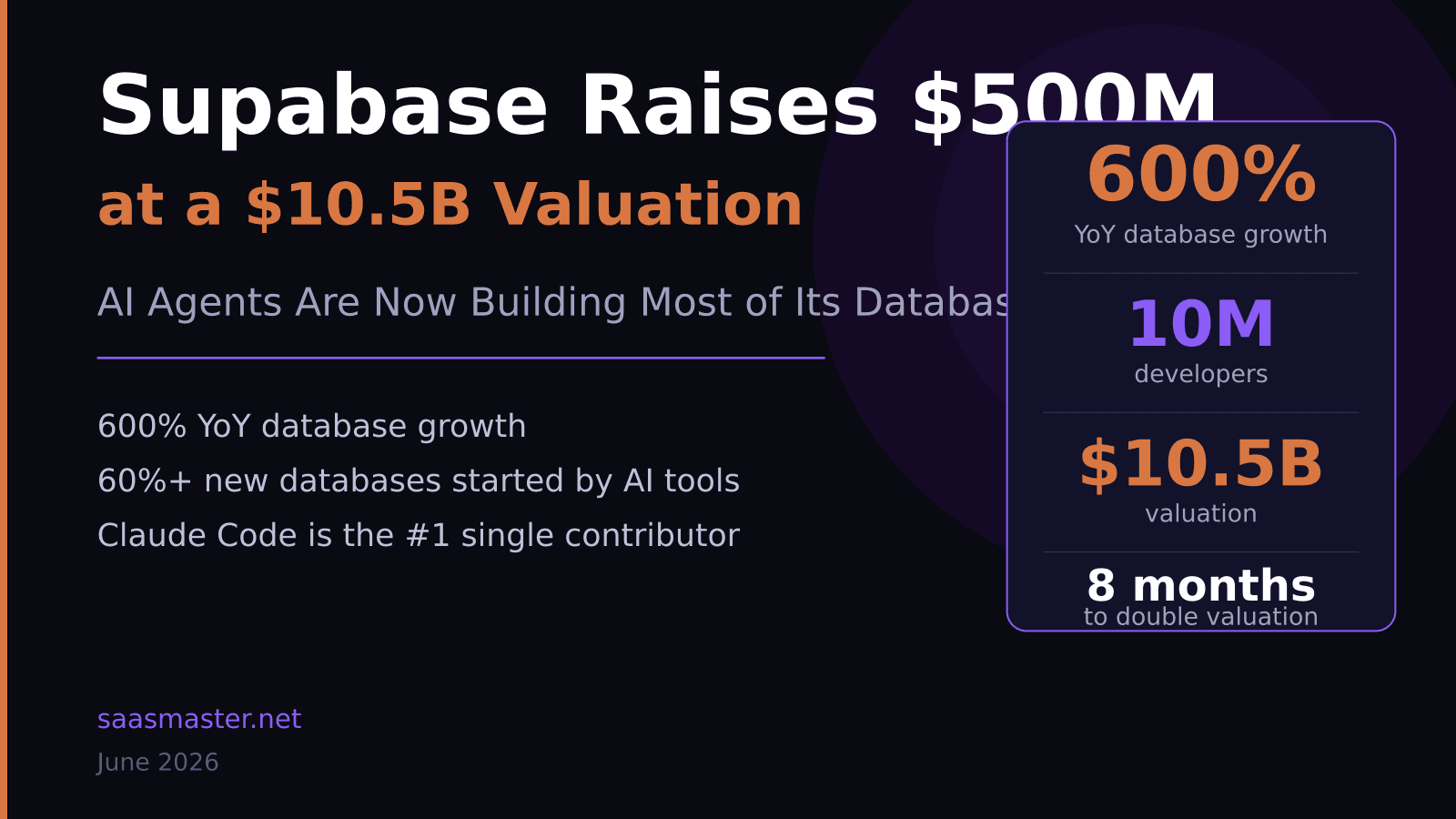
More than 60 percent of the databases created on Supabase this year were started by an AI coding agent, not a person. That single statistic explains why the open-source Postgres platform just raised $500 million at a $10.5 billion valuation — and it signals something bigger about where software development is heading.
Key takeaways
- Supabase closed a $500M Series F on June 4, 2026, led by Singapore's GIC at a $10.5B post-money valuation
- The company doubled its valuation in just 8 months from the previous Series E round
- More than 60% of new databases on the platform are now created by AI coding tools, not humans
- Anthropic's Claude Code is the single largest contributor of new databases, ahead of all other tools
- Supabase launched Multigres, an open-source horizontal scaling layer for PostgreSQL, under Apache 2.0
How a database company became the backbone of the AI coding boom
Supabase started as a developer-friendly alternative to Firebase — a way to spin up a Postgres database with auth, real-time subscriptions, and storage without writing backend boilerplate from scratch. It attracted indie developers who wanted Firebase's speed with Postgres's flexibility and ownership.
Then vibe coding happened.
Starting in late 2025 and accelerating sharply through early 2026, tools like Cursor, Replit Agent, Bolt, and Anthropic's Claude Code made it possible to build and deploy full-stack applications through natural conversation. These agents need somewhere to store data. They need auth, vector embeddings for AI features, and a database that can be provisioned programmatically without human input. Supabase fits that profile almost perfectly — it has an MCP connector, official agent documentation, and an API-first architecture that agents can drive directly.
The result has been a database explosion. Supabase reported 600 percent year-over-year growth in the number of databases running on its platform. A majority of those new databases were never opened in a browser by a developer. An agent deployed them, configured the schema, and started writing data — all as part of building an application for a user who may not even know what a database is.
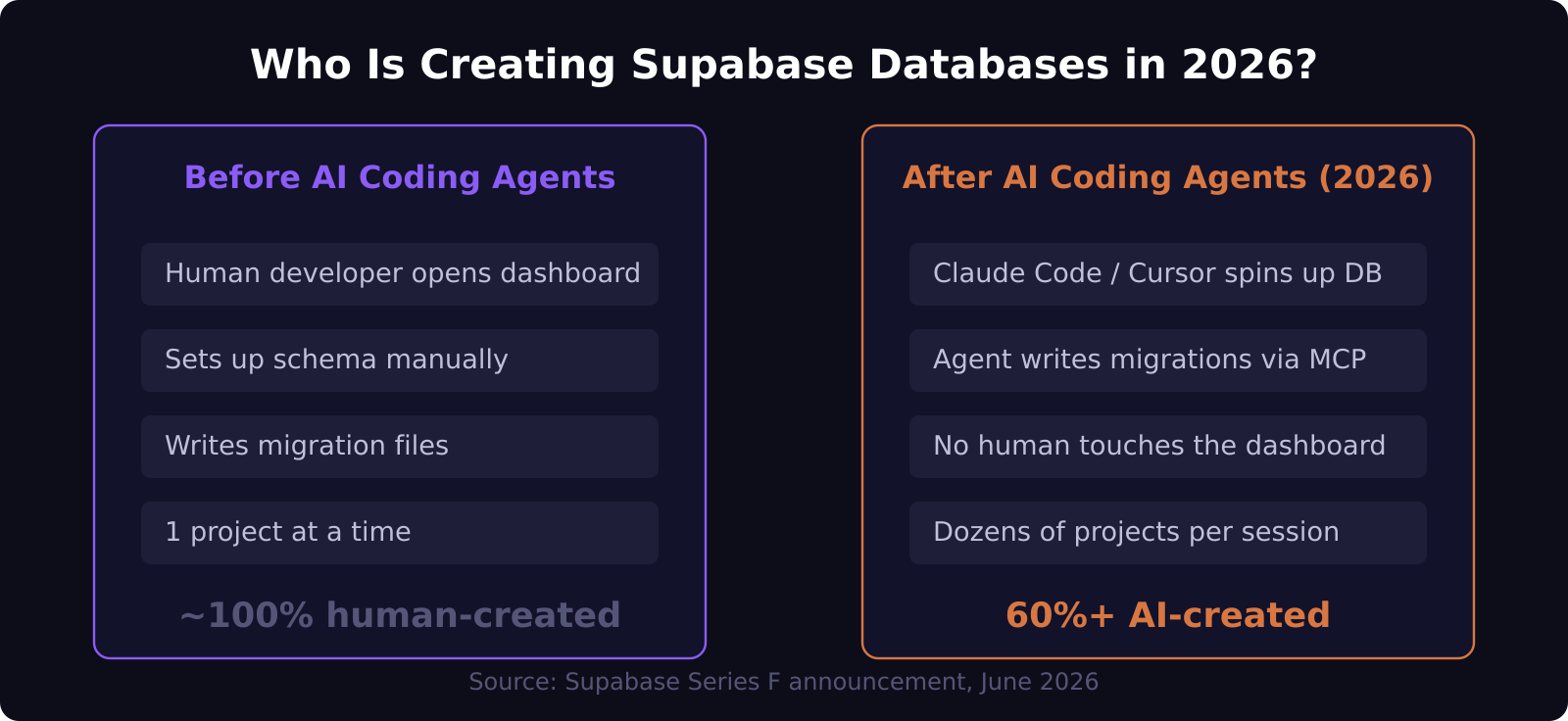
Claude Code is the biggest driver. Anthropic's coding agent became the single largest source of new Supabase databases since the start of 2026 — ahead of every other tool and platform. Supabase also announced an official Claude connector alongside the funding round, and published agent skill documentation specifically so coding agents can use Supabase correctly without hallucinating schema commands or migration syntax.
What the $500M will actually build
The round was led by GIC, Singapore's sovereign wealth fund, with all existing investors returning — Accel, Y Combinator, Craft Ventures, Felicis, Peak XV, and Coatue. Stripe increased its stake. Salesforce Ventures joined as a new investor, which signals enterprise expansion is part of the roadmap.
Total capital raised now exceeds $1 billion. The $10.5 billion post-money valuation is approximately double what the company was worth at its Series E, completed just eight months earlier. Nearly 10 million developers now build on Supabase, up from fewer than 5 million eight months ago. The company counts 250,000 customers and roughly 350 employees.
The biggest product announcement alongside the funding was Multigres. This is an open-source horizontal scaling layer for PostgreSQL, built by Sugu Sougoumarane — the engineer who co-created Vitess, the system that scaled MySQL at Google and YouTube. Multigres adapts that same architectural approach for Postgres: sharding, zero-downtime migrations, and high availability, all without modifying the Postgres engine itself.
Why Multigres matters for SaaS builders
Single-node Postgres has natural scaling limits. For most applications, those limits are well beyond what you will ever hit. But when you have AI agents spinning up tens of thousands of databases, and when companies are building platforms where each of their customers gets their own database, the math changes.
Supabase's "Supabase for Platforms" product — which lets companies like Lovable and Bolt run their own AI app builders on top of Supabase infrastructure — grew its customer base 370 percent in six months. Those customers are each provisioning databases for their own users, which creates a multi-level scaling challenge that single-node Postgres cannot easily absorb.
Multigres gives Supabase (and anyone who wants to self-host it) a Postgres-native answer to that problem. The Apache 2.0 license is deliberate: Supabase wants Multigres to become the standard horizontal scaling layer for the broader Postgres ecosystem, not just a proprietary feature for Supabase customers.
Is this a bubble or a structural shift?
The cynical read: vibe-coded apps generate lots of throwaway databases — experiments that get abandoned, agent sessions that create ten databases to test one idea. A 600 percent increase in database count does not automatically equal 600 percent revenue growth.
The optimistic read, which the investor roster backs: even if half of those databases are experiments, the other half represent a new category of software being built faster than any previous generation. Supabase positioned itself as the default backend for AI-built applications before most competitors understood the opportunity.
My read as someone who has watched the vibe coding space closely: the architectural fit is real. Agents need a backend they can drive through APIs and documented schemas. Supabase is the most agent-friendly option that also handles production-grade workloads. The growth numbers reflect a genuine shift in how software is being built, not just inflated experiment counts.
The risk is that AWS, Google Cloud, or Azure accelerate their own agent-friendly managed Postgres offerings. Supabase has a head start in tooling, documentation, and developer trust — but hyperscalers have distribution advantages that $1 billion cannot easily replicate.
Frequently asked questions
Is Supabase free to use?
Supabase has a free tier that includes 2 active projects, 500MB of database storage, 5GB of bandwidth, and 1GB of file storage. Paid plans start at $25/month for Pro, which raises all limits significantly. The Multigres scaling layer is separate and open source under Apache 2.0.
What is Multigres and why does it matter?
Multigres is an open-source horizontal scaling layer for PostgreSQL built by Sugu Sougoumarane, co-creator of Vitess (which scaled MySQL at Google and YouTube). It adds sharding, zero-downtime migrations, and high availability to Postgres without modifying the database engine. For high-scale SaaS products, it means Postgres can scale horizontally without switching to a different database.
Why is Claude Code the biggest source of new Supabase databases?
Claude Code from Anthropic is the most widely used AI coding agent for full-stack development. When Claude Code builds an application, it selects Supabase as the default backend because of available MCP integration, official agent documentation, and ease of programmatic setup. Supabase published official agent skills and an MCP connector specifically to support agentic workflows.
Was this article helpful?
SaaS Master
Creator behind SaaS Master — tutorials, walkthroughs, reviews, and explainers that help SaaS, AI, and WordPress products get understood and chosen. Writing here about the tools, trends, and tactics that actually move the needle. Work with me →
Want your product explained this clearly — in video?
Tutorials, walkthroughs, reviews, and shorts for SaaS, AI, and WordPress products.
Work With SaaS Master