AI & SaaS
Best AI Agents for Business Automation in 2026: What Is Actually Worth Using
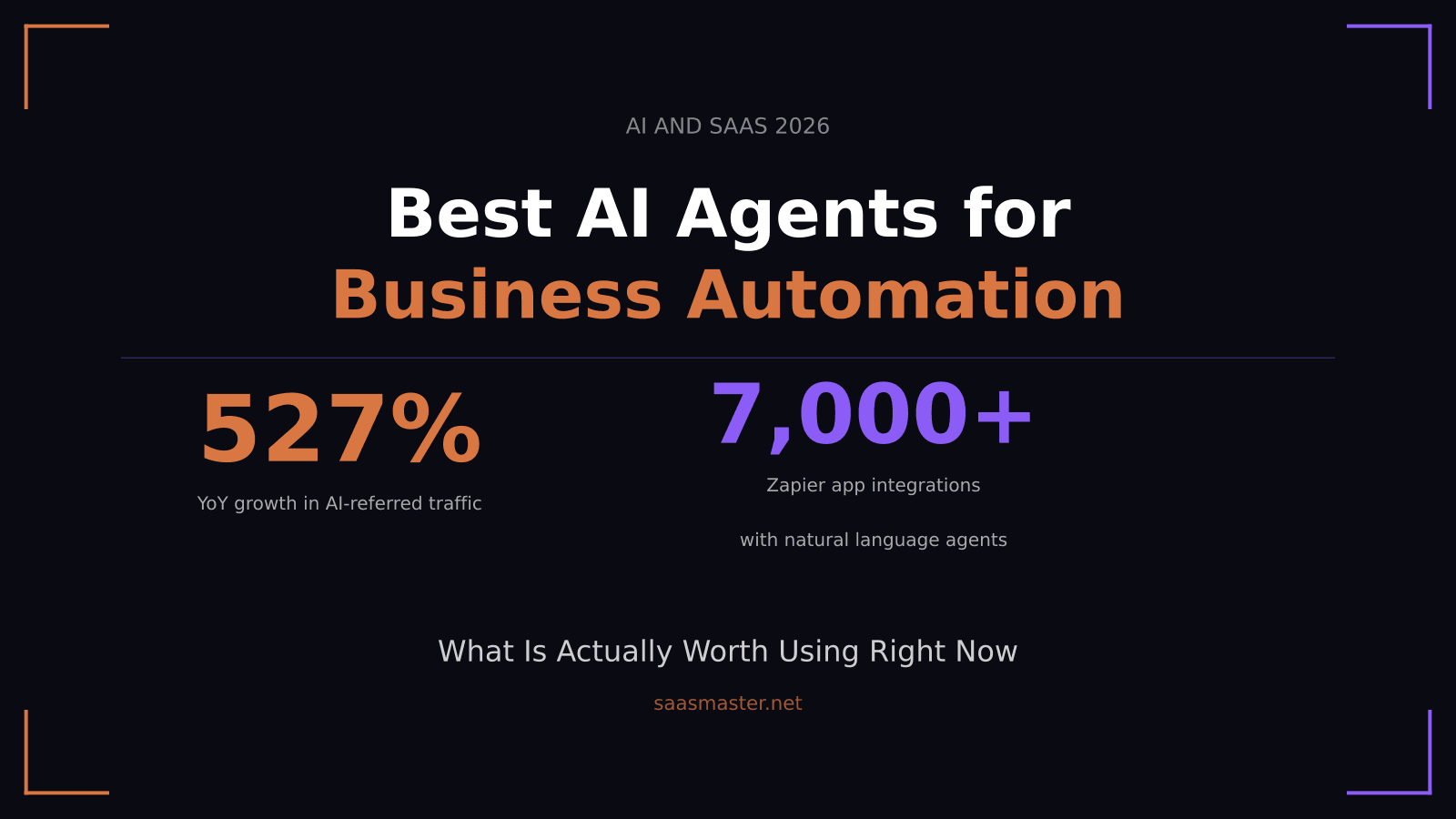
AI agents in 2026 are a real shift from what they were 18 months ago. The best tools for business automation now include Zapier Central for cross-app workflow automation (7,000+ integrations with a natural language agent layer), Devin for end-to-end software engineering tasks, Apollo.io for AI-driven sales prospecting, and enterprise platforms like Workato and Ema for moving full business processes end-to-end. The right choice depends on whether you need app-to-app automation, autonomous coding, or complete workflow orchestration across departments.
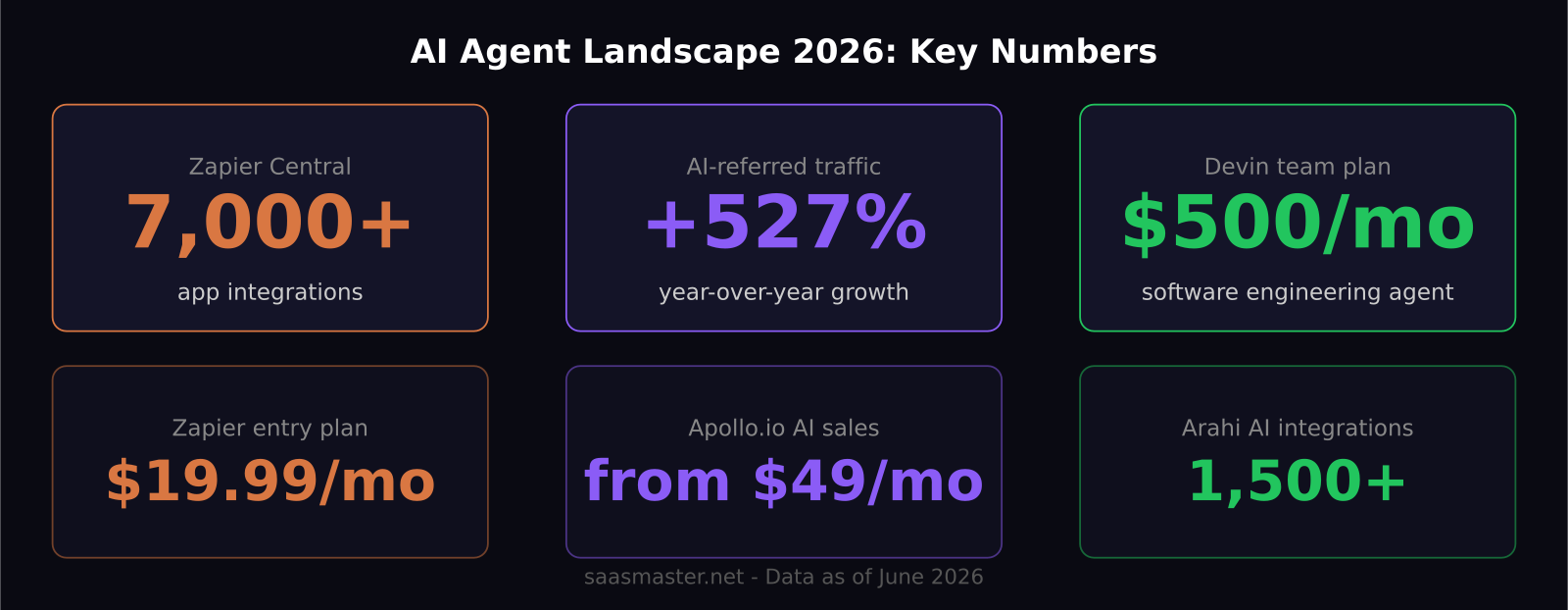
Key takeaways: - AI-referred sessions grew 527% year-over-year in early 2025 — agents are becoming a primary discovery and interaction channel for buyers - Zapier Central connects 7,000+ apps through natural language agent commands, making it the most accessible entry point for non-technical teams - Devin from Cognition handles complete software engineering workflows — writing, testing, debugging, and deploying code — at team pricing around $500 per month - Enterprise platforms like Workato and Ema move complete business processes end-to-end across departments, not just individual tasks - The highest ROI agent category in 2026 is sales and customer success automation, with Apollo.io and Robylon delivering measurable pipeline and retention impact
Why 2026 is different for AI agents
The phrase "year of AI agents" has appeared in every major tech publication since 2023. What is different in 2026 is that the underlying models actually closed the gap between what agents promise and what they reliably deliver in production.
Claude Opus 4.8 scoring 84% on Online-Mind2Web — the benchmark for autonomous browser navigation across real websites — is a concrete indicator that agents can now handle multi-step web tasks without falling over at every unexpected modal or changed form layout. GPT-5.5 crossing meaningful thresholds on Terminal-Bench 2.1 means shell-based automation agents are viable for a wider range of production workflows. The models powering agent platforms in 2026 are fundamentally more capable than what existed 12 months ago, and the difference shows in production failure rates.
The market consequence is a wave of agent platforms that mostly work. The caveats still matter — agents work best on well-scoped tasks with clear success criteria, and open-ended reasoning tasks still require human oversight. But the era of building elaborate exception-handling scaffolding around every agent because the model would inevitably drop a step or hallucinate a tool name is mostly behind us.
Zapier Central: The most practical starting point
For non-technical teams and small businesses, Zapier Central is the clearest entry point into AI agents. It extends Zapier's existing 7,000+ app integrations with an AI agent layer that accepts natural language instructions and builds or adjusts automations without requiring manual configuration of every trigger and action.
Tell Zapier Central "when a deal closes in HubSpot, pull the company's LinkedIn data, add it to the customer success sheet, and notify the account manager in Slack" and it reasons about the right combination of existing integrations and builds the workflow. For teams that need reliable, repeatable connections between business apps, this removes most of the manual overhead that made Zapier powerful but configuration-heavy.
The limitation is depth. Zapier Central agents excel at connecting apps and moving data but are not designed for open-ended research, complex reasoning, or multi-turn problem-solving. They are best understood as workflow automation with a natural language interface — powerful for what they do, but distinct from general-purpose AI agents. Entry plans start at $19.99 per month.
Devin: When you need an agent that codes
Devin from Cognition is the most ambitious product in the category. It is a software engineering agent designed to receive a task description and handle the complete engineering workflow: reading the existing codebase, writing code, running tests, interpreting failure output, iterating on the fix, and opening a pull request.
For founders and small SaaS teams running lean on engineering resources, Devin can meaningfully fill the gap on well-scoped tasks. The honest caveat is that it works best when the problem is clearly defined and the codebase context is organized and well-documented. Open-ended architecture decisions, tasks requiring deep knowledge of undocumented internal systems, or work that requires significant business context tend to produce less reliable results. The model architecture improved considerably in early 2026, but complex context-dependent engineering still benefits from human framing.
Pricing has shifted toward team plans, with most serious use cases falling on plans starting around $500 per month. That positions Devin clearly as a team tool — an AI software engineer you pay monthly rather than an individual developer subscription.
Enterprise workflow automation: Workato and Ema
Workato and Ema address a different problem than Zapier or Devin. Rather than automating individual tasks or engineering workflows, they focus on moving complete business processes end-to-end across multiple systems, teams, and approval layers.
Workato's AI Workbot handles cross-departmental workflows — procurement request to manager approval to vendor PO to payment confirmation — with the ability to escalate to a human at any configured step and maintain a complete audit trail. Ema operates similarly but with a stronger emphasis on healthcare and financial services compliance requirements. Both platforms are built for organizations that need AI agents to operate within clearly defined boundaries with full audit logging.
Both require meaningful implementation investment and typically land in organizations with dedicated IT, RevOps, or business automation resources. The ROI case is strong for companies running repetitive multi-system processes that currently require manual handoffs — but neither is plug-and-play.
Sales and customer success: Where agent ROI shows up first
The highest-density ROI cases for AI agents in 2026 are sales prospecting and customer success, where automation connects directly to revenue metrics that are measurable within weeks.
Apollo.io uses AI agents to research prospects in real time — pulling current company data including recent funding rounds, new hires, and tech stack changes from live web sources — personalize outreach sequences, and manage lead scoring without manual CRM data entry. Pricing starts around $49 per month for small teams. For sales teams spending hours per day on prospect research, the time savings are immediate and quantifiable.
Robylon handles the customer success side: monitoring product usage signals for accounts showing churn risk indicators, drafting personalized check-in messages based on what a customer has and has not done in your product, and flagging accounts that need human attention before they cancel. For SaaS companies managing more accounts than their CS team can manually monitor, the calculation is direct.
Frequently asked questions
What is an AI agent in plain terms?
An AI agent is a system that takes a goal — "find 50 qualified leads in healthcare and draft personalized outreach for each one" — and breaks it into steps, executes those steps using tools like web browsing, code execution, and API calls, and adjusts its approach based on what it finds. The key difference from a regular AI chatbot is that an agent acts rather than just responds.
Is Zapier still relevant in 2026 with purpose-built AI agents?
Yes. Zapier Central's combination of 7,000+ app integrations and a natural language agent interface makes it more powerful than its pre-AI version, and it remains the fastest path to reliable app-to-app automation for non-technical teams. Purpose-built agents like Devin (coding) or Apollo.io (sales) go deeper in their specific domains, but Zapier is still the best general-purpose workflow automation platform for connecting business apps.
How much do AI agents cost for a small business?
Zapier Central plans start at $19.99 per month. Apollo.io for sales automation starts around $49 per month. Devin for software engineering starts at approximately $500 per month for team plans. Enterprise platforms like Workato are custom-priced. For most small businesses, Zapier Central and Apollo.io are the practical starting points with the clearest and fastest ROI.
Was this article helpful?
SaaS Master
Creator behind SaaS Master — tutorials, walkthroughs, reviews, and explainers that help SaaS, AI, and WordPress products get understood and chosen. Writing here about the tools, trends, and tactics that actually move the needle. Work with me →
Want your product explained this clearly — in video?
Tutorials, walkthroughs, reviews, and shorts for SaaS, AI, and WordPress products.
Work With SaaS Master