AI & SaaS
What Is GEO (Generative Engine Optimization) and Why Your SaaS Blog Needs It in 2026
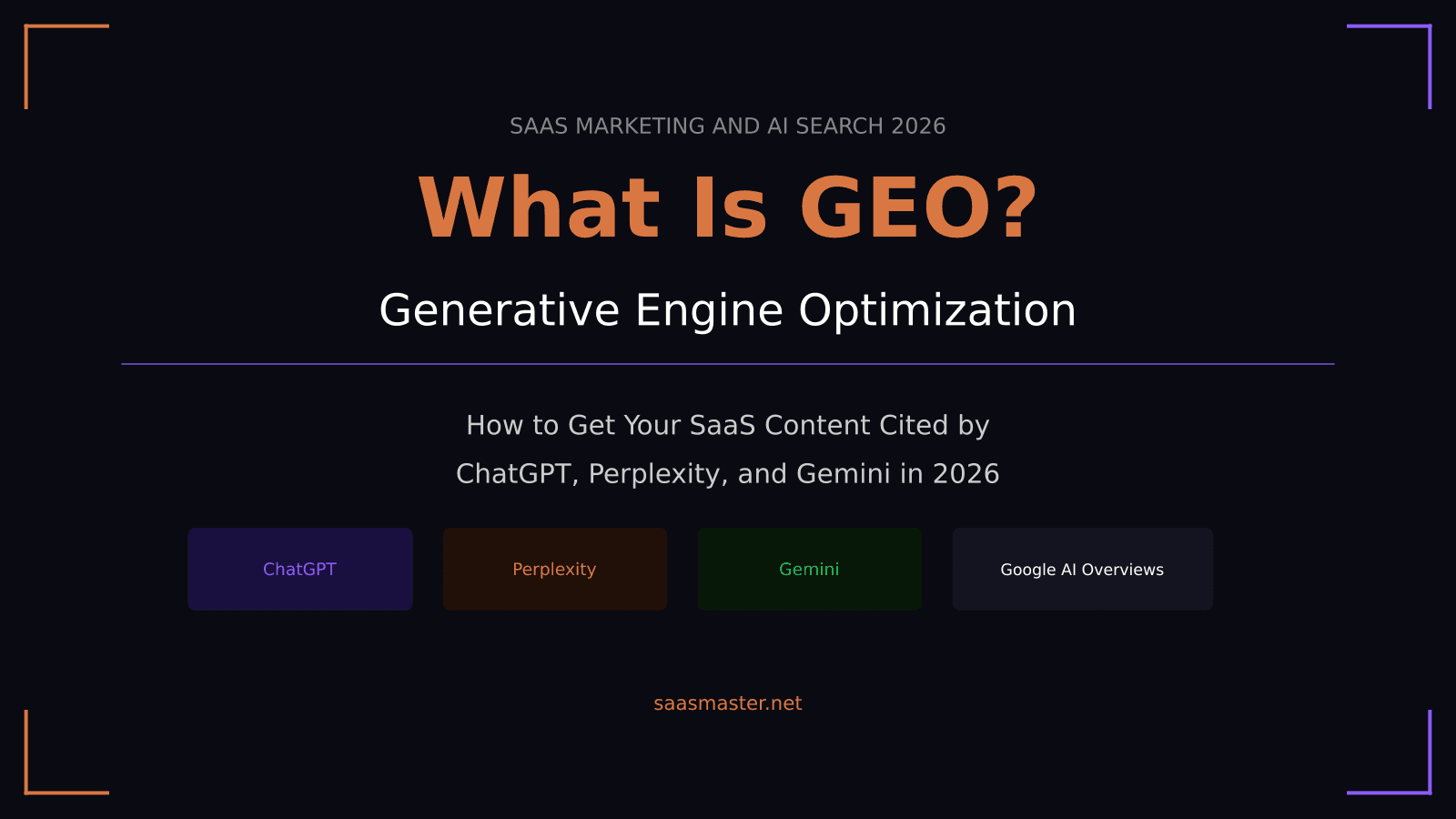
Generative Engine Optimization is the practice of structuring content to get cited in AI-generated answers from ChatGPT, Perplexity, Google AI Overviews, and Gemini — not just to rank in traditional search results. For SaaS companies, GEO matters because AI tools are becoming a primary research channel for B2B buyers. AI-referred sessions grew 527% year-over-year in the first five months of 2025, and the overlap between Google's top-ranking pages and AI-cited sources has dropped from 70% to below 20%. If your blog is not structured for GEO, you are invisible to a fast-growing segment of potential buyers before they ever reach your website.
Key takeaways: - AI-referred traffic grew 527% year-over-year in early 2025 — faster than any other referral channel - Only 20% of content that ranks on Google page one now gets cited in AI answers, down from 70%, so SEO success no longer guarantees AI visibility - GEO requires answering the core question in your first 40-60 words — that opening is what AI engines quote directly - 50% of content cited by AI engines was published within the last 13 weeks, making freshness a direct GEO ranking signal - Named authors with verifiable credentials, original data with specific numbers, and FAQ sections dramatically increase AI citation rates
What is GEO and how is it different from SEO?
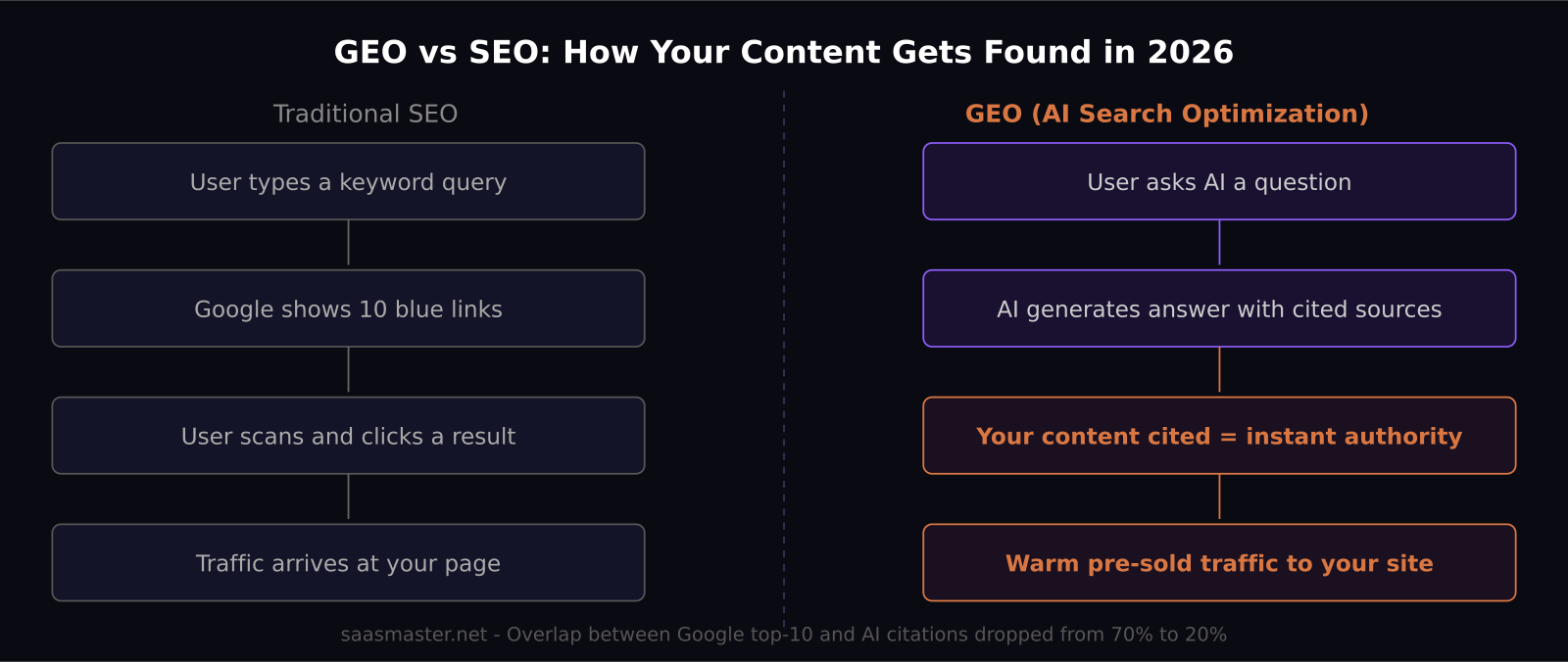
SEO gets you onto the first page of Google. GEO gets your content quoted inside an AI answer. They optimize for fundamentally different outcomes.
Traditional SEO optimizes for keyword relevance, backlink authority, and domain score. GEO optimizes for answer quality — whether your content directly and accurately answers the exact question an AI engine is trying to resolve. A tightly structured, data-dense, recently published piece from a named expert gets cited far more often than a comprehensive pillar page optimized with keyword density.
The most important data point: research from GEO firm Brandlight tracked the overlap between Google's top-ranking pages and AI-cited sources over time. That overlap dropped from 70% to below 20% as AI systems developed independent preferences for which sources to cite — preferences now meaningfully different from Google's ranking algorithm. Ranking on Google is no longer a reliable predictor of AI citation. GEO requires its own strategy.
The structural difference matters practically. Traditional SEO rewards comprehensiveness and keyword coverage. GEO rewards specificity, directness, and citeability. A 600-word post that answers one question precisely and includes verifiable data is more likely to be cited than a 3,000-word comprehensive guide that hedges every claim and buries the answer three paragraphs in.
Why this matters specifically for SaaS companies
B2B SaaS buyers' research behavior has shifted in a way that makes GEO directly revenue-relevant. In 2024, most SaaS buyers started software research with a Google search. By mid-2026, a measurable and growing share starts by asking ChatGPT or Perplexity something like "what is the best project management tool for a 15-person engineering team" or "how does Linear compare to Jira for software teams."
If your product does not appear in those AI answers, you are not in the consideration set for a portion of your market. Unlike SEO, where you can still show up even without top placement if someone searches and clicks through results, an AI answer that does not mention your product ends the consideration process before it begins — the buyer has their answer and moves on.
The SaaS category is particularly well-suited to GEO success because B2B buyers ask highly specific, factual questions: "what does X cost," "does X integrate with Salesforce," "how does X compare to Y for use case Z." These are exactly the questions AI engines answer by pulling from well-structured, citable, current sources. If your content answers those questions clearly, you are in the running to be cited.
The GEO tactics that work in 2026
A handful of concrete practices consistently drive AI citations. They require changing how you structure posts and landing pages, but the underlying logic is straightforward: give AI engines something they can quote and verify.
Answer first. AI engines quote the first clear, direct answer in your content. Put the actual answer to your title question in your opening two to three sentences. Not a teaser, not a "this article will explore" framing — the answer itself. If your post is titled "What Is GEO?" the first sentence should tell the reader exactly what GEO is, in one clear sentence.
Use specific verifiable numbers. Content with traceable statistics is cited at significantly higher rates than content making general claims. "AI-referred traffic grew 527% year-over-year in the first five months of 2025" is citable. "AI traffic is growing fast" is not. Include at least one data point with a date and a source every 150-200 words. The specificity signals reliability to AI citation systems.
Stay current. Half of all content cited in AI answers was published within the last 13 weeks. A post from 2023 that still holds Google rankings is unlikely to appear in a Perplexity answer today. For SaaS content teams, this means publication frequency matters for GEO in a way it no longer does for traditional SEO, where old content holds rankings for years.
Name your author and build their presence. AI engines use E-E-A-T signals. Content attributed to a named person with a verifiable online presence — social profiles, external mentions, a bio that matches the topic — receives higher trust scores than anonymous or brand-bylined content. Every piece of content on your SaaS blog should have a named author with a short bio and links to external profiles.
Structure for extraction. Clear H2 and H3 headers that match how real users phrase questions help AI engines parse your content. An FAQ section at the bottom of every post maps directly to how AI engines resolve user queries — the question-answer format is exactly what they extract and cite.
What actively hurts your GEO performance
Several practices that built SEO success now harm GEO citation rates. Keyword density optimization reduces the clarity that AI engines prioritize. Long padded introductions — three paragraphs before the actual answer — cause AI engines to skip your opening, missing the most citable part of your content.
Fabricated statistics are a GEO failure mode. AI engines cross-reference claims against their training data and live web sources with increasing reliability. A made-up statistic that cannot be found elsewhere will not be cited and may reduce trust in your domain over time. Use only verifiable data with traceable sources. If you do not have original data, cite authoritative sources and link directly to them.
Hedged, non-committal content performs poorly. AI engines are looking for authoritative answers, not balanced overviews that say "it depends" without resolving the dependency. If the answer genuinely depends on context, provide the context and resolve the question — do not leave the reader with an unresolved "it depends."
Frequently asked questions
What does GEO stand for?
GEO stands for Generative Engine Optimization — the practice of structuring and publishing content so that AI tools like ChatGPT, Perplexity, Google AI Overviews, and Gemini cite it when answering users' questions. The goal is to appear in AI-generated answers, not just in traditional search results.
Is GEO replacing traditional SEO?
Not replacing — layering on top of it. The technical foundations of SEO (site health, structured data, E-E-A-T signals, quality content) are still required and carry over to GEO. GEO adds specific requirements: answer-first writing structure, freshness, verifiable data points, named authors, and FAQ-format content elements. You need both.
How do I know if my content is being cited by AI tools?
Track AI-referred sessions in your analytics platform — Perplexity and some ChatGPT configurations pass referral headers that appear as distinct traffic sources. You can also test manually: ask ChatGPT, Perplexity, and Gemini the questions your content targets and check whether your domain appears in their cited sources. Direct testing is the most reliable signal for whether your GEO strategy is working.
Was this article helpful?
SaaS Master
Creator behind SaaS Master — tutorials, walkthroughs, reviews, and explainers that help SaaS, AI, and WordPress products get understood and chosen. Writing here about the tools, trends, and tactics that actually move the needle. Work with me →
Want your product explained this clearly — in video?
Tutorials, walkthroughs, reviews, and shorts for SaaS, AI, and WordPress products.
Work With SaaS Master