AI Tools
Best AI Video Generator in 2026: Kling 3.0 vs Runway Gen-4.5 vs Veo 3.1 for Creators
AI video generation has changed fast enough in the past year that tools I was recommending in early 2025 are already dated or discontinued. Sora's consumer product shut down in April 2026. The market has consolidated around a smaller group of seriously capable tools.
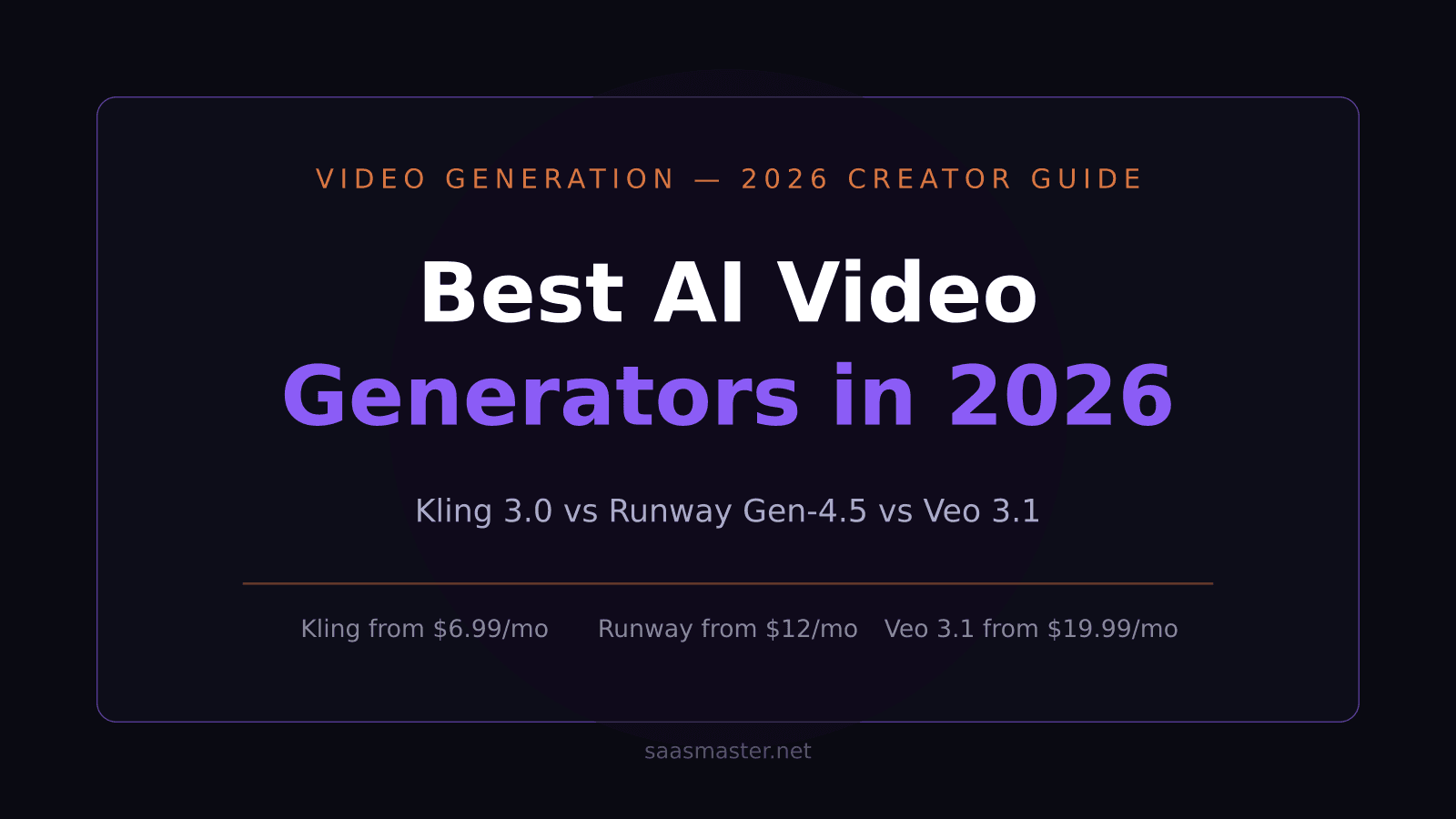
For creators in 2026, three AI video generators stand out: Kling 3.0 for volume and value, Runway Gen-4.5 for professional cinematic control, and Veo 3.1 from Google for realism and native audio. Here is how to pick the right one for your actual workflow.
Key takeaways
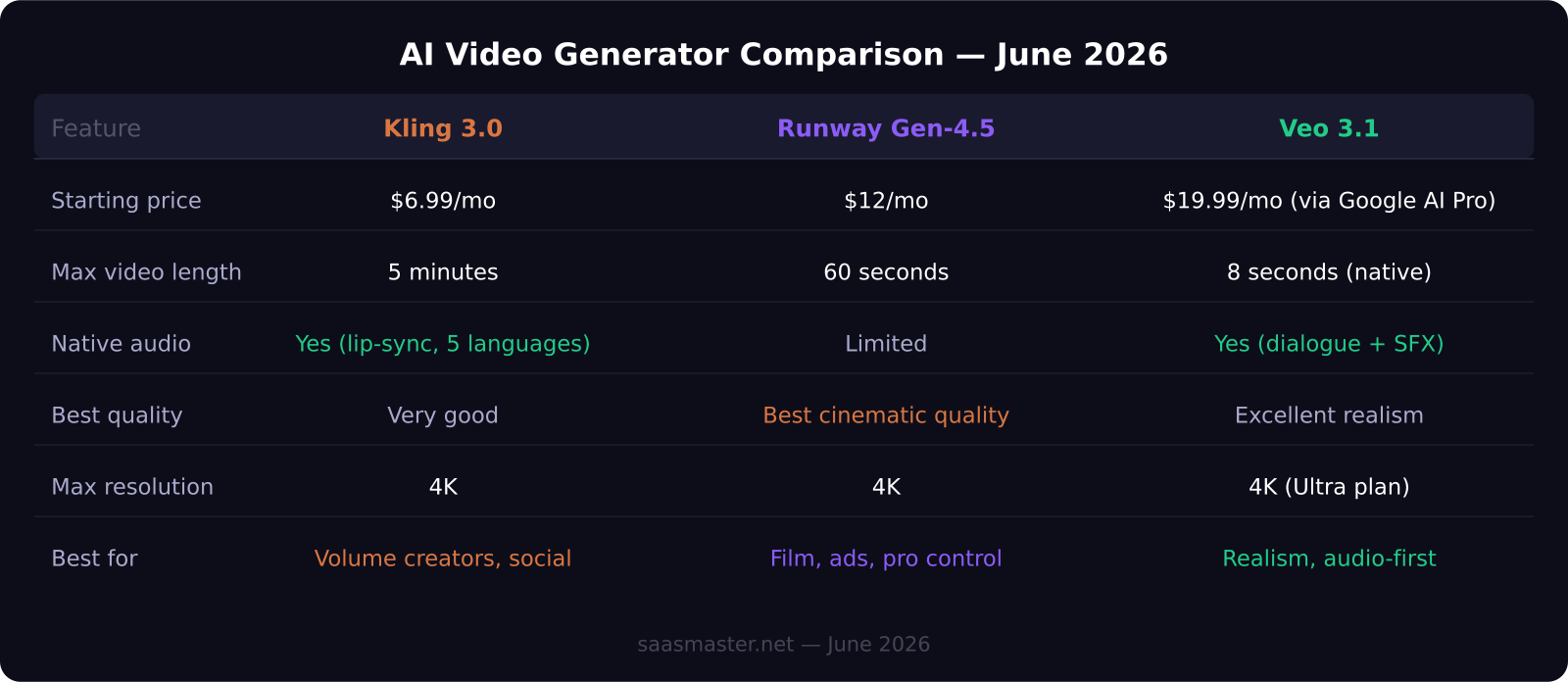
- Runway Gen-4.5 produces the highest cinematic quality and supports 60-second clips, but costs more per generation
- Kling 3.0 starts at $6.99 per month, generates clips up to 5 minutes long, and has native audio with lip sync in 5 languages
- Veo 3.1 from Google has the best audio integration — native dialogue, sound effects, and ambient sound baked into generation
- Sora's consumer web app was discontinued in April 2026; the API continues until September 2026
- For most content creators and marketers, Kling 3.0 at the Standard or Pro tier offers the best cost-to-output ratio
What happened to Sora?
Before getting into the active tools: OpenAI announced in March 2026 that the Sora web and app experiences would be discontinued on April 26, 2026. The API continues until September 24, 2026, which means developers can still integrate it, but the consumer product is gone.
This reshuffled the market. Creators who were using Sora for text-to-video have mostly moved to Kling or Runway, while the quality bar those tools set has pushed Runway and Veo to release major updates in late 2025 and early 2026.
Runway Gen-4.5: the cinematic professional's pick
Runway Gen-4.5 launched in December 2025 and is currently the technical benchmark-leader for video quality. Independent reviews consistently describe it as the most photorealistic AI video available, with better character consistency and prompt adherence than any competitor.
What makes it stand out is granular creative control. Camera moves, Motion Brush for controlling where things move in the frame, and reference-driven character consistency let you produce footage that looks like it was planned and shot, not generated. If you are making ads, short films, or branded content where quality and control matter more than volume, this is the tool.
The credit system is the main friction. One second of Gen-4.5 video costs 25 credits. A 10-second clip costs 150 credits. On the Standard plan at $12 per month (625 credits), that is just four clips per month before you need to upgrade. The Pro plan at $28 per month gives 2,250 credits — enough for about 15 ten-second clips. Volume content creators will find the cost adds up quickly.
Kling 3.0: the content creator's workhorse
Kling 3.0 is built by Kuaishou, the Chinese short-video company, and it shows: the tool is clearly designed for high-volume creators who need solid results fast.
The headline feature is clip duration. Kling generates clips up to 5 minutes long — a capability that genuinely opens use cases that Runway and Veo cannot address natively. For product walkthroughs, explainer videos, or social content that requires length, this is a meaningful advantage.
Kling 3.0 also has the strongest image-to-video feature of the three. Its 3D face and body reconstruction technology reduces the warping distortion that plagues simpler tools when you try to animate a photo. Feeding in a reference image and getting a smoothly animated version is where Kling genuinely excels.
Audio is another strength: native multilingual lip sync in 5 languages lets you generate a video and have it speak in Spanish, Mandarin, English, Japanese, or Korean without separate dubbing. For international content, that saves significant post-production time.
Pricing starts at $6.99 per month for the Standard tier (660 monthly credits, 1080p, no watermark). Pro at $29.99 per month gives 3,000 credits. The cost-to-output ratio is the best available for creators producing at volume.
Veo 3.1: Google's audio-first video model
Veo 3.1 from Google DeepMind is the most recent major model in this comparison, having received a significant update on January 13, 2026 that added vertical video support for TikTok and YouTube Shorts.
Veo's defining characteristic is audio. Unlike Runway and Kling, which treat audio as a secondary feature, Veo bakes synchronized dialogue, sound effects, and ambient soundscapes directly into the generation process. If you describe a forest scene, you get wind and birds. If you describe dialogue, you get it with matching mouth movements. This is a fundamentally different approach than generating video and then adding audio separately.
The quality and realism are excellent. Benchmarks put Veo 3.1 as the overall safest pick for quality-to-price, though it lags Runway on creative control.
The pricing structure is complicated. Access through the free Gemini app is limited. Google AI Pro at $19.99 per month gives limited Veo 3.1 Fast access. Full Veo 3.1 Standard with 4K output and no watermark requires Google AI Ultra at $249.99 per month — by far the most expensive entry point in this comparison. Developers can access it through the Vertex AI API at $0.03 to $0.60 per second depending on tier and resolution.
Which AI video generator should you use?
Choose Runway Gen-4.5 if
You are producing high-value content where visual quality is non-negotiable — ads, branded films, creative projects. The camera control and character consistency are worth the credit cost when the output needs to look professional.
Choose Kling 3.0 if
You are creating volume content: social media clips, product demos, educational videos, or any use case where you need lots of generations per month at solid quality. The Standard plan at $6.99 per month is the most accessible entry point in this category.
Choose Veo 3.1 if
Audio is central to your video. Explainer videos with spoken dialogue, ambient scene setting, or content where synchronized sound is part of the experience — these are where Veo's built-in audio generation creates a real workflow advantage over tools that require separate audio production.
Frequently asked questions
Is Sora completely gone in 2026?
The consumer Sora web and app product was discontinued April 26, 2026. The Sora API remains available until September 24, 2026 for developers who built integrations. OpenAI has not announced a replacement consumer product.
Can Kling 3.0 generate videos longer than a minute?
Yes. Kling 3.0 can generate clips up to 5 minutes long, which is the longest native single-generation duration in this comparison. Runway Gen-4.5 supports up to 60 seconds, and Veo 3.1 generates 8-second clips natively.
Do I need to pay for the most expensive Veo plan to use it seriously?
For casual use or testing, the $19.99 Google AI Pro plan gives limited access. For professional use requiring 4K output, no watermarks, and priority processing, Google AI Ultra at $249.99 per month is the only tier that unlocks the full Veo 3.1 experience. Developer API access is more cost-effective for high-volume use cases.
Was this article helpful?
SaaS Master
Creator behind SaaS Master — tutorials, walkthroughs, reviews, and explainers that help SaaS, AI, and WordPress products get understood and chosen. Writing here about the tools, trends, and tactics that actually move the needle. Work with me →
Want your product explained this clearly — in video?
Tutorials, walkthroughs, reviews, and shorts for SaaS, AI, and WordPress products.
Work With SaaS Master