AI Tools
Claude Sonnet 4.6 vs Gemini 2.5 Pro: Which AI Model Should You Use Every Day in 2026?
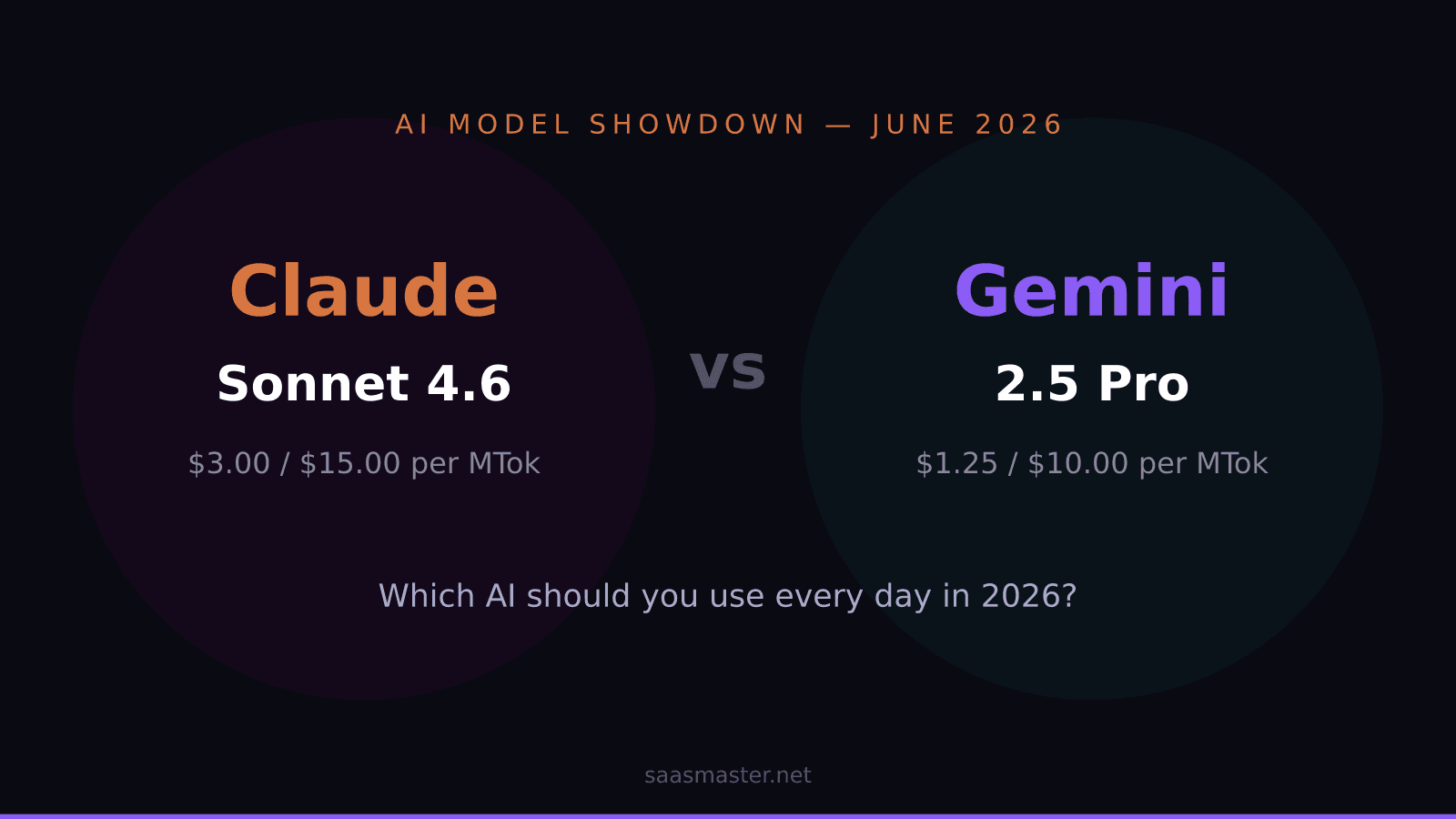
Claude Sonnet 4.6 and Gemini 2.5 Pro are the two mid-tier AI models most people actually use day-to-day in 2026. Opus 4.8 and GPT-5.5 get the headlines, but these two are what power real workflows — and choosing between them has real consequences for both performance and cost.
The bottom line: Claude Sonnet 4.6 outperforms Gemini 2.5 Pro on coding, agentic tasks, and writing. Gemini 2.5 Pro is cheaper and offers a 1M-token context window that Sonnet cannot match. Your use case determines which matters more.
Key takeaways
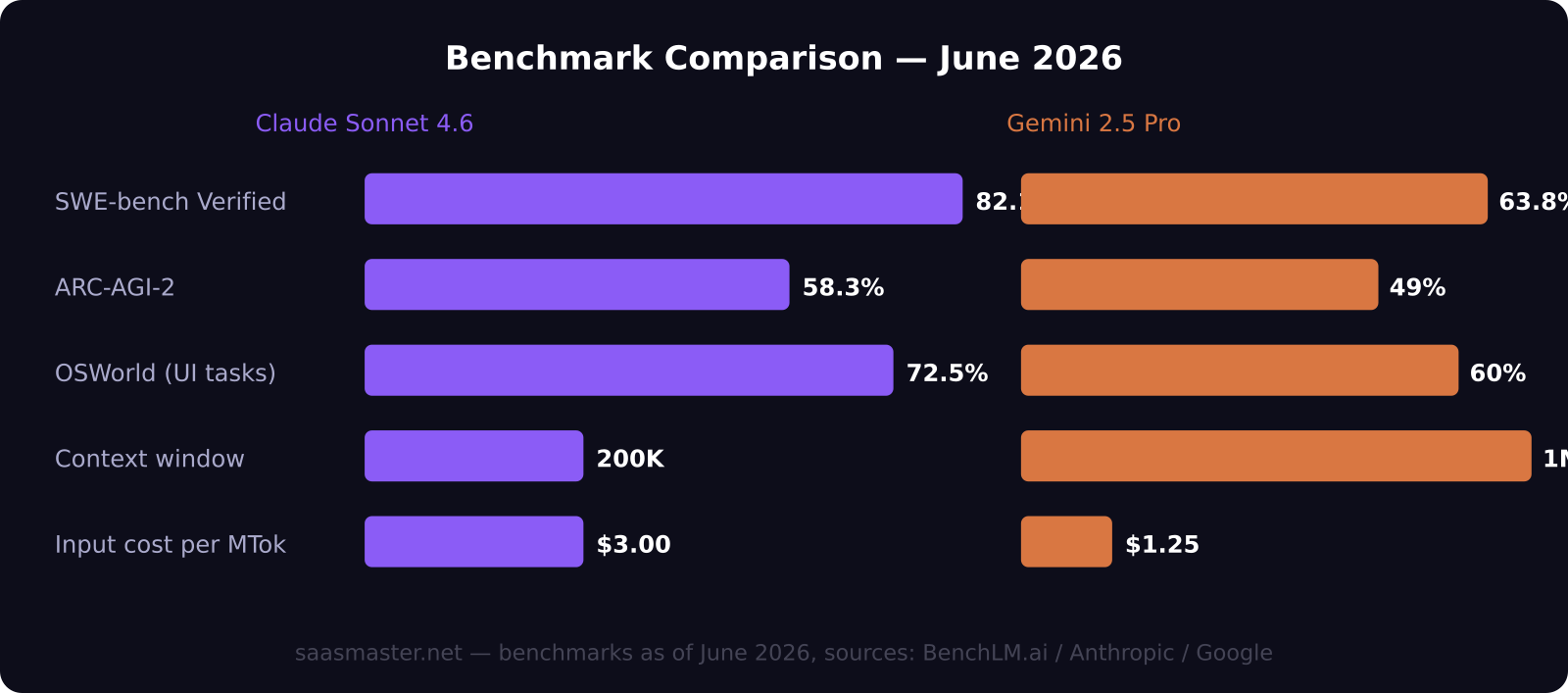
- Claude Sonnet 4.6 scores 82.1% on SWE-bench Verified versus Gemini 2.5 Pro's 63.8% — a significant gap for coding tasks
- Gemini 2.5 Pro costs $1.25 per million input tokens; Claude Sonnet 4.6 costs $3.00 — a 58% difference on input
- Gemini's 1M token context window is 5x larger than Sonnet's 200K, and no long-context premium applies to Gemini
- Sonnet 4.6 was released February 17, 2026 and is the default model for claude.ai free and Pro users
- Gemini 2.5 Pro remains the best choice when you need to process massive documents, video frames, or audio alongside text
What each model actually is in 2026
Claude Sonnet 4.6 launched February 17, 2026 as Anthropic's mid-tier workhorse. It is the model powering the claude.ai free plan, Claude Pro, and Claude Cowork by default. The main upgrades from 4.5 include extended reasoning that can sustain 100-step chains, a 64% reduction in tool-call latency, and interleaved tool calls during extended thinking. If you use Claude daily, you are already using Sonnet 4.6 unless you manually switch to Opus 4.8.
Gemini 2.5 Pro is Google's equivalent — a capable, cost-efficient model that integrates natively into Google Workspace, YouTube, and the broader Google ecosystem. Its defining technical advantage in 2026 is the 1M-token context window, which lets you feed entire codebases, book-length documents, or long video transcripts without chunking.
Which model is cheaper?
Gemini 2.5 Pro wins on cost, and it is not close. Input tokens cost $1.25 per million for Gemini versus $3.00 for Sonnet 4.6. Output is $10.00 versus $15.00 per million.
For a team running 10 million input tokens per month through an AI pipeline, that is roughly $17,500 per year in savings. That kind of difference is meaningful at scale.
The caveat is quality. If Claude Sonnet 4.6 produces a correct result in one attempt where Gemini needs three, the per-task cost may actually favor Claude. Benchmark data suggests this is particularly true for coding and multi-step agentic work.
How is coding performance different?
On SWE-bench Verified — the industry standard for testing whether an AI can actually fix real GitHub issues — Claude Sonnet 4.6 scores 82.1% compared to Gemini 2.5 Pro's 63.8%. That is not a small gap. For developers using AI to write, debug, and refactor code, Sonnet 4.6 is meaningfully more capable.
Sonnet 4.6 also scores 72.5% on OSWorld-Verified, which tests whether a model can navigate real computer interfaces and complete multi-step tasks. Gemini scores around 60% on similar UI task benchmarks. For agentic workflows — coding agents, browser agents, automation — Sonnet holds a real edge.
When does Gemini 2.5 Pro win?
The 1M-token context window is Gemini's clearest advantage. If you need to feed an entire codebase, a 400-page research document, or hours of video transcripts into a single prompt, Gemini is the only mid-tier model that can handle it natively.
Gemini also benefits from native integration with Google products. If your team uses Google Docs, Sheets, YouTube, or Workspace, Gemini's context is aware of those surfaces in ways Claude cannot be without an MCP or integration layer.
For tasks requiring deep Google ecosystem knowledge or massive context windows at low cost, Gemini 2.5 Pro is the right call.
Writing quality compared
Both models are excellent writers. Sonnet 4.6 is generally preferred for long-form writing, narrative work, and tasks that require maintaining a consistent voice across thousands of words. Users preferred Sonnet 4.6 over Sonnet 4.5 in 70% of head-to-head comparisons and over Opus 4.5 in 59% — showing that the model punches above its tier.
Gemini tends to produce cleaner factual summaries, particularly when the source material is structured. For content pipelines that are more summarization-heavy than creative-writing-heavy, the performance gap closes.
Which model should you use every day?
Pick Claude Sonnet 4.6 if you write code, run agentic tasks, work with tools and APIs, or produce long-form content. It is the stronger model at what most knowledge workers do most of the time.
Pick Gemini 2.5 Pro if you regularly process giant documents, work inside Google Workspace, or run high-volume AI pipelines where the cost difference at scale is significant.
For many builders and creators, the answer is to use both: Sonnet as the default for daily work and Gemini for specific long-context or high-volume jobs.
Frequently asked questions
Is Claude Sonnet 4.6 available on the free plan?
Yes. Claude Sonnet 4.6 is the default model for free accounts on claude.ai as of 2026, though usage limits apply. Pro and Max subscribers get significantly higher limits and access to Opus 4.8 for complex tasks.
Does Gemini 2.5 Pro have a free tier?
Yes. Gemini 2.5 Pro is available through Google AI Studio for free at the API level during development, with rate limits. Consumer access through Google products like Gemini.google.com includes the model on paid Google One AI Premium plans.
Which model is better for video and audio understanding?
Gemini 2.5 Pro. Google built native multimodal capabilities into Gemini from the ground up. If your workflow includes analyzing video frames, audio content, or images alongside text at scale, Gemini is the more capable and cost-effective choice.
Was this article helpful?
SaaS Master
Creator behind SaaS Master — tutorials, walkthroughs, reviews, and explainers that help SaaS, AI, and WordPress products get understood and chosen. Writing here about the tools, trends, and tactics that actually move the needle. Work with me →
Want your product explained this clearly — in video?
Tutorials, walkthroughs, reviews, and shorts for SaaS, AI, and WordPress products.
Work With SaaS Master