Best Brevo Alternatives in 2026 (Free & Paid)
In short
The 7 best Brevo alternatives in 2026 compared by price, features, and use case — including free options for small teams and e-commerce stores.
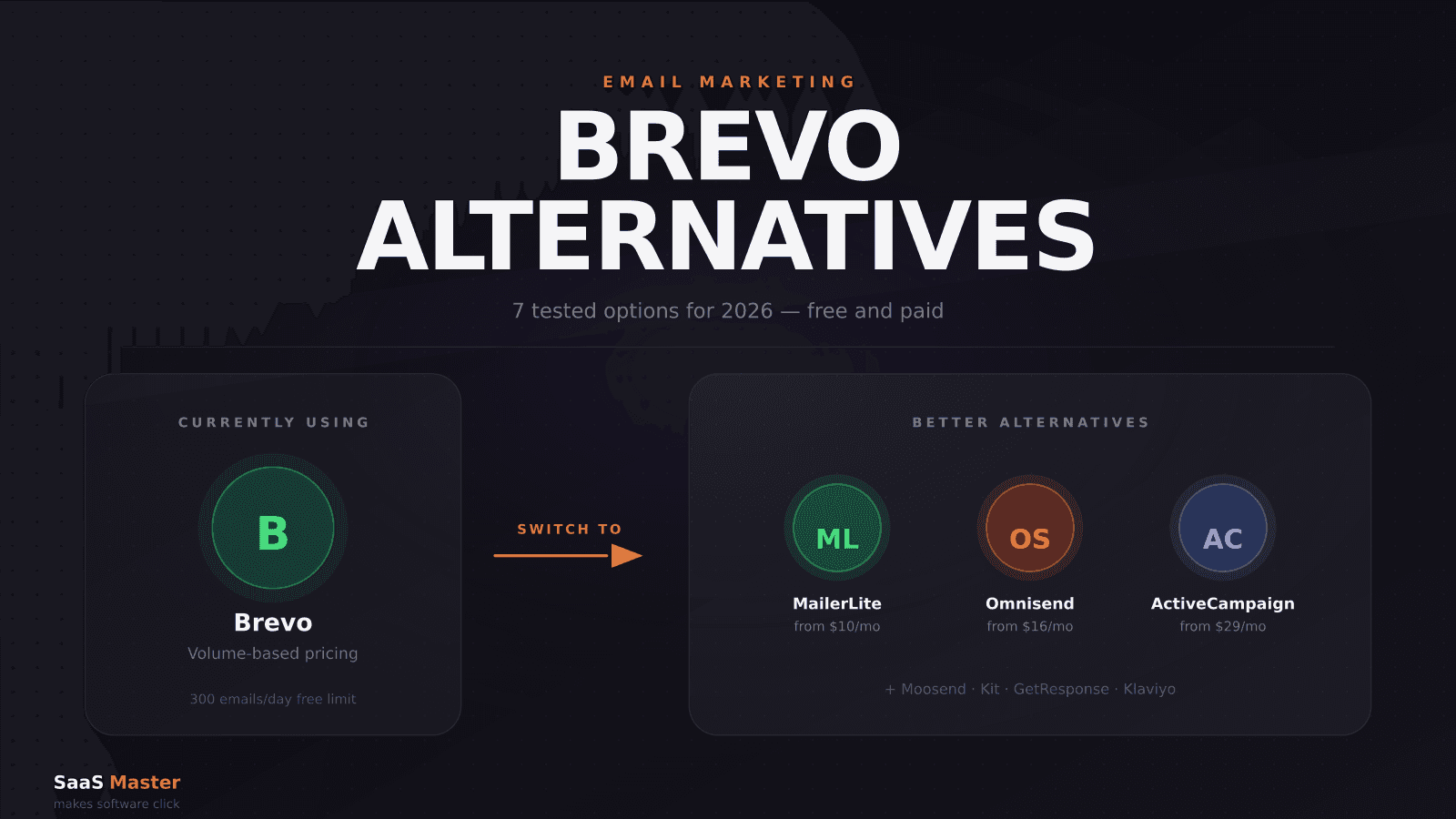
The best alternative to Brevo for most teams is MailerLite — it costs less at low contact counts, has a cleaner interface, and gives you unlimited sends on paid plans without the daily cap that trips up Brevo's free users. If your store runs on Shopify or WooCommerce, Omnisend is the stronger pick, with native cart abandonment flows and SMS baked into the same dashboard. For teams that need deep behavioral automation, ActiveCampaign is worth the higher price.
Brevo (formerly Sendinblue) is a solid email platform, and it wins on one specific scenario: you have a large list you only email occasionally. Because it prices by email volume rather than contact count, you pay less when you send infrequently to many people. Outside that scenario, most teams run into limits — the free plan's 300 daily email cap is unusually restrictive, inbox placement to Gmail accounts has been inconsistent in independent tests (around 72% in some audits), and live support is paywalled on the entry plan.
Key takeaways:
- MailerLite is the best direct swap — simpler, cheaper for small lists, unlimited sends on paid plans from $10/month.
- Omnisend wins for e-commerce with native SMS, pre-built Shopify flows, and a true omnichannel dashboard.
- ActiveCampaign leads on automation depth but costs more, starting at $29/month.
- Moosend is the most affordable paid option at $9/month with no daily send caps.
- Kit (formerly ConvertKit) is right for creators, newsletter writers, and anyone selling digital products.
- Klaviyo dominates for high-revenue DTC brands that need serious list segmentation.
- GetResponse adds built-in webinar hosting — unique at this price point.
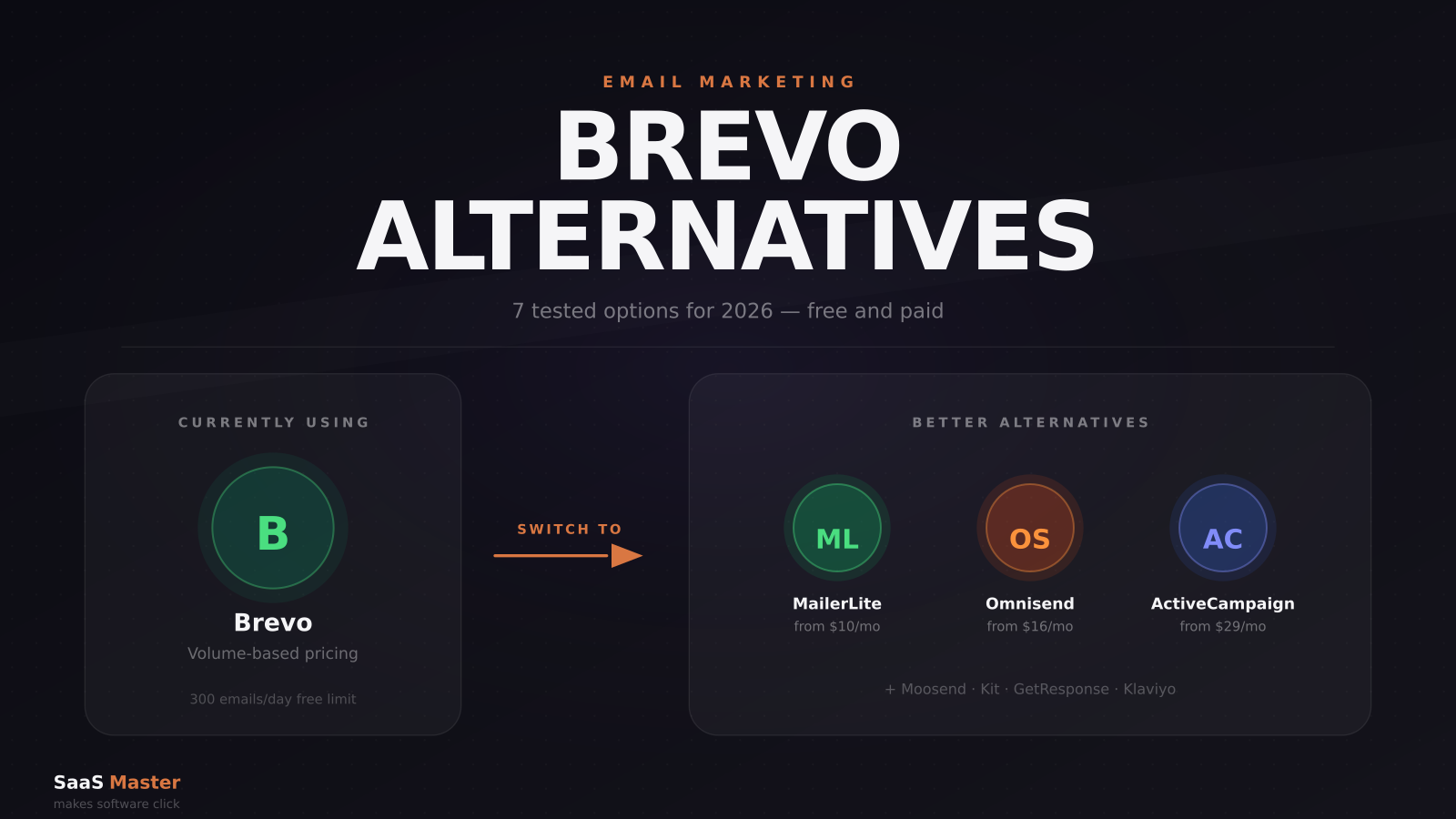
MailerLite — Best Overall Brevo Alternative
MailerLite was built for simplicity, and it shows. The editor is one of the cleanest in email marketing, automations are visual and easy to set up without a learning curve, and the pricing stays predictable as you grow.
Where Brevo charges by email volume, MailerLite charges by subscriber count on paid plans — which is more intuitive for most small teams. The free plan covers up to 1,000 subscribers with 12,000 monthly emails and access to automations, landing pages, and signup forms. That's more generous than Brevo's free tier, which limits you to 300 emails per day regardless of list size.
Best for: small businesses, bloggers, solopreneurs, and anyone who found Brevo's interface confusing.
Pricing: Free up to 1,000 subscribers (12,000 emails/month). Growing Business from $10/month. Advanced from $20/month.
Pros: drag-and-drop editor, unlimited sends on all paid plans, solid automation on every tier, 24/7 live chat on Advanced plan.
Cons: no built-in CRM, fewer integrations than Mailchimp, email deliverability occasionally lags Klaviyo in head-to-head tests.
If you're migrating your email stack as part of a broader tool audit, our guide to choosing AI tools for SaaS teams covers how to evaluate any platform before committing.
Omnisend — Best for E-commerce
Omnisend was designed specifically for online stores. It connects natively with Shopify, WooCommerce, and BigCommerce, and ships with pre-built automation workflows for cart abandonment, welcome sequences, order confirmations, and post-purchase upsells — without importing any third-party templates.
The platform also handles email, SMS, and web push notifications in one dashboard, which is where it pulls ahead of Brevo for store owners. Brevo technically supports SMS, but the experience feels more bolt-on; Omnisend's omnichannel flows feel native.
Best for: Shopify and WooCommerce store owners, DTC brands, any team that wants email and SMS under one subscription.
Pricing: Free for up to 250 contacts (500 emails/month). Standard from $16/month (scales with list size — approximately $65/month at 5,000 contacts). Pro from $59/month with unlimited email sends.
Pros: native e-commerce integrations, pre-built store automation flows, email plus SMS plus push in one platform, strong segmentation on purchase history and behavior.
Cons: overkill for service businesses or simple newsletters, pricing escalates steeply past 10,000 contacts, limited for non-e-commerce use cases.
ActiveCampaign — Best for Advanced Automation
If you have outgrown basic email sequences and want automation that responds to real customer behavior — page visits, product interests, support ticket status, deal stage in your CRM — ActiveCampaign is the clearest step up from Brevo. Its automation builder is visual and powerful, supporting conditional logic, multiple branches, goal tracking, and direct CRM updates in the same workflow.
Brevo has automation, but it is simpler. ActiveCampaign's depth becomes valuable once you are building multi-step nurture sequences or sales handoff flows that span weeks. It is also one of the few tools at this price point where the CRM is genuinely built in rather than treated as an add-on.
Best for: marketing teams at software companies, B2B SaaS businesses, teams that use email as a core sales and nurture channel rather than just a broadcast tool.
Pricing: Lite from $29/month (1,000 contacts). Plus from $49/month. Professional from $149/month. Enterprise from $259/month. Annual billing required for these rates; monthly adds approximately 20 to 25%.
Pros: best-in-class automation builder, built-in CRM on Plus and above, detailed contact scoring and engagement tracking, strong deliverability reputation.
Cons: steeper learning curve than MailerLite or Brevo, no meaningful free plan (14-day trial only), overkill for simple newsletter use cases.
For SaaS teams looking to automate more than just email, our automation and no-code guide hub covers Zapier, Make, n8n, and AI-powered workflow tools that pair well with ActiveCampaign.
Moosend — Best Budget Option
Moosend does not get as much attention as the bigger names, but it is one of the few platforms where you get unlimited emails on every paid plan starting at $9/month — no daily caps, no per-email charges. The automation builder covers the common flows (welcome, cart abandonment, birthday emails), and the platform includes A/B testing and a landing page builder on entry-level plans.
Brevo's volume pricing can actually be higher than Moosend at low send volumes. If you email your list frequently and stay under 5,000 contacts, Moosend is almost always cheaper.
Best for: budget-conscious small businesses, teams migrating off Brevo's Starter plan, solopreneurs who email their list more than once a week.
Pricing: 30-day free trial (1,000 subscribers, unlimited emails). Pro from $9/month for 500 contacts with unlimited sends. Annual billing saves 15 to 20%.
Pros: unlimited emails on all paid plans, solid automation coverage for the price, good price-to-feature ratio.
Cons: smaller integration library than ActiveCampaign or Mailchimp, no built-in SMS, brand recognition lower than the category leaders.
Kit (formerly ConvertKit) — Best for Creators and Newsletters
Kit was built for writers, podcasters, and course creators, and that focus shows in everything from the subscriber tagging model to the commerce tools that let you sell digital products directly from an email sequence. If your business runs on a newsletter, Kit's broadcast-first interface makes more sense than Brevo's campaign-oriented layout.
The free plan is genuinely generous: unlimited sends to up to 10,000 subscribers with access to broadcast tools. Automation is locked behind the Creator plan, but that free tier is one of the most valuable in email marketing if you are still building your list.
Best for: newsletter writers, course creators, bloggers, coaches, and anyone building an audience around content rather than a retail product.
Pricing: Free up to 10,000 subscribers (broadcasts only, no automation). Creator from $29/month for 1,000 subscribers. Creator Pro from $59/month.
Pros: best-in-class subscriber tagging for content businesses, built-in digital product sales, generous free plan, clean writing-first interface.
Cons: limited design flexibility for visual email campaigns, no built-in SMS, automation only on paid plans, not designed for e-commerce product marketing.
GetResponse — Best for Webinar Plus Email Combo
GetResponse has one feature no other tool on this list offers at its price point: a built-in webinar platform. If you use live sessions to sell or onboard customers — common in coaching, SaaS, and education businesses — GetResponse lets you run those webinars and email the attendees from the same platform, without a separate Zoom or webinar tool subscription.
Email marketing features are solid without being exceptional. The automation builder is good but not as deep as ActiveCampaign, and the interface is slightly dated compared to MailerLite.
Best for: coaches, course creators, SaaS companies that use webinars for demos or onboarding, teams that want email and webinar hosting on one bill.
Pricing: Free for up to 500 contacts. Email Marketing from $19/month. Marketing Automation from $59/month. Webinars are included from the $59 tier.
Pros: built-in webinar hosting (unique at this price), solid email automation on mid-tier plans, website builder included, landing page builder with A/B testing.
Cons: automation features weaker than ActiveCampaign at similar pricing, interface less intuitive than MailerLite, pricing jumps sharply between tiers.
Klaviyo — Best for High-Revenue E-commerce
Klaviyo is the platform that serious DTC brands choose when Brevo, Omnisend, or Mailchimp can no longer keep up. Its segmentation engine is the deepest in email marketing — you can build audiences based on predicted customer lifetime value, purchase likelihood, product view history, and hundreds of other signals from your store data.
The trade-off is cost. Klaviyo is among the most expensive tools on this list, and the price scales quickly as your list grows. At 50,000 contacts, you are paying $720/month for email only. For brands generating hundreds of thousands of dollars in e-commerce revenue annually, that cost is easy to justify. For a store doing $5,000/month, it is harder to make the math work.
Best for: DTC brands with significant annual e-commerce revenue, stores with large catalogs and complex segmentation needs, Shopify merchants with serious email ROI focus.
Pricing: Free for up to 250 contacts (500 emails/month). Email plan from $20/month at 500 contacts, scaling to $45/month at 1,500 contacts and $720/month at 50,000 contacts. SMS is priced separately.
Pros: most powerful segmentation engine in email marketing, deep Shopify and BigCommerce integration, predictive analytics built in, industry-standard for serious e-commerce teams.
Cons: expensive at scale, overkill for businesses earlier in their e-commerce journey, steeper learning curve than Omnisend or Brevo.
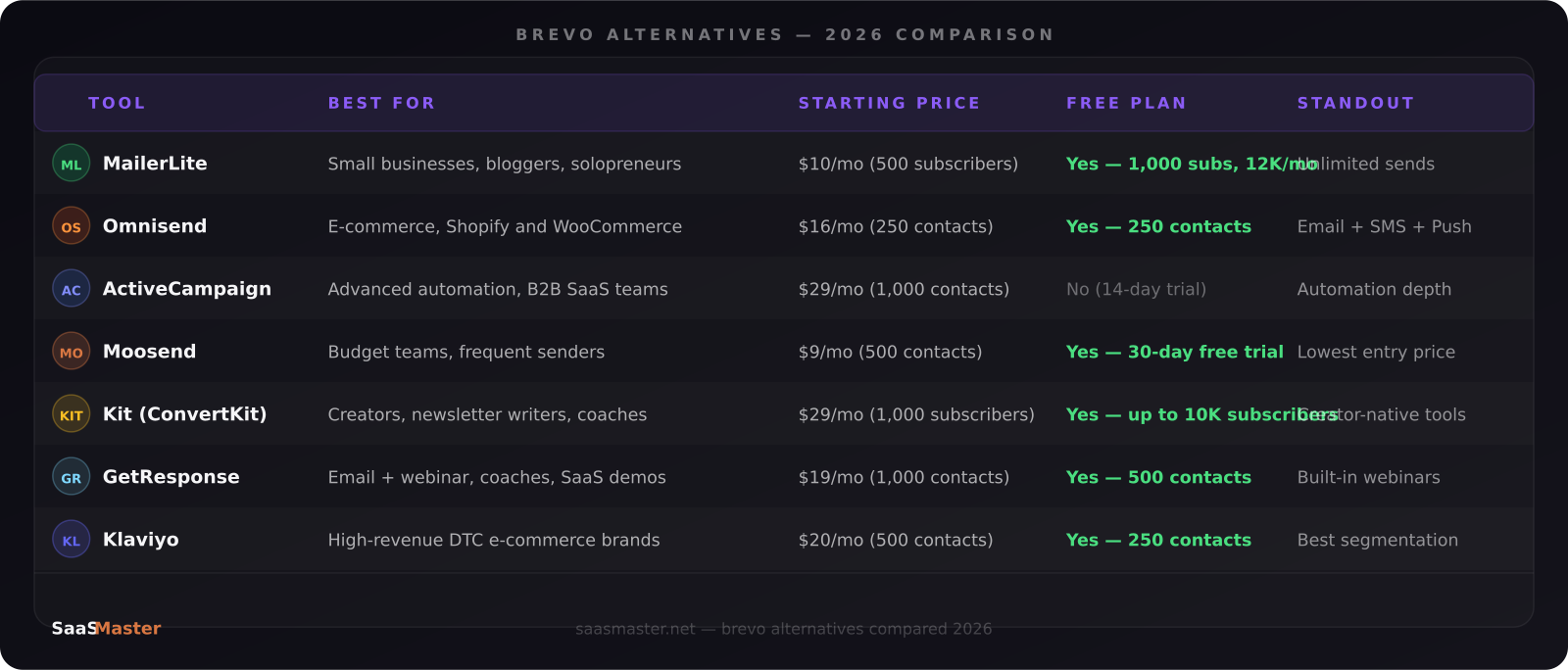
How to choose
Start with how you want to be priced. If you have a large, mostly-dormant list you email twice a month, Brevo's volume pricing might actually be the right call and you might not need an alternative at all. For everyone else, the decision breaks down cleanly.
You are a small business or blogger sending regular newsletters: choose MailerLite. It is simpler, cheaper at low subscriber counts, and has unlimited sends on paid plans.
Your business sells products online: choose Omnisend if you are earlier-stage, or Klaviyo if you are generating serious e-commerce revenue and need segmentation power to match.
You need behavioral automation that reacts to customer actions across email, CRM, and your site: choose ActiveCampaign.
You are a creator, newsletter writer, or course seller: choose Kit. The tagging model and digital product tools are built for your use case.
You use live webinars to sell or onboard: choose GetResponse. The webinar feature alone often justifies the subscription.
You want the lowest possible monthly bill with unlimited sends: choose Moosend.
Need to show customers how your platform works? A software walkthrough video paired with a strong onboarding email sequence is one of the highest-ROI moves in early SaaS growth. If you're comparing automation tools for your full no-code stack, that guide breaks down Zapier vs Make vs n8n costs at scale.
Frequently asked questions
Is Brevo free?
Yes, Brevo has a free plan. It includes unlimited contacts and 300 emails per day — roughly 9,000 per month. The daily cap is the main friction point; many teams hit it within the first week and find themselves upgrading. Competitors like MailerLite (12,000 emails/month to 1,000 subscribers) and Kit (unlimited sends to up to 10,000 subscribers) offer more generous free tiers for different use cases.
What is the main difference between Brevo and MailerLite?
Brevo charges by email volume. MailerLite charges by subscriber count on paid plans. For a business with 3,000 contacts sending two emails per week, MailerLite at around $30/month is usually cheaper than Brevo's equivalent tier. Brevo becomes more cost-effective when you have a large list (50,000 or more contacts) and only send occasionally. MailerLite also has a cleaner editor and more intuitive automation for teams without a dedicated email marketer.
Can I switch from Brevo to a new platform without losing my data?
Yes. Every platform on this list supports CSV contact imports with custom field mapping. Export your subscriber list from Brevo — including custom fields, tags, and subscription status — clean up any bounced or unsubscribed contacts before importing, then rebuild your automations in the new platform. MailerLite, Omnisend, and ActiveCampaign all have dedicated import wizards that map Brevo fields automatically and most complete the process in under an hour for lists under 50,000 contacts.
Tools mentioned
Was this article helpful?
Jorge Aguilar
Founder & Creator, SaaS Master
Producing SaaS and AI product videos since 2019 — 800+ videos for 200+ brands, covering tutorials, demos, walkthroughs, and explainers. Writing here about the tools, trends, and tactics that actually move the needle. LinkedIn · About · Work with me
Building an AI product that needs a clearer onboarding flow?
Client-owned videos that make your product easy to understand — demos, walkthroughs, onboarding, and explainers.
Explore AI product video production