GLM-5.2, DeepSeek V4 Pro, and Kimi K2.6: The Chinese AI Models Cutting SaaS API Costs by 90%
In short
GLM-5.2, DeepSeek V4 Pro, and Kimi K2.6 compared on real July 2026 benchmarks, API pricing, and which one fits which SaaS workload — at 60–90% less than OpenAI and Anthropic.
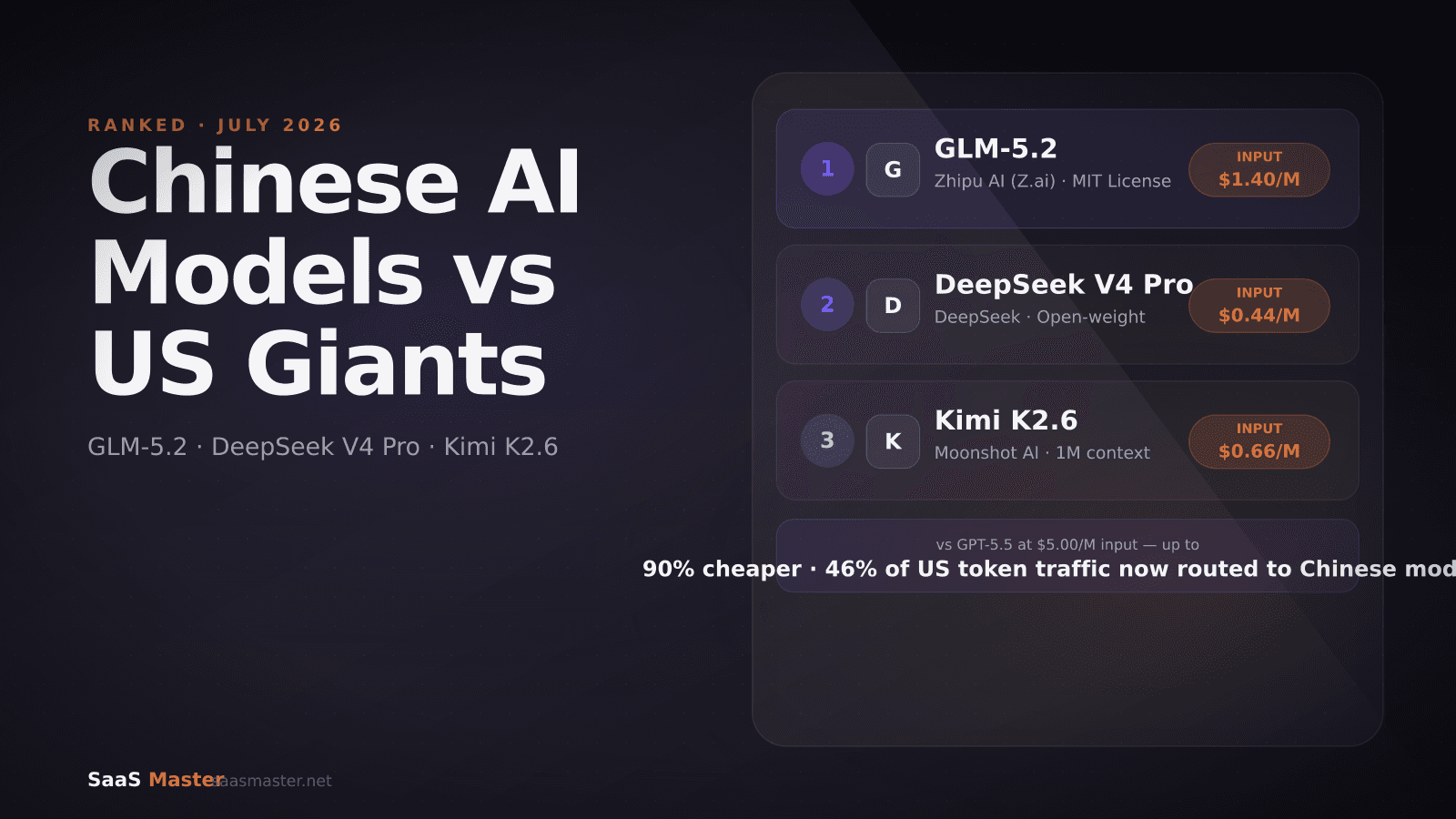
Forty-six percent of the AI tokens that US companies ran through OpenRouter in early July 2026 went through Chinese models. That number was 11 percent a year ago. Something changed — and if you're paying OpenAI or Anthropic rates to process routine SaaS tasks, it directly affects your infrastructure budget.
The catalyst is a cluster of three Chinese open-weight models that arrived in the last few months: Z.ai's GLM-5.2, DeepSeek V4 Pro, and Moonshot AI's Kimi K2.6. All three are open-weight, MIT-licensed (GLM and DeepSeek) or permissively licensed, and all three undercut the leading US models by 60 to 90 percent on input token price without sacrificing much on the benchmarks that matter for coding and reasoning tasks.
Key takeaways
- GLM-5.2, DeepSeek V4 Pro, and Kimi K2.6 cost $0.44–$1.40 per million input tokens versus $5.00 for GPT-5.5 and $5.00 for Claude Opus 4.8
- GLM-5.2 saw 80x customer growth and 27x daily token volume in its first week on Vercel — the fastest adoption of any model tracked by the platform in 2026
- DeepSeek V4 Pro scores 80.6% on SWE-bench Verified, matching the coding accuracy of frontier US models at a fraction of the cost
- Data security concerns still limit adoption in regulated industries and enterprise contexts
- The right move for most SaaS teams is intelligent routing: Chinese models for batch, content, and lower-stakes tasks; frontier US models for sensitive or safety-critical work
What is GLM-5.2 and why is it moving so fast?
Z.ai (the commercial arm of Zhipu AI, one of China's top AI labs) released GLM-5.2 in mid-June 2026, one day after the US government banned Anthropic from supplying its flagship models outside the country. The timing was noticed. The performance was noticed more.
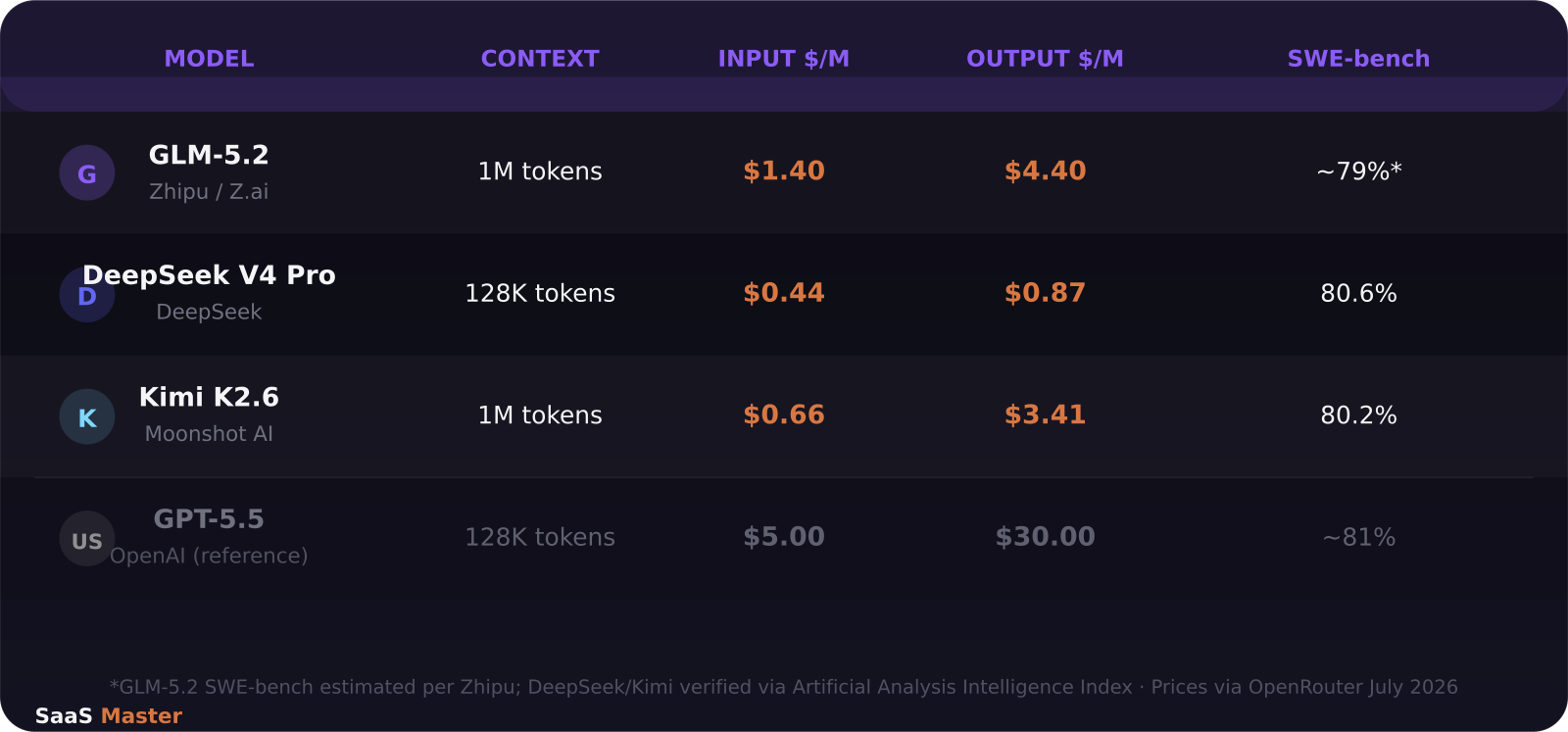
GLM-5.2 runs on a 1 million token context window — meaning it can process roughly 750,000 words in a single pass. It scores 51 on the Artificial Analysis Intelligence Index v4.1, placing it above both MiniMax M3 (44) and DeepSeek V4 Pro (44) on that leaderboard. Via OpenRouter, pricing is $1.40 per million input tokens and $4.40 per million output tokens. Compare that to GPT-5.5 at $5/$30 and Claude Opus 4.8 at $5/$25.
The model is MIT licensed with no regional restrictions. That last detail matters: GLM-5.2 explicitly has no US usage lock that the Chinese government could flip off, which was one of the concerns that slowed adoption of earlier Chinese models.
From a creator perspective testing it on long-context summarization and structured content tasks, GLM-5.2 handles document-length inputs cleanly. It doesn't have the same instruction-following reliability as Claude Sonnet 5 for nuanced prompts, but for tasks where you're throwing a 50,000-word product documentation dump and asking for a summary? It works, and it costs almost nothing.
DeepSeek V4 Pro: the cheapest capable model on the leaderboard
DeepSeek has been the story of the last 18 months in open-source AI, and V4 Pro extends that streak. At $0.44 per million input tokens on a cache miss (and $0.003625 on a cache hit), it's the cheapest capable model that shows up on any serious benchmark leaderboard.
On SWE-bench Verified — the benchmark that matters most if you're using AI for code — DeepSeek V4 Pro scores 80.6%. That puts it in direct competition with frontier proprietary models. On Terminal-Bench 2.0, the agentic evaluation that tests whether a model can actually complete multi-step software tasks, it scores 67.9%. Kimi K2.6 is right behind at 66.7%.
DeepSeek V4 Pro also leads on GPQA Diamond (scientific reasoning) at 90.1%, behind only Gemini 3.1 Pro (94.3%) and MiniMax M3 (92.68%). For SaaS teams using AI to generate technical documentation, answer support tickets, or assist in data analysis, V4 Pro is genuinely hard to argue against on a cost-per-result basis.
Is Which Should SaaS Routing Strategy Make Sense?
Kimi K2.6 from Moonshot AI sits in an interesting middle position. At $0.66 per million input tokens and $3.41 output, it's more expensive than DeepSeek but less than GLM-5.2. Its advantage is a 1 million token context window (matching GLM-5.2) and strong long-document performance.
On the Intelligence Index, Kimi K2.6 scores 43, slightly below DeepSeek V4 Pro's 44. On SWE-bench, it scores 80.2%, nearly identical to DeepSeek's 80.6%. If you're running tasks that need long context and strong reasoning without GLM-5.2's MIT license, Kimi K2.6 is the alternative worth evaluating.
Which Chinese AI model should SaaS teams actually use?
The honest answer is that the right model depends on the task — and the right architecture uses all three.
For high-volume, cost-sensitive tasks (content generation, summarization, classification, translation): DeepSeek V4 Pro wins on price. The cache hit pricing at sub-cent rates per million tokens is genuinely transformative for high-throughput pipelines.
For long-context tasks (ingesting full product docs, long-form user research transcripts, large codebases): GLM-5.2 or Kimi K2.6, both offering 1M context windows versus DeepSeek's 128K.
For agentic coding workflows where you need the absolute ceiling: still GPT-5.5 or Claude Sonnet 5 if accuracy on complex multi-step tasks matters most. The Chinese models are close on benchmarks, but the gap shows up in edge cases.
A routing layer like OpenRouter makes this straightforward to implement. You define a set of criteria — task type, required context length, acceptable error rate — and route accordingly. Several teams I've spoken with this summer have moved 60-70% of their token volume to Chinese models and seen 50-70% cost reductions without noticeable quality drops on the routed tasks.
The data security question you can't skip
This is where the analysis gets complicated. Open-weight Chinese models can be self-hosted, which eliminates the data sovereignty concern entirely. On a self-hosted setup, your data never leaves your infrastructure, regardless of where the model was trained.
The concern is with hosted API usage through Chinese-operated endpoints. A startup that moved 100% of its traffic from Anthropic to DeepSeek made the move for cost reasons, but acknowledged that regulated enterprise clients will almost certainly require the self-hosted version.
For SaaS teams serving regulated industries (healthcare, finance, legal, government), self-hosting on your own cloud infrastructure is the path. For SaaS teams where data is not particularly sensitive — marketing content, SEO workflows, sales email generation, product copy — the hosted API is likely fine.
The one area I'd keep on US frontier models regardless of cost: anything touching personally identifiable user data, customer financials, or anything that falls under GDPR or CCPA processing requirements.
What this means for your stack in the second half of 2026
The 46% token traffic share going to Chinese models isn't a fringe statistic. It's a structural shift in how AI infrastructure budgets are being allocated. CNBC reported that running the same workload costs $544 on Zhipu's GLM versus $4,811 on Claude — a 9x difference that no CFO is going to ignore indefinitely.
The practical move right now is to audit your AI spending, identify which tasks genuinely require frontier model quality, and start testing Chinese model alternatives on the others. OpenRouter's model router makes this cheap to prototype. The benchmarks suggest you'll find more quality than you expect.
For video-heavy SaaS workflows — scripting, storyboarding, content briefs — I've been testing both GLM-5.2 and DeepSeek V4 Pro as content generation layers, with results that are genuinely competitive with Claude. The transition isn't instant, but it's worth the prompt engineering investment at these price points.
Explore more AI tool comparisons and workflow guides or learn how to incorporate AI tools into your SaaS video production.
Frequently asked questions
Are Chinese AI models safe to use for business data?
Open-weight Chinese models like DeepSeek V4 Pro and GLM-5.2 can be self-hosted on your own infrastructure, which eliminates data sovereignty concerns. For sensitive or regulated data, self-hosting is the right path. For non-sensitive tasks like marketing content or product copy, using hosted APIs is generally acceptable, though each team should evaluate their specific compliance requirements.
How do GLM-5.2, DeepSeek V4 Pro, and Kimi K2.6 compare on coding benchmarks?
All three score between 80–81% on SWE-bench Verified, which places them in direct competition with frontier US models that cost 5-10x more. DeepSeek V4 Pro leads at 80.6%, Kimi K2.6 follows at 80.2%, and GLM-5.2 is estimated in a similar range based on Zhipu's published data.
Which Chinese AI model is the cheapest?
DeepSeek V4 Pro is the cheapest capable option at $0.44 per million input tokens (or under one cent per million on cache hits). GLM-5.2 costs $1.40/M input and Kimi K2.6 costs $0.66/M input. All three are significantly cheaper than GPT-5.5 ($5/M) and Claude Opus 4.8 ($5/M).
Was this article helpful?
Jorge Aguilar
Founder & Creator, SaaS Master
Producing SaaS and AI product videos since 2019 — 800+ videos for 200+ brands, covering tutorials, demos, walkthroughs, and explainers. Writing here about the tools, trends, and tactics that actually move the needle. LinkedIn · About · Work with me
Building an AI product that needs a clearer onboarding flow?
Client-owned videos that make your product easy to understand — demos, walkthroughs, onboarding, and explainers.
Explore AI product video productionRelated guides
More AI Tools & AI Workflows →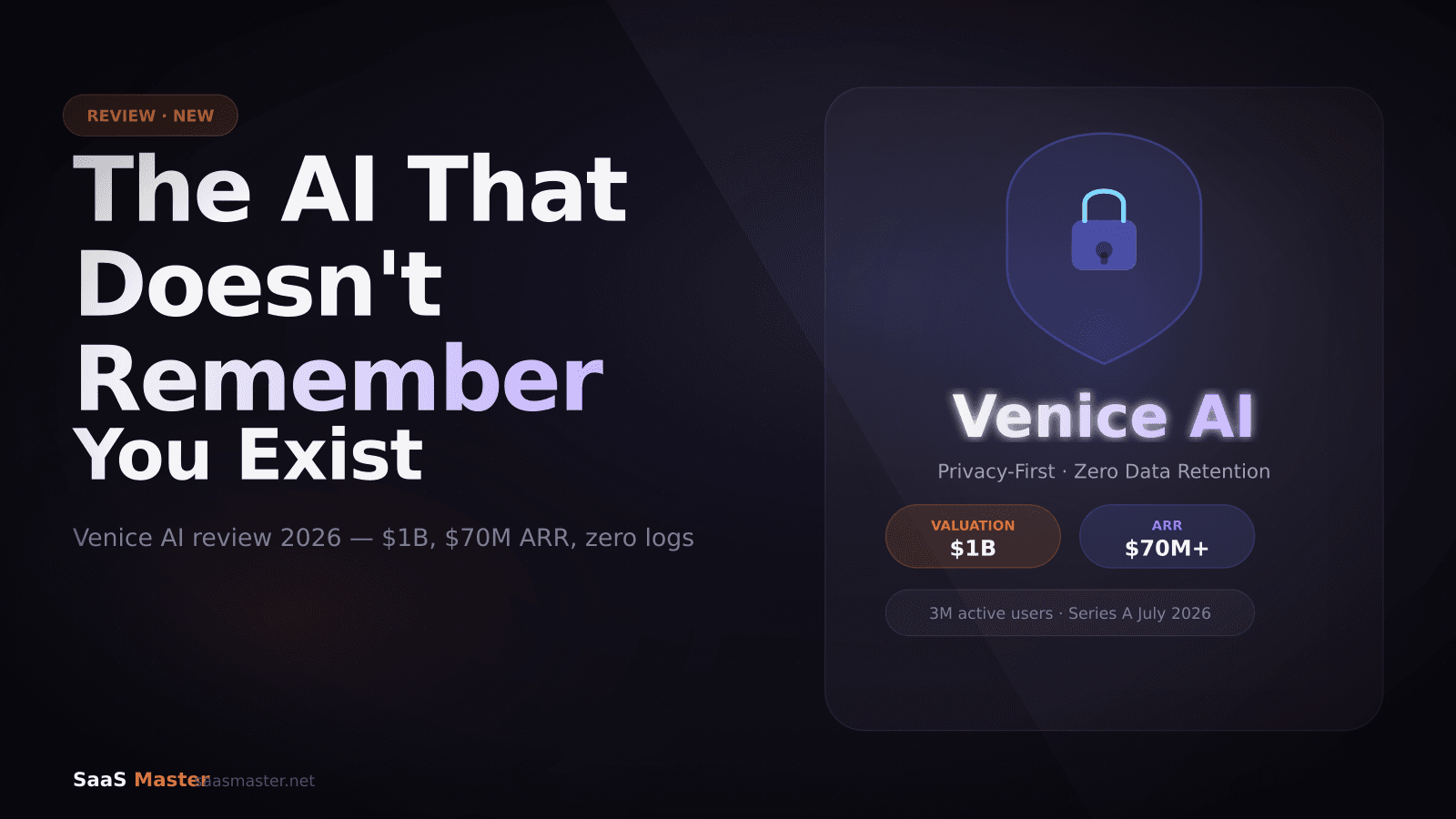
Venice AI Review 2026: The Privacy-First AI Platform That Hit $1B Without Storing Your Data
Veo 3.1 vs Kling 3.0 vs Runway Gen-4.5: Best AI Video Generator in 2026 (Sora Is Gone)
Claude Opus 4.8 vs GPT-5.5: Every Benchmark, Real Pricing, and Which to Use in 2026