How to Use MiniMax M3 with Claude Code for Free — AI Web Development That Actually Works
In short
MiniMax M3 is a 428B open-weight model with 1M context that you can use free via API. Here's how to combine it with Claude Code for a surprisingly capable free AI coding stack.
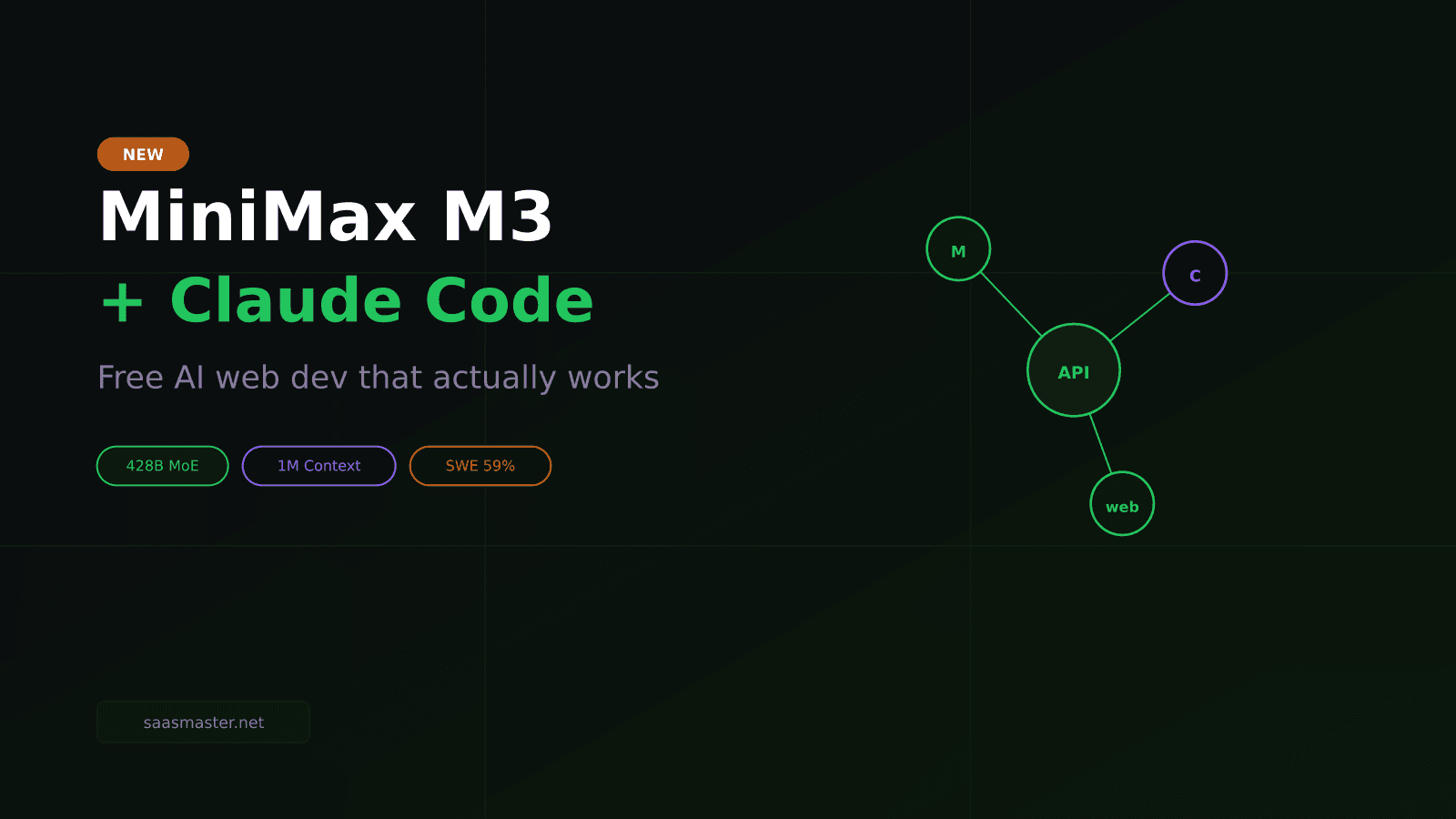
The setup: MiniMax M3 is a massive 428-billion-parameter model that costs nothing on the free API tier. Claude Code is Anthropic's terminal-based coding agent. Together they form a free (or near-free) AI web development workflow that outperforms setups costing significantly more.
[[video:GM32tNeSP3E]]
What Is MiniMax M3?
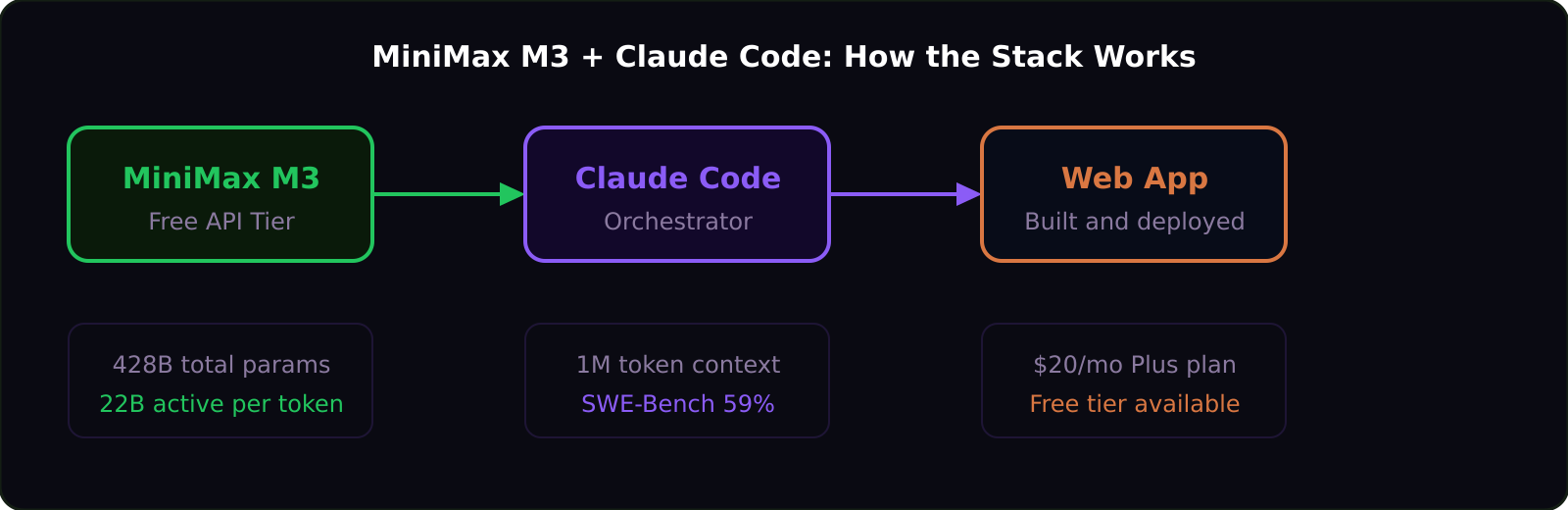
MiniMax M3 is an open-weight mixture-of-experts (MoE) model from Chinese AI lab MiniMax. The headline numbers: 428B total parameters, 22B active at inference, a 1-million-token context window, and a 59% score on SWE-Bench Lite. It's open-weight, meaning the model weights are publicly available, though the most practical way to use it is through MiniMax's API.
The free API tier is genuinely free — not a trial with a credit card required, but an ongoing free tier with rate limits. For developers building prototypes or testing ideas, this changes the cost equation dramatically.
Key Takeaways
- MiniMax M3 has 428B parameters but only 22B are active per token — this is why it's fast and affordable
- 1M token context means you can feed entire codebases or documentation sets into a single prompt
- The free API tier has rate limits but is sufficient for development and testing
- Claude Code acts as the orchestrator — it writes, executes, and iterates on code in your terminal
- Combined, the two tools handle full web app development tasks that would previously require a paid subscription
Why the MoE Architecture Matters
Most large language models run all their parameters for every token. Mixture-of-experts models like MiniMax M3 activate only a subset of parameters per token — in M3's case, 22B out of 428B. This is why you get near-frontier quality at a fraction of the compute cost.
The practical result: the free API tier can handle sophisticated requests that you'd expect to need a paid plan for. For AI tool video production scripts, technical documentation, or web component generation, the quality is genuinely good.
How to Set Up the Stack
The workflow is straightforward once you understand how the two tools interact. Claude Code runs in your terminal and has access to your file system. You configure it to use MiniMax's API as the model backend via an OpenAI-compatible endpoint, so Claude Code's orchestration logic runs on top of M3's inference.
Step 1: Get a MiniMax API key. Go to api.minimax.io, create an account, and generate an API key. The free tier activates automatically — no credit card required.
Step 2: Install Claude Code. Follow Anthropic's official installation guide at docs.claude.com. Claude Code is a command-line tool that integrates directly into your development workflow.
Step 3: Configure the model. In Claude Code's settings, point the API endpoint to MiniMax's OpenAI-compatible API URL with your MiniMax key.
Step 4: Start building. From your project directory, give Claude Code natural-language instructions — "build me a Next.js landing page with a contact form" — and watch it write, test, and iterate on real files.
What You Can Actually Build With This Stack
The 1M context window is where M3 pulls ahead of most alternatives. You can paste an entire existing codebase into context and ask for targeted modifications without losing context on earlier files. For a SaaS product with 20+ components, this is transformative.
Practical use cases that work well: building new feature pages from a design brief, writing database schemas and migration files, generating test suites for existing functions, refactoring legacy code with full context, and creating API integrations.
For non-developers building SaaS products, this stack represents a meaningful accessibility shift. If you can describe what you want in plain English, Claude Code can translate that into working code. This is the SaaS Master approach — testing tools as a builder, not a developer.
SWE-Bench Performance in Context
SWE-Bench Lite tests models on real GitHub issues — the model is given an issue description and a codebase, and must produce a working code patch. MiniMax M3's 59% score is competitive with frontier models that cost significantly more per token.
In practical terms, this means the model handles realistic coding tasks at a high success rate. Complex multi-file refactors with ambiguous requirements still struggle — but for clear-cut tasks that make up most web development work, the first attempt usually gets you most of the way there.
Compare this to the Gemini 3.5 Flash vs Claude Haiku 4.5 vs GPT-5 Mini comparison for a sense of where M3 fits in the broader model landscape.
Rate Limits and When You'll Need to Pay
The free tier on MiniMax API typically allows around 10 requests per minute with a daily token cap (check current limits at api.minimax.io — these change). For active development sessions, you'll hit these limits within a working hour of intensive coding.
The paid tier ($20/month for Plus) removes rate limits and increases context priority. If you're using this stack professionally rather than for experimentation, the Plus plan is the right move. At $20/month with a 1M context window, it's still significantly cheaper than comparable alternatives.
Limitations to Know Before You Start
MiniMax M3's training data has a knowledge cutoff that may lag frontier models. For questions about very recent frameworks or APIs, the model may give outdated answers. Always verify generated code against current documentation.
The model is also from a Chinese AI lab, which some teams have compliance concerns about. Check your organization's policies on open-weight models from non-US labs before using it in production workflows.
For building complete SaaS products, combine this coding stack with a structured SaaS video marketing strategy to ship and promote faster.
Frequently Asked Questions
Is MiniMax M3 truly free to use?
The free API tier is genuinely free with rate limits. You don't need a credit card to sign up for the base tier. Heavy daily usage will require the paid Plus plan at $20/month.
How does the 1M context window help in coding?
It means you can include your entire codebase, documentation, and feature request in a single prompt. The model retains context across all of it, eliminating the context-switching overhead that plagues smaller-context models.
Can I use Claude Code with other free models?
Yes. Claude Code is compatible with any OpenAI-compatible API endpoint. MiniMax is one option; others include together.ai's hosted models (as covered in our Together AI deep dive) and locally-run Ollama instances.
What's the difference between MiniMax M3 and their other models?
M3 is the flagship model optimized for reasoning and code. MiniMax also offers lighter models for faster inference. For coding tasks, M3 is the right choice despite its larger parameter count.
Does this work on Windows?
Claude Code runs on macOS and Linux natively. Windows users can use WSL (Windows Subsystem for Linux) to run the full stack. Performance in WSL is comparable to native Linux.
Was this article helpful?
Jorge Aguilar
Founder & Creator, SaaS Master
Producing SaaS and AI product videos since 2019 — 800+ videos for 200+ brands, covering tutorials, demos, walkthroughs, and explainers. Writing here about the tools, trends, and tactics that actually move the needle. LinkedIn · About · Work with me
Building an AI product that needs a clearer onboarding flow?
Client-owned videos that make your product easy to understand — demos, walkthroughs, onboarding, and explainers.
Explore AI product video productionRelated guides
More AI Tools & AI Workflows →
Veo 3.1 vs Kling 3.0 vs Runway Gen-4.5: Best AI Video Generator in 2026 (Sora Is Gone)
Claude Opus 4.8 vs GPT-5.5: Every Benchmark, Real Pricing, and Which to Use in 2026
I Turned a Boring PDF Into an Interactive Flipbook Using Flipsnack — Here's What I Found