Venice AI Review 2026: The Privacy-First AI Platform That Hit $1B Without Storing Your Data
In short
Venice AI review 2026: how zero-retention architecture works, 200+ models through one interface, pricing, and whether it's the right fit for SaaS teams handling sensitive data.
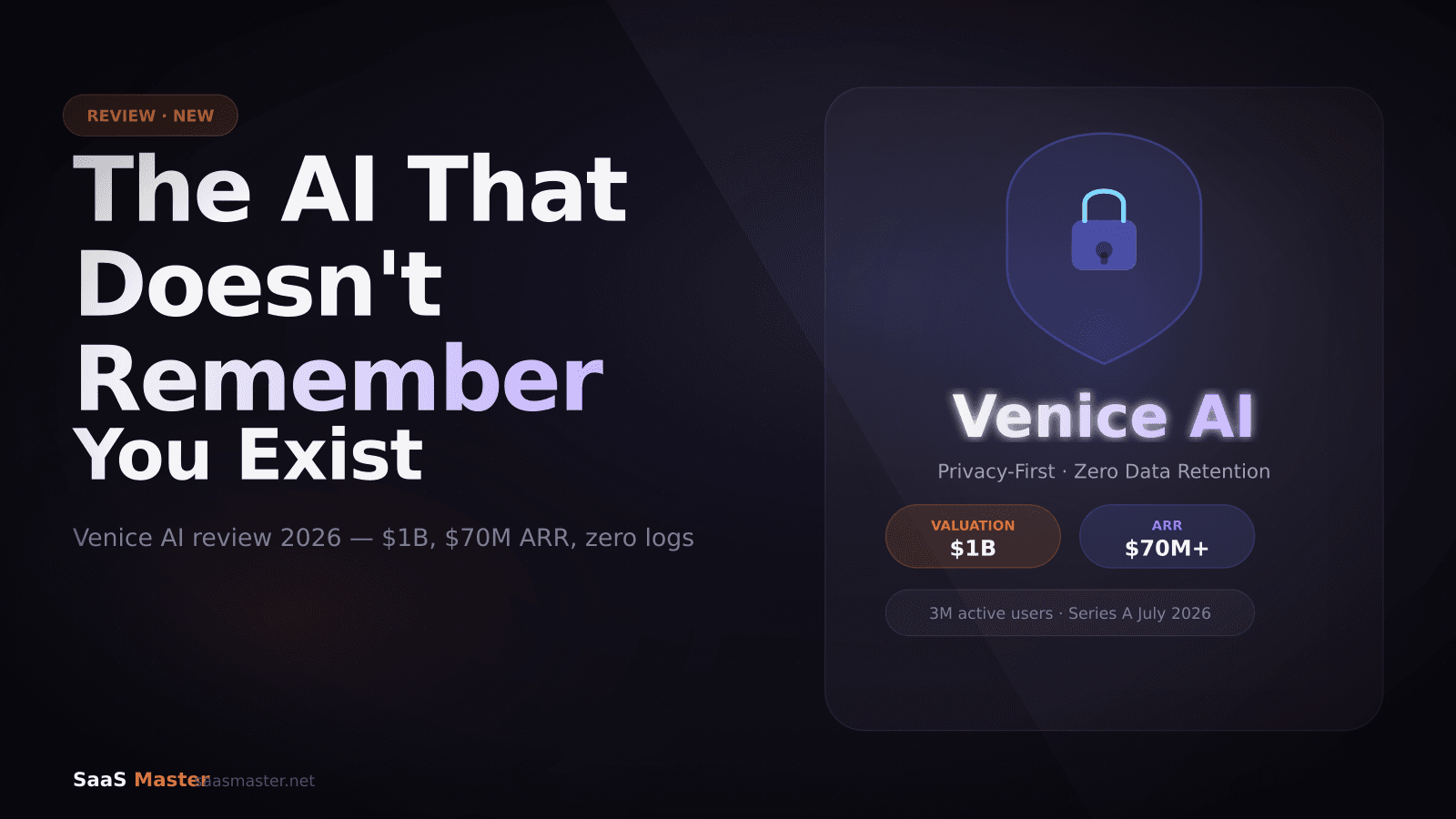
Venice AI just hit a $1 billion valuation — and it's profitable, with $70 million in annualized revenue and three million active users. The thing it built its business on? Not remembering you exist.
Every conversation you have with Venice AI disappears the moment you close your browser. No logs, no training data, no conversation history on Venice's servers. Your prompts are processed through an encrypted proxy that strips metadata before touching any GPU, and the response streams straight back to your device. If you've ever wondered whether ChatGPT or Claude is reading your product strategy docs, Venice is the answer to that concern.
Key takeaways
- Venice AI raised $65M at a $1B valuation in July 2026, already profitable at $70M+ ARR from 3 million users
- Zero-retention architecture: no prompts logged, no conversations stored, no data used for training
- Access to 200+ AI models (text, image, video, audio) through a single interface and API
- $65M Series A led by Dragonfly, with Coinbase Ventures and North Island Ventures participating
- Enterprise zero-knowledge data security is in active development — the platform is adding homomorphic encryption and confidential computing
What is Venice AI?
Venice AI is a privacy-first AI platform that routes queries through more than 200 open-source and proprietary models without storing anything you type. It was co-founded by Erik Voorhees (a well-known crypto entrepreneur) and Jesse Proudman, and launched roughly two years ago as an alternative to mainstream AI chatbots for users who don't want their data harvested.
The company initially attracted attention from the crypto community — there's a VVV token that users can stake for AI credits — but 92% of its revenue comes from traditional subscriptions and API access. The crypto layer is real, but it's not the core of the business.
What's driven the $70M ARR and 1.7 million daily API calls is something simpler: a lot of professionals don't want their AI provider storing their client strategy sessions, legal research, or internal product roadmaps. Venice is the clean answer to that.
How the zero-retention architecture actually works
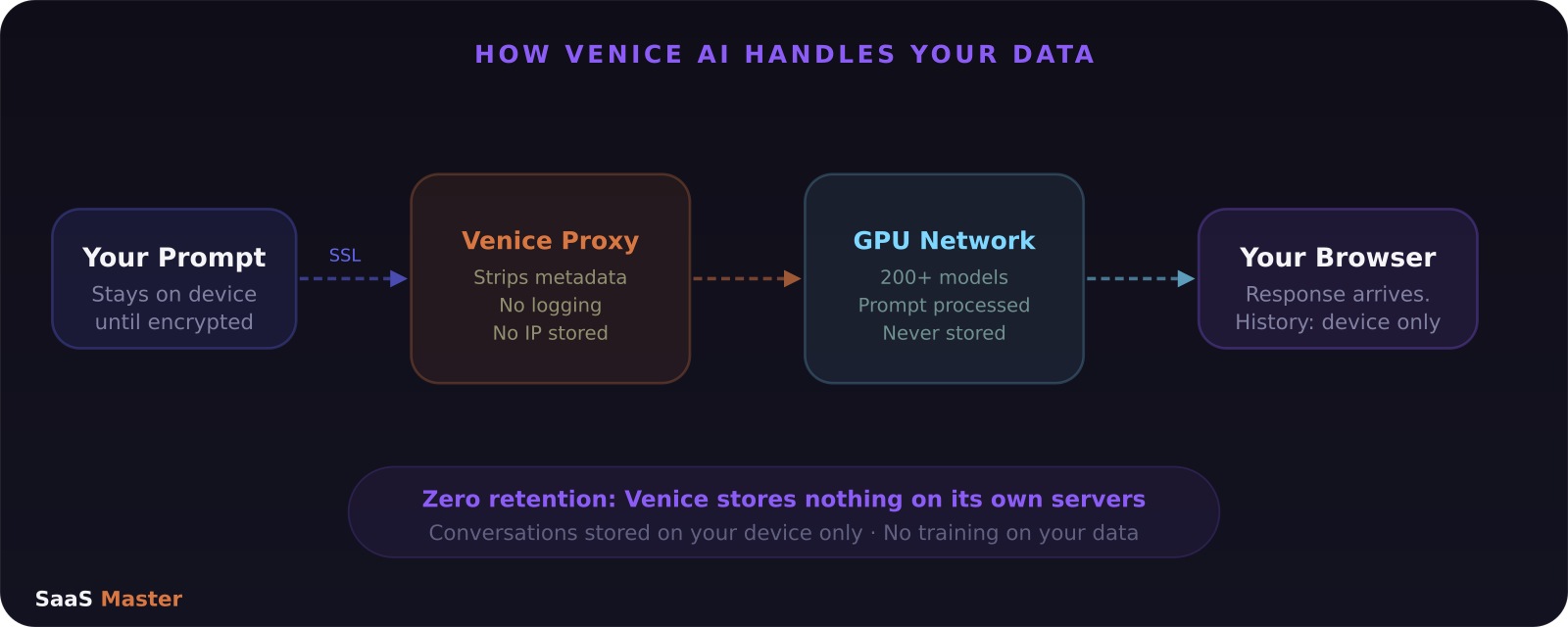
Venice's privacy model has four layers. First, your prompt is sent via SSL-encrypted connection from your browser. Second, it passes through Venice's controlled proxy, which strips identifying metadata — no IP address logging, no session correlation, no user profiling. Third, the cleaned request reaches a pool of GPU inference providers, where the actual model processing happens. Fourth, the response streams directly back to your browser.
At no point does Venice store your conversation on its own servers. Your chat history lives only in your browser's local storage. If you clear your browser history, the conversation is gone permanently — Venice can't recover it because they never had it.
The company is actively building on top of this foundation. Homomorphic encryption, which would allow AI inference on fully encrypted data without ever decrypting the prompt at the model layer, is in research. Zero-knowledge proofs and trusted execution environments (TEEs) are also on the roadmap, which would allow users to cryptographically verify that their data was handled correctly without taking Venice's word for it.
For SaaS teams, the architecture has a practical implication: Venice qualifies as a data processor that retains zero personal data, which significantly simplifies GDPR and CCPA compliance paperwork compared to mainstream AI providers.
200+ models through one interface
One of Venice's less-discussed features is breadth. The platform routes to more than 200 models across text, image, video, and audio — a combination of open-source models (Mistral, LLaMA variants, open-weight Chinese models) and proprietary ones. You're not locked into a single provider's capability set.
This matters more than it might sound. On a typical day, I might need a fast cheap model for content drafts, a better reasoning model for script structure, and an image model for thumbnail concepts. Venice handles all three through a single API key and a single privacy architecture. The alternative is juggling three separate API integrations with three separate data processing agreements.
For the AI tool video workflows I work on at SaaS Master, this kind of unified access is genuinely useful. You're not managing API keys across a half-dozen providers, and you're not explaining six different privacy policies to clients.
Pricing and the VVV token
Venice's standard pricing is subscription-based. The consumer tier gives you access to the full model library with daily credit limits. The API tier is for developers and SaaS teams, priced per-token through the provider network.
The VVV token is a secondary mechanism: users can stake VVV tokens to generate DIEM, which converts to daily AI credits. It's functional — 8% of users actively use crypto to pay — but Venice has built a business on the 92% who pay in dollars. The token mechanics are real, but you don't need to engage with them to use the product.
Revenue is already profitable on the subscription base alone, which is a data point worth noting. Most AI platforms at this funding stage are burning capital heavily. Venice generating $70M ARR from subscriptions before raising its first outside round suggests the privacy use case has genuine paying demand.
How Venice compares to ChatGPT and Claude for SaaS use
The comparison that matters most for SaaS teams is data handling, not benchmark scores. ChatGPT (Plus tier) and Claude (both tiers) use your conversations to improve their models unless you explicitly opt out — and even with opt-out, the data still passes through their servers and is retained for a period for safety review. Venice's zero-retention claim is structurally different: there is no data to opt out of because nothing is written to disk.
On capability, Venice's access to 200+ models means you can select the right tool for each task. For pure frontier capability on reasoning and coding, GPT-5.5 and Claude Fable 5 still have an edge at the absolute ceiling. But for the majority of SaaS content, support, and documentation tasks, the models accessible through Venice are more than adequate, and the privacy architecture removes a category of risk entirely.
The one trade-off: model access through Venice is dependent on Venice's relationships with GPU providers. You're not calling OpenAI or Anthropic directly — you're calling them through Venice's routing layer, which adds a small latency overhead and means you're dependent on Venice's uptime for access to those models.
Who Venice AI is built for
Venice fits three types of SaaS teams well. First, teams in regulated industries (legal, healthcare, finance) where logging AI interactions creates compliance complexity — Venice simplifies that by logging nothing. Second, teams working with sensitive client data (agency work, consulting, M&A) where even indirect data exposure is a business risk. Third, any team that wants multi-model access without managing multiple APIs and privacy agreements.
It's less ideal for teams that need tight integration with OpenAI's specific API features, need guaranteed uptime SLAs from a single provider, or work primarily with fine-tuned models on proprietary data.
For SaaS companies producing educational content and video — the space I work in at SaaS Master — Venice is a strong fit for content drafting, research, and scripting tasks where I'd rather not have those strategic conversations stored anywhere. The AI tool video production workflow benefits from knowing your creative briefs stay private.
What the $65M round means
The Dragonfly-led round with Coinbase Ventures and North Island Ventures is interesting because it bridges the crypto VC world and traditional enterprise AI. Venice has a foot in both, and the investors reflect that.
The stated uses for the capital: expand engineering, procure more GPU compute, and accelerate enterprise zero-knowledge security features. That last item is important. The current architecture is already more private than mainstream alternatives, but enterprise clients — particularly in finance and healthcare — need cryptographic proofs, not just claims. Homomorphic encryption and TEEs would make Venice verifiably private, not just contractually private.
If that enterprise tier ships in the next 12 months, Venice moves from a strong privacy-focused consumer product to a legitimate enterprise AI infrastructure option. At $70M ARR and growing, the momentum is there.
Explore more AI tools, reviews, and workflow guides, or see how privacy-conscious AI fits into SaaS video production workflows.
Frequently asked questions
Is Venice AI actually private, or just marketing?
Venice's privacy is structural, not just a policy claim. Your prompts are stripped of metadata and processed through GPU providers that never store the data, and Venice retains nothing on its own servers. You can verify this by checking that no conversation history exists after clearing your browser — because it never lived anywhere else. The company is also developing homomorphic encryption and zero-knowledge proofs to allow cryptographic verification of these claims.
How much does Venice AI cost?
Venice operates on a subscription and API model. Consumer subscriptions give access to 200+ models with daily credit limits. API access is priced per token through the provider network. The VVV token staking mechanism is an optional alternative payment method used by about 8% of users. Exact tier pricing is available at venice.ai.
Can SaaS teams use Venice AI for client work?
Yes, and it's a strong fit for agencies and consultants who handle sensitive client strategy. Because Venice logs nothing, you're not creating a data processing trail that needs to be disclosed to clients or addressed in data processing agreements. For teams in regulated industries, this simplifies compliance considerably compared to mainstream AI providers that retain data even with opt-out enabled.
Was this article helpful?
Jorge Aguilar
Founder & Creator, SaaS Master
Producing SaaS and AI product videos since 2019 — 800+ videos for 200+ brands, covering tutorials, demos, walkthroughs, and explainers. Writing here about the tools, trends, and tactics that actually move the needle. LinkedIn · About · Work with me
Building an AI product that needs a clearer onboarding flow?
Client-owned videos that make your product easy to understand — demos, walkthroughs, onboarding, and explainers.
Explore AI product video productionRelated guides
More AI Tools & AI Workflows →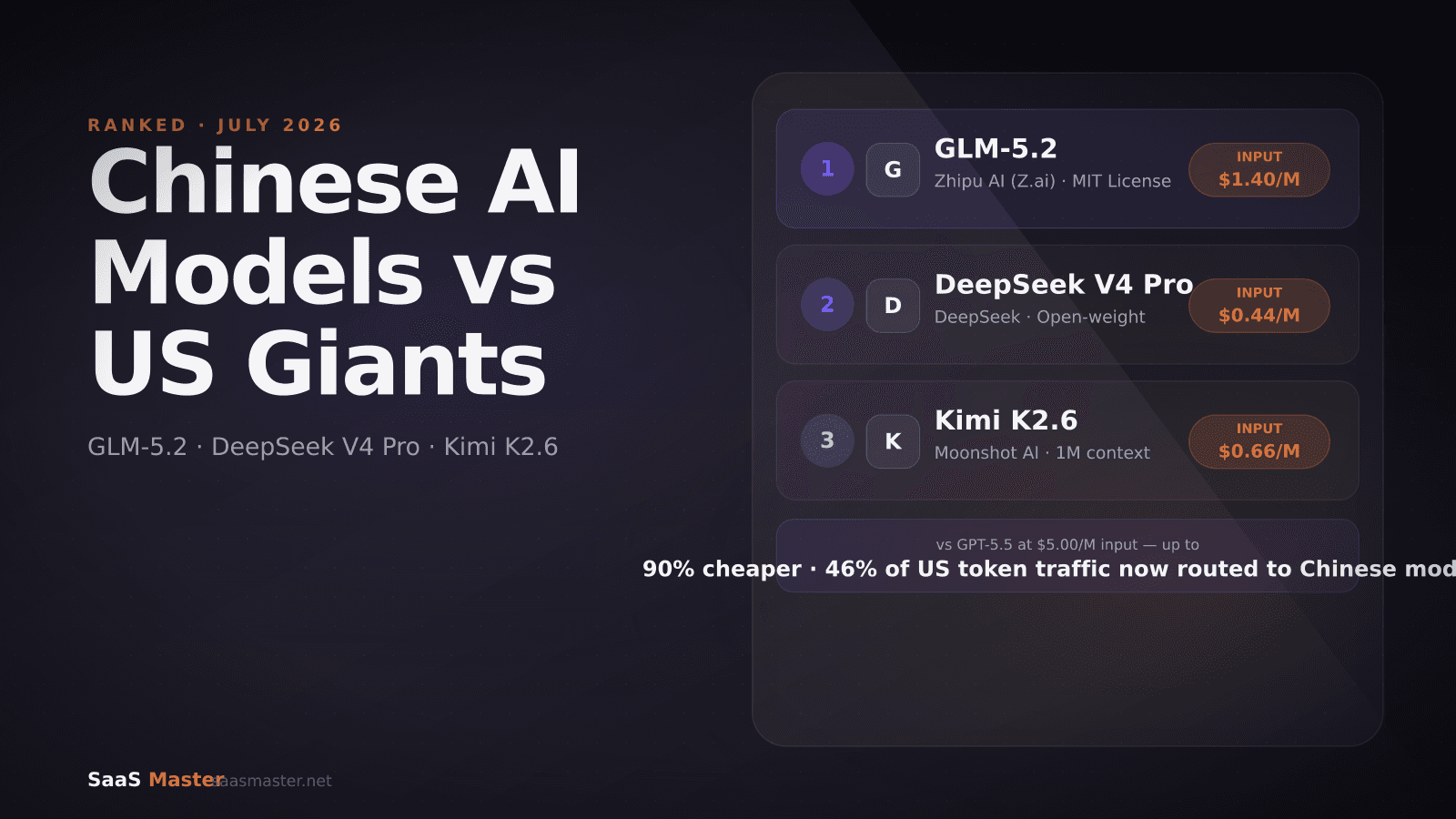
GLM-5.2, DeepSeek V4 Pro, and Kimi K2.6: The Chinese AI Models Cutting SaaS API Costs by 90%
Veo 3.1 vs Kling 3.0 vs Runway Gen-4.5: Best AI Video Generator in 2026 (Sora Is Gone)
Claude Opus 4.8 vs GPT-5.5: Every Benchmark, Real Pricing, and Which to Use in 2026