Veo 3.1 vs Kling 3.0 vs Runway Gen-4.5: Best AI Video Generator in 2026 (Sora Is Gone)
In short
Sora was discontinued April 26, 2026. We compared Veo 3.1, Kling 3.0, and Runway Gen-4.5 on quality, price, clip length, and audio to find the best AI video generator in 2026.
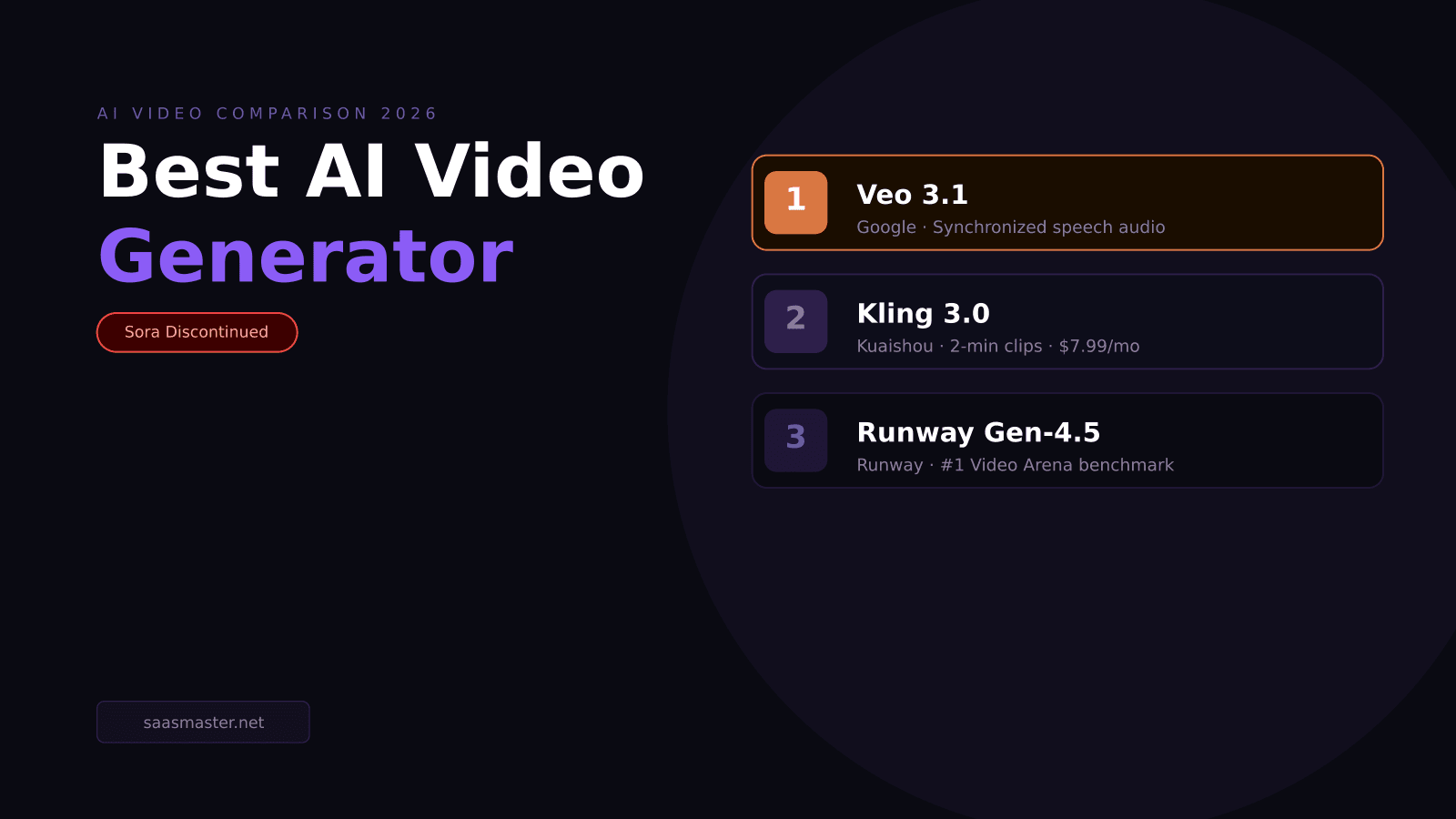
What happened to Sora: OpenAI discontinued Sora on April 26, 2026, folding video generation into a broader multimodal product. If you were using Sora, you need a new tool. This guide covers what's actually worth switching to.
The AI Video Landscape in 2026
Three tools have emerged as the clear leaders post-Sora: Google's Veo 3.1, Kuaishou's Kling 3.0, and Runway's Gen-4.5. Each has a distinct strength — Veo on synchronized audio, Kling on clip length and value, Runway on benchmark quality scores. The right choice depends on your primary use case and budget.
Key Takeaways
- Veo 3.1 is the only tool with synchronized speech audio — it generates voiceover that matches lip movement
- Kling 3.0 offers the longest clips (up to 2 minutes) at the lowest entry price ($7.99/month)
- Runway Gen-4.5 ranks #1 on the Video Arena benchmark for overall visual quality
- Sora was discontinued April 26, 2026 — migrate before any existing integrations break
- Luma Dream Machine is a solid free-tier option if budget is the primary constraint
Why Synchronized Audio Changes Everything for SaaS Video
For most of the AI video generation era, audio was an afterthought — you'd generate a video clip, then overlay music or a separate voiceover in post-production. Veo 3.1 breaks this model by generating synchronized speech audio that matches the on-screen action.
For SaaS explainer videos and product demos, this is a significant workflow change. A 30-second product walkthrough that previously required a separate recording session, editing pass, and lip-sync check can now be generated in a single prompt. The quality isn't yet at professional voice actor level, but for internal demos, social content, and first-draft scripts, it's genuinely useful.
Veo 3.1: The Audio Leader
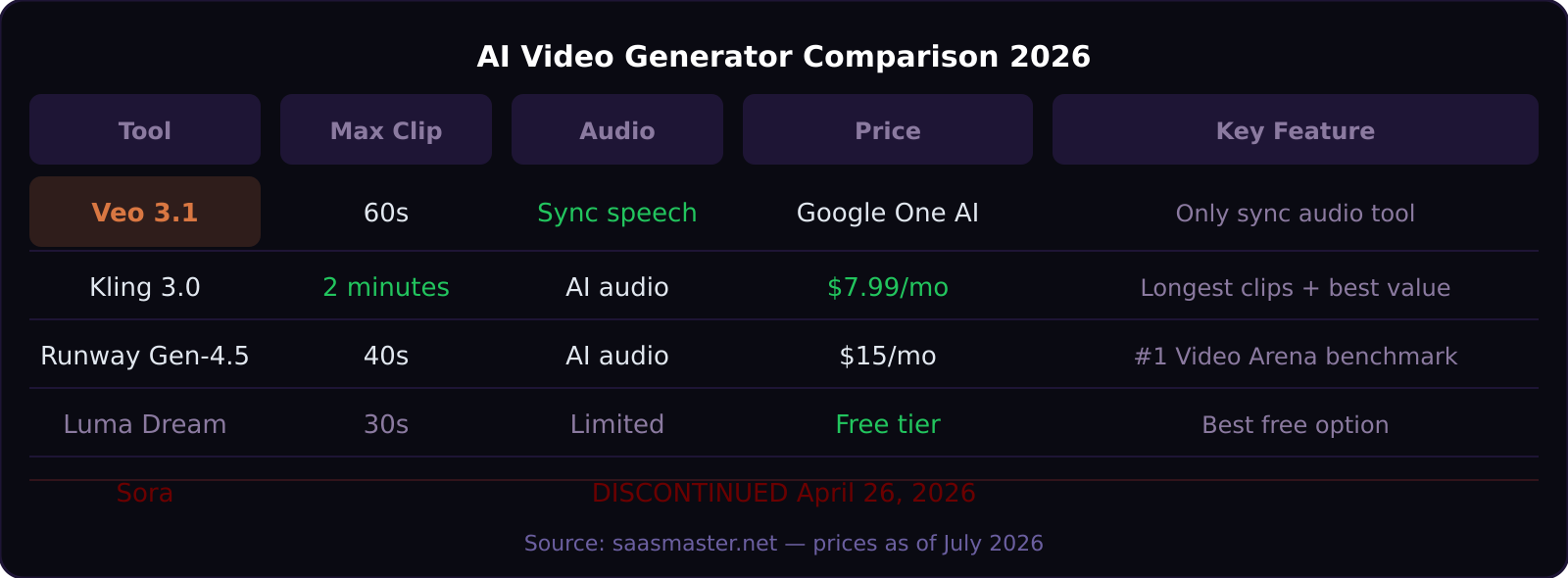
Veo 3.1 is Google's third-generation video model, available through Google One AI Premium and the Gemini API. Maximum clip length is 60 seconds per generation.
Audio: Synchronized speech, ambient sound, and music generation — all generated together with the video. This is Veo's defining advantage over every other tool on this list.
Quality: Photorealistic with strong temporal consistency (objects and people maintain appearance across frames). Struggles with complex physics and multi-person interactions at long durations.
Pricing: Included in Google One AI Premium. API pricing is per-second of generated video.
Best for: Marketing videos with dialogue, product demos with narration, social content where sound is critical.
The synchronized audio capability alone makes Veo 3.1 the default recommendation for product video production that includes speech.
Kling 3.0: The Value Champion
Kling 3.0 is the latest model from Kuaishou, the Chinese short-video platform. Kling has steadily improved since its 2024 launch and version 3.0 represents a significant quality jump.
Maximum clip length: 2 minutes — the longest of any mainstream AI video tool. This is Kling's defining advantage.
Audio: AI-generated ambient audio. Speech sync is not yet at Veo's level.
Quality: Excellent motion quality with strong coherence at longer durations. Character movement is particularly smooth.
Pricing: Free tier available. Paid plans start at $7.99/month — the lowest entry price in this category.
Best for: Narrative video, B-roll footage, content creators who need longer clips on a budget.
The 2-minute clip length dramatically reduces the number of generations needed for a finished piece. For SaaS video production teams with limited budgets, Kling 3.0 at $7.99/month represents the best cost-per-minute ratio currently available.
Runway Gen-4.5: The Quality Benchmark Leader
Runway's Gen-4.5 is the fourth major model generation from Runway, which has been a fixture in the AI video space since 2022.
Maximum clip length: 40 seconds.
Audio: AI-generated ambient and music audio. Speech generation is in beta.
Quality: Ranks #1 on the Video Arena benchmark — a community-driven leaderboard where humans vote between blind video comparisons. Particularly strong on cinematic quality, color grading, and artistic style adherence.
Pricing: Free tier with limited credits. Paid plans start at $15/month.
Best for: High-quality visual content, film-adjacent projects, teams where benchmark quality is the primary requirement.
Runway's Video Arena #1 ranking is meaningful because it's human-preference based, not a synthetic benchmark. If you need video that looks the most professional to a human viewer, Runway Gen-4.5 is the current leader.
What Actually Happened to Sora
OpenAI launched Sora in February 2024 to massive attention, then struggled with quality consistency and production scale. The April 2026 discontinuation folded Sora's technology into OpenAI's broader multimodal product (accessed through the standard ChatGPT interface) rather than as a standalone service.
This means Sora-based integrations, API access, and pricing plans are no longer available. If you built workflows around Sora's API, migrating to Veo or Kling is the most straightforward path given their OpenAI-compatible API structures.
For AI-assisted video creation workflows using automation tools, see our n8n vs Zapier vs Make comparison for how to wire these tools together efficiently.
Which Should You Choose?
For SaaS product demos and explainer videos: Veo 3.1 for anything with speech; Kling 3.0 for silent product walkthroughs where budget matters.
For social content creators: Kling 3.0 for the price and clip length. Runway Gen-4.5 if visual quality is the priority.
For agencies and production companies: Runway Gen-4.5 as the primary tool, with Veo 3.1 for audio-forward deliverables.
For individual creators on a tight budget: Kling 3.0 at $7.99/month, with Luma Dream Machine's free tier for low-stakes content.
The AI video space is advancing quickly. See our Mureka AI Music review for the parallel landscape in AI audio generation.
Building an AI Video Workflow in 2026
The most effective AI video workflows combine multiple tools: Veo 3.1 for speech-heavy scenes, Kling 3.0 for B-roll and longer cuts, and Runway Gen-4.5 for hero shots requiring maximum visual quality. This multi-tool approach is more flexible than committing to a single platform and lets you optimize cost per scene.
For AI tool video production teams producing weekly content, this stack can reduce video production costs by 60-80% compared to traditional production. The bottleneck shifts from production to creative direction and quality review — exactly where human judgment adds the most value.
Frequently Asked Questions
Why was Sora discontinued?
OpenAI hasn't published detailed reasons, but the consensus among industry observers is that Sora struggled to scale to competitive quality levels against Veo and Kling while remaining cost-effective. The technology has been integrated into OpenAI's broader platform rather than maintained as a standalone product.
Can AI video tools generate text on screen reliably?
Text generation remains a weakness across all tools — letters often distort, blur, or change mid-clip. For text overlays, add them in post-production using a standard video editor. This is a known limitation the field is actively working to address.
How do these tools handle brand consistency across multiple clips?
None of the current tools have built-in brand memory. Maintaining visual consistency across a campaign requires detailed prompting (specifying exact color palettes, character descriptions, and style references) and often generating multiple clips from the same base prompt. This is where professional SaaS video production teams add significant value.
Is there an API for all three tools?
Veo 3.1 has a public API via Google AI Studio. Kling has a business API. Runway has a developer API at dev.runwayml.com. All three support programmatic video generation for production pipelines.
What resolution do these tools output?
All three support 1080p output. Veo 3.1 and Runway Gen-4.5 support 4K on higher tiers. For social media content, 1080p is sufficient; for broadcast or cinema work, verify resolution requirements against current tier capabilities before committing to a workflow.
Was this article helpful?
Jorge Aguilar
Founder & Creator, SaaS Master
Producing SaaS and AI product videos since 2019 — 800+ videos for 200+ brands, covering tutorials, demos, walkthroughs, and explainers. Writing here about the tools, trends, and tactics that actually move the needle. LinkedIn · About · Work with me
Building an AI product that needs a clearer onboarding flow?
Client-owned videos that make your product easy to understand — demos, walkthroughs, onboarding, and explainers.
Explore AI product video productionRelated guides
More AI Tools & AI Workflows →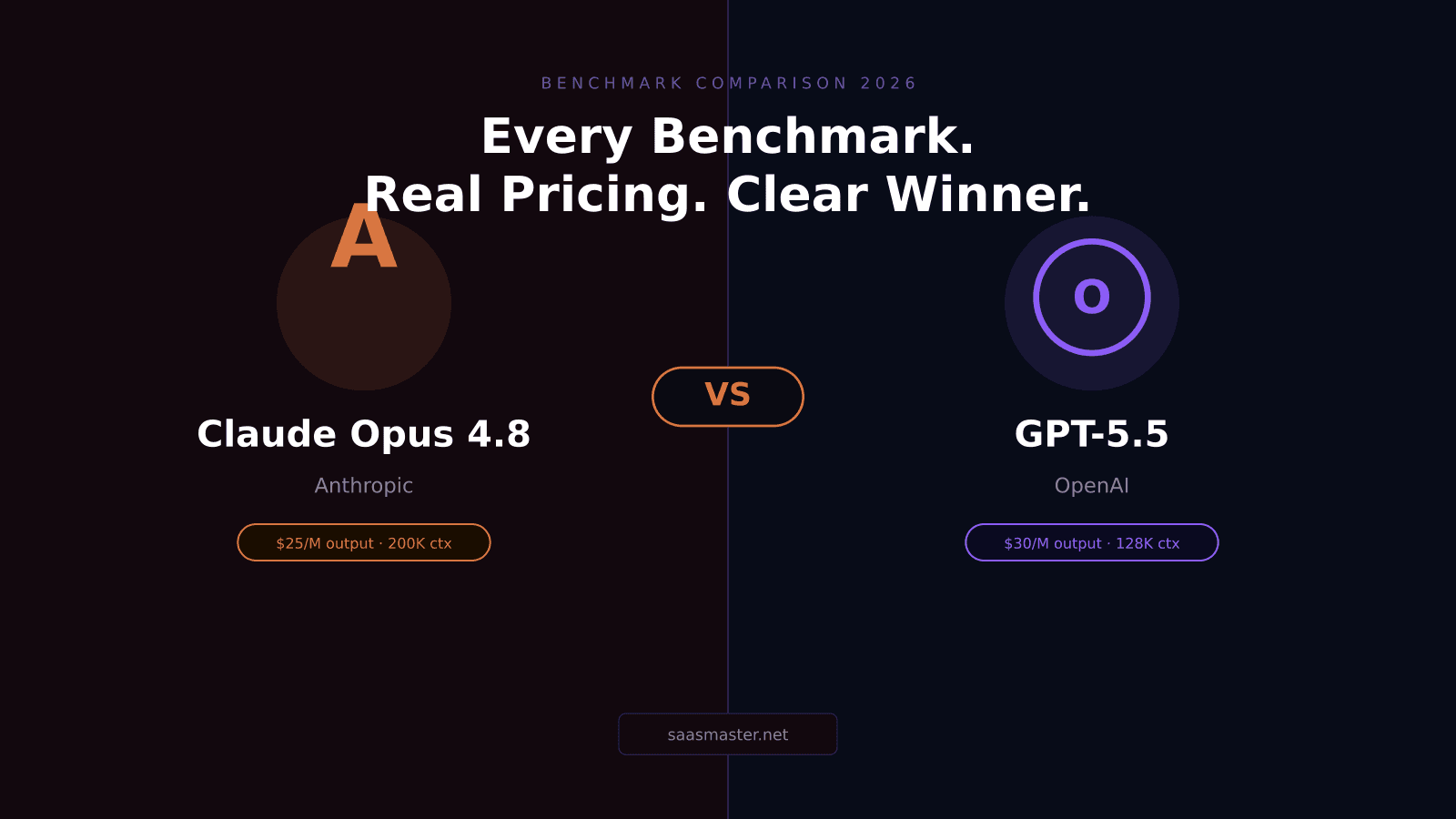
Claude Opus 4.8 vs GPT-5.5: Every Benchmark, Real Pricing, and Which to Use in 2026
How to Use MiniMax M3 with Claude Code for Free — AI Web Development That Actually Works
I Turned a Boring PDF Into an Interactive Flipbook Using Flipsnack — Here's What I Found