Claude Fable 5 vs GPT-5.6 vs Gemini 3.5 Pro: Which AI Model Wins in July 2026?
In short
Claude Fable 5, GPT-5.6, and Gemini 3.5 Pro compared in July 2026 — benchmarks, pricing, and a clear verdict on which frontier model is right for your team.
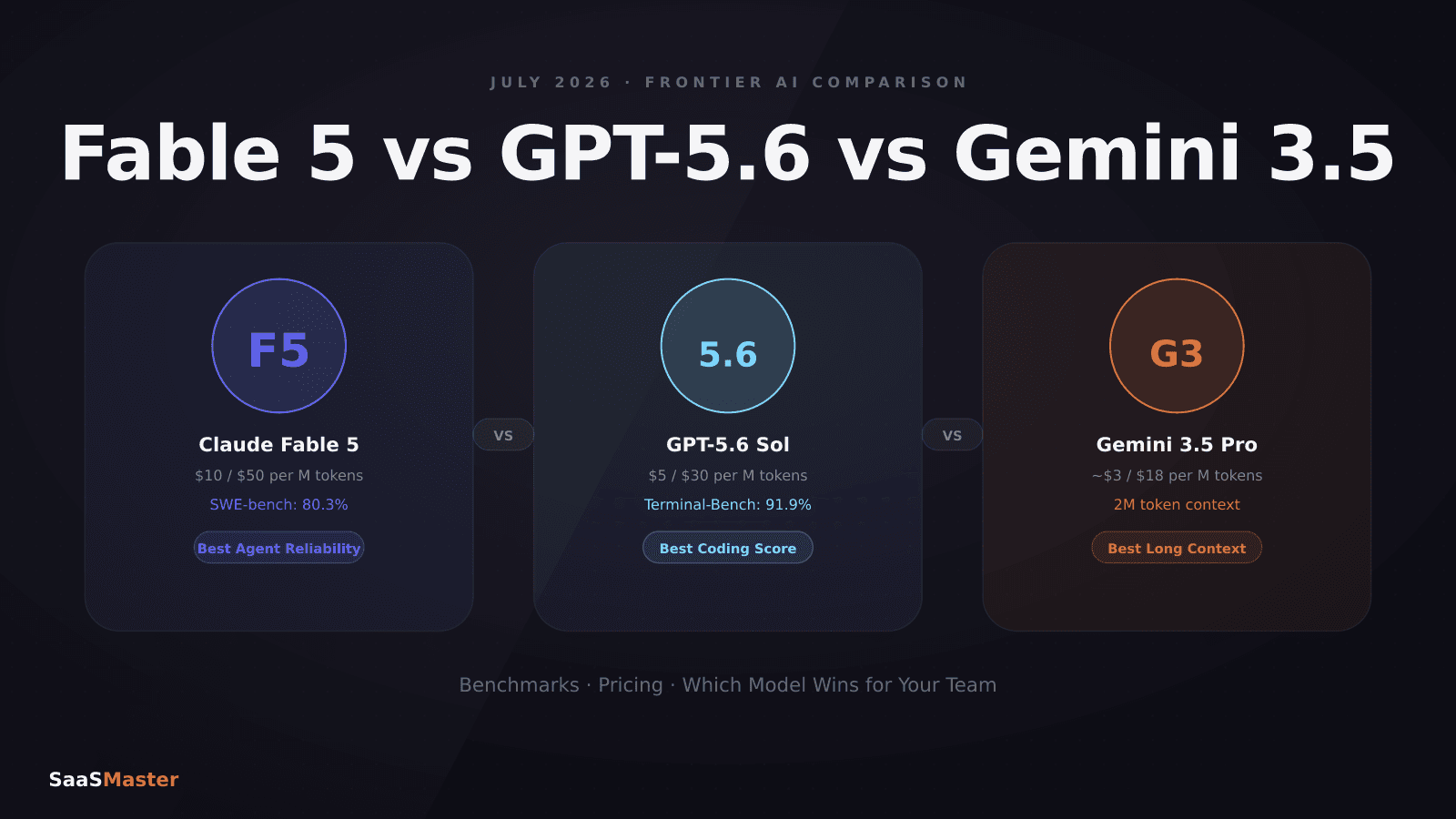
Three frontier AI models launched within days of each other in late June and early July 2026: Claude Fable 5, GPT-5.6, and Gemini 3.5 Pro. If you need the short answer: Fable 5 leads on agent reliability and real-world software engineering, GPT-5.6 Sol scores highest on coding benchmarks at roughly half the price, and Gemini 3.5 Pro is the one to pick for long-context and multimodal work. This guide walks through benchmarks, pricing, and the clearest use-case split I can give you right now.
Key takeaways
- Claude Fable 5 scores 80.3% on SWE-bench Pro — the highest of any publicly available model as of July 2026
- GPT-5.6 Sol hits 91.9% on Terminal-Bench 2.1, priced at $5 input / $30 output per million tokens
- Gemini 3.5 Pro carries a 2M-token context window and Deep Think reasoning, with pricing estimated at ~$3/$18 per million tokens
- Fable 5 is the most expensive at $10/$50 per million tokens — roughly 2x Sol, 3x Gemini 3.5 Pro
- For production agents and complex pipelines: Fable 5. For coding tasks at scale: Sol or Terra. For long documents and multimodal work: Gemini 3.5 Pro
What is happening in frontier AI this month?
All three of the biggest AI labs dropped top-tier models within ten days of each other. Claude Fable 5 shipped June 9, GPT-5.6 reached general availability on July 9, and Gemini 3.5 Pro was in limited Vertex AI enterprise preview as of July 12 with broader public launch expected around July 17. The performance gaps between models are narrower than they have ever been, which makes pricing, context limits, and specific use-case fit more important than raw benchmark rankings.
The market is splitting into two tiers: models you reach for when quality is everything (Fable 5), and models you run at volume for efficiency (GPT-5.6 Terra, Gemini 3.5 Pro). Most serious teams will end up routing different task types to different models.
Claude Fable 5: the quality and agent reliability leader
Fable 5 is Anthropic's first Mythos-class model. When it launched on June 9, it immediately took the top spot on the WebDev Arena leaderboard — 92 Elo points ahead of second place, the widest margin ever recorded at launch. On SWE-bench Pro, it scores 80.3%, which is 11 points ahead of Claude Opus 4.8 (69.2%) and more than 20 points ahead of GPT-5.5 (58.6%) and Gemini 3.1 Pro (54.2%).
What actually matters in practice is agent reliability. Fable 5 hallucinates significantly less than the competition on agentic tasks — specifically on tasks where a model has to call external tools, maintain state across multiple steps, and complete a workflow without human intervention. In real-world testing, it is the only model that consistently completes 15-step code review and deployment pipelines without tool-call failures.
The tradeoff is cost. At $10 per million input tokens and $50 per million output tokens, it is the most expensive model on this list. Context window: 1M tokens generally available, 32K max output. For high-volume production workloads the cost compounds quickly; for lower-volume, high-stakes work — legal document review, production agent deployments, complex multi-step automations — the premium is easier to justify.
GPT-5.6 Sol, Terra, and Luna: OpenAI's tiered model strategy
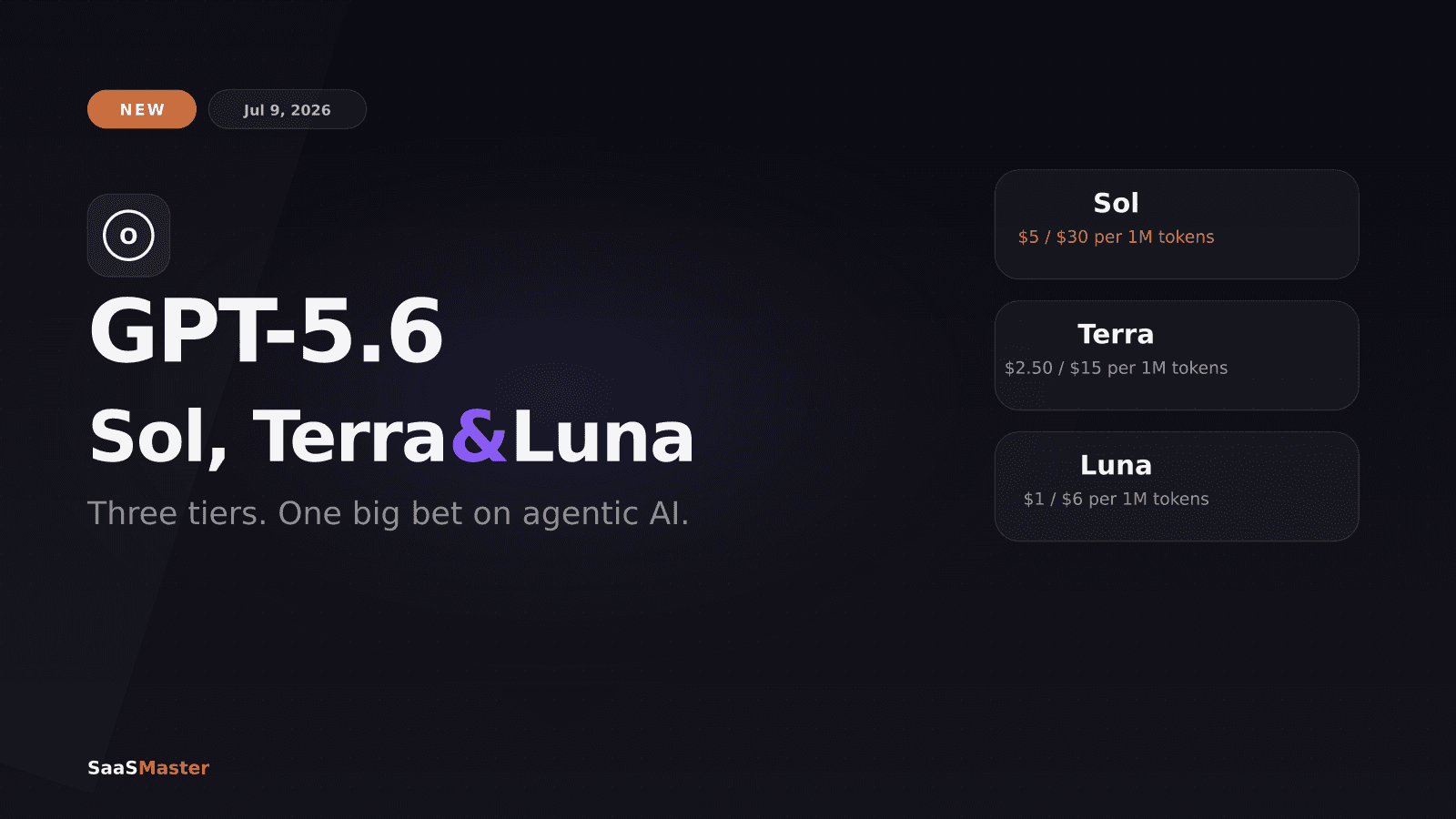
GPT-5.6 is OpenAI's first API-level tiered model: three variants sharing a 1M-token context window and a February 2026 knowledge cutoff, differentiated by capability and cost.
Luna at $1/$6 per million tokens is the speed play — cheap, fast, suited for high-volume lower-complexity tasks like classification, extraction, and summarization. Terra at $2.50/$15 sits in the middle: GPT-5.5-competitive performance at 2x lower cost than Sol. Sol at $5/$30 is the flagship, and it earns its place with a 91.9% score on Terminal-Bench 2.1, the highest of any model in this comparison.
Sol's Terminal-Bench lead is real, but Terminal-Bench tests a specific kind of structured coding challenge. On real-world agentic tasks that require multi-step reasoning, tool selection, and state management, Fable 5 still wins on completion rate. Sol is the better choice for tasks that map cleanly to benchmark-style coding work — writing and reviewing code, solving algorithmic problems, structured programming tasks. Terra is the choice when you need that quality tier at scale and want to keep costs reasonable.
GPT-5.6 Luna and Terra are generally available. Sol is in a limited API preview as of July 12, with broader access rolling out through Q3 2026.
Gemini 3.5 Pro: Google's long-context and multimodal play
Gemini 3.5 Pro is not yet publicly available as of this writing — it is in limited Vertex AI enterprise preview as of July 12, with public launch expected around July 17. Google has confirmed a 2M-token context window (the largest of the three by a factor of 2), Deep Think reasoning for complex multi-step problems, and native multimodal support across text, image, video, and audio.
Estimated pricing sits at approximately $3 per million input tokens and $18 per million output tokens — well below Fable 5 and competitive with Sol. Google's context caching reduces cached input costs by roughly 90%, making it particularly cost-effective for repeated queries against large codebases or documents.
Gemini 3.5 Pro's edge cases are clear: long-document analysis, multimodal content workflows, anything benefiting from 2M tokens of context, and any team already deep in the Google Cloud ecosystem. Where it trails: agentic coding reliability, where Fable 5 still leads, and structured benchmark performance, where Sol leads on Terminal-Bench.
How do Claude Fable 5, GPT-5.6, and Gemini 3.5 Pro compare on benchmarks?
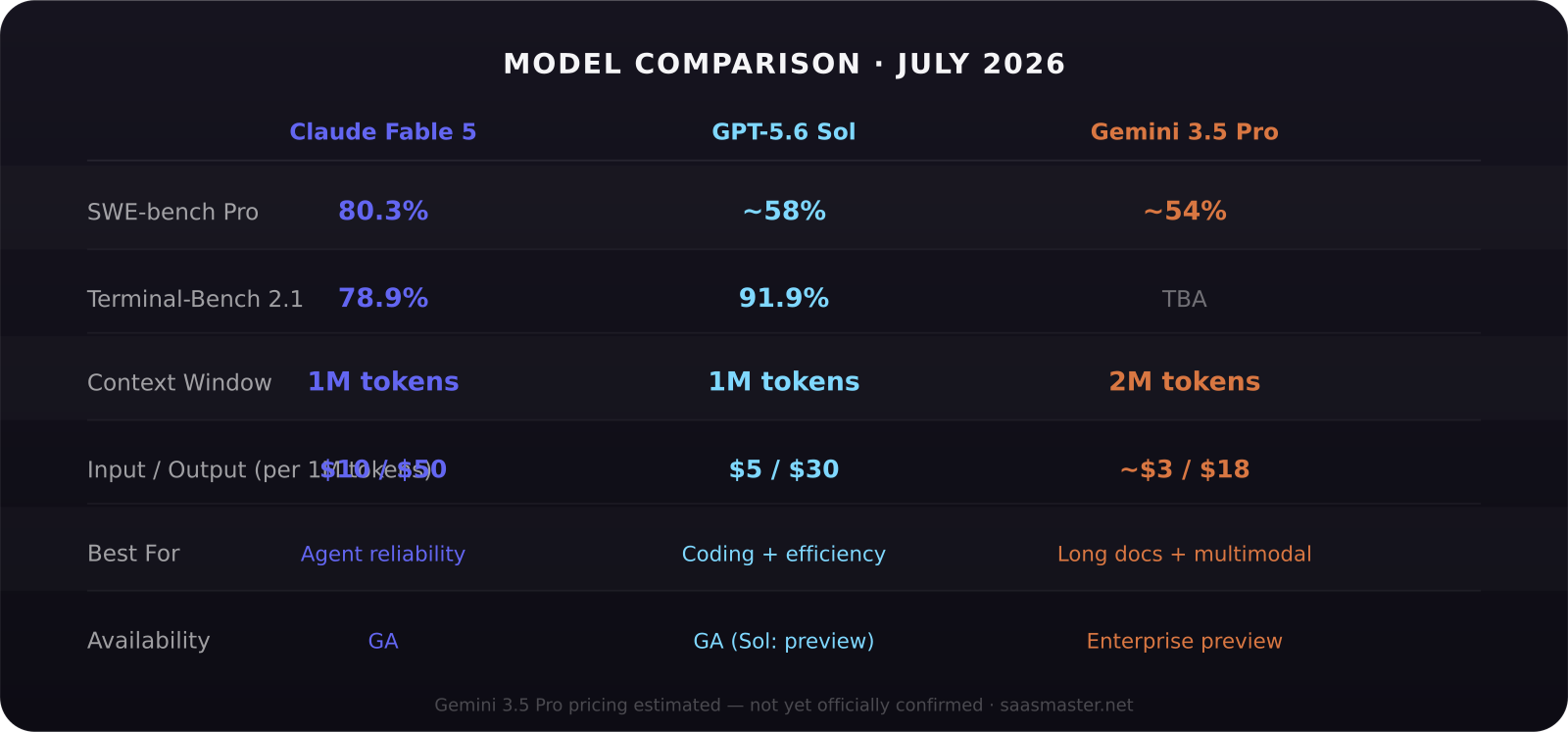
The benchmark picture as of July 12, 2026:
- SWE-bench Pro (real-world software engineering tasks): Fable 5 at 80.3%, GPT-5.5 baseline at ~58%, Gemini 3.1 Pro at ~54% — Gemini 3.5 Pro results not yet published
- Terminal-Bench 2.1 (coding agent tasks): Sol at 91.9%, Fable 5 at 78.9%, Gemini 3.5 Pro TBA
- GPQA Diamond (graduate-level reasoning): Gemini 3.5 Pro is expected to lead based on Google's pre-launch benchmarks, followed closely by Fable 5
- Multimodal (MMMU Pro): Gemini leads, Sol second, Fable 5 third
No model wins every benchmark. The correct framing is not "which model is best" but "which model is best for this specific task."
What does each model actually cost at scale?
For a mid-size team running 10M input tokens and 2M output tokens per month, the monthly cost looks like this:
- Claude Fable 5: $100 input + $100 output = $200/month
- GPT-5.6 Sol: $50 + $60 = $110/month
- GPT-5.6 Terra: $25 + $30 = $55/month
- Gemini 3.5 Pro (estimated): $30 + $36 = $66/month
For content work, research, or general-purpose AI tasks where the output quality difference between Fable 5 and Terra is marginal, Terra or Gemini 3.5 Pro deliver roughly 80% of the quality at 25–33% of the cost. For coding-intensive agentic work where a bad output has real consequences, Fable 5's higher price is easier to justify.
Which model should you pick?
If you are running production AI agents — where a hallucinated tool call or missed step causes a real downstream problem — Fable 5 is the defensible choice. The lower failure rate on multi-step tasks is worth the premium.
If you are doing structured coding work, reviewing code, or running benchmark-style tasks at volume, Sol gives you the highest ceiling at half the Fable 5 price. Terra is the pick if you need to run Sol-adjacent quality across thousands of requests.
If your work involves long documents, multimodal inputs, or you're already in the Google Cloud ecosystem, Gemini 3.5 Pro is worth waiting for. The 2M context window and estimated pricing make it the logical choice for those workflows once it hits general availability.
Most teams building serious AI products will route different task types to different models. Fable 5 for the hard agentic work. Sol or Terra for coding volume. Gemini 3.5 Pro for the long-context layer.
For a deeper look at AI tools in video production and content strategy, see our AI tool video production service and explore the AI Tools hub for more comparisons like this one.
For context on how AI coding agents like Claude Code compare to each other, our OpenCode vs Claude Code vs Cursor guide covers that space in detail.
Frequently asked questions
Is Claude Fable 5 better than GPT-5.6 Sol?
It depends on the task. Fable 5 leads on SWE-bench Pro (80.3% vs ~58% for the GPT-5.5 baseline) and real-world agent completion rates. Sol leads on Terminal-Bench 2.1 at 91.9% and costs roughly half as much. For production agent deployments where reliability matters most, Fable 5 is the safer pick. For high-volume coding tasks where benchmark scores predict performance, Sol is competitive at a lower cost.
When will Gemini 3.5 Pro be publicly available?
As of July 12, 2026, Gemini 3.5 Pro is available in limited Vertex AI enterprise preview only. Google has not confirmed a specific public launch date, but multiple reports point to around July 17, 2026. Official pricing has not been announced — community estimates suggest approximately $3/$18 per million tokens.
How much does Claude Fable 5 cost compared to its predecessors?
Fable 5 is priced at $10 per million input tokens and $50 per million output tokens. Claude Opus 4.8 was priced at $5/$25, making Fable 5 exactly twice the price. The premium is positioned around the Mythos-class quality improvements — specifically the agent reliability and SWE-bench Pro lead over Opus 4.8.
Was this article helpful?
Jorge Aguilar
Founder & Creator, SaaS Master
Producing SaaS and AI product videos since 2019 — 800+ videos for 200+ brands, covering tutorials, demos, walkthroughs, and explainers. Writing here about the tools, trends, and tactics that actually move the needle. LinkedIn · About · Work with me
Building an AI product that needs a clearer onboarding flow?
Client-owned videos that make your product easy to understand — demos, walkthroughs, onboarding, and explainers.
Explore AI product video productionRelated guides
More AI Tools & AI Workflows →
Notion AI in 2026: Custom Agents, Pricing Changes, and the Honest Verdict
Qwen3.7-Max vs DeepSeek V4 Pro: China's Best AI Models Compared
GPT-5.6 Sol, Terra & Luna: What OpenAI Just Shipped (And Which Tier Is Right for You)