GPT-5.6 Sol, Terra & Luna: What OpenAI Just Shipped (And Which Tier Is Right for You)
In short
OpenAI released GPT-5.6 on July 9, 2026 — three tiers named Sol, Terra, and Luna, plus ChatGPT Work. Here's the full breakdown with pricing, benchmarks, and who should use each.
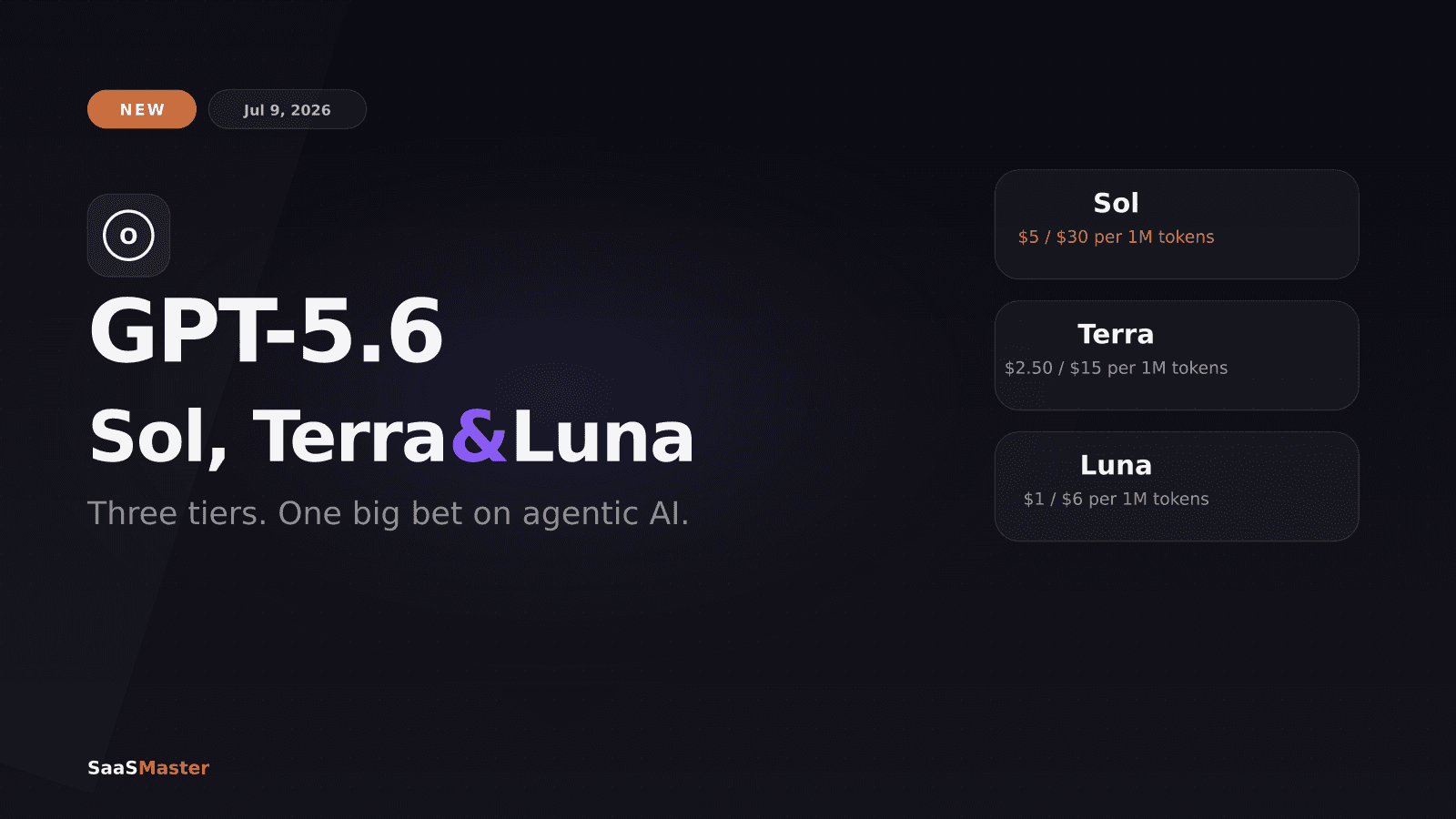
OpenAI shipped three new models on July 9, 2026 — Sol, Terra, and Luna — under the GPT-5.6 family name, alongside a new product called ChatGPT Work. If you've been waiting for the clearest picture yet of what OpenAI's current model lineup actually costs and what each tier is genuinely for, here it is.
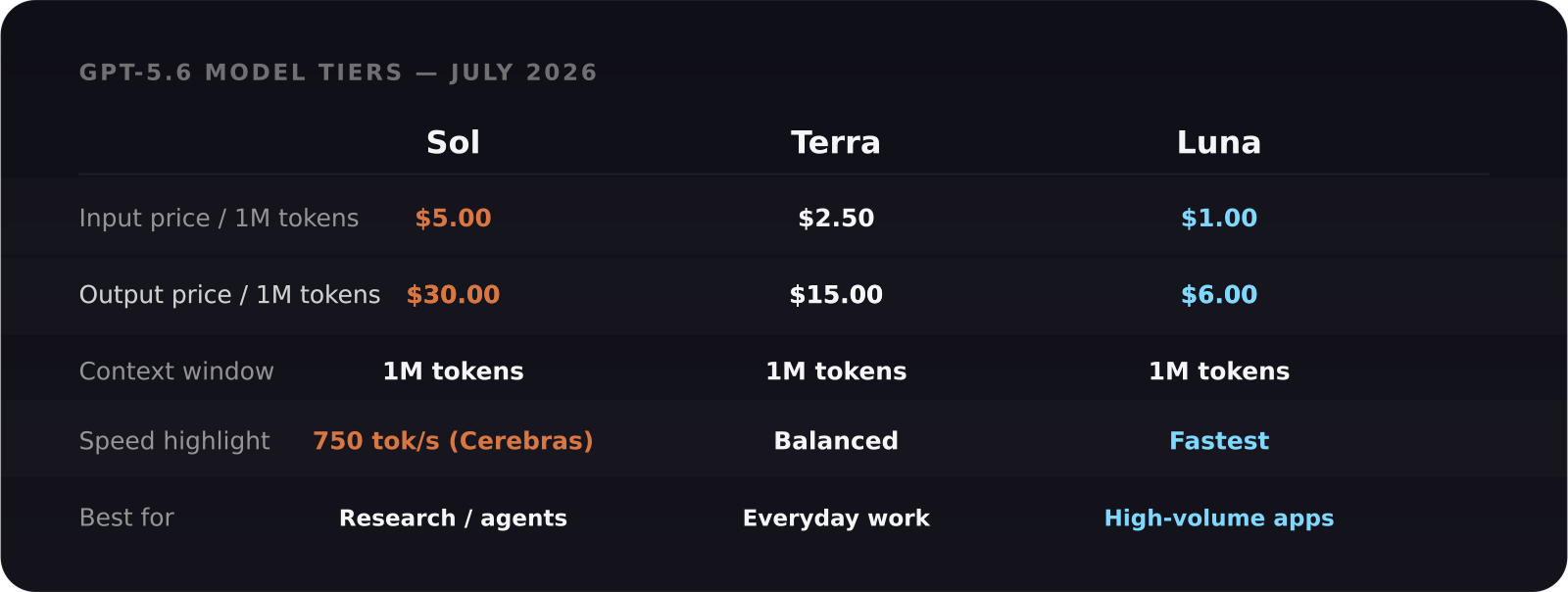
Key takeaways: - GPT-5.6 comes in three tiers: Sol ($5/$30 per 1M tokens), Terra ($2.50/$15), and Luna ($1/$6) — all with 1M token context. - ChatGPT Work is OpenAI's new autonomous workplace agent, available today for Pro, Enterprise, and Edu plans. - Sol runs on Cerebras at up to 750 tokens per second — frontier intelligence at real-time speed. - Claude Sonnet 5 at $2/$10 (intro pricing through August 31) is still the cheaper production option for many teams. - The real story isn't the models — it's ChatGPT Work, the first time OpenAI has shipped an agent that outputs finished documents, not just chat.
What exactly did OpenAI release on July 9?
Two things launched together, and conflating them misses the point. First, the GPT-5.6 model family: three API-accessible models that represent OpenAI's current cost-performance spectrum. Second, ChatGPT Work: an autonomous agent product built on GPT-5.6, designed to complete multi-step business tasks with minimal supervision.
The models share a common spec: 1M token context window, 128,000 maximum output tokens, and a knowledge cutoff of February 16, 2026. What differs is where they sit on the intelligence-vs-cost curve.
The three-tier breakdown: Sol, Terra, Luna
Sol is OpenAI's flagship. At $5 input and $30 output per 1M tokens, it's priced at a premium that will make most engineering teams wince. But the benchmark numbers justify the position: Sol averages 94.6 on knowledge tasks and hit 91.9% on Terminal-Bench 2.0, a meaningful jump over its predecessor GPT-5.5. In a test that made headlines before launch, Sol Ultra (running on Cerebras hardware at up to 750 tokens per second) proved a long-unsolved mathematical conjecture — the Cycle Double Cover Conjecture — in under an hour using 64 parallel subagents. That kind of performance is irrelevant for most apps but tells you where the ceiling sits.
Terra is the middle-ground model at $2.50 input and $15 output per 1M tokens. OpenAI designed it for "everyday work" — think complex document processing, multi-turn agentic tasks, and production pipelines where you want more than Luna but can't justify Sol's output costs. For most SaaS teams building AI features, Terra is probably the entry point for serious evaluation.
Luna is the speed and cost play at $1 input and $6 output per 1M tokens. It won't outperform the frontier on reasoning, but for classification, summarization, lightweight agents, and user-facing responses where latency matters, Luna competes directly with Claude Haiku and Gemini Flash. At a dollar per million input tokens, high-volume apps finally have an OpenAI option that makes the numbers work.
ChatGPT Work: the agentic product that matters more than the models
The model specs are interesting. ChatGPT Work is more important.
OpenAI describes it as an agent that "takes an outcome, gathers information across your connected apps and workflows, breaks the job into smaller steps, and completes them independently — staying with complex projects for hours." The output is finished material: spreadsheets, slides, documents, interactive web apps.
It integrates natively with Slack, Microsoft Teams, Google Drive, SharePoint, email, calendars, CRM platforms, and project management tools. The control surfaces are smart: Plan mode shows you a step-by-step plan before work starts, configurable check-ins let you approve at any stage, and action approvals mean you decide how autonomous it actually gets.
For SaaS companies, the clearest use case is internal ops work that currently burns senior people's time — competitive analysis, weekly reporting, customer research synthesis. ChatGPT Work handles the gathering and the first draft; a human handles the judgment call. That's a reasonable division of labor.
It's available today on Pro, Enterprise, and Edu plans. Plus and Business users get access "in the next few days" — which, given OpenAI's rollout history, could mean anything from 48 hours to three weeks.
How does GPT-5.6 stack up against the competition right now?
The honest comparison is mostly with Claude Sonnet 5 and Gemini 3.1 Pro, since those are the current production-relevant frontier models.
Claude Sonnet 5 is priced at $2 input and $10 output per 1M tokens through August 31, 2026 — then moving to $3/$15. It scores 63.2% on SWE-bench Pro versus GPT-5.5's 58.6%, though GPT-5.6 Sol's knowledge advantage is significant. The practical read: Sonnet 5 is cheaper and slightly ahead on agentic coding; Sol leads on deep knowledge tasks. If you're building production coding pipelines, Sonnet 5 has a strong cost-performance argument right now. If you need max knowledge depth — research, legal analysis, complex reasoning — Sol is worth the premium.
Gemini 3.1 Pro leads on front-end and multimodal tasks, with a 1,487 Elo on WebDev Arena and top LiveCodeBench scores. That's a meaningful niche for teams building UI-heavy products.
The pattern that keeps repeating: no single model is the best at everything. The teams winning with AI right now are routing tasks to the right model per use case, not betting the whole stack on one provider.
Is GPT-5.6 actually available to you right now?
GPT-5.6 is available via the OpenAI API, ChatGPT (all paid tiers), Codex, and — as of July 9 — GitHub Copilot. The broader rollout is gradual; Sol in particular is still scaling to full API availability.
The launch on Cerebras for Sol is worth flagging specifically for SaaS developers: 750 tokens per second is fast enough to power real-time user-facing experiences you couldn't previously build with a frontier model. That gap between "frontier model" and "production-usable speed" is narrowing faster than most teams have updated their assumptions.
Who should actually switch or upgrade?
If you're currently on GPT-4o or GPT-5.0: Terra is likely a meaningful intelligence upgrade at roughly comparable cost depending on your usage pattern. Test it on your actual workload — the improvement on knowledge and reasoning tasks is measurable.
If you're on Claude Sonnet 5 for coding: the cost advantage still favors staying put through August. Reassess when Anthropic's intro pricing expires.
If you're building high-volume user-facing features: Luna at $1/$6 per 1M tokens is a serious option. Run it against Gemini Flash and Claude Haiku on your specific task — don't assume one wins without testing.
If you're evaluating ChatGPT Work for enterprise: the integrations and control surfaces are more mature than I expected at launch. The Plan mode approval flow is what enterprise IT actually needs to feel comfortable deploying autonomous agents. Worth a pilot if your team has recurring research-to-document workflows.
I've been watching the AI tool space closely, and the three-tier model structure is something other labs will copy quickly. The real differentiator OpenAI is betting on isn't model quality alone — it's the ChatGPT Work product layer on top. That's the stickier asset.
For a deeper look at how AI models are reshaping how SaaS companies present their tools, software walkthrough videos are one area where Luna and Terra are particularly well-suited for script generation and iteration.
Frequently asked questions
What is the difference between GPT-5.6 Sol, Terra, and Luna? Sol is OpenAI's most capable model ($5/$30 per 1M tokens), Terra offers balanced performance ($2.50/$15), and Luna is optimized for speed and cost ($1/$6). All three share a 1M token context window and a February 2026 knowledge cutoff.
What is ChatGPT Work and who can use it? ChatGPT Work is OpenAI's autonomous workplace agent that integrates with Slack, Teams, Google Drive, CRM tools, and more to complete multi-step tasks and produce finished outputs like documents and spreadsheets. It launched July 9, 2026 for Pro, Enterprise, and Edu plans.
Is GPT-5.6 Sol better than Claude Sonnet 5? On knowledge benchmarks, Sol leads significantly (94.6 average vs Sonnet 5's lower knowledge scores). On agentic coding, Claude Sonnet 5 holds a competitive position at a lower price ($2/$10 intro pricing vs Sol's $5/$30). The better choice depends on your use case.
Was this article helpful?
Jorge Aguilar
Founder & Creator, SaaS Master
Producing SaaS and AI product videos since 2019 — 800+ videos for 200+ brands, covering tutorials, demos, walkthroughs, and explainers. Writing here about the tools, trends, and tactics that actually move the needle. LinkedIn · About · Work with me
Building an AI product that needs a clearer onboarding flow?
Client-owned videos that make your product easy to understand — demos, walkthroughs, onboarding, and explainers.
Explore AI product video productionRelated guides
More AI Tools & AI Workflows →
Qwen3.7-Max vs DeepSeek V4 Pro: China's Best AI Models Compared
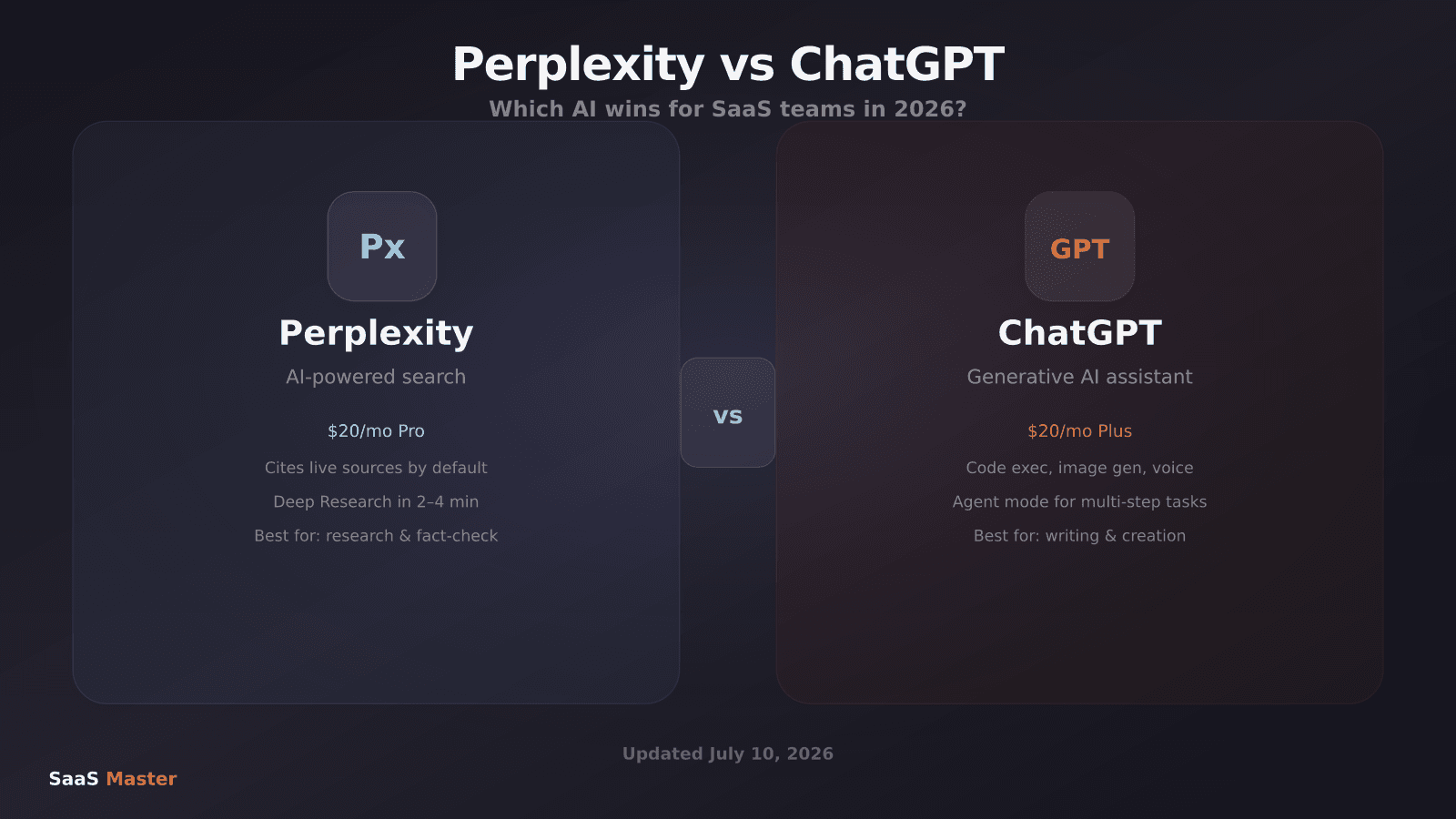
Perplexity vs ChatGPT for SaaS Teams in 2026: Which AI Actually Wins?
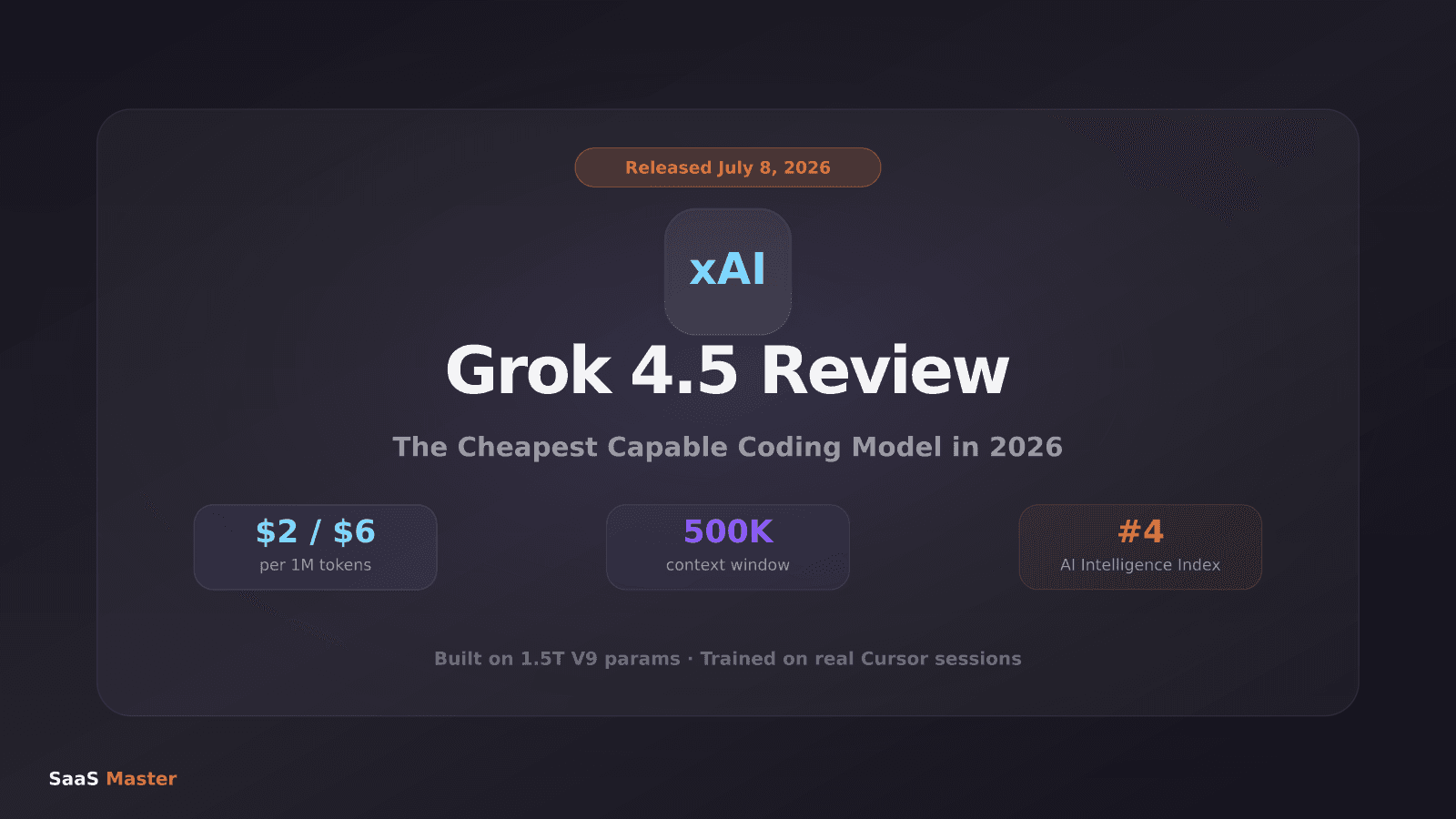
Grok 4.5 Review: xAI's Cheapest Capable Coding Model Is Here (July 2026)