Zapier vs Make vs n8n in 2026: Which Automation Tool Saves You the Most?
In short
Zapier, Make, and n8n compared for 2026 — real pricing, AI capabilities, and a clear pick by team type. Includes cost breakdown at scale.
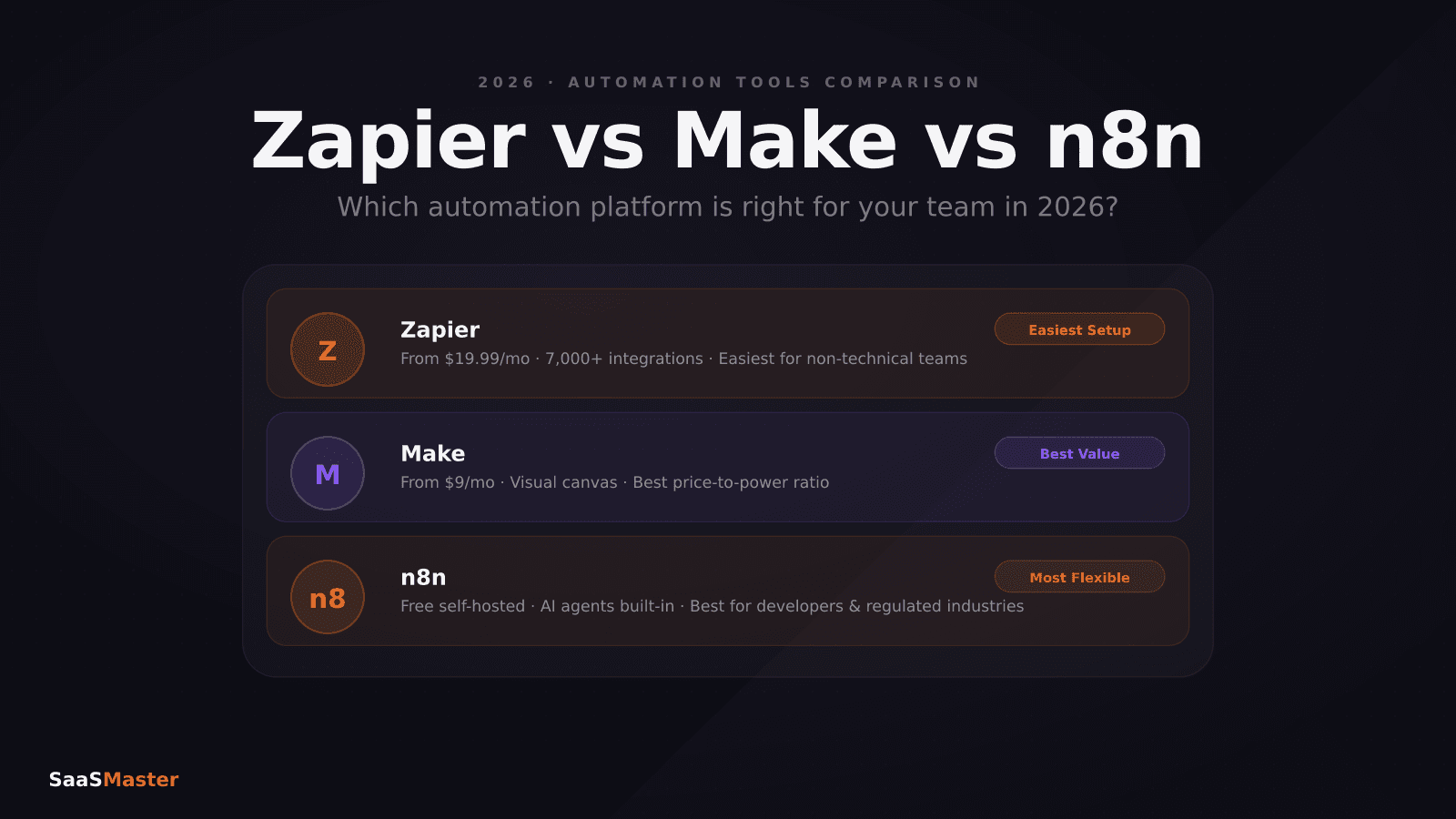
If you are choosing between Zapier, Make, and n8n for automation in 2026, the answer depends almost entirely on who is building the workflows and how much data you are moving. Zapier wins on simplicity and integration breadth, Make wins on value for visual complex workflows, and n8n wins on cost at scale and control for technical teams. This guide breaks down the real numbers so you can make the call.
Key takeaways
- Zapier starts at $19.99/month and counts every action step as a separate task — costs compound fast on multi-step workflows
- Make starts at $9/month and charges per operation, with a visual canvas that handles complex logic better than Zapier
- n8n is free to self-host (Community Edition) with unlimited executions, and charges per whole workflow run on its cloud plans
- For 10,000 runs of a 10-step workflow per month: Zapier costs roughly $940, Make around $60–100, n8n cloud around $60 self-hosted around $15–25
- All three now have native AI agent capabilities, but n8n's LangChain integration makes it the strongest choice for complex AI orchestration
Why does choosing the right automation tool actually matter?
The wrong tool does not just cost you money — it limits what you can build. Zapier's per-task pricing model means a 10-step workflow running 10,000 times a month consumes 100,000 tasks, which puts you well into the $540–$940/month range depending on the plan. The same workflow on Make costs a fraction of that. On self-hosted n8n, you pay only your server costs regardless of how many steps the workflow has.
The gap is not theoretical. Real teams that have switched from Zapier to n8n report cost reductions of 80–90% on equivalent workflows. The tradeoff is setup time and technical complexity — and that tradeoff is real too.
Zapier: the no-code standard with 7,000+ integrations
Zapier is the tool most people reach for first, and for good reason. It connects to 7,000+ apps — more than Make and n8n combined — and the setup experience is genuinely simple enough that anyone in a team can build and modify Zaps without touching a config file. The two-step interface (trigger → action), built-in Zap templates, and in-app help make it the fastest path from "I want to automate this" to a working workflow.
The pricing model is where things get complicated. Zapier counts tasks: every action step that successfully runs is one task. A Zap with one trigger and three action steps burns three tasks per run. At the free tier, you get 100 tasks per month, which lasts about 33 runs of a three-step Zap. The Starter plan at $19.99/month gives you 750 tasks. Scaling to serious automation volumes gets expensive quickly.
Zapier's 2026 AI additions connect to OpenAI and Anthropic via action steps, and there are AI-native templates for content workflows, lead qualification, and inbox processing. These work well for linear single-model tasks but do not match n8n's depth for multi-agent orchestration.
Best for: non-technical teams, fast prototyping, workflows that need to connect unusual or niche apps, and situations where setup speed matters more than cost optimization.
Make: the visual canvas for complex workflows
Make (formerly Integromat) sits between Zapier's simplicity and n8n's technical depth. The drag-and-drop canvas handles branching logic, error routing, iterators, and conditional paths in a way that Zapier's linear interface does not. For workflows that need to process arrays, transform data structures, or branch on multiple conditions, Make's visual model is genuinely better suited.
Make's pricing is based on operations — one operation per module execution — rather than Zapier's per-action-step model. The Core plan at $9/month gives you 10,000 operations. The Pro plan at $16/month gives you 10,000 operations with more features. For most SMBs, Make delivers a better price-to-capability ratio than Zapier for mid-complexity workflows.
The integration library at ~1,500 apps covers most common tools, and Make's HTTP module lets you connect to any REST API. AI capabilities come via OpenAI and Anthropic modules, and Make's scenario templates include AI-powered content generation, CRM enrichment, and support ticket routing.
One limitation worth naming: Make does not have a self-hosted option. Your data flows through Make's servers, which matters for teams in regulated industries.
Best for: SMB teams that need more power than Zapier but do not have developers on hand, multi-branch workflows, data transformation, and teams where visual scenario editing is important.
n8n: free self-hosting, AI agents, and no per-task pricing
n8n is the only one of the three that you can run completely free on your own server. The Community Edition is fully open-source, covers all 350+ native integrations, and has no execution limits — you pay only your server costs, typically $5–25/month for a basic VPS running Docker Compose.
The pricing model on n8n cloud is also structurally different: you pay per workflow execution, not per step. A 50-step workflow and a 2-step workflow each consume exactly one execution per run. The Starter plan at €24/month gives you 2,500 executions, Pro at €60/month gives 10,000, and Business at €800/month gives unlimited. For high-step workflows at volume, this model is dramatically cheaper than Zapier.
The AI agent capabilities are n8n's 2026 standout feature. The native AI Agent node runs LangChain tool agents that can call any other n8n node as a tool, maintain conversation memory, and stream responses. n8n's 70+ LangChain-based nodes for agents, memory, vector stores, and LLM calls make it the clearest choice for teams building agentic workflows that go beyond a single model call.
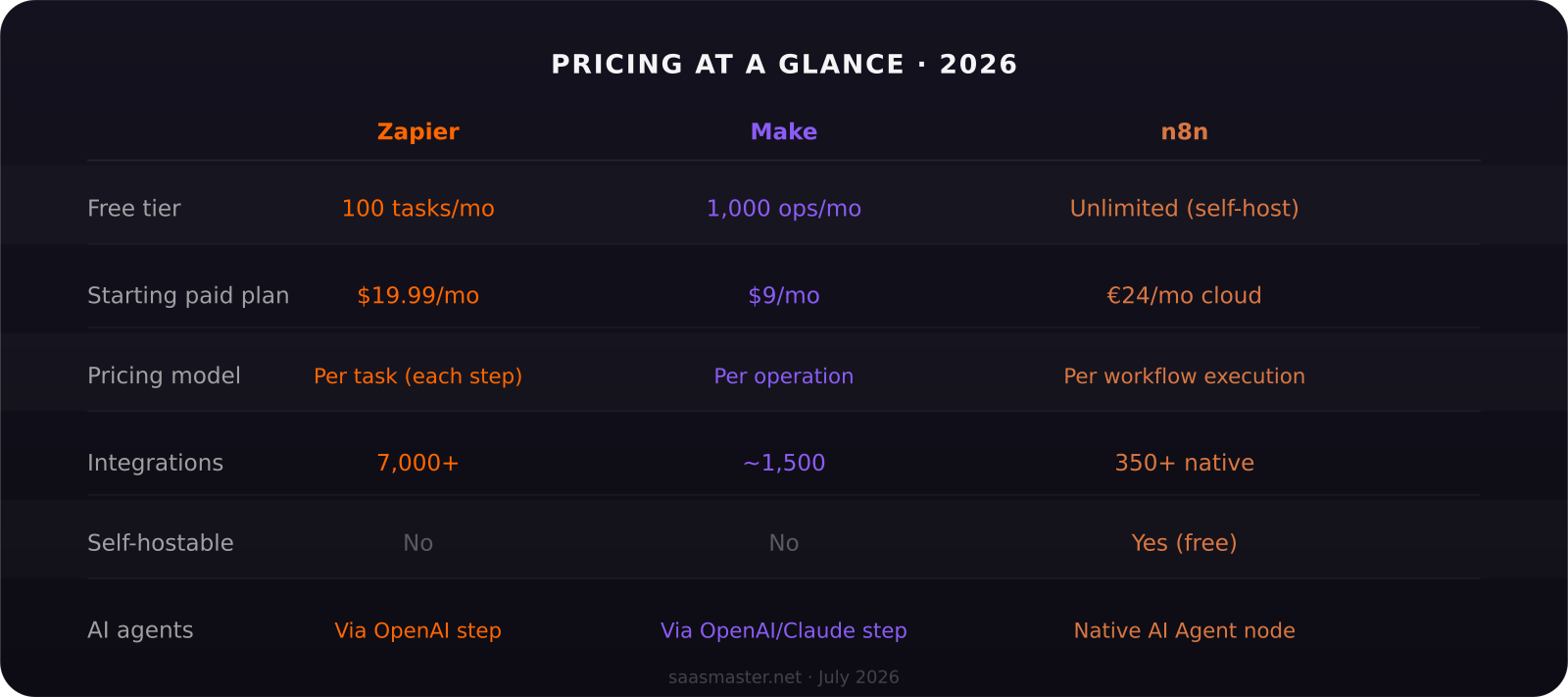
The setup requirement is real. n8n's self-hosted option requires someone comfortable with Docker and basic server management. The cloud version reduces that barrier but does not eliminate the learning curve of n8n's node-based interface, which is more technical than Zapier or Make.
Best for: technical teams and developers, regulated industries where data residency matters, AI agent workflows, and any team running high-volume automations where per-task pricing would be prohibitive.
How do you choose between Zapier, Make, and n8n in 2026?
The decision comes down to three variables: team technical level, workflow complexity, and volume.
If your team is non-technical and you need to move fast, Zapier. The setup time is measured in minutes and the integration coverage is unmatched. Accept the cost tradeoff for the convenience.
If your team is moderately technical and you need complex workflow logic without the cost of Zapier at scale, Make. The $9/month starting point and visual canvas cover most SMB automation needs at a fraction of Zapier's price once you move beyond basic Zaps.
If your team has developers, you care about data control, or you are building AI agent workflows that need to scale, n8n. Self-hosted Community Edition is genuinely free and powerful. Even the cloud plans are significantly cheaper than Zapier at equivalent volumes.
For teams building automation into a broader SaaS product stack, explore the automation and no-code hub for more guides like this one.
For a video walkthrough of building real automation workflows, our software walkthrough video service covers how to show complex tools to a non-technical audience.
Frequently asked questions
Is n8n really free?
The n8n Community Edition is free and open-source with no usage limits. You self-host it on your own server — typically a VPS costing $5–25/month — and get unlimited workflow executions, all 350+ native integrations, and full access to the AI Agent nodes. The free tier does not include n8n's cloud hosting, support, or AI Assistant (coming soon to self-hosted). Cloud plans start at €24/month.
Why is Zapier more expensive than Make or n8n?
Zapier's task-based pricing model counts every successful action step as one task. A five-step Zap running 1,000 times per month consumes 5,000 tasks. This model makes simple two-step automations affordable but compounds quickly on multi-step workflows. Make charges per operation with a much higher operation ceiling per dollar, and n8n charges per execution regardless of how many steps the workflow contains.
Which automation tool has the best AI agent support in 2026?
n8n leads on native AI agent support. Its AI Agent node runs LangChain tool agents with memory, tool-calling, and streaming, and the 70+ LangChain-based nodes let you build multi-agent workflows directly in the canvas. Zapier and Make both offer AI capabilities via OpenAI and Anthropic action steps, but neither matches n8n's depth for orchestrating complex agentic systems. If your automation needs involve AI agents making decisions across multiple tools, n8n is the strongest choice.
Was this article helpful?
Jorge Aguilar
Founder & Creator, SaaS Master
Producing SaaS and AI product videos since 2019 — 800+ videos for 200+ brands, covering tutorials, demos, walkthroughs, and explainers. Writing here about the tools, trends, and tactics that actually move the needle. LinkedIn · About · Work with me
Need to show users how an automation workflow works in practice?
Client-owned videos that make your product easy to understand — demos, walkthroughs, onboarding, and explainers.
Explore product walkthrough video productionRelated guides
More Automation & No-Code →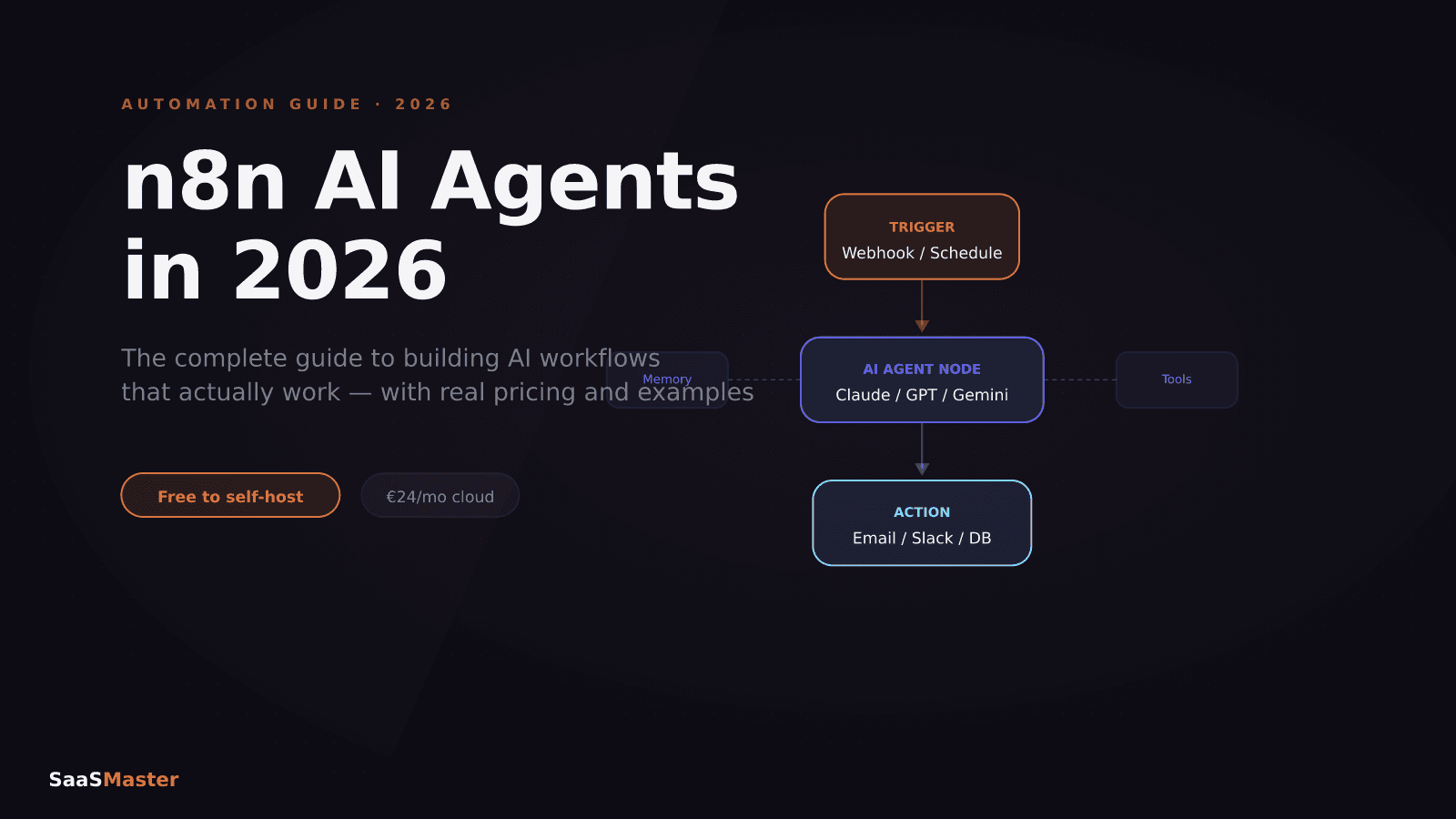
n8n AI Agents in 2026: The Complete Guide to Building AI Workflows

Short-Form Video for SaaS: How to Make Reels and Shorts That Actually Convert
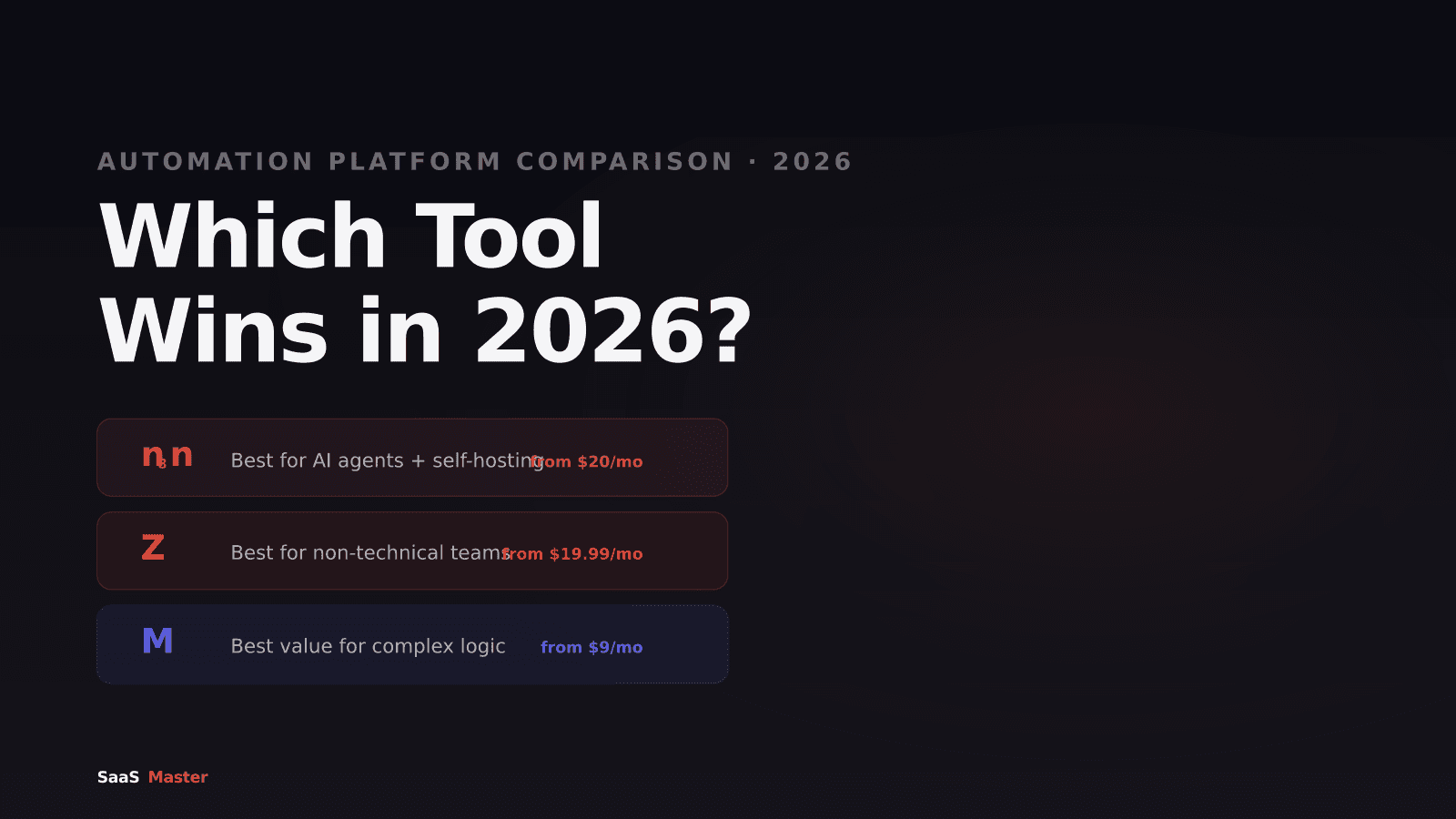
n8n vs Zapier vs Make in 2026: Real Pricing, AI Agents, and Which One Fits Your Stack