Qwen3.7-Max vs DeepSeek V4 Pro: China's Best AI Models Compared
In short
Qwen3.7-Max vs DeepSeek V4 Pro: benchmarks, pricing, and which Chinese AI model to choose in July 2026. DeepSeek costs 8.6x less but leads on agentic tasks.
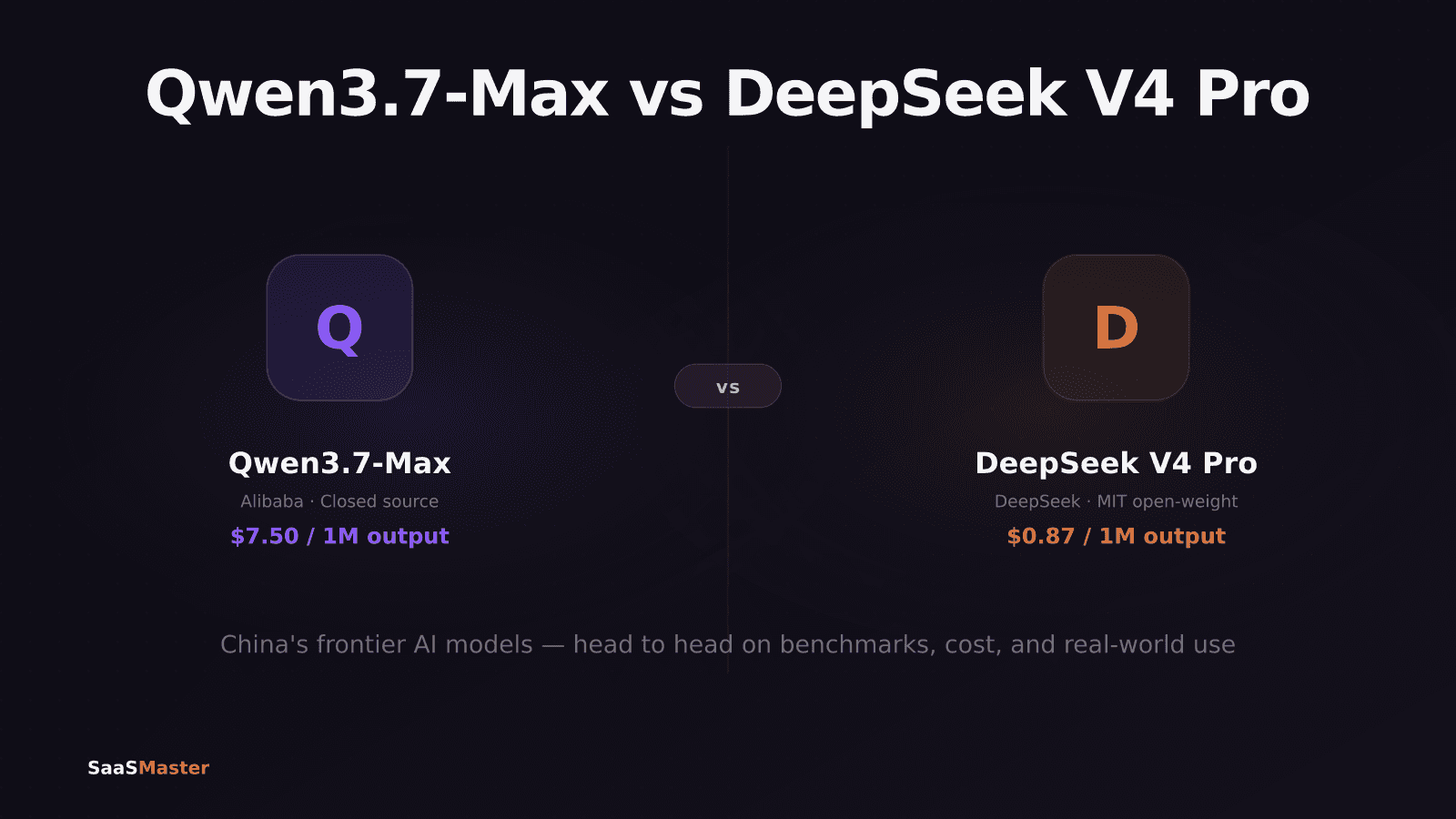
China's two strongest open and semi-open AI models are now directly comparable on both benchmarks and pricing — and the gap between them is starker than most Western coverage suggests. Qwen3.7-Max costs roughly 8.6x more per output token than DeepSeek V4 Pro, yet DeepSeek actually leads on agentic tasks. Here's what that means for teams making a real buying decision.
Key takeaways: - Qwen3.7-Max scores 84 on BenchLM overall vs DeepSeek V4 Pro's 80 — Qwen leads on raw benchmarks. - DeepSeek V4 Pro wins on agentic task performance (74.5 vs 69.7) and competitive coding (93.5% LiveCodeBench). - DeepSeek V4 Pro output costs $0.87 per 1M tokens with a permanent 75% discount; Qwen3.7-Max costs $7.50. - DeepSeek is MIT-licensed and self-hostable; Qwen3.7-Max is closed-source API-only. - A typical agentic coding session costs $1.63 with Qwen vs $0.26 with DeepSeek.
The headline numbers
Qwen3.7-Max, released by Alibaba in May 2026 and updated through July, sits at the top of the BenchLM Chinese model leaderboard with a score of 83–84. It leads on SWE-bench Pro (+5.2 over DeepSeek), GPQA Diamond (+2.3), and math benchmarks (97.1 vs 95.2 on Apex Math). If benchmark charts are your primary signal, Qwen wins.
DeepSeek V4 Pro launched April 24, 2026 — a 1.6 trillion parameter Mixture-of-Experts architecture, MIT-licensed, full weights available. Despite trailing on the overall leaderboard, it leads where it arguably matters more for production use: agentic tasks (74.5 vs Qwen's 69.7) and competitive programming (93.5% LiveCodeBench, 3206 Codeforces).
The distinction matters. Benchmark leadership and production leadership are not the same thing. DeepSeek V4 Pro is faster to iterate on, dramatically cheaper, and better at the multi-step autonomous workflows that SaaS teams are actually building.
Pricing: the 8.6x gap that changes the decision
Qwen3.7-Max: $7.50 per 1M output tokens. DeepSeek V4 Pro: $0.87 per 1M output tokens (permanently discounted, with cached input at $0.145 per 1M tokens).
In concrete terms, a typical agentic coding session that runs 500K input tokens and 50K output tokens costs $1.63 with Qwen versus $0.26 with DeepSeek. If you're running 1,000 such sessions per month — a realistic production load for a mid-sized SaaS team — that's $1,630/month versus $260/month. The difference funds a junior developer or a meaningful chunk of infrastructure.
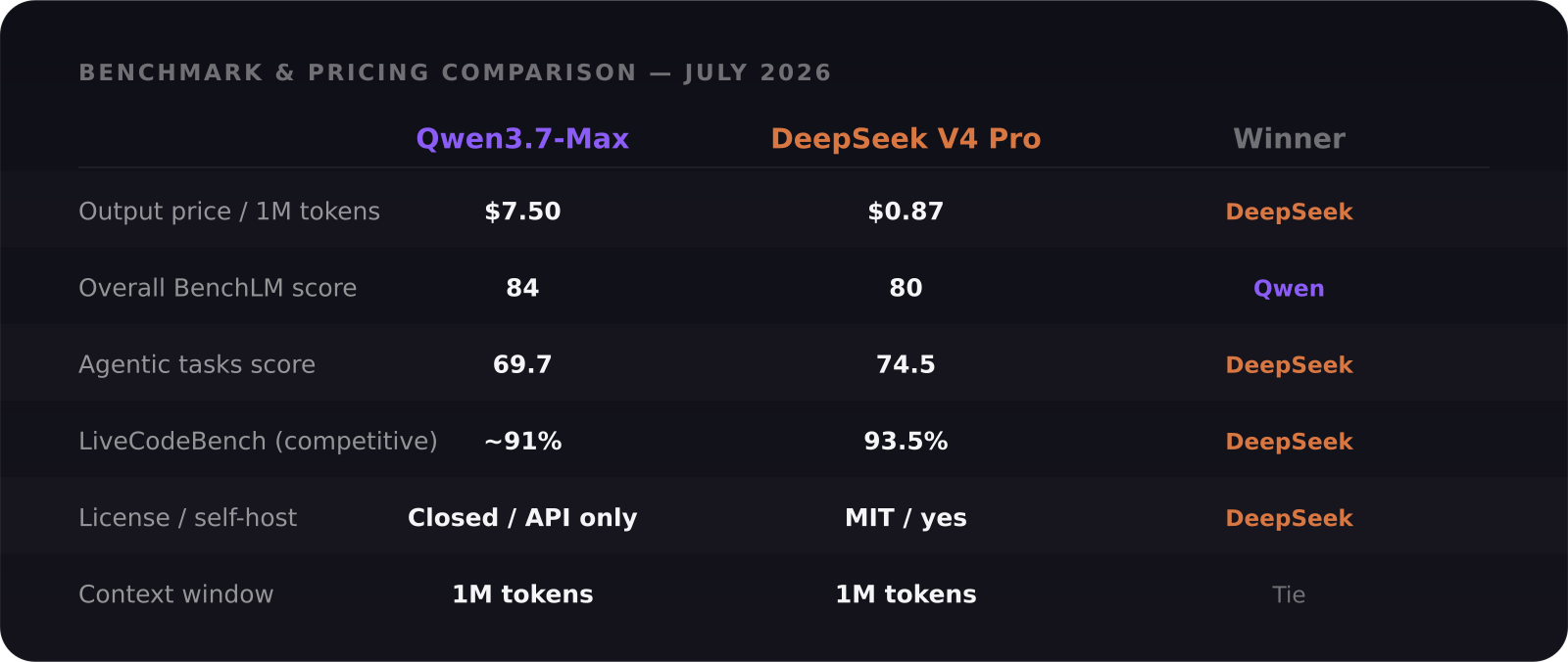
Qwen3.7-Max's higher benchmark scores are real. Whether those scores translate to 8.6x better outcomes on your specific workload is almost certainly not true. The correct approach is to benchmark both on your actual tasks. Most teams that do this report DeepSeek performing at 80–85% of Qwen's quality at one-ninth the cost — math that almost always favors DeepSeek for volume use cases.
Openness: why MIT matters more than people admit
This is the second dimension where the two models diverge completely.
DeepSeek V4 Pro ships under MIT with full weights downloadable. That means you can run it on your own infrastructure, fine-tune it on proprietary data, modify it for specific domains, and never send a token to an external API. For healthcare, finance, legal, and other regulated industries, self-hosting isn't a preference — it's a compliance requirement. DeepSeek is one of the very few frontier-class models that meets that bar.
Qwen3.7-Max is closed-source and API-only. Alibaba hasn't disclosed the parameter count or architecture details. You're calling their API, your data goes to their servers, and the model is a black box. For many use cases that's fine — it's the same deal you make with OpenAI or Anthropic. But the openness gap is real and worth naming.
What each model actually excels at
DeepSeek V4 Pro's agentic lead (74.5 vs 69.7 on agentic benchmarks) isn't coincidental. Its MoE architecture activates specialized expert layers per task, which gives it an edge on multi-step tool-use pipelines where different reasoning modes are needed in sequence. If you're building AI agents that autonomously navigate codebases, manage API calls, and handle error recovery, DeepSeek's architecture is well-suited.
Qwen3.7-Max's strength is long-horizon autonomous sessions. The model was tested in a 35-hour continuous operation benchmark involving 1,158 tool calls in a single session, maintaining coherence throughout. That's an unusual edge case for most teams, but for research-automation and scientific computing workflows where sessions run for hours, it's a meaningful capability.
Both models run 1M token context windows, though they handle long context differently internally. Qwen3.7-Max was specifically optimized for multi-modal long-running sessions. DeepSeek V4 Pro's context handling is competitive but prioritizes throughput efficiency over sustained-session coherence.
Where Kimi K2.6 fits in
The third Chinese model worth mentioning is Kimi K2.6 from Moonshot AI. It matches Qwen3.6-Max and DeepSeek V4 on several benchmarks but falls just behind the top closed models. Kimi's standout characteristic is creative, unconventional framing — useful for content generation and idea exploration. For core coding and agentic tasks, it trails both Qwen3.7-Max and DeepSeek V4 Pro. It's a strong third option for creative use cases, not a replacement for either of the top two.
Which should you choose?
The honest answer depends on three variables: budget, compliance requirements, and task type.
If you need self-hosting for compliance or data sovereignty: DeepSeek V4 Pro. It's the only MIT-licensed frontier model in this class.
If you're running high-volume production API calls with a tight budget: DeepSeek V4 Pro. The 8.6x cost gap dominates most other considerations.
If you need maximum benchmark performance and cost is secondary — a research team with grant funding, an enterprise pilot where the output quality delta matters more than the bill: Qwen3.7-Max is worth the premium.
If you're building autonomous agents for complex multi-step workflows: test both on your specific tasks. DeepSeek's agentic lead is consistent across evaluations, but Qwen's long-session coherence is real for particular workloads.
My read: DeepSeek V4 Pro wins the default-choice position for most SaaS developers. The MIT license, the price, and the agentic performance make it the rational starting point. Upgrade to Qwen3.7-Max if benchmarks on your specific task justify it.
I cover the broader AI tools landscape and have been tracking Chinese AI models closely since DeepSeek R1 first surprised the market. This comparison is about as close as the Chinese frontier has gotten to the Western labs — a different kind of race than a year ago.
If you're building AI-powered products and want to show customers what your tool actually does, AI tool video production is something worth thinking about early — especially as models get powerful enough to do genuinely impressive things on screen.
For more on AI model comparisons, see Perplexity vs ChatGPT for SaaS teams and the Grok 4.5 review for context on where the other labs sit right now.
Frequently asked questions
Is Qwen3.7-Max better than DeepSeek V4 Pro? On overall benchmarks, yes — Qwen3.7-Max scores 84 vs DeepSeek's 80 on BenchLM. But DeepSeek V4 Pro leads on agentic tasks (74.5 vs 69.7) and competitive coding, at roughly one-ninth the output token cost. Neither is universally better; the right choice depends on your use case and budget.
Can I run DeepSeek V4 Pro on my own servers? Yes. DeepSeek V4 Pro is MIT-licensed with full model weights available for download, making it self-hostable. Qwen3.7-Max is closed-source and available only via Alibaba Cloud API.
How much cheaper is DeepSeek V4 Pro than Qwen3.7-Max? DeepSeek V4 Pro costs $0.87 per 1M output tokens (with a permanent 75% discount). Qwen3.7-Max costs $7.50 per 1M output tokens. That's an 8.6x difference — a typical agentic session costs $0.26 with DeepSeek vs $1.63 with Qwen.
Was this article helpful?
Jorge Aguilar
Founder & Creator, SaaS Master
Producing SaaS and AI product videos since 2019 — 800+ videos for 200+ brands, covering tutorials, demos, walkthroughs, and explainers. Writing here about the tools, trends, and tactics that actually move the needle. LinkedIn · About · Work with me
Building an AI product that needs a clearer onboarding flow?
Client-owned videos that make your product easy to understand — demos, walkthroughs, onboarding, and explainers.
Explore AI product video productionRelated guides
More AI Tools & AI Workflows →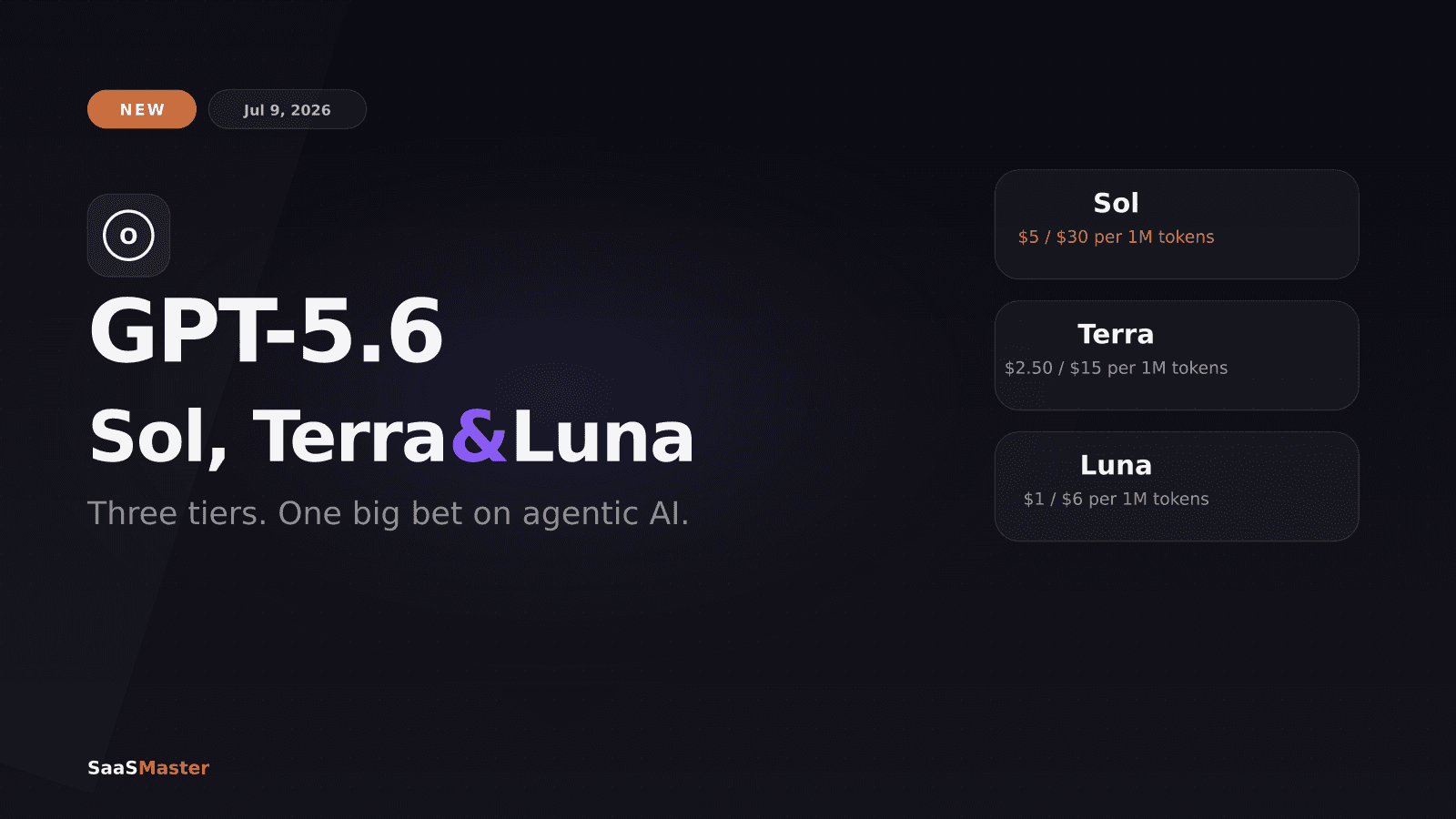
GPT-5.6 Sol, Terra & Luna: What OpenAI Just Shipped (And Which Tier Is Right for You)
Perplexity vs ChatGPT for SaaS Teams in 2026: Which AI Actually Wins?
Grok 4.5 Review: xAI's Cheapest Capable Coding Model Is Here (July 2026)