AI Tools
Claude Opus 4.8 vs GPT-5.5 vs Gemini 3.1 Pro: Which AI API Is Worth the Cost in 2026?
Claude Opus 4.8, GPT-5.5, and Gemini 3.1 Pro are the three frontier AI models competing for the top of every benchmark leaderboard in mid-2026. Claude Opus 4.8 leads on coding and autonomous agent work, GPT-5.5 wins on omnimodal tasks including native audio and video, and Gemini 3.1 Pro offers the cheapest API with the widest free tier. Here is how the real numbers compare when you are deciding where to put your API budget.
Key takeaways
- Claude Opus 4.8 is priced at $5 per million input tokens and $25 per million output tokens. Prompt caching brings effective input cost down to around $0.50 per million on cached reads.
- GPT-5.5 costs $5 per million input tokens and $30 per million output tokens at standard pricing, or $2.50 and $15 via Batch and Flex tiers.
- Gemini 3.1 Pro is the value leader at $1.25 per million input tokens and $5 per million output tokens.
- GPT-5.5 scores 88.6% on SWE-bench Verified. Claude Opus 4.8 scores 82.1% on SWE-bench Verified and 69.2% on the harder SWE-bench Pro.
- All three consumer plans are priced between $19.99 and $20 per month.
The current flagship models
Anthropic released Claude Opus 4.8 on May 28, 2026. It is the current flagship of the Claude family, replacing Opus 4.7. The headline improvements are a jump to 69.2% on SWE-bench Pro (up from 64.3%), a new Fast Mode that costs three times less than Opus 4.7 fast mode, and Dynamic Workflows for running parallel subagents inside Claude Code. Context window is 1 million tokens at general availability pricing.
GPT-5.5 is OpenAI's current flagship model, generally available since April 24, 2026. It is the first in the GPT series with fully native omnimodal architecture: text, images, audio, and video are handled by a single model rather than routed to separate specialist systems. GPT-5.5 features a 1 million token context window and supports function calling, structured outputs, and prompt caching. GPT-4.5 was retired from ChatGPT on June 26, 2026.
Gemini 3.1 Pro is Google's current flagship and the default model in Google's AI Mode globally. It is the weakest of the three on pure coding benchmarks but the strongest on price per token and the widest free consumer tier.
Benchmark results
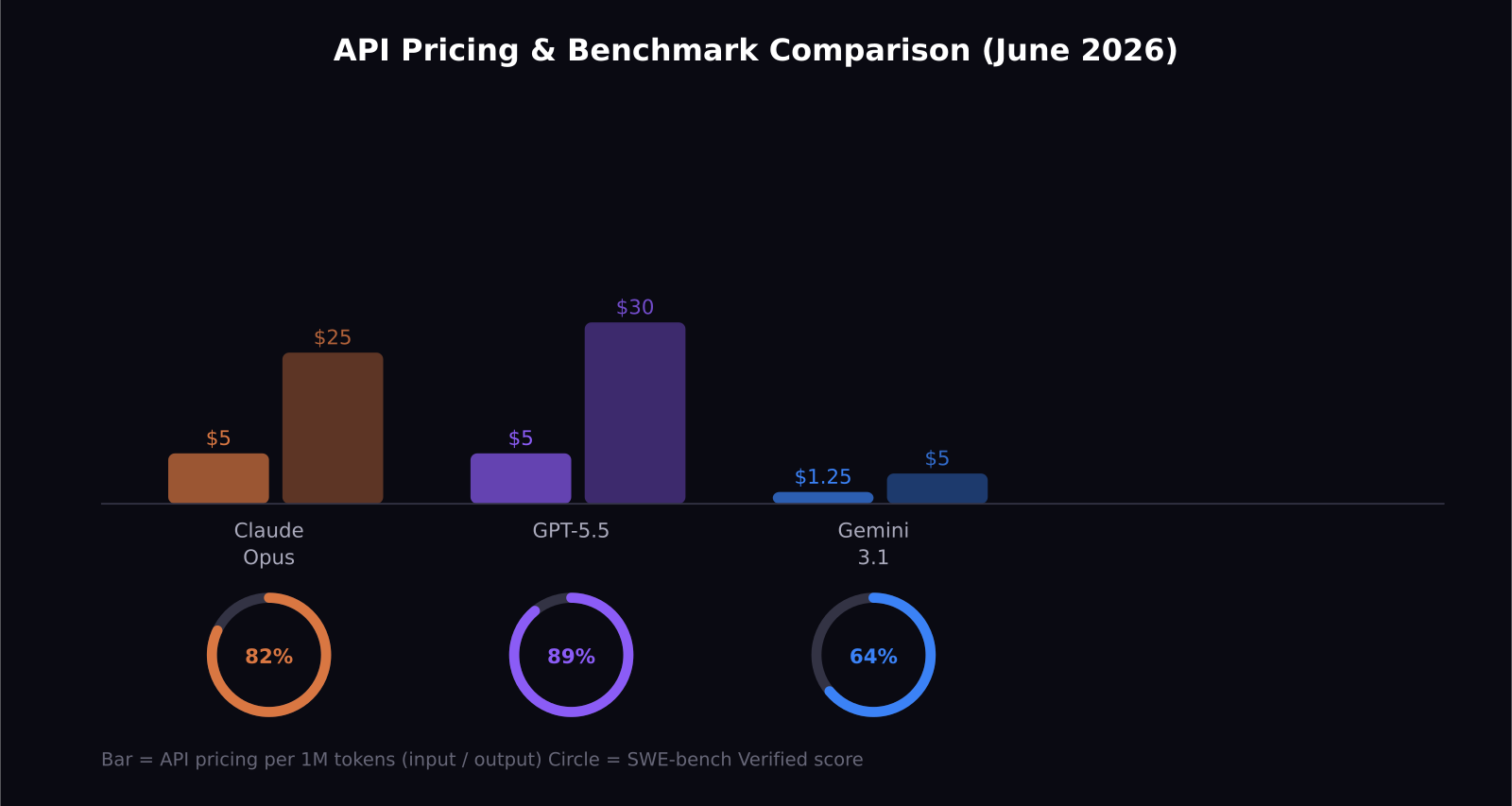
On SWE-bench Verified, the most widely cited coding benchmark in 2026, GPT-5.5 leads at 88.6%. Claude Opus 4.8 scores 82.1% on SWE-bench Verified and 69.2% on the harder SWE-bench Pro, up 4.9 points from Opus 4.7. Gemini 3.1 Pro scores 63.8% on SWE-bench Verified, a gap of roughly 25 points from GPT-5.5 on coding.
On agent benchmarks, Claude Opus 4.8 holds the lead. It scores 84% on Online-Mind2Web for browser agent work and is the only model to complete every case end-to-end on Hebbia's Super-Agent benchmark. Claude is also the first model to break 10% on the Legal Agent Benchmark all-pass standard. These numbers matter for SaaS teams building automation or autonomous workflows.
On hallucination and factual accuracy, GPT-5.5 reports a 60% reduction in hallucination rate compared to GPT-5.4. Claude Opus 4.8 leads human-preference leaderboards for writing quality in head-to-head comparisons.
API pricing in detail
The pricing gap between these models is substantial. Gemini 3.1 Pro at $1.25 input and $5 output per million tokens is the most cost-effective of the three by a significant margin. Claude Opus 4.8 at $5 input and $25 output is four times more expensive on input and five times more expensive on output than Gemini. The gap closes with Claude's prompt caching, which discounts cache reads to roughly $0.50 per million on input, but only for prompts you can cache.
GPT-5.5 standard pricing is $5 input and $30 output per million tokens, making it slightly more expensive than Claude on output. The Batch and Flex tiers cut this to $2.50 and $15, making GPT-5.5 competitive in cost with Claude at non-cached pricing when you can tolerate latency.
At 100 million input tokens per month, the difference between Gemini and Claude Opus 4.8 is about $375,000 per year at list price. For high-volume SaaS products, that number is not academic.
Consumer plans side by side
ChatGPT Plus is $20 per month and gives access to GPT-5.5 with higher usage limits, image generation via Sora 2, voice mode, and Custom GPTs. Claude Pro is $20 per month (or $17 billed annually) and includes Claude Opus 4.8 with priority access. Google AI Pro is $19.99 per month with Gemini 3.1 Pro and access to Google's AI Mode.
All three consumer plans give priority access to the flagship model with higher message limits than free tiers. The meaningful differences show up in multimodal capabilities, integrations, and which features are gated by plan tier.
Which model fits which use case
For autonomous coding and agent workflows, Claude Opus 4.8 is the strongest choice. The SWE-bench Pro lead over Gemini is significant, and the Dynamic Workflows feature for running parallel subagents is not yet matched by the other two at the same reliability level.
For audio, video, and image tasks in a single pipeline, GPT-5.5 is the only model with a truly native omnimodal architecture. If you are building a product that processes voice, image, and text in the same flow, GPT-5.5 simplifies the stack considerably.
For cost-sensitive SaaS applications that need frontier-adjacent quality without paying Opus-level pricing, Gemini 3.1 Pro is the practical choice. The benchmark gap on coding is real, but for content generation, summarization, and customer-facing chat, the quality difference is narrow enough that most users will not notice it.
My perspective from using all three
I have been running all three through the same content and code workflows for several months. The headline benchmarks do reflect real differences in day-to-day use. Claude Opus 4.8 is noticeably better at taking a complex technical task and seeing it through without needing correction mid-way. GPT-5.5 feels the most natural for work that mixes audio transcription, image analysis, and text generation in the same session. Gemini 3.1 Pro is the best value for anything that does not require the absolute frontier.
The right model is the one that matches your actual workload. For high-volume document processing or cost-constrained products, start with Gemini. For serious agent or coding work, the Opus premium is justified. For products that need native multimodal handling, GPT-5.5 is the answer.
Frequently asked questions
Is Claude Opus 4.8 worth the premium over Gemini 3.1 Pro?
For autonomous agent tasks and complex coding, yes. Opus 4.8 scores roughly 18 percentage points higher on SWE-bench Verified and leads on every agentic benchmark published in 2026. For standard content generation or summarization work, Gemini's price advantage of four to five times less per token is hard to ignore.
What is GPT-5.5 Fast Mode and how does pricing work?
GPT-5.5's Batch and Flex tiers are the equivalent of a fast mode, cutting standard pricing from $5 and $30 per million tokens to $2.50 and $15. The tradeoff is latency: Batch is asynchronous and Flex has no latency guarantees. For offline processing or non-real-time workloads, these tiers make GPT-5.5 cost-competitive with Claude Opus 4.8.
Which model has the longest context window?
All three flagship models support 1 million tokens of context. Gemini was first to this scale. Claude Opus 4.8 added the 1 million token window at general availability pricing, without requiring the previous extended-context surcharge.
Was this article helpful?
SaaS Master
Creator behind SaaS Master — tutorials, walkthroughs, reviews, and explainers that help SaaS, AI, and WordPress products get understood and chosen. Writing here about the tools, trends, and tactics that actually move the needle. Work with me →
Want your product explained this clearly — in video?
Tutorials, walkthroughs, reviews, and shorts for SaaS, AI, and WordPress products.
Work With SaaS Master