AI Tools
Claude Sonnet 5 Context Window: How to Use 1M Tokens in Real SaaS Products
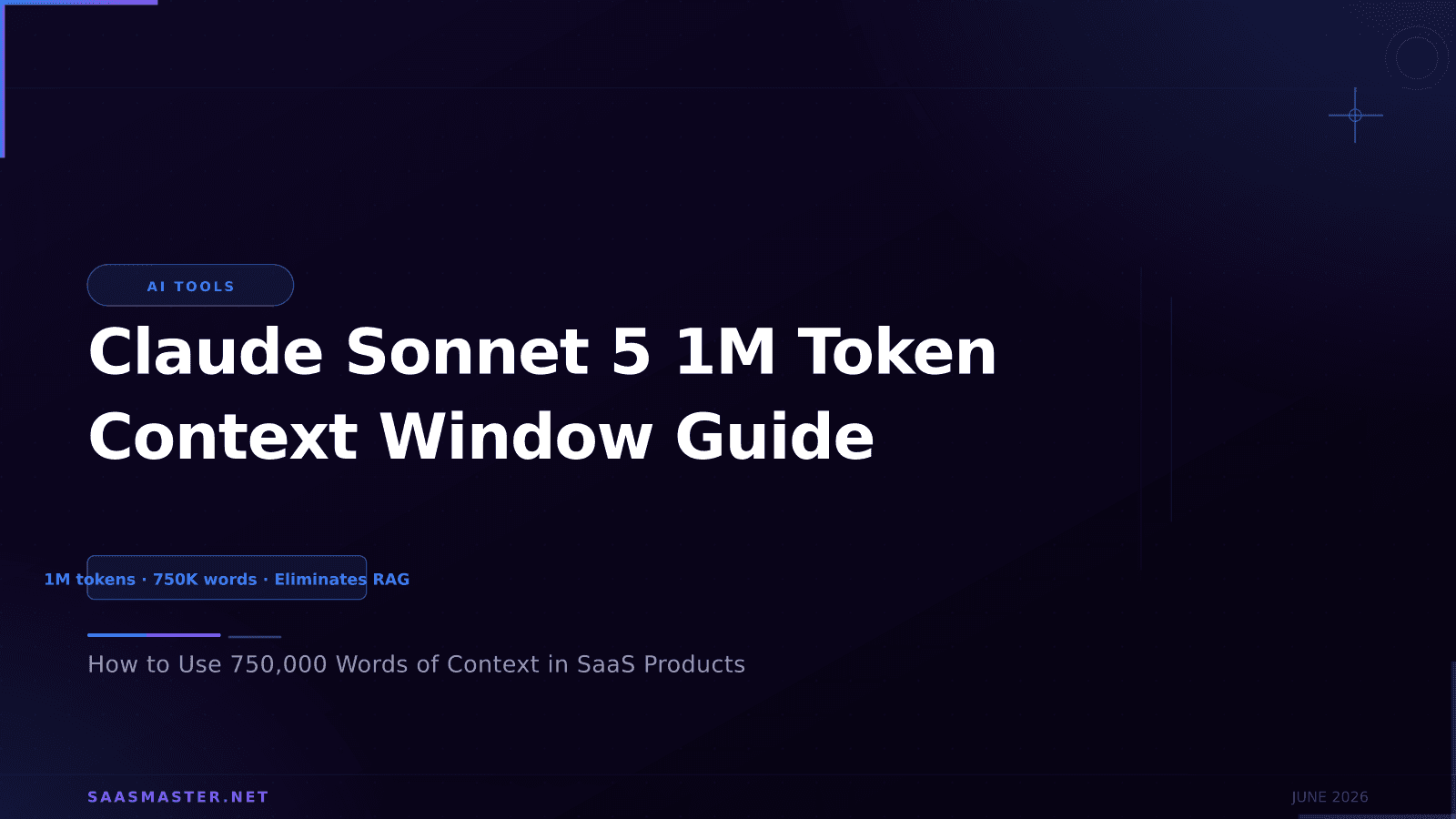
Claude Sonnet 5's 1 million token context window is one of the most practically significant features for SaaS builders, and it is consistently underused. Most AI features in 2026 use a few thousand tokens per call. A 1 million token window holds roughly 750,000 words, 1,500 pages of text, or an entire medium-sized software codebase. Understanding what this enables changes how you think about building AI-powered SaaS products.
Key takeaways
- Sonnet 5's 1 million token context holds approximately 750,000 words, 1,500 pages, or a 50,000-line codebase.
- Large context eliminates many RAG retrieval pipelines for products where the full dataset fits within the window.
- The most practical SaaS uses are: full codebase review, large document analysis, entire knowledge base ingestion, and multi-document legal or financial analysis.
- 1M tokens of input at Sonnet 5 intro pricing costs $2. Large context is inexpensive for the use cases it enables.
- Context window does not mean quality is consistent across all positions. Sonnet 5 performs best on content positioned early and later in the context.
What 1 million tokens actually holds
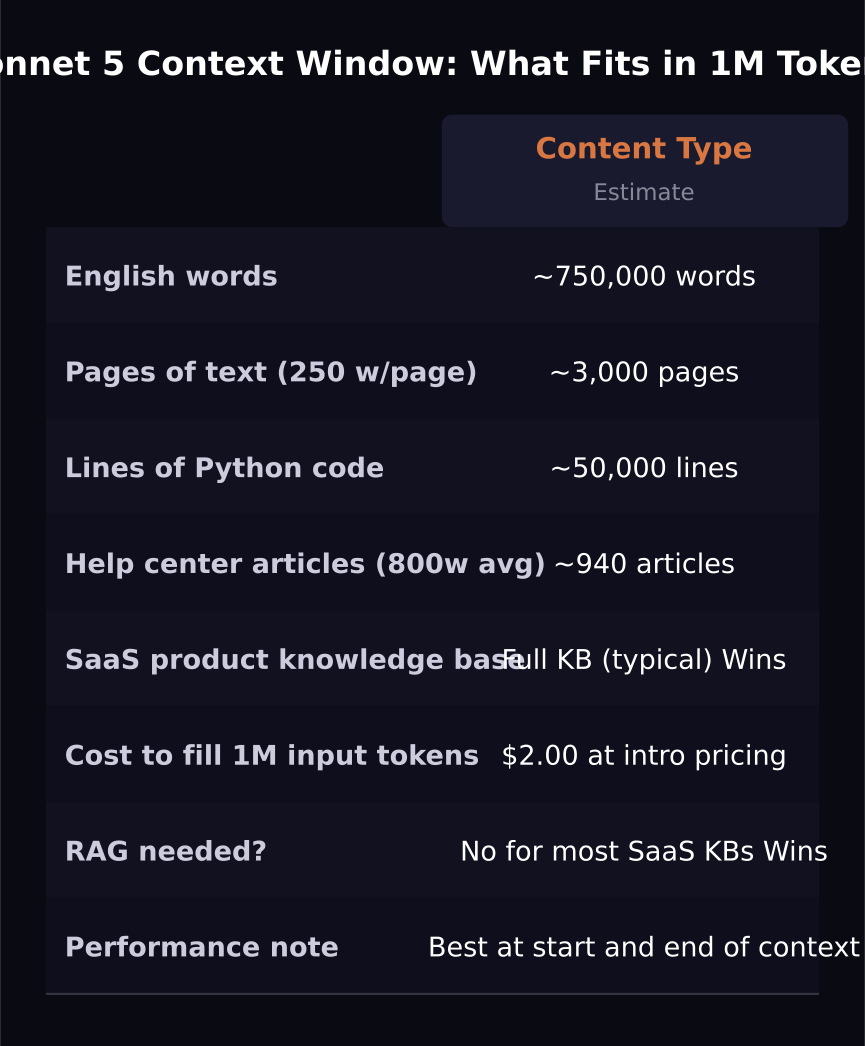
To put the context window in practical terms: one million tokens is approximately 750,000 English words. At 250 words per page, that is 3,000 pages of text. A typical novel is 80,000 to 100,000 words, so the context window holds roughly 8 to 10 novels simultaneously.
For a software codebase, one million tokens holds approximately 50,000 lines of Python code, a full Next.js application with all its dependencies, or an entire small startup's codebase. You can send the complete codebase as context for a code review without chunking or retrieval.
For legal and financial documents, one million tokens holds a large commercial contract package, an entire due diligence data room, or a company's full annual report plus supporting documents.
When large context replaces RAG
Retrieval-augmented generation (RAG) is the common pattern for making large knowledge bases available to AI: chunk the documents, embed them in a vector database, and retrieve the most relevant chunks for each query. This introduces retrieval quality as a variable — if the wrong chunks are retrieved, the model gets the wrong context.
For products where the total knowledge base fits within 1 million tokens, Sonnet 5's large context window eliminates the retrieval step. Inject the full knowledge base directly into context and let Sonnet 5 find the relevant information. This simplifies architecture and eliminates retrieval failures.
A product knowledge base for a typical SaaS product (50 to 200 help articles, typical article length 500 to 1,000 words) fits comfortably within 300,000 tokens, well below the 1M limit. RAG is not needed for this scale.
Full codebase review
Sending a complete codebase in context enables code review patterns that are not possible with chunked retrieval. Sonnet 5 can identify architectural inconsistencies, find duplicate logic across files, catch cross-file dependency issues, and suggest refactors that require understanding multiple files simultaneously.
Typical chunked code review misses cross-file issues because each chunk is analyzed independently. Full-context review catches these. For security audits, this matters significantly — vulnerabilities that span multiple files require full-context understanding to identify.
Practical context window management
While the context is 1 million tokens, Sonnet 5's performance degrades somewhat for information buried in the middle of very large contexts. The model's attention is strongest on content at the beginning and end of the context window. For the most important instructions or content, position them at the start or end of your prompt rather than in the middle of a million-token document.
When processing multiple large documents, structure them with clear delimiters and titles so the model can navigate the context efficiently. Use XML tags to separate documents: `<document name="contract_2024">...</document>`.
Cost of large context calls
At Sonnet 5 intro pricing of $2 per million input tokens, a call using 500,000 input tokens (roughly 375,000 words) costs exactly $1 in input tokens. A call using the full 1 million tokens costs $2 in input tokens. For analytical and review workflows, this is extremely cost-effective compared to the manual labor costs it replaces.
Frequently asked questions
Does using more context tokens make Sonnet 5 slower?
Yes. Processing larger contexts takes more time. A 1M token context call is significantly slower than a 5K token call. For latency-sensitive features, keep context tight. For batch workflows where latency is less critical, large context is practical.
Are there limits on how often I can use large context?
Sonnet 5 large context calls are available on paid API plans. There may be rate limits on very large context calls depending on your API tier. Check Anthropic's rate limit documentation for your specific plan level.
Can I use the full 1M context on Amazon Bedrock and Google Vertex?
Sonnet 5's 1M context window is available on Anthropic's direct API. Availability of the full context window on Bedrock and Vertex depends on those platforms' Sonnet 5 configuration. Check each platform's model documentation for confirmed context window sizes.
Was this article helpful?
SaaS Master
Creator behind SaaS Master — tutorials, walkthroughs, reviews, and explainers that help SaaS, AI, and WordPress products get understood and chosen. Writing here about the tools, trends, and tactics that actually move the needle. Work with me →
Want your product explained this clearly — in video?
Tutorials, walkthroughs, reviews, and shorts for SaaS, AI, and WordPress products.
Work With SaaS Master