AI Tools
Claude Sonnet 5 Intro Pricing Ends August 31: Build Now and Save 50%
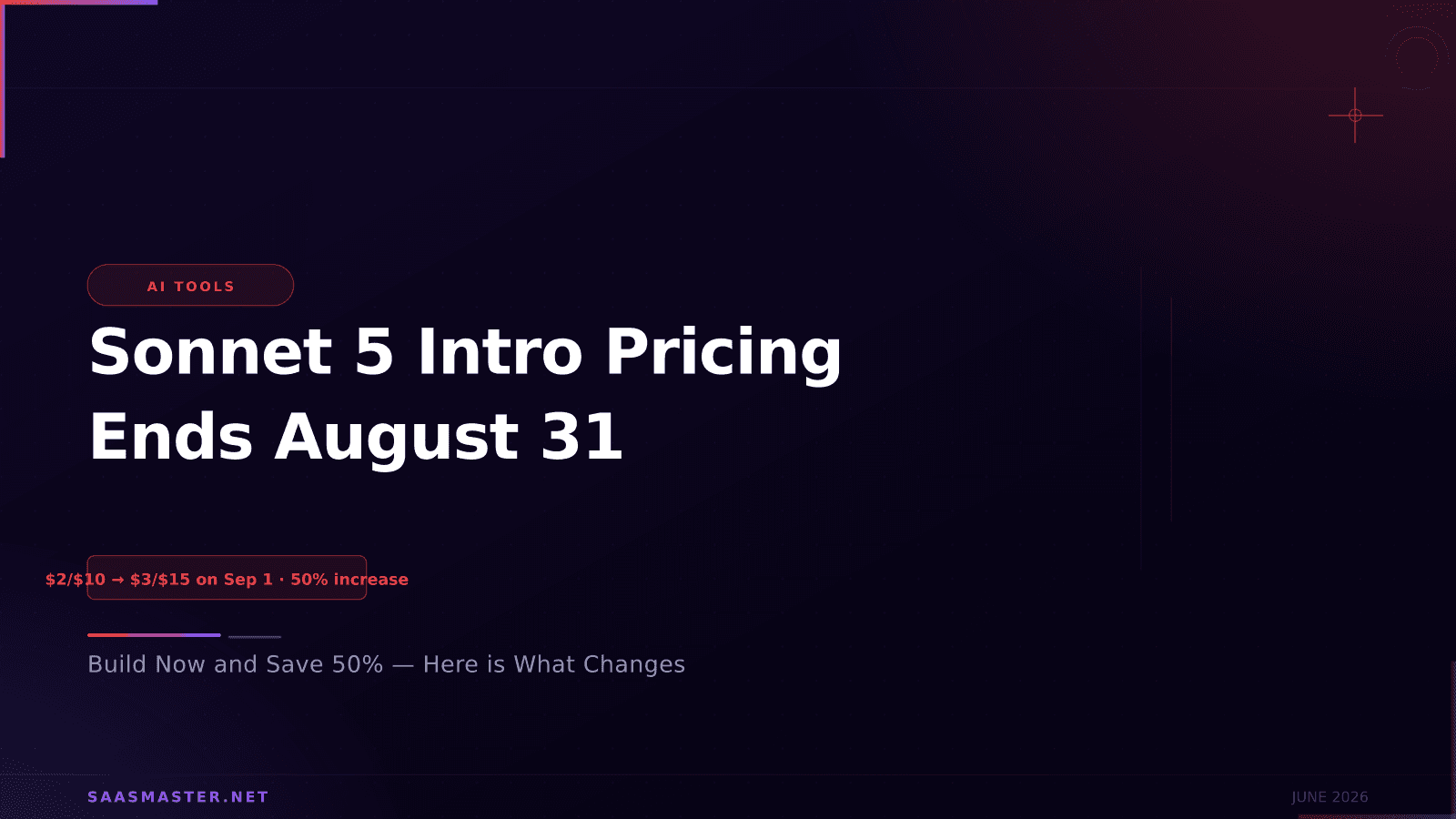
Anthropic launched Claude Sonnet 5 on June 30, 2026, with an introductory pricing offer: $2 per million input tokens and $10 per million output tokens through August 31, 2026. After that date, pricing moves to the standard rate of $3 per million input tokens and $15 per million output tokens. That is a 50% increase on input and a 50% increase on output. If you are building SaaS products with AI, the next 60 days are the most cost-effective window to prototype, test, and scale with Sonnet 5.
Key takeaways
- Sonnet 5 intro pricing ends August 31, 2026. After that, input rises from $2 to $3 per million tokens, output from $10 to $15.
- The 50% price increase on output tokens is the most significant change for agentic and long-output workloads.
- Teams that build and validate their agent architecture during the intro period lock in learnings that transfer to optimized production pipelines at standard pricing.
- The intro period is the right time to run large-scale evaluations, tune prompts, and identify which tasks genuinely need Sonnet 5 versus Haiku 4.5.
- Even at standard pricing, Sonnet 5 at $15 output is cheaper than GPT-5.5 at $30 output and far below Opus 4.8 at $25.
What changes on September 1
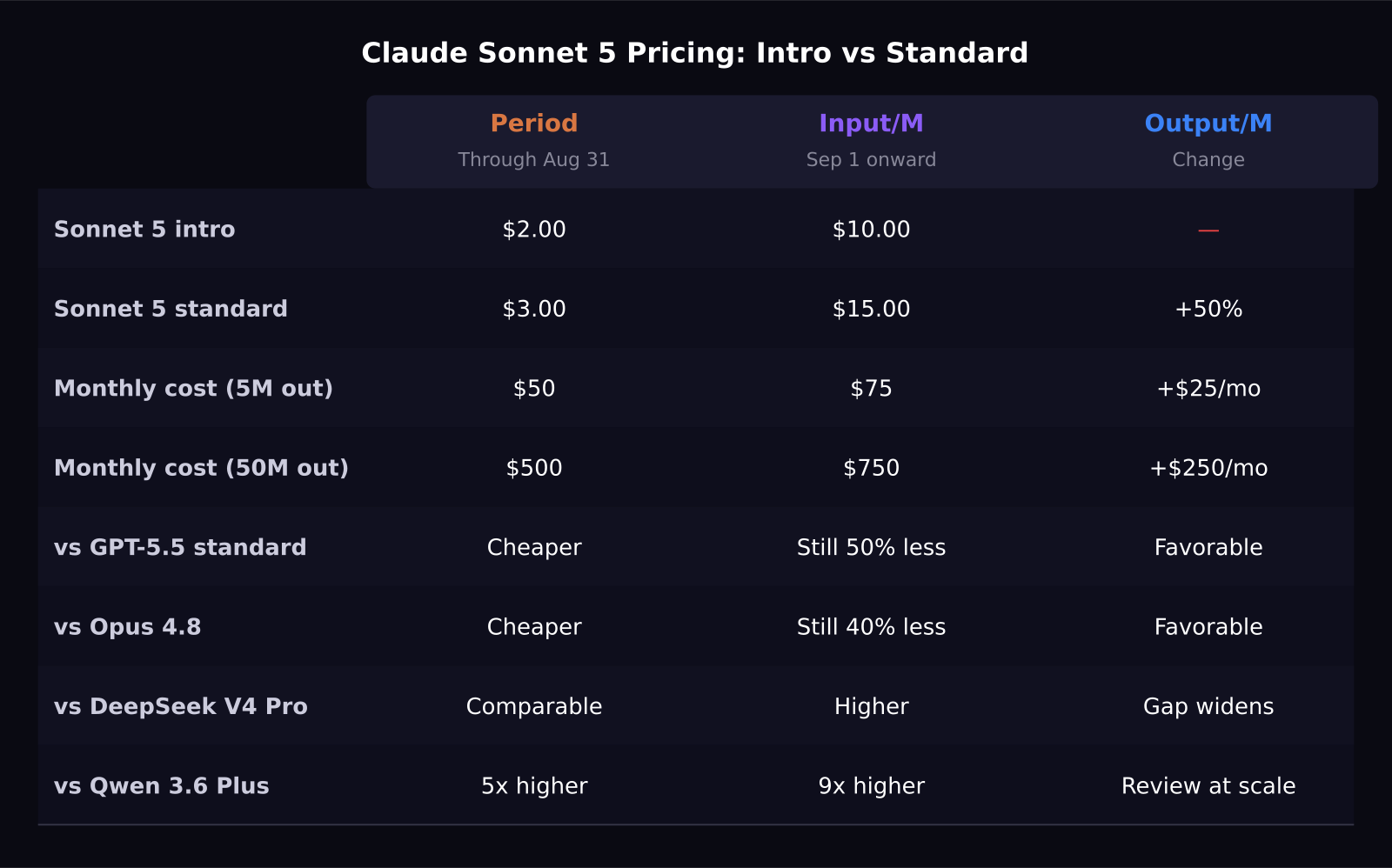
The specific price change: input tokens go from $2 to $3 per million (50% increase). Output tokens go from $10 to $15 per million (50% increase). Both are standard rate increases that Anthropic applies at the end of model intro periods.
For a SaaS product generating 50 million output tokens per month, the monthly cost increase is $250,000 at intro rate versus $750,000 at standard rate. That is a $500 increase per month. For a product generating 5 million output tokens per month, the increase is $25 per month — irrelevant to the business decision.
Your output token volume is the number that matters. If you do not know your current or projected monthly output token volume, calculate it before September.
What to build during the intro period
The intro period is the right time to prototype expensive things. Multi-step agent pipelines, long-context document analysis workflows, computer use automations, and large-scale prompt evaluations all cost 50% less right now than they will in September.
Use the intro period to: build and run your full agent pipeline end-to-end and measure token consumption per workflow; identify which tasks in your pipeline can be routed to Haiku 4.5 without quality loss; run your prompt evaluation suite across a large sample of real cases; prototype features you have been deferring because of cost concerns.
The smart architecture to build now
The biggest mistake is building everything on Sonnet 5 during the intro period and then discovering in September that you need to redesign your architecture to hit cost targets at standard pricing.
Build with cost optimization in mind now. Route classification and simple tasks to Haiku 4.5 from day one. Set maximum token budgets per workflow and enforce them. Log every run with token counts so you have real data on your cost structure before pricing changes.
A pipeline that costs $1,000 per month on Sonnet 5 intro pricing, but where 70% of that could run on Haiku 4.5, costs $500 per month on Sonnet 5 standard pricing after rerouting — less than it would cost on Sonnet 5 standard without optimization.
Competitive pricing context
Even at standard pricing, Sonnet 5 remains well-positioned. At $3 input and $15 output, it costs less on input than DeepSeek V4 Pro ($1.74) is to Sonnet 5 at intro — the gap narrows but Sonnet 5 remains the better-benchmarked Western model. Versus GPT-5.5 at $5/$30 standard, Sonnet 5 is still half the output cost. Versus Opus 4.8 at $5/$25, Sonnet 5 is 60% cheaper on input and 40% cheaper on output.
The standard pricing changes the comparison with Chinese open-weight models more significantly. Qwen 3.6 Plus at $0.33/$1.95 becomes 9x cheaper on output than Sonnet 5 standard. For teams where output cost is the primary constraint at scale, the intro-period gap shrinks but the strategic conversation changes.
Frequently asked questions
Does the intro pricing apply to Bedrock and Vertex AI?
Anthropic's intro pricing applies to the direct Anthropic API. Amazon Bedrock and Google Cloud Vertex AI pricing may differ and are set by those platforms. Check each platform's pricing page for their Sonnet 5 rates, which may not match Anthropic's intro offer exactly or may have different end dates.
Will Anthropic extend the intro pricing period?
Anthropic has not announced any extension of the intro period. Plan based on the published August 31 end date. If you need certainty about pricing beyond August, negotiate a contract rate directly with Anthropic's enterprise sales team.
Is it worth switching from Sonnet 4.6 to Sonnet 5 during the intro period?
Yes, for most use cases. Sonnet 5 at $2/$10 intro is priced identically to Sonnet 4.6 at launch (prices were similar in that range), and Sonnet 5's benchmark improvements mean better outputs for the same cost. The main reason to stay on Sonnet 4.6 would be if you have heavily tuned prompts that need re-testing on the new model.
Was this article helpful?
SaaS Master
Creator behind SaaS Master — tutorials, walkthroughs, reviews, and explainers that help SaaS, AI, and WordPress products get understood and chosen. Writing here about the tools, trends, and tactics that actually move the needle. Work with me →
Want your product explained this clearly — in video?
Tutorials, walkthroughs, reviews, and shorts for SaaS, AI, and WordPress products.
Work With SaaS Master