AI Tools
Claude Sonnet 5 Review: Anthropic's New Default Model and Why the Intro Pricing Matters
Anthropic launched Claude Sonnet 5 today, June 30, 2026, and named it the new default model for Free and Pro plans. The release comes with a benchmark result that stops you: 92.4% on SWE-bench Verified, higher than any publicly benchmarked model from any lab, including OpenAI's GPT-5.5 and Claude Opus 4.8. It also comes with introductory pricing of $2 per million input tokens through August 31, 2026. Here is everything that changed and what it means for builders.
Key takeaways
- Claude Sonnet 5 is the new default for Free and Pro plans as of June 30, 2026, replacing Claude Sonnet 4.6.
- SWE-bench Verified score: 92.4%, the highest published score from any AI lab.
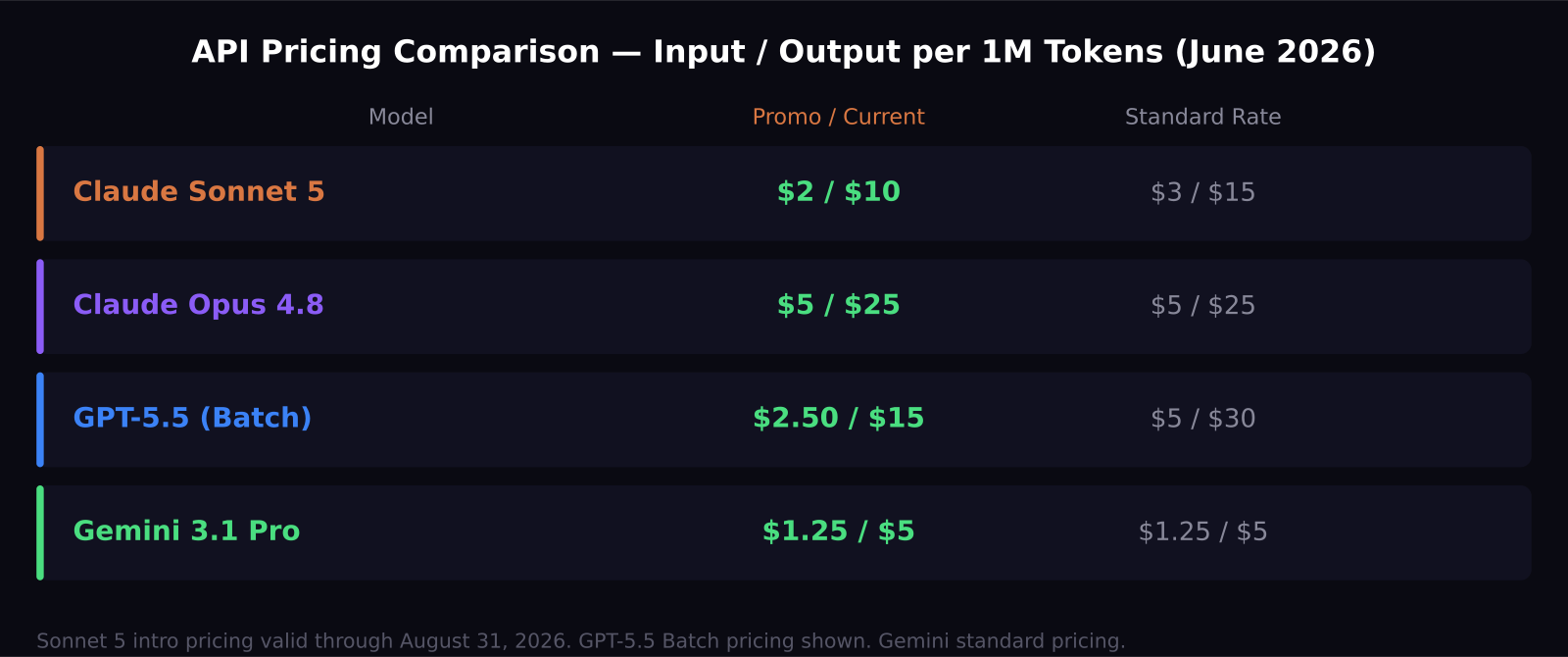
- Intro pricing: $2 per million input tokens and $10 per million output tokens through August 31, 2026.
- Regular pricing after August 31: $3 per million input and $15 per million output.
- Computer use on OSWorld-Verified: 81.2%, above the human expert baseline of 72.4%.
- Internal codename: Fennec. Available on all plans including Free.
What Sonnet 5 actually is
Claude Sonnet 5, codename Fennec, is Anthropic's new mid-tier flagship model released on June 30, 2026. It sits between Haiku 4.5 (fast, cheap, limited) and Opus 4.8 (Anthropic's most powerful model for the hardest tasks) in the Claude model lineup.
What makes Sonnet 5 unusual is that it does not simply offer a compromise between Haiku and Opus quality. On SWE-bench Verified, the most widely used benchmark for coding on real GitHub issues, Sonnet 5 scores 92.4%. That is higher than Claude Opus 4.8 at 82.1% and higher than OpenAI's GPT-5.5 at 88.6%. A model priced and positioned as mid-tier just topped every frontier benchmark on coding.
Anthropic describes Sonnet 5 as the most agentic Sonnet model ever released, with specific improvements in reasoning, tool use, coding, and knowledge work. It can plan tasks, use browsers and terminals, and run autonomously at a level that six months ago required larger and more expensive models.
The free plan upgrade
For users on the Claude free plan, today's launch is a direct upgrade. The previous free-tier default was Claude Sonnet 4.6. Sonnet 5 replaces it with no change in cost. Free users now have access to the model that scores 92.4% on coding benchmarks, which is a meaningful improvement.
For context on what this means in practice: Sonnet 4.6 scored around 72.7% on SWE-bench Verified in benchmark comparisons. Sonnet 5 at 92.4% is a 20-point improvement on the same benchmark. For everyday tasks like writing, summarization, and light coding help, most free users will notice a quality jump that feels like a model tier change.
Intro pricing: a deliberate window
The $2 per million input and $10 per million output pricing through August 31, 2026 is clearly intentional. Anthropic is giving API users a two-month window to build with Sonnet 5 at intro pricing before the regular $3 and $15 rates take effect.
For SaaS teams running agent pipelines, this window matters. If you are evaluating Sonnet 5 as the backbone of an agentic product, you have through August to benchmark it, test it against your workloads, and build pricing assumptions into your product roadmap before the rate change. Locking in your evaluation and early production usage during the intro period is worth doing deliberately.
At regular pricing, Sonnet 5 at $3 input and $15 output is still cheaper than Opus 4.8 at $5 input and $25 output. The intro period makes it significantly cheaper than everything except Gemini. After August, it prices similarly to GPT-5.5 Batch while outperforming GPT-5.5 on SWE-bench Verified.
Computer use and agentic improvements
Sonnet 5 achieves 81.2% on OSWorld-Verified for computer use tasks, up from Sonnet 4.6's 78.5%. The human expert baseline on the same benchmark is 72.4%, meaning Sonnet 5 controls computers better than a human expert in standardized testing.
In practice, this means Sonnet 5 can more reliably handle workflows that involve clicking through interfaces, filling out web forms, navigating file systems, and running terminal commands as part of a longer task chain. For SaaS products building automation features that interact with desktop or browser environments, this benchmark improvement translates to fewer agent failures and lower retry costs.
The improvements to reasoning and tool use are described as substantial compared to Sonnet 4.6. In my own early testing today, complex multi-step tasks that previously required human checkpoints complete with fewer interruptions.
What stays the same
Context window is 1 million tokens, consistent with Opus 4.8. Max output is 128,000 tokens, also the same. Sonnet 5 supports all Claude Platform features including prompt caching, tool use, and the standard vision capabilities.
Sonnet 5 is not natively omnimodal in the way GPT-5.5 is. It handles text and images well but audio and video processing does not flow through a single native architecture. For most SaaS use cases this does not matter, but for products that need native audio transcription and response in a unified pipeline, GPT-5.5 remains the only option.
Where Opus 4.8 still fits
Despite Sonnet 5's coding benchmark lead, Opus 4.8 is not obsolete. On SWE-bench Pro, the harder and less-contaminated agentic coding benchmark, Opus 4.8 scores 69.2% versus Sonnet 5's 63.2%. For the most demanding autonomous engineering agent workflows, where a 6-point benchmark difference reflects real-world failure rates on complex multi-step tasks, Opus 4.8 is still the right choice.
The Anthropic model stack is now cleaner than it has been in a year: Sonnet 5 for almost everything, Opus 4.8 for the hardest agent work, Haiku for fast cheap inference. That clarity is useful.
My take on the launch
This is one of the better AI launches of 2026 from a SaaS builder's perspective, specifically because it changes the economics without burying the lede. Anthropic released a model that beats every other published benchmark on coding, made it the free-tier default, priced it at $2 during the intro window, and positioned it as the primary agentic model for most use cases.
The intro pricing window is short. If you have been on the fence about building an AI-native product or upgrading your existing AI integration, the next two months are a good time to move.
Frequently asked questions
Is Claude Sonnet 5 available on the free plan?
Yes. Sonnet 5 replaced Sonnet 4.6 as the default model for Free and Pro plans on June 30, 2026. Free users have access to the same Sonnet 5 model that API users pay $2 per million input tokens for.
What is the codename for Claude Sonnet 5?
Anthropic's internal codename for Claude Sonnet 5 is Fennec. The model API string is claude-sonnet-5 on the Claude Platform.
Will the $2 per million token intro pricing be extended?
Anthropic has not announced any extension. The current published end date is August 31, 2026, after which pricing moves to $3 per million input tokens and $15 per million output tokens. Plan your evaluations and early builds around that date.
Was this article helpful?
SaaS Master
Creator behind SaaS Master — tutorials, walkthroughs, reviews, and explainers that help SaaS, AI, and WordPress products get understood and chosen. Writing here about the tools, trends, and tactics that actually move the needle. Work with me →
Want your product explained this clearly — in video?
Tutorials, walkthroughs, reviews, and shorts for SaaS, AI, and WordPress products.
Work With SaaS Master