AI Tools
Claude Sonnet 5 vs Gemini 3.1 Flash: Speed vs Intelligence for SaaS in 2026
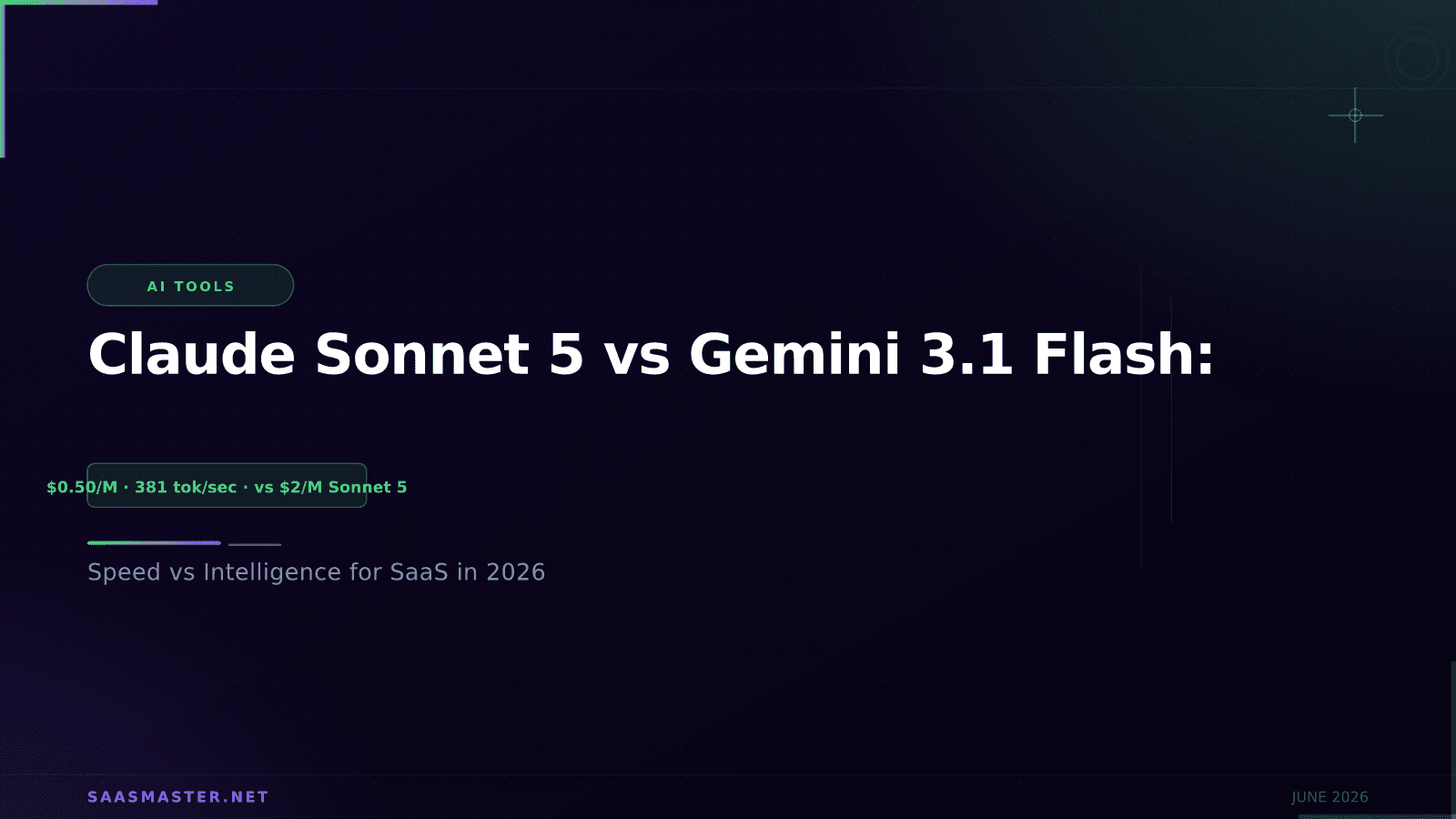
Claude Sonnet 5 and Gemini 3.1 Flash represent a genuine speed-versus-intelligence trade-off in mid-2026. Sonnet 5 at 92.4% SWE-bench Verified is the benchmark leader for coding and agent tasks. Gemini 3.1 Flash at $0.50 per million input tokens runs at a fraction of the cost with significantly faster throughput. For SaaS teams building features where response speed and per-token cost matter as much as raw capability, this comparison deserves a close look.
Key takeaways
- Claude Sonnet 5 scores 92.4% on SWE-bench Verified. Gemini 3.1 Flash focuses on speed rather than matching frontier coding benchmarks.
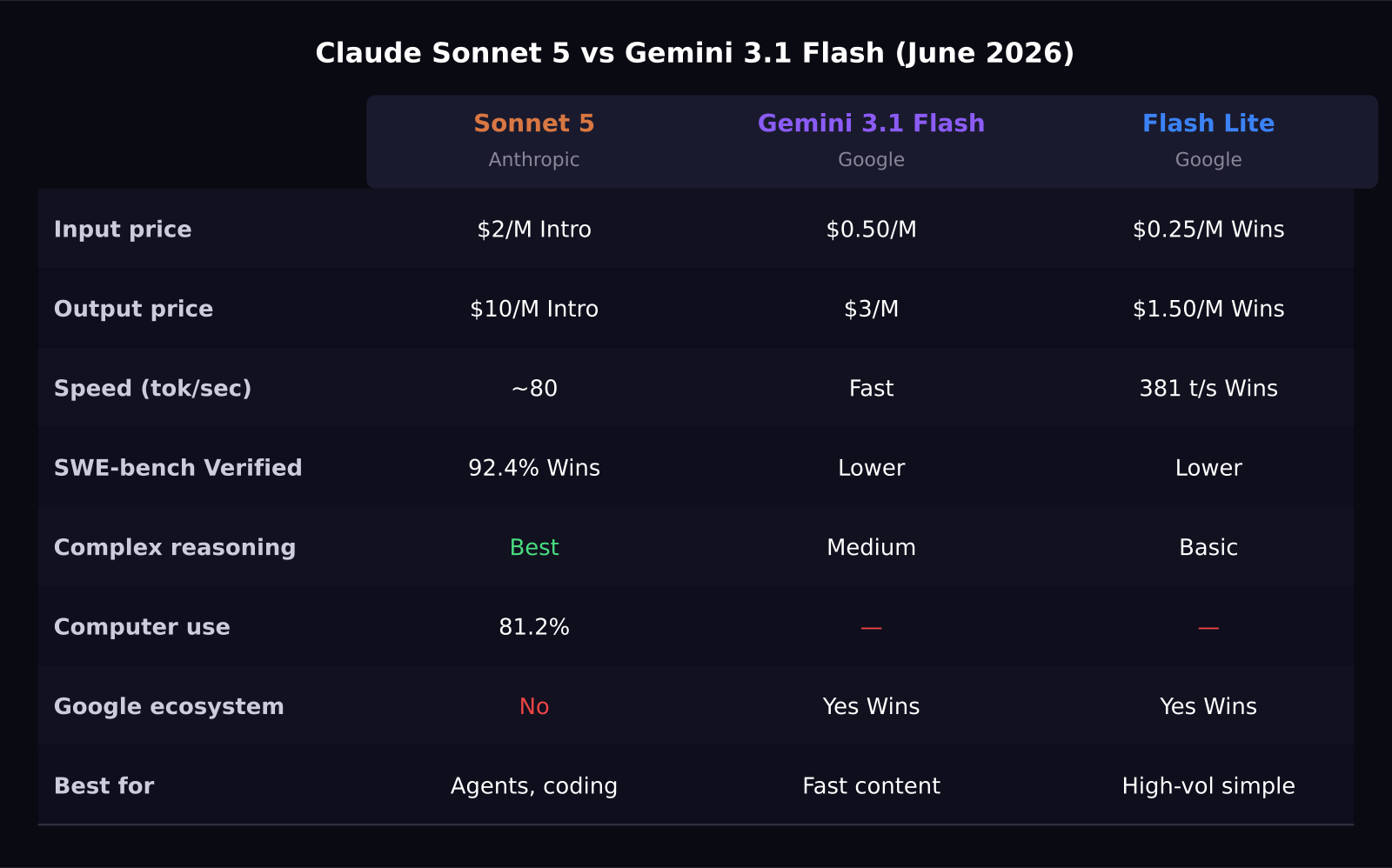
- Gemini 3.1 Flash costs $0.50 per million input tokens and $3 per million output tokens. Sonnet 5 intro pricing is $2 and $10.
- Gemini 3.1 Flash is 3x faster than its predecessor and significantly faster than Sonnet 5 for most prompt types.
- Flash Lite, the cheapest variant, costs $0.25 input and $1.50 output and runs at 381 tokens per second.
- For real-time, high-volume features where speed and cost matter more than frontier coding, Gemini Flash is the Google-native choice.
The speed gap is real
Gemini 3.1 Flash and its Lite variant are among the fastest models available through any major API in 2026. Flash Lite runs at 381 tokens per second, compared to Sonnet 5's typical throughput of 60 to 90 tokens per second. For applications where a user is waiting in real time for a streaming response, the difference is measurable in user experience.
This speed comes at a capability trade-off. Gemini 3.1 Flash does not compete with Sonnet 5 on SWE-bench Verified or complex multi-step agent benchmarks. Flash is optimized for fast, cost-efficient inference on tasks that do not require the deepest reasoning.
Pricing comparison
Gemini 3.1 Flash at $0.50 input and $3 output is 4x cheaper than Sonnet 5 on input and 3.3x cheaper on output at intro pricing. Flash Lite at $0.25 and $1.50 is 8x cheaper on input and 6.7x cheaper on output.
For SaaS products that generate millions of tokens per day on relatively simple tasks, the cost difference justifies serious testing. A product spending $10,000 per month on Sonnet 5 for tasks that Gemini Flash handles equally well could reduce that to $2,500 or less.
What each model is best for
Sonnet 5 wins for: complex coding tasks, agentic workflows, computer use, multi-step reasoning, and any task where the model's intelligence directly affects the quality of the output in a way users notice.
Gemini 3.1 Flash wins for: real-time chat where sub-second responses matter, high-volume content generation where the task is straightforward, summarization of structured documents, and Google ecosystem integration where you are already on Vertex AI.
The Google ecosystem angle
Gemini 3.1 Flash is the natural choice for teams already building on Google Cloud. Vertex AI integration, Google Workspace compatibility, and Search integration are practical advantages that go beyond raw benchmark numbers. If your SaaS product already lives in the Google ecosystem, Flash is the lowest-friction choice for features that do not need Sonnet-level depth.
Frequently asked questions
Can Gemini 3.1 Flash handle coding tasks?
Yes, for routine coding tasks like short function generation, code explanation, and documentation writing. For complex multi-file refactors, debugging production issues, or autonomous coding agents, Sonnet 5 is significantly stronger on benchmarks and real-world reliability.
Is Gemini 3.1 Flash Lite worth using?
For the highest-volume, simplest tasks, yes. At $0.25 input and $1.50 output, Flash Lite running at 381 tokens per second is an extreme value play. Autocomplete, classification, short-form content generation, and routing are all candidates for Flash Lite's economics.
How does Gemini Flash compare to Haiku 4.5?
Both are speed and cost champions in their respective families. Haiku 4.5 at $1 input and $5 output is priced between Flash and Flash Lite. Flash Lite is cheaper and faster. Haiku 4.5 tends to score better on reasoning tasks within the fast-cheap tier. The right choice depends on your benchmarks for your specific tasks.
Was this article helpful?
SaaS Master
Creator behind SaaS Master — tutorials, walkthroughs, reviews, and explainers that help SaaS, AI, and WordPress products get understood and chosen. Writing here about the tools, trends, and tactics that actually move the needle. Work with me →
Want your product explained this clearly — in video?
Tutorials, walkthroughs, reviews, and shorts for SaaS, AI, and WordPress products.
Work With SaaS Master