AI Tools
Claude Sonnet 5 vs Haiku 4.5: When to Use Each in Your SaaS API Stack
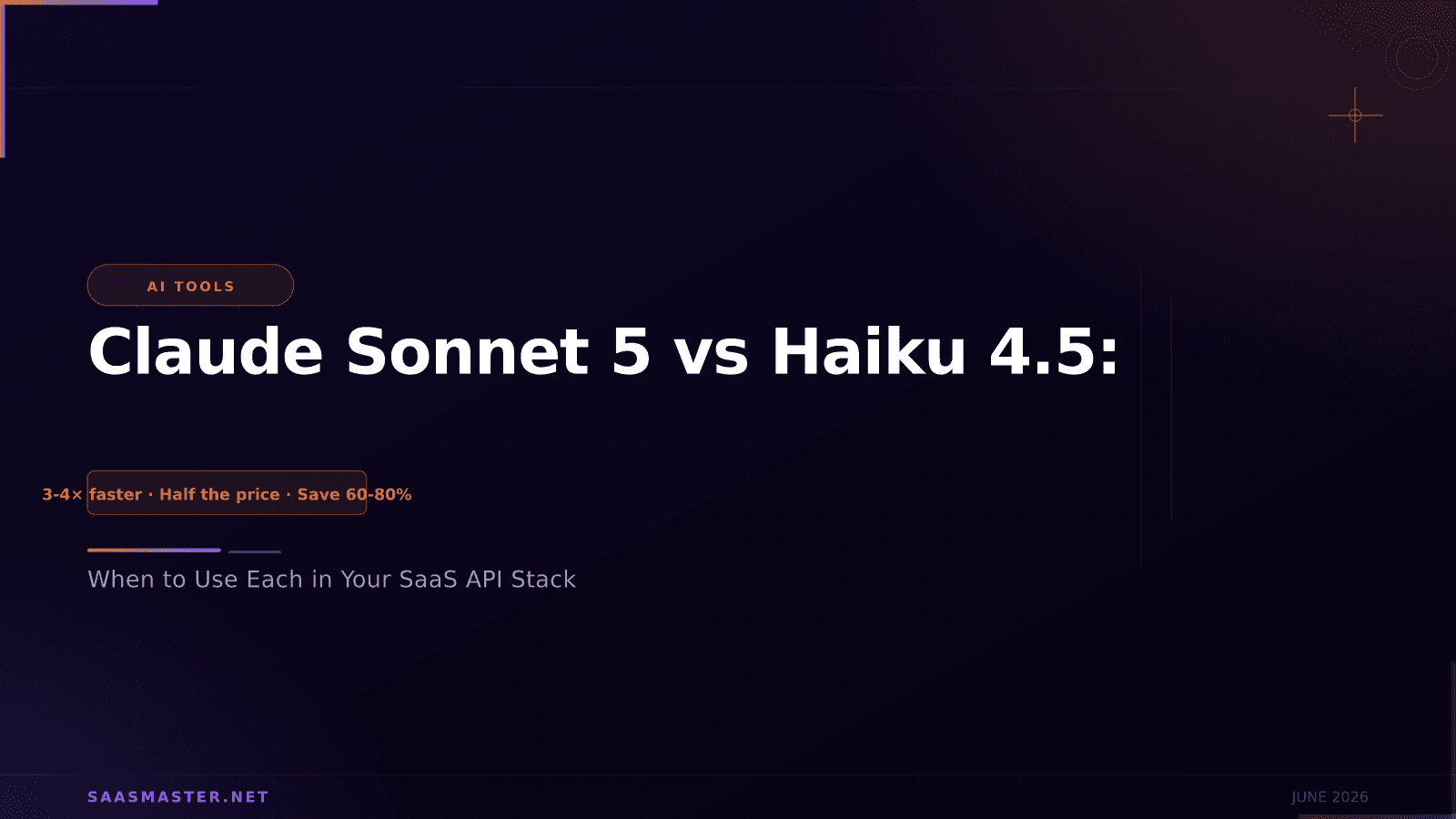
Claude Sonnet 5 and Claude Haiku 4.5 are both excellent models in 2026, but they are built for completely different jobs in your SaaS stack. Sonnet 5 is Anthropic's new agentic flagship at $2 per million input tokens. Haiku 4.5 is the speed and cost champion at $1 per million input tokens with response times under 200 milliseconds for short prompts. Knowing when to use each one is worth more than picking one and sticking with it.
Key takeaways
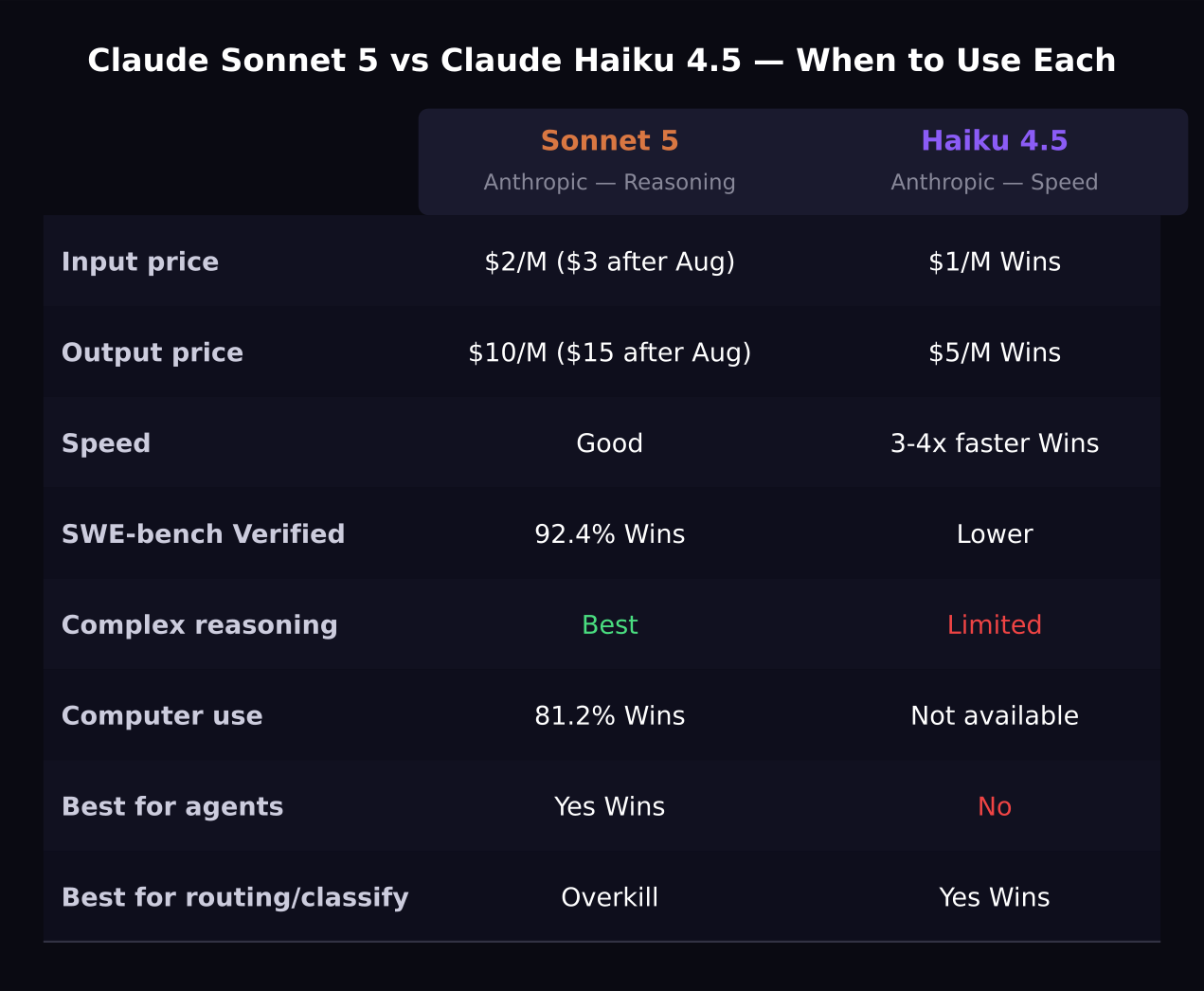
- Claude Haiku 4.5 costs $1 per million input tokens and $5 per million output tokens, half the price of Sonnet 5 intro and one-fifth at Sonnet 5 standard rates.
- Haiku 4.5 runs at 80 to 120 tokens per second, 3 to 4 times faster than Sonnet for typical prompts.
- Sonnet 5 scores 92.4% on SWE-bench Verified. Haiku 4.5 is significantly lower on complex coding benchmarks.
- Haiku 4.5 is ideal for classification, routing, summarization, commit messages, and high-volume chat where speed matters more than depth.
- Sonnet 5 is right for multi-step agents, complex code generation, reasoning, and computer use.
What Haiku 4.5 is designed for
Haiku 4.5 is Anthropic's fast, cheap inference model. It delivers responses under 200 milliseconds for short prompts, running at 80 to 120 tokens per second. At $1 input and $5 output per million tokens, it is a third of Sonnet 5's intro pricing and a fifth at standard rates.
The use cases where Haiku 4.5 excels are high-volume, low-depth tasks: classifying incoming messages, generating short commit messages or PR summaries, running intent detection in a chat interface, summarizing short documents, or powering a real-time autocomplete feature. Any task that fires thousands of API calls per day and does not require deep reasoning is a strong Haiku candidate.
What Sonnet 5 is designed for
Sonnet 5 is built for tasks that require depth, reasoning, multi-step execution, or autonomous decision-making. Its 92.4% SWE-bench Verified score reflects genuine coding capability at the frontier level. Its 81.2% OSWorld computer use score means it can control a browser or desktop reliably. Its improved tool calling efficiency means it completes multi-step agent tasks with fewer wasted steps.
Sonnet 5 is right when the task could fail if the model makes a reasoning error, when you need the model to plan before acting, or when the output will directly affect a user-facing feature where quality matters.
The tiered architecture that works
The best-performing SaaS AI stacks in 2026 typically use two or three Claude models together. Haiku 4.5 handles the front line: routing incoming requests, classifying intent, running quick lookups, and filtering noise. Sonnet 5 handles the tasks that require reasoning, coding, or multi-step execution. Opus 4.8 sits in reserve for the hardest agent runs where even Sonnet 5 struggles.
This tiered approach extracts Haiku's speed and cost savings on the work that does not need Sonnet, while ensuring Sonnet is available for the tasks that justify its cost.
A simple example: a SaaS customer support product uses Haiku 4.5 to classify every incoming ticket (50,000 tickets per day, mostly simple) and route anything complex to Sonnet 5 for a full response. That mix saves roughly 80% on API costs compared to running everything through Sonnet 5.
Choosing by task type
Use Haiku 4.5 for: autocomplete suggestions, quick intent classification, short-form content generation, real-time chat responses to simple queries, code comment generation, and any workflow where the latency of Sonnet 5 would degrade user experience.
Use Sonnet 5 for: multi-file code generation and review, autonomous agent loops, computer use and browser control, complex customer inquiries requiring reasoning, document analysis beyond a few pages, and any task where getting the answer right is more important than getting it fast.
Frequently asked questions
Should I default to Sonnet 5 for everything to simplify my stack?
For development and prototyping, yes, using Sonnet 5 for everything is fine. For production at scale, the cost difference is meaningful. A SaaS product that classifies 100,000 messages per day with Sonnet 5 at $0.002 per call costs $200 per day. The same with Haiku 4.5 at $0.001 per call costs $100 per day. At high volume, a routing layer pays for itself quickly.
How much faster is Haiku 4.5 than Sonnet 5?
Haiku 4.5 runs at 80 to 120 tokens per second and delivers responses under 200 milliseconds for short prompts. Sonnet 5 is meaningfully slower for equivalent prompts. For features where the user is waiting in real time, Haiku's speed advantage is noticeable.
Is Haiku 4.5 available on the free plan?
Haiku 4.5 is not the free plan default. Claude Sonnet 5 replaced Sonnet 4.6 as the free plan default on June 30, 2026. Haiku 4.5 is available through the API for developers at $1 per million input tokens.
Was this article helpful?
SaaS Master
Creator behind SaaS Master — tutorials, walkthroughs, reviews, and explainers that help SaaS, AI, and WordPress products get understood and chosen. Writing here about the tools, trends, and tactics that actually move the needle. Work with me →
Want your product explained this clearly — in video?
Tutorials, walkthroughs, reviews, and shorts for SaaS, AI, and WordPress products.
Work With SaaS Master