AI Tools
Claude Sonnet 5 vs Llama 4 Scout: Closed AI vs Open Source for SaaS in 2026
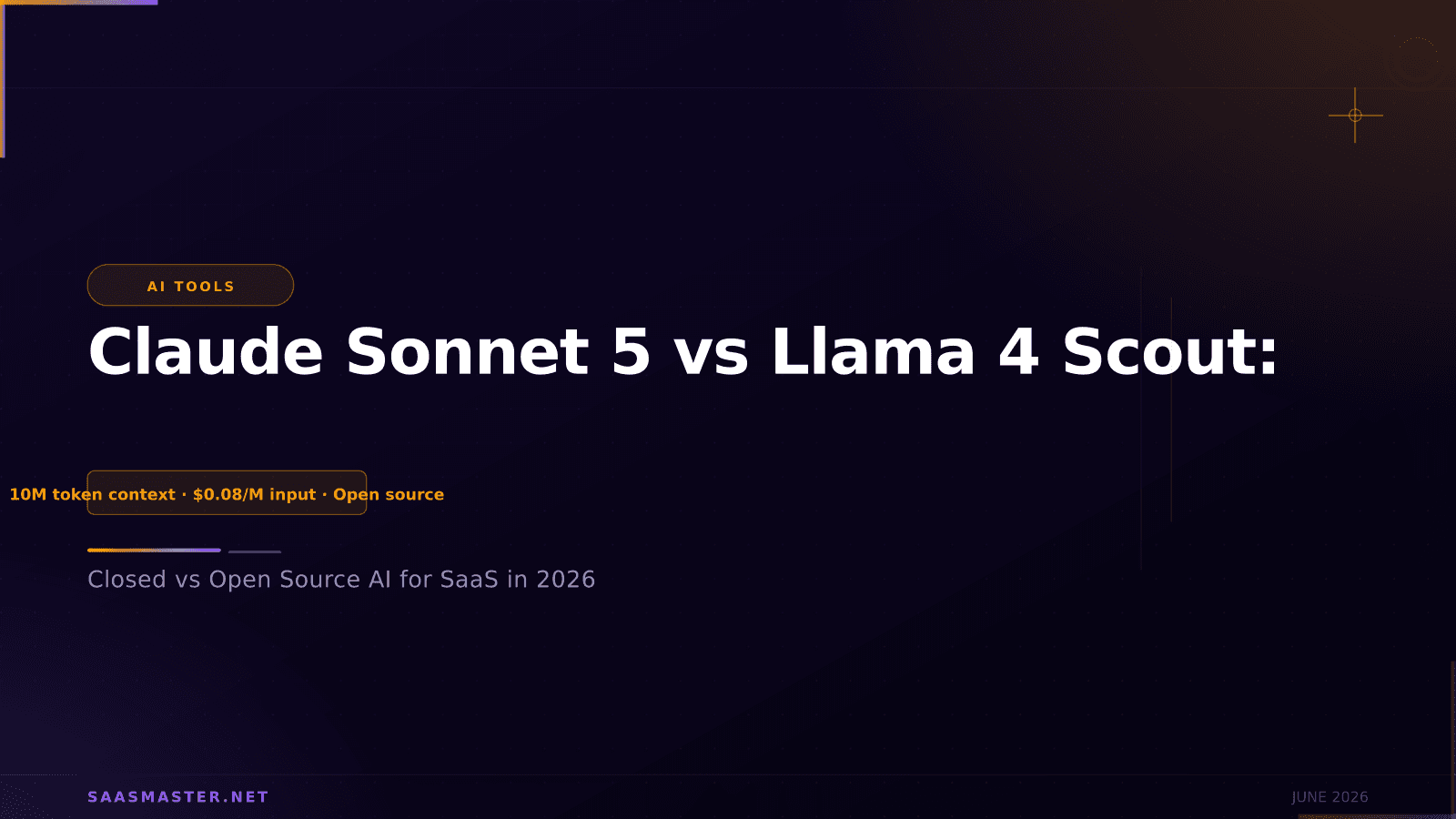
Claude Sonnet 5 and Llama 4 Scout represent the clearest closed-versus-open divide in AI for SaaS builders in 2026. Sonnet 5 is Anthropic's best-in-class closed model at 92.4% SWE-bench Verified. Llama 4 Scout from Meta is an open-source multimodal model with an extraordinary 10 million token context window, available at $0.08 per million input tokens through third-party providers. For SaaS teams choosing between API dependency and open deployment, this comparison cuts to the core of the decision.
Key takeaways
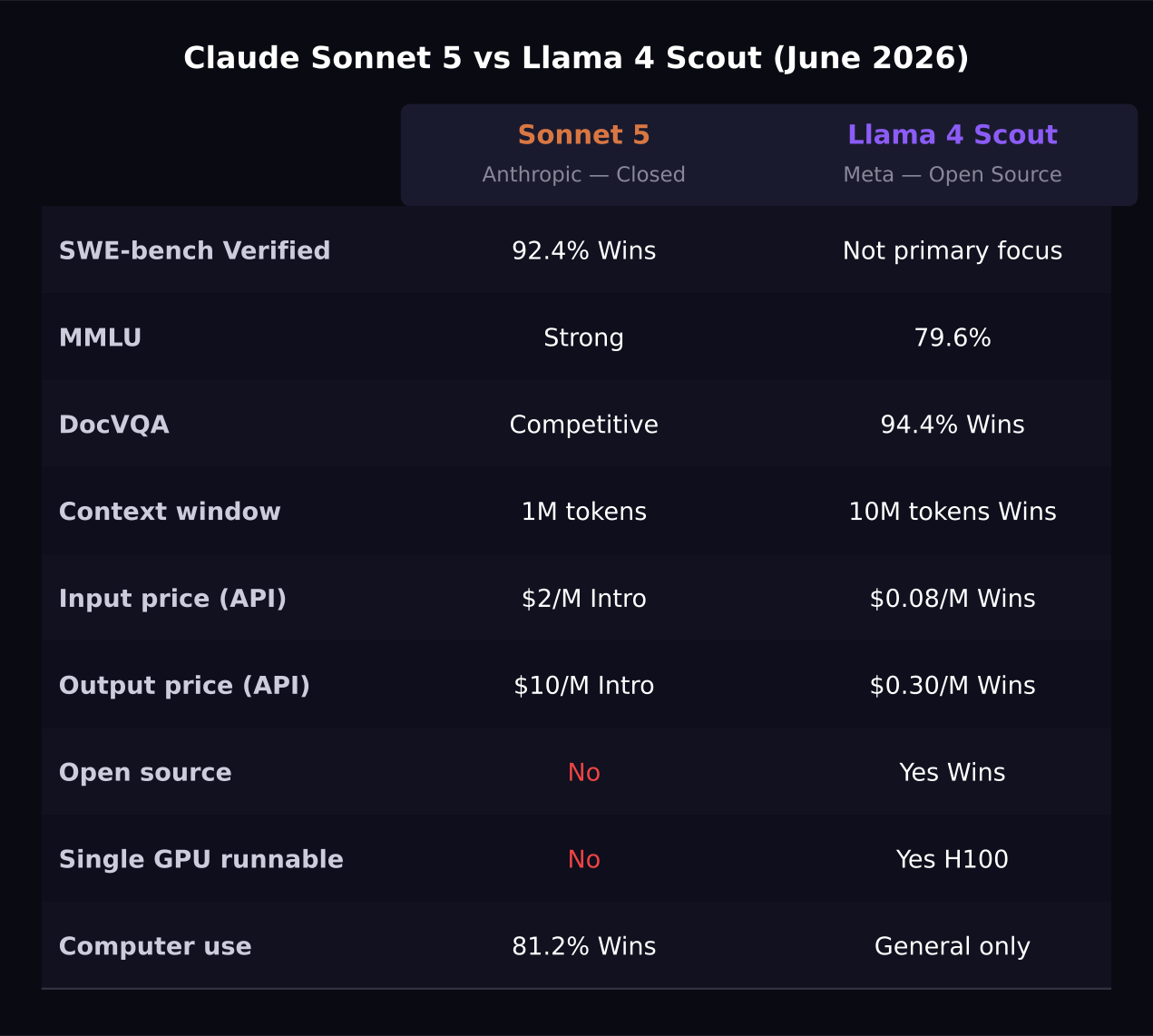
- Claude Sonnet 5 scores 92.4% on SWE-bench Verified. Llama 4 Scout scores 79.6% on MMLU with strong multimodal benchmarks for its size class.
- Llama 4 Scout costs as little as $0.08 per million input tokens and $0.30 per million output tokens through providers like Together AI and DeepInfra.
- Llama 4 Scout has a 10 million token context window, the largest of any model in this comparison.
- Llama 4 Scout is open-source, runs on a single NVIDIA H100, and has native multimodal support for text and images.
- For teams needing complete control, massive context, and near-zero inference cost, Llama 4 Scout is a serious option.
The 10 million token context window
Llama 4 Scout's 10 million token context window is the standout number in this comparison. Most frontier models, including Sonnet 5, Opus 4.8, and GPT-5.5, cap at 1 million tokens. Llama 4 Scout can hold 10 times more context in a single call.
For SaaS applications that work with very large documents, entire codebases in a single prompt, long conversation histories, or massive datasets, this context window is genuinely useful and has no equivalent in the closed-model world at any price. You could feed an entire legal document library or a large software repository into a single Llama 4 Scout call.
Benchmark gap in real terms
Llama 4 Scout's MMLU of 79.6% puts it in the strong-but-not-frontier tier on general knowledge benchmarks. Its DocVQA score of 94.4% shows excellent performance on document and visual question answering. Its ChartQA of 88.8% is competitive.
For pure coding tasks measured by SWE-bench Verified, Sonnet 5's 92.4% represents a significant lead. Llama 4 Scout was not designed as a coding specialist. It is a general-purpose multimodal model optimized for broad capability on a single GPU.
Cost and deployment
At $0.08 per million input tokens and $0.30 per million output, Llama 4 Scout through third-party providers is 25 times cheaper on input and 33 times cheaper on output than Sonnet 5 at intro pricing. These are not small differences.
For SaaS products that process millions of documents per month, or that need to run AI inference at a price point that makes AI-powered features economically viable for a consumer audience, Llama 4 Scout's cost structure enables product economics that Sonnet 5 cannot match.
Self-hosting is also viable. Llama 4 Scout fits on a single NVIDIA H100, which means a team with GPU access can run it in-house at infrastructure cost rather than per-token pricing.
When Sonnet 5 wins clearly
For agentic workflows that require reliable tool calling, computer use, and multi-step reasoning, Sonnet 5 is significantly ahead. Claude's agentic infrastructure is among the most mature available, and Sonnet 5 at 81.2% on OSWorld computer use is in a different tier from Llama 4 Scout's general-purpose agent capabilities.
For coding tasks on real production codebases, Sonnet 5's SWE-bench Verified lead is meaningful. For any feature where AI quality directly affects user perception, Sonnet 5 produces more consistent results.
Frequently asked questions
Is Llama 4 Scout good enough for SaaS document processing?
For bulk document processing, summarization, and extraction where the 10M context window matters, yes. For tasks requiring deep reasoning about the content, Sonnet 5 produces higher quality. The right choice depends on whether your use case is primarily about fitting large context or about sophisticated reasoning.
Can Llama 4 Scout be used commercially?
Yes, with Meta's Llama license. The license allows commercial use above certain scale thresholds. For SaaS products above Meta's usage thresholds, a commercial license from Meta is required.
How does running Llama 4 Scout on my own H100 compare to Sonnet 5 API costs?
A cloud H100 costs approximately $2 to $4 per hour depending on provider and contract. Llama 4 Scout generates roughly 100 to 200 tokens per second per GPU. At that rate, 1 million tokens takes 1.4 to 2.8 hours of GPU time, costing $2.80 to $11 per million tokens, before infrastructure overhead. At scale with optimized batching, self-hosting becomes competitive with mid-tier API pricing.
Was this article helpful?
SaaS Master
Creator behind SaaS Master — tutorials, walkthroughs, reviews, and explainers that help SaaS, AI, and WordPress products get understood and chosen. Writing here about the tools, trends, and tactics that actually move the needle. Work with me →
Want your product explained this clearly — in video?
Tutorials, walkthroughs, reviews, and shorts for SaaS, AI, and WordPress products.
Work With SaaS Master