AI Tools
Claude Sonnet 5 vs Microsoft MAI Models: Best AI for Azure SaaS in 2026
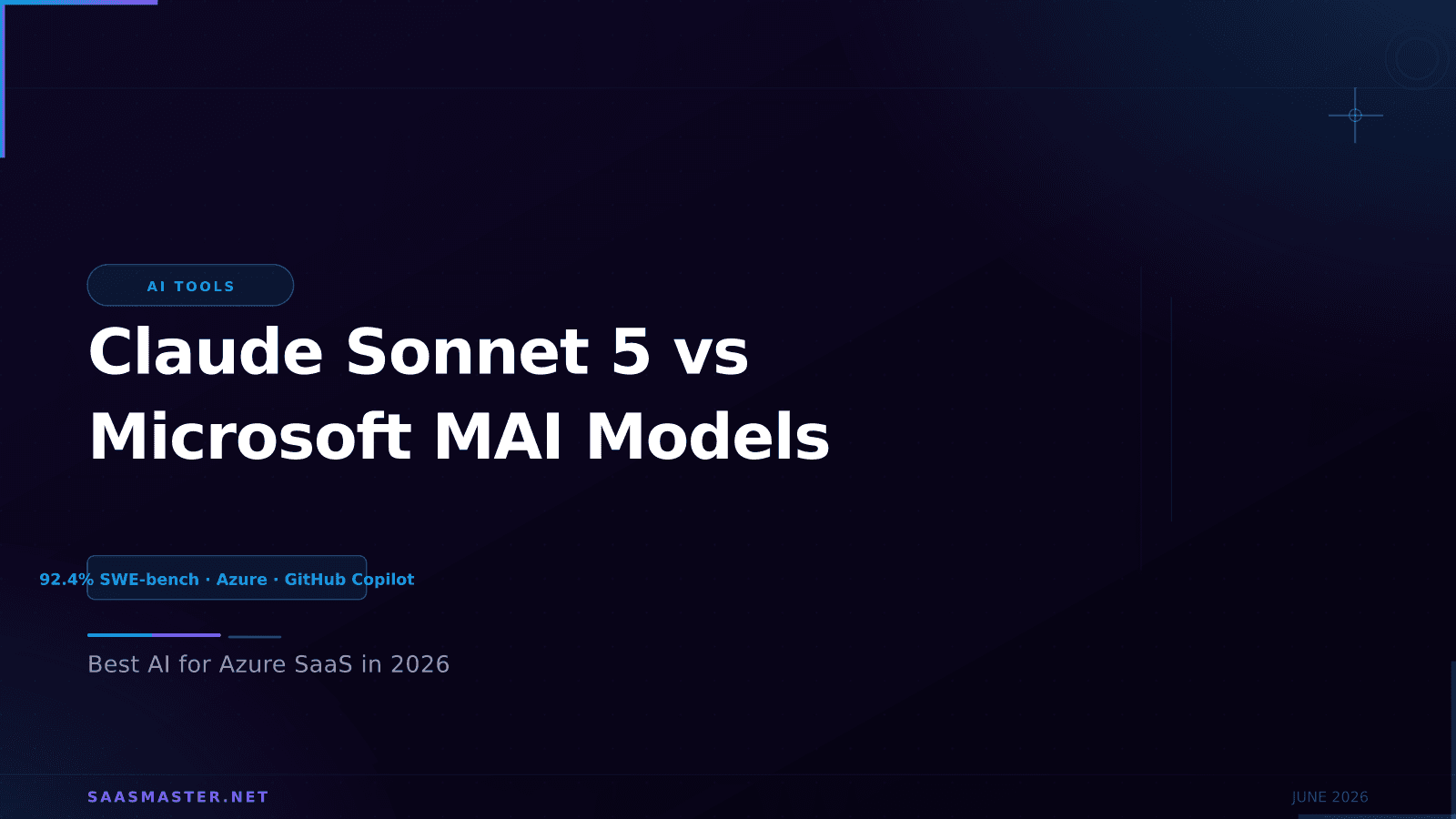
Microsoft launched its MAI model family at Build 2026, and Claude Sonnet 5 arrived the same month, creating a direct comparison between Anthropic's new default and Microsoft's in-house AI on the benchmarks that matter for SaaS developers. MAI-Thinking-1 is Microsoft's reasoning flagship and MAI-Code-1-Flash is its fast coding model. Sonnet 5 is the benchmark leader at 92.4% on SWE-bench Verified. Here is how they compare for teams building on Azure versus the broader Claude ecosystem.
Key takeaways
- Claude Sonnet 5 scores 92.4% on SWE-bench Verified. MAI-Thinking-1 is Microsoft's reasoning flagship with strong benchmark results but different deployment context.
- MAI models are natively integrated with Azure, GitHub Copilot, and Microsoft 365. Sonnet 5 integrates with Amazon Bedrock, Google Vertex, and Anthropic's direct API.
- MAI models were trained without OpenAI data and reflect Microsoft's first fully independent AI infrastructure.
- For teams already on Azure, MAI models reduce vendor dependency on OpenAI while staying in the Microsoft ecosystem.
- For teams on AWS, Google Cloud, or multi-cloud setups, Sonnet 5 is the better-benchmarked and more portable option.
What the MAI model family is
Microsoft launched seven in-house MAI models at Build 2026, trained without any OpenAI data. MAI-Thinking-1 is the flagship reasoning model and MAI-Code-1-Flash is the fast coding model optimized for GitHub Copilot integration. Microsoft built this family to reduce its dependency on OpenAI while offering customers models that run natively on Azure infrastructure.
For enterprise customers concerned about OpenAI's pricing, Microsoft's ability to maintain commercial terms and model availability, or data sovereignty within Microsoft's compliance boundary, the MAI family represents a meaningful alternative.
Benchmark comparison
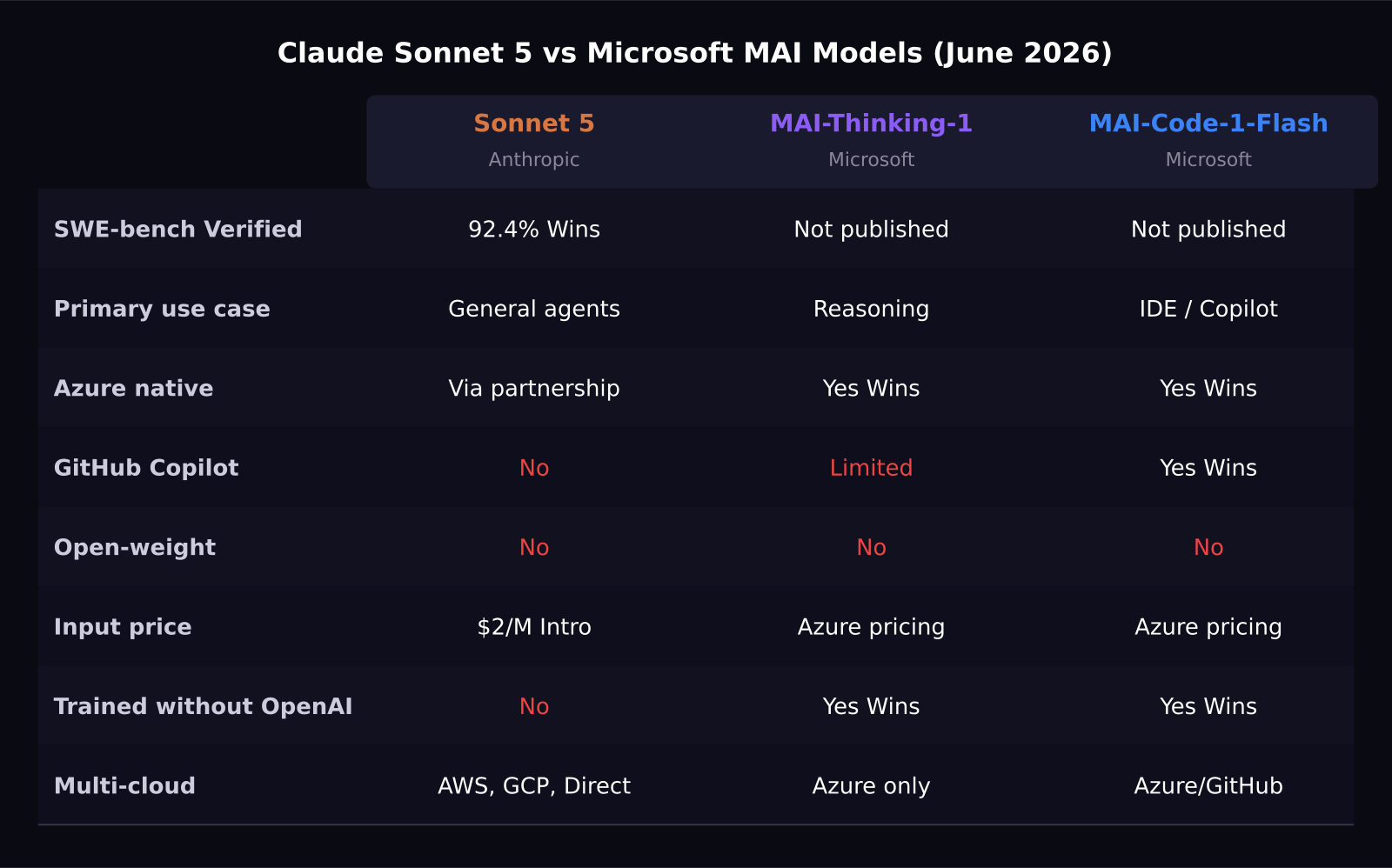
Sonnet 5's 92.4% SWE-bench Verified score is the highest published by any lab as of late June 2026. Microsoft has not published MAI-Thinking-1's SWE-bench Verified score in the same format. MAI-Code-1-Flash is positioned as a fast coding assistant for IDE and CI/CD contexts rather than a benchmark leader.
The comparison here is partly architectural. Sonnet 5 is a general-purpose agentic model that excels at coding. MAI-Code-1-Flash is purpose-built for the developer workflow pipeline, from Copilot suggestions to pull request review to GitHub Actions.
Azure integration depth
MAI models are natively available through Azure OpenAI Service, which means enterprise Azure customers can access them under their existing Azure contract, compliance framework, and data handling agreement. For an enterprise SaaS team that has spent significant effort getting Azure's compliance certifications, using MAI models adds no new compliance overhead.
Sonnet 5 on Azure is available through Azure's partnership with Anthropic, which means it runs on Azure infrastructure but under Anthropic's model terms. The integration is solid but the data handling and compliance terms are a distinct arrangement from native Azure services.
When to choose MAI over Sonnet 5
The clearest case for MAI models is a team that is deeply committed to the Microsoft enterprise stack: Azure, GitHub, Microsoft 365, and Teams. For that team, MAI models simplify the procurement, compliance, and integration story. MAI-Code-1-Flash inside GitHub Copilot is a particularly clean integration for development workflows that already live in GitHub.
For any team not anchored to Microsoft's ecosystem, Sonnet 5's benchmark lead and broader deployment options, including direct API, Bedrock, and Vertex, make it the stronger default for SaaS AI products.
Frequently asked questions
Can MAI models match Sonnet 5 on coding benchmarks?
Microsoft has not published SWE-bench Verified scores for MAI models comparable to Sonnet 5's 92.4%. MAI-Thinking-1 is positioned for reasoning and MAI-Code-1-Flash for fast IDE integration rather than pure benchmark competition. Direct comparison is difficult without Microsoft's published scores.
Are MAI models available outside of Azure?
MAI models are primarily available through Azure services. They are not distributed as open-weight models and are not available through third-party providers the way Sonnet 5 is through Bedrock and Vertex.
Should I switch from Sonnet 5 to MAI if I'm on Azure?
Not necessarily. Sonnet 5 is available on Azure through the Anthropic partnership and performs at 92.4% on SWE-bench Verified. The main reason to prefer MAI models on Azure is if you need native Microsoft compliance certifications for your specific regulated industry or if you want to eliminate all dependencies on third-party AI vendors within your Azure contract.
Was this article helpful?
SaaS Master
Creator behind SaaS Master — tutorials, walkthroughs, reviews, and explainers that help SaaS, AI, and WordPress products get understood and chosen. Writing here about the tools, trends, and tactics that actually move the needle. Work with me →
Want your product explained this clearly — in video?
Tutorials, walkthroughs, reviews, and shorts for SaaS, AI, and WordPress products.
Work With SaaS Master