AI Tools
Claude Sonnet 5 vs Opus 4.8: Does Anthropic's Cheaper Model Win in 2026?
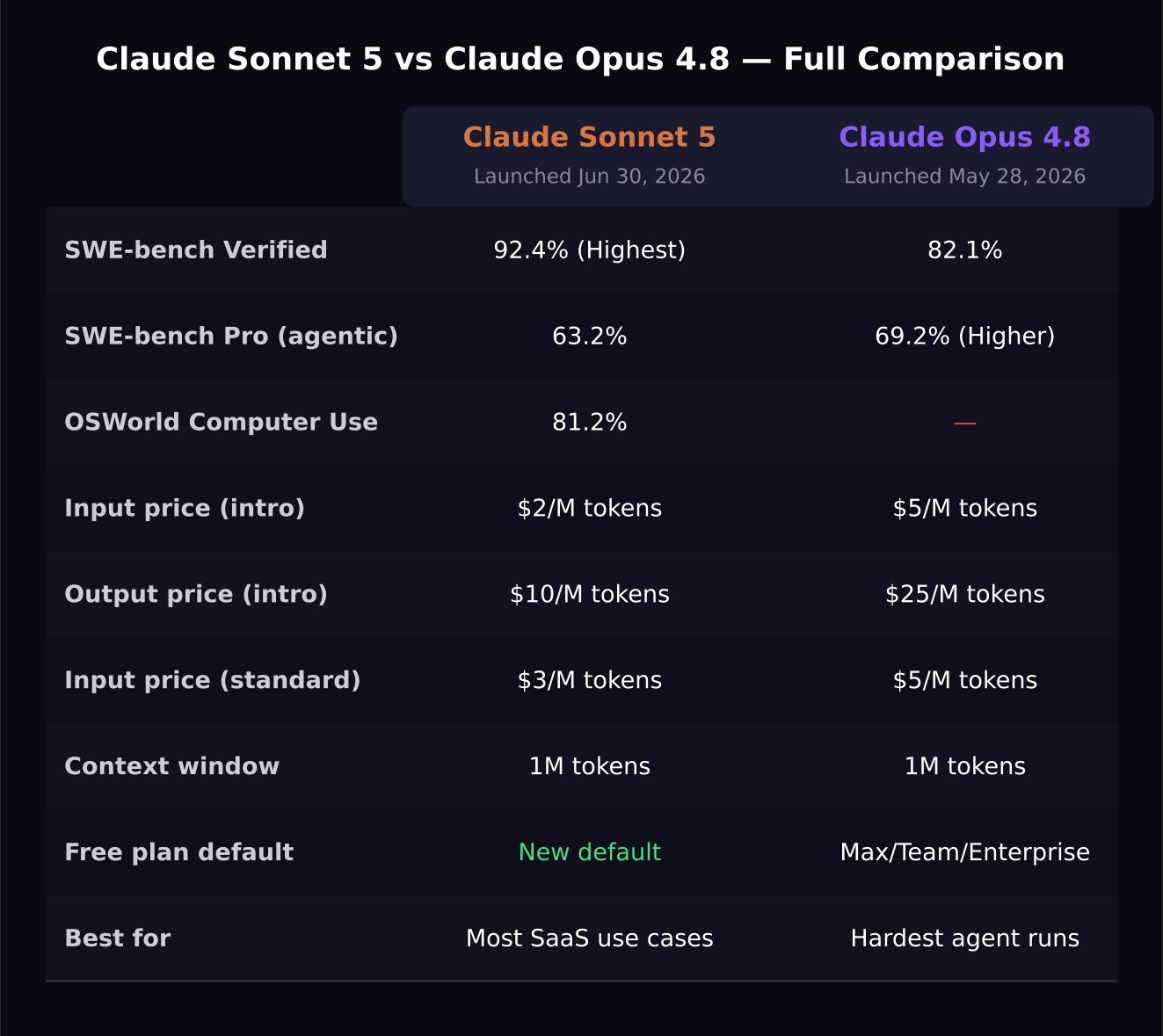
Claude Sonnet 5 launched today, June 30, 2026, and the most interesting question it raises is simple: does the flagship still make sense? With Sonnet 5 scoring 92.4% on SWE-bench Verified versus Opus 4.8's 82.1%, and launching at $2 per million input tokens versus Opus 4.8's $5, the cheaper model now outperforms the more expensive one on the most widely cited coding benchmark. Here is what the full comparison actually looks like.
Key takeaways
- Sonnet 5 scores 92.4% on SWE-bench Verified. Opus 4.8 scores 82.1% on the same benchmark, making Sonnet 5 the higher performer on standard coding tests.
- Opus 4.8 still leads on the harder SWE-bench Pro agentic coding benchmark: 69.2% versus Sonnet 5's 63.2%.
- Sonnet 5 launches at $2 per million input tokens and $10 per million output tokens through August 31, 2026. Regular pricing after that is $3 input and $15 output.
- Opus 4.8 costs $5 per million input tokens and $25 per million output tokens, 2.5 times more expensive at standard rates.
- Sonnet 5 is the new default model for Free and Pro Claude plans. Opus 4.8 remains the top-tier option on Max, Team, and Enterprise plans.
The benchmark reversal nobody expected
When Anthropic releases a new Sonnet, the assumption is usually that Opus stays ahead on raw performance while Sonnet trades some capability for lower cost. Sonnet 5 breaks that pattern on the most widely cited benchmark.
On SWE-bench Verified, the industry-standard test for coding capability on real GitHub issues, Sonnet 5 scores 92.4%. Opus 4.8, released just weeks earlier on May 28, 2026, scores 82.1% on the same benchmark. That is a 10-point gap in Sonnet's favor.
The benchmark picture gets more nuanced when you look at SWE-bench Pro, which is the harder, less contaminated version of the test. On SWE-bench Pro agentic coding, Opus 4.8 leads at 69.2% versus Sonnet 5's 63.2%. So Sonnet 5 is better on standard coding tasks, while Opus 4.8 is still stronger for the most demanding multi-step autonomous engineering work.
Pricing: Sonnet 5 during intro period
Sonnet 5's intro pricing through August 31, 2026 is $2 per million input tokens and $10 per million output tokens. After that it moves to $3 input and $15 output per million tokens.
At intro pricing, Sonnet 5 is 60% cheaper on input and 60% cheaper on output than Opus 4.8 at $5 and $25. At standard pricing after August, Sonnet 5 is still 40% cheaper on input and 40% cheaper on output.
For SaaS teams running high volumes through the API, this is a meaningful difference. At 100 million input tokens per month, intro-period Sonnet 5 saves $300,000 per year compared to Opus 4.8. At regular pricing it still saves $240,000 per year.
Where Opus 4.8 still wins
On the hardest agentic coding tasks, Opus 4.8 still leads. The 6-point gap on SWE-bench Pro might not sound large, but it reflects real differences in how the two models handle complex multi-step agent runs where failures cascade.
Opus 4.8 also leads on the Hebbia Super-Agent benchmark and the Legal Agent Benchmark, which measure whether a model can complete very long, interdependent task sequences end-to-end. For products that run fully autonomous agents over hours-long workflows, Opus 4.8 is still the more reliable choice.
The 1 million token context window is the same for both models, so context length is not a differentiator.
Computer use and OSWorld
Sonnet 5 scores 81.2% on OSWorld-Verified for computer use tasks, up from Sonnet 4.6's 78.5%. This means Sonnet 5 can control a computer and complete desktop tasks at a rate meaningfully above the human expert baseline of 72.4%.
Opus 4.8 also supports computer use but Sonnet 5 is the better option here specifically, given the lower cost per task and competitive performance on the computer-use benchmark. For SaaS teams building products with browser automation or computer control features, Sonnet 5 at intro pricing is the obvious choice over Opus 4.8.
Which model should you use?
The practical split I recommend after testing both today is this: if you are building features that involve standard coding, content generation, summarization, tool use, or computer control, Sonnet 5 at the intro price is the clear choice. It outperforms Opus 4.8 on standard coding and costs 60% less through August.
If you are building autonomous agents that need to run multi-step engineering tasks without human oversight, or if you are using Claude in a product where the hardest 5% of tasks matter most, Opus 4.8 still earns its premium on SWE-bench Pro agentic coding.
The decision changes in September when Sonnet 5 moves to $3 and $15. At that point, Sonnet 5 is still the better value for most tasks but the gap is smaller and the Opus premium for hard agent work becomes more defensible.
My take
Sonnet 5 is the most significant price-to-performance shift I have seen from Anthropic in one release. Beating the flagship on SWE-bench Verified while pricing at 60% less is not a minor update. It is a genuine rethinking of where you put compute to get the best results per dollar.
For most SaaS use cases, the conversation about whether to use Opus 4.8 or Sonnet 5 is now a straightforward cost analysis: Sonnet 5 does more for less on the tasks you probably care about most, with a specific carve-out for the hardest autonomous agent runs where Opus still leads.
Frequently asked questions
Does Sonnet 5 replace Opus 4.8 entirely?
No. Sonnet 5 outperforms Opus 4.8 on SWE-bench Verified but trails on SWE-bench Pro agentic coding. For complex, long-running autonomous agent workflows, Opus 4.8 is still the stronger model. For standard coding, content, tool use, and computer control, Sonnet 5 is now the better cost-adjusted choice.
How long does the Sonnet 5 intro pricing last?
The $2 per million input and $10 per million output pricing is valid through August 31, 2026. After that date, Sonnet 5 moves to $3 per million input and $15 per million output, which is still significantly cheaper than Opus 4.8 at $5 and $25.
Is Claude Sonnet 5 available on the free plan?
Yes. Sonnet 5 is the new default model for Free and Pro Claude plans as of its launch on June 30, 2026. Free users who previously had access to Sonnet 4.6 now have access to Sonnet 5 at no additional cost.
Was this article helpful?
SaaS Master
Creator behind SaaS Master — tutorials, walkthroughs, reviews, and explainers that help SaaS, AI, and WordPress products get understood and chosen. Writing here about the tools, trends, and tactics that actually move the needle. Work with me →
Want your product explained this clearly — in video?
Tutorials, walkthroughs, reviews, and shorts for SaaS, AI, and WordPress products.
Work With SaaS Master