Claude Sonnet 5 vs Opus 4.8: Which One Should Actually Build Your SaaS?
In short
Claude Sonnet 5 costs 60% less than Opus 4.8 and now beats it on one benchmark. Here's which model should build your SaaS in 2026.
Claude Sonnet 5 costs roughly 60% less than Claude Opus 4.8 right now, and on one real benchmark it already scores higher. That is not a typo, and it changes the calculus for anyone building a SaaS product with Claude Code or the API today.
Anthropic shipped Sonnet 5 on June 30, 2026, calling it the most agentic Sonnet model yet. I have spent the past few days moving parts of my own build workflow between the two models, and the honest answer is: most builders should default to Sonnet 5 and reach for Opus 4.8 only for a specific kind of problem.
Key takeaways
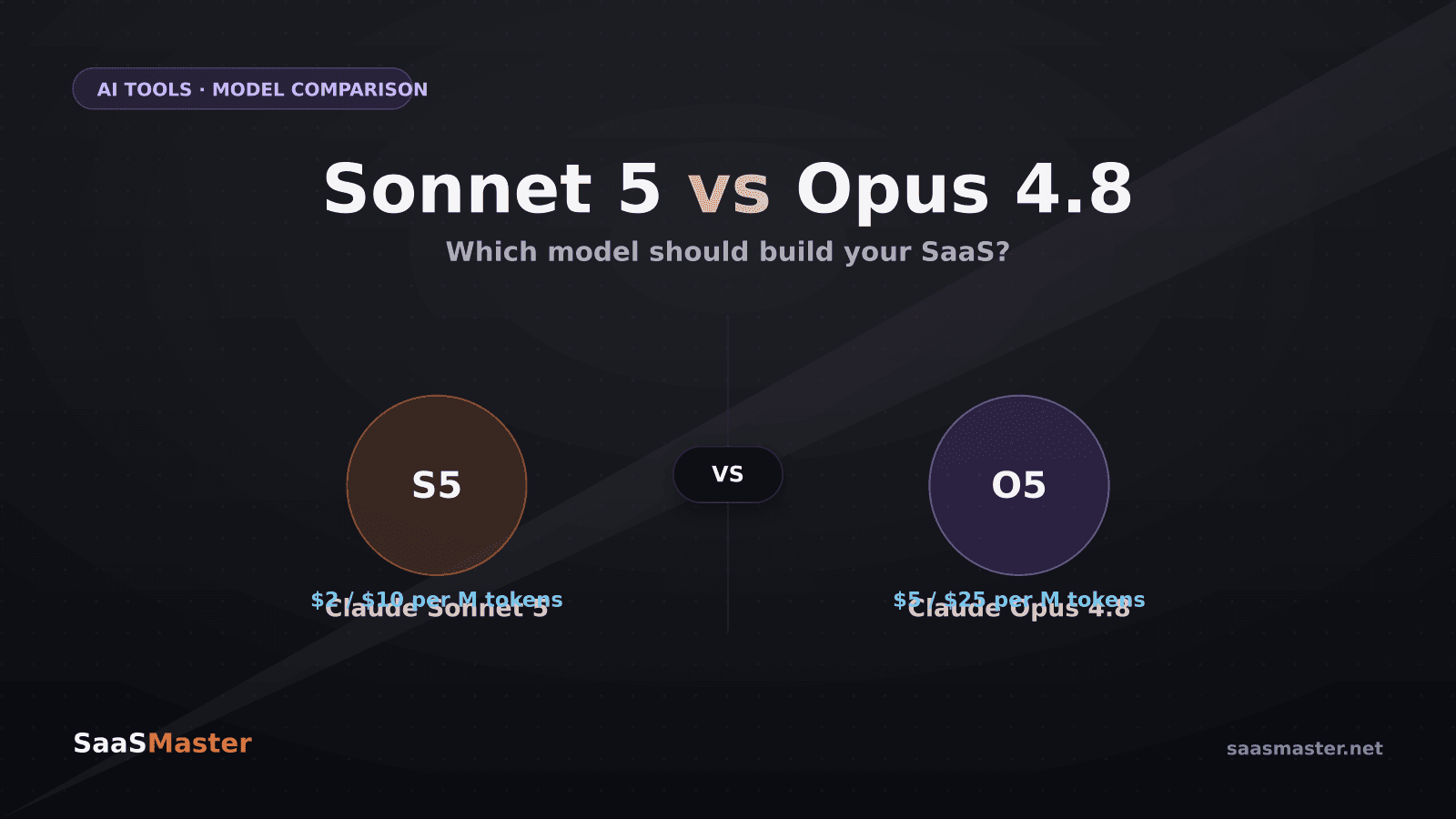
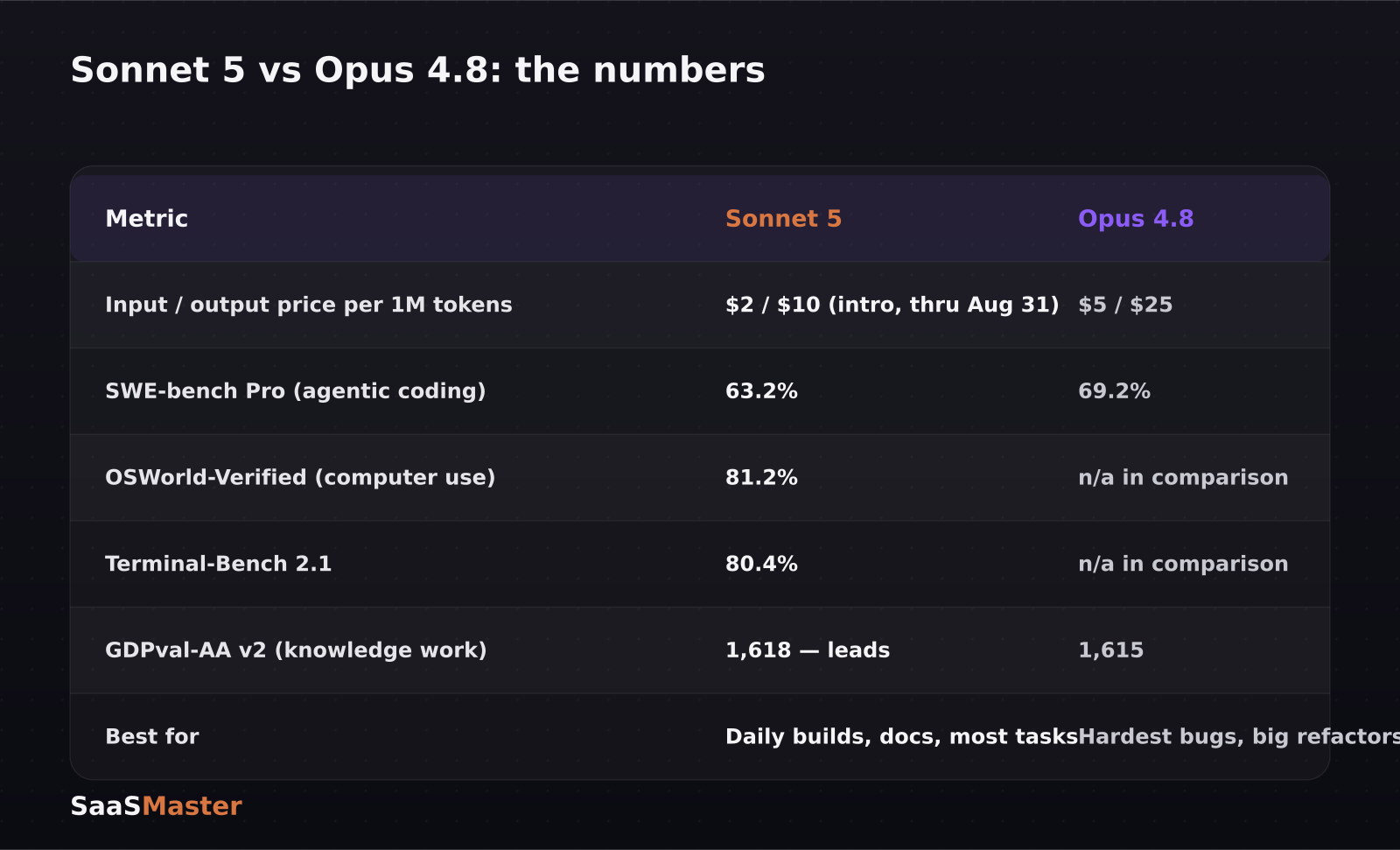
- Sonnet 5 is priced at $2 per million input tokens and $10 per million output tokens through August 31, 2026, then moves to $3/$15. Opus 4.8 stays at $5/$25.
- On SWE-bench Pro, Sonnet 5 hits 63.2% versus Opus 4.8's 69.2% — Opus still wins on raw agentic coding difficulty.
- On the GDPval-AA v2 knowledge-work benchmark, Sonnet 5 actually edges out Opus 4.8: 1,618 versus 1,615.
- Sonnet 5 jumped hard on tool use and computer-use tasks: 81.2% on OSWorld-Verified and 80.4% on Terminal-Bench 2.1, both sizable gains over Sonnet 4.6.
- A tokenizer change means the same text can cost 1.0 to 1.35 times more tokens than before, which quietly affects your real per-task cost.
What actually changed with Claude Sonnet 5?
Sonnet 5 is not a minor point release. Anthropic built it on an updated tokenizer (the one introduced with Opus 4.7) and clearly optimized it for the kind of long, tool-heavy sessions that define modern SaaS development: multi-file refactors, running tests, reading logs, and clicking through a browser to verify a UI actually works.
That shows up in the numbers. Computer-use performance jumped from 78.5% to 81.2% on OSWorld-Verified, and Terminal-Bench 2.1 climbed from 67.0% to 80.4% compared to Sonnet 4.6. If your workflow leans on Claude Code running commands, reading error output, and iterating without you babysitting every step, this is the upgrade that matters more than any leaderboard score.
How much does Claude Sonnet 5 cost compared to Opus 4.8?
This is where the decision gets easy for most people. Sonnet 5's introductory pricing runs through August 31, 2026 at $2 per million input tokens and $10 per million output tokens. After that window it settles at $3/$15. Opus 4.8 is $5 per million input tokens and $25 per million output tokens, full stop.
Run the math on a typical week of building: if you are burning tokens on scaffolding a new feature, writing tests, and debugging, Opus 4.8 will cost roughly 2.5x more per task at standard rates, and closer to 5x more during Sonnet 5's introductory window. For a solo founder or small team watching burn, that difference adds up fast — especially since the tokenizer change means you are already paying somewhat more per request than you were on Sonnet 4.6.
Which model wins on coding benchmarks?
Opus 4.8 still leads on the hardest agentic coding test available: SWE-bench Pro, where it scores 69.2% against Sonnet 5's 63.2%. That six-point gap is real and it shows up most on gnarly, multi-step bugs in large, unfamiliar codebases — the kind of task where a model has to hold a lot of context and make several correct decisions in a row without a person checking in.
But that is a narrower slice of real work than the benchmark suggests. On GDPval-AA v2, which measures broader knowledge work rather than pure coding difficulty, Sonnet 5 actually surpasses Opus 4.8: 1,618 to 1,615. That benchmark is a better proxy for the day-to-day mix of a SaaS build — writing copy, drafting a database schema, explaining a tradeoff in plain language, reviewing a PR description — and Sonnet 5 is not just "good enough" there, it is ahead.
So which one should you use for your SaaS build?
Here is how I would frame it for a non-developer building with AI tools, which is exactly the audience I make videos for.
Use Claude Sonnet 5 for the majority of your work: feature builds, day-to-day debugging, writing marketing copy or documentation, database and API design, and any task where you are working interactively and can course-correct if something is off. This is at least 90% of what a SaaS founder actually does with Claude in a given week, and Sonnet 5 handles it at a fraction of the cost with noticeably better tool use than its predecessor.
Reach for Claude Opus 4.8 when you hit a specific wall: a bug that has survived two or three attempts from Sonnet 5, a large refactor across a codebase you do not fully understand, or a security-sensitive piece of logic (auth, payments, data access rules) where you want the model with the highest ceiling on hard reasoning, even at 2.5x the cost. Treat Opus as your escalation path, not your default.
My take after switching my own workflow
I moved my default Claude Code sessions to Sonnet 5 the day it launched and only dropped back to Opus 4.8 twice in the following week — both times for a stubborn state-management bug that Sonnet 5 had already gotten 80% of the way to solving. That pattern matches what the benchmarks predict: Sonnet 5 is not "the cheap option," it is the better default, with Opus as a scalpel for the hard 10%.
The tokenizer change is worth watching if you are tracking spend closely. Because the same prompt can now map to up to 1.35x more tokens, your bill per request may look slightly higher even though the per-token price dropped. Net-net it is still meaningfully cheaper for most workloads, but budget a little padding if you are forecasting API costs for a client project.
If you are building or scaling a SaaS product right now, pairing a strong default model with disciplined escalation rules is the same instinct behind good SaaS video marketing strategy — use the efficient tool for the common case, and bring in the heavier resource only when the task actually demands it. For teams pairing Claude with other AI tools in their build stack, our breakdown of Claude AI and MiniMax M3 for landing pages covers a similar cost-tiering approach for a different part of the stack.
If you are also watching the broader model landscape, our comparison of Kimi K2.6, Qwen3.7 Max, and DeepSeek V4 Pro covers where the Chinese frontier models land on price and coding benchmarks, and our look at the cheapest AI subscriptions of 2026 puts Claude Pro's consumer pricing next to Gemini and ChatGPT Go. For teams that want a video explainer walking through an AI-tool workflow for their own audience, that is exactly the kind of content we build with AI tool video production.
Explore more of our AI Tools coverage for ongoing model comparisons as pricing and benchmarks keep shifting through the rest of 2026.
Frequently asked questions
Is Claude Sonnet 5 good enough to replace Opus 4.8 entirely?
For most SaaS-building tasks, yes. Sonnet 5 matches or beats Opus 4.8 on knowledge-work benchmarks like GDPval-AA v2 and on tool-use tasks like computer use and terminal work. Opus 4.8 still holds a clear lead on the hardest agentic coding benchmark, SWE-bench Pro, so keep it as a fallback for your toughest bugs rather than dropping it completely.
How long will Claude Sonnet 5's introductory pricing last?
Anthropic has Sonnet 5 priced at $2 per million input tokens and $10 per million output tokens through August 31, 2026. After that date, pricing moves to $3 per million input tokens and $15 per million output tokens, still well below Opus 4.8's $5/$25.
Will switching to Sonnet 5 change how much I pay per request?
Possibly, in a small way. Sonnet 5 uses an updated tokenizer that can turn the same text into 1.0 to 1.35 times more tokens than before. The much lower per-token price still makes it cheaper overall for nearly every workload, but the token-count increase is worth factoring in if you are forecasting costs precisely.
Was this article helpful?
Jorge Aguilar
Founder & Creator, SaaS Master
Producing SaaS and AI product videos since 2019 — 800+ videos for 200+ brands, covering tutorials, demos, walkthroughs, and explainers. Writing here about the tools, trends, and tactics that actually move the needle. LinkedIn · About · Work with me
Building an AI product that needs a clearer onboarding flow?
Client-owned videos that make your product easy to understand — demos, walkthroughs, onboarding, and explainers.
Explore AI product video production