The Complete SaaS Video Marketing Strategy Guide
In short
A complete SaaS video marketing strategy: which videos to make, where they live in the buyer journey, how to build a repeatable system, and what to measure.
SaaS video marketing isn't one hero video on your homepage — it's a system of short, purposeful videos placed at the exact moments where buyers and users get stuck. Done well, it shortens the distance between 'what is this?' and 'I get it, let's go,' at every stage from first click to renewal. This guide lays out the whole strategy: which videos actually matter, where each one lives in the buyer journey, how to produce them without reinventing the wheel each time, and how to know if they're working.
The throughline is simple: every video should make the product easier to understand for a specific person at a specific moment. That's the standard behind everything SaaS Master produces, and it's what turns video from a cost line into a growth channel.
Key takeaways
- Treat video as a system mapped to the buyer journey, not a single explainer.
- Match each video type to a stage: awareness, consideration, decision, onboarding, retention.
- Build one strong product story, then cut it into placements instead of filming each from scratch.
- Short-form and long-form work together — discovery up top, depth where intent is high.
- Measure the metric that matches the stage: reach, engagement, conversion, activation, or support deflection.
What SaaS video marketing actually is
Most SaaS teams think about video as 'we should make an explainer.' That's a tactic, not a strategy. A strategy asks: where in our funnel do people drop off or get confused, and what video removes that friction? The answer is almost never one video — it's a small library, each piece doing a specific job.
The good news is you don't need dozens of productions. A handful of well-placed videos, built from one clear product story, covers most of the journey. The skill is in choosing the right few and putting them where the buyer is already looking.
Map your videos to the buyer journey
The cleanest way to plan a SaaS video strategy is stage by stage. Each stage has a different job and a different ideal video:
- Awareness: short-form clips, YouTube tutorials, and comparison content that reach people researching the problem — before they know your product exists.
- Consideration: an explainer or category video that frames the problem and where your product fits, plus honest comparisons.
- Decision: a product demo built around one core workflow, and use-case demos for specific buyer types — the videos that resolve 'will this actually work for me?'
- Onboarding: walkthroughs and tutorials that get new users to their first win fast, reducing early churn.
- Retention: feature-education and workflow videos that deepen usage and cut support tickets.
The core video types every SaaS company needs
You don't need all of these on day one, but this is the full menu — pick based on where your funnel hurts most:
- Product demo — shows the product solving a specific problem; the workhorse of the decision stage.
- Explainer — sets up the concept or category so the product makes sense; great for new or complex ideas.
- Walkthrough — step-by-step 'how to use it,' ideal for onboarding and evaluators.
- Onboarding videos — get a new user to first value quickly and reduce early drop-off.
- Tutorials — answer the specific 'how do I…?' questions that also rank on search and YouTube.
- Short-form clips — Shorts, Reels, and TikToks that distribute one feature or hook for reach.
- Launch videos — give new features and releases a story people can repeat.
Build a repeatable system, not one-off videos
The teams that win with video don't film everything separately — they build one strong product story and cut it into many placements. A single core demo can become a landing-page hero, a 60-second social clip, an email-ready version, and a handful of Shorts. One tutorial can spawn three answer-style short videos.
This 'produce once, distribute many' approach keeps the message consistent everywhere a buyer meets you and dramatically lowers the cost per placement. It also makes video sustainable — you're compounding a system, not restarting each quarter.
Where each video should live
Placement is half the strategy. A demo buried on a sub-page underperforms the same demo on the pricing page. Map each asset to its home: the homepage and pricing page for the primary demo; YouTube for searchable tutorials and comparisons; social feeds for short-form discovery; onboarding emails and in-app for walkthroughs; the help center for feature education; and sales sequences for use-case demos.
The same video can appear in several places, but each placement should be sized and framed for that context — autoplay-friendly and silent-readable on a landing page, hook-first on social, deeper on a sales call.
Measure what matters at each stage
Judging every video by 'views' is a mistake — a top-of-funnel Short and a pricing-page demo have completely different jobs. Match the metric to the stage: reach and watch-through for awareness; engagement and click-through for consideration; conversion and signup lift for decision videos; activation and time-to-first-value for onboarding; and support-ticket deflection and feature adoption for retention content.
You won't get clean attribution for everything, and that's fine. Track the metric closest to each video's job, watch the trend, and double down on the placements that move it.
Common SaaS video mistakes
The recurring ones to avoid:
- Making one 'about us' video and calling it a video strategy.
- Feature tours with no story, no single takeaway, and no clear next step.
- Ignoring onboarding and retention video — where video quietly saves the most money.
- Filming every asset from scratch instead of cutting from one core story.
- Judging every video by raw views instead of its stage-appropriate metric.
How to start: your first three videos
If you're starting from zero, resist the urge to plan a 20-video content calendar. Ship three videos that cover the highest-leverage moments, then expand:
- A product demo built around your buyers' single biggest question — for the homepage and pricing page.
- A first-run onboarding walkthrough that gets new users to their first win — to cut early churn.
- One short-form clip that distributes your strongest hook — for discovery on social and YouTube.
Frequently asked questions
How many videos does a SaaS company actually need?
Fewer than most teams think — but placed deliberately. Start with three (a core demo, an onboarding walkthrough, and one short-form clip), then add explainers, tutorials, and use-case demos as you see where the funnel leaks. A focused handful mapped to the journey beats a large library of unfocused videos.
Should SaaS video live on YouTube or on our own site?
Both, for different jobs. YouTube is for discovery — searchable tutorials, comparisons, and how-tos that reach people before they know you. Your own site is for conversion — demos on the homepage and pricing page, and walkthroughs in onboarding. The same core story can feed both.
How do we keep video sustainable without a big team?
Build one strong product story and cut it into many placements rather than filming each asset separately. Batch production, reuse footage across formats, and prioritize the videos that map to your biggest funnel leaks. A production partner who understands software can help you build the system once and keep it consistent.
Was this article helpful?
Jorge Aguilar
Founder & Creator, SaaS Master
Producing SaaS and AI product videos since 2019 — 800+ videos for 200+ brands, covering tutorials, demos, walkthroughs, and explainers. Writing here about the tools, trends, and tactics that actually move the needle. LinkedIn · About · Work with me
Need a product demo, walkthrough, or SaaS explainer?
Client-owned videos that make your product easy to understand — demos, walkthroughs, onboarding, and explainers.
Explore SaaS video productionRelated guides
More Product Demos & Video Marketing →
What Does SaaS Video Production Cost?
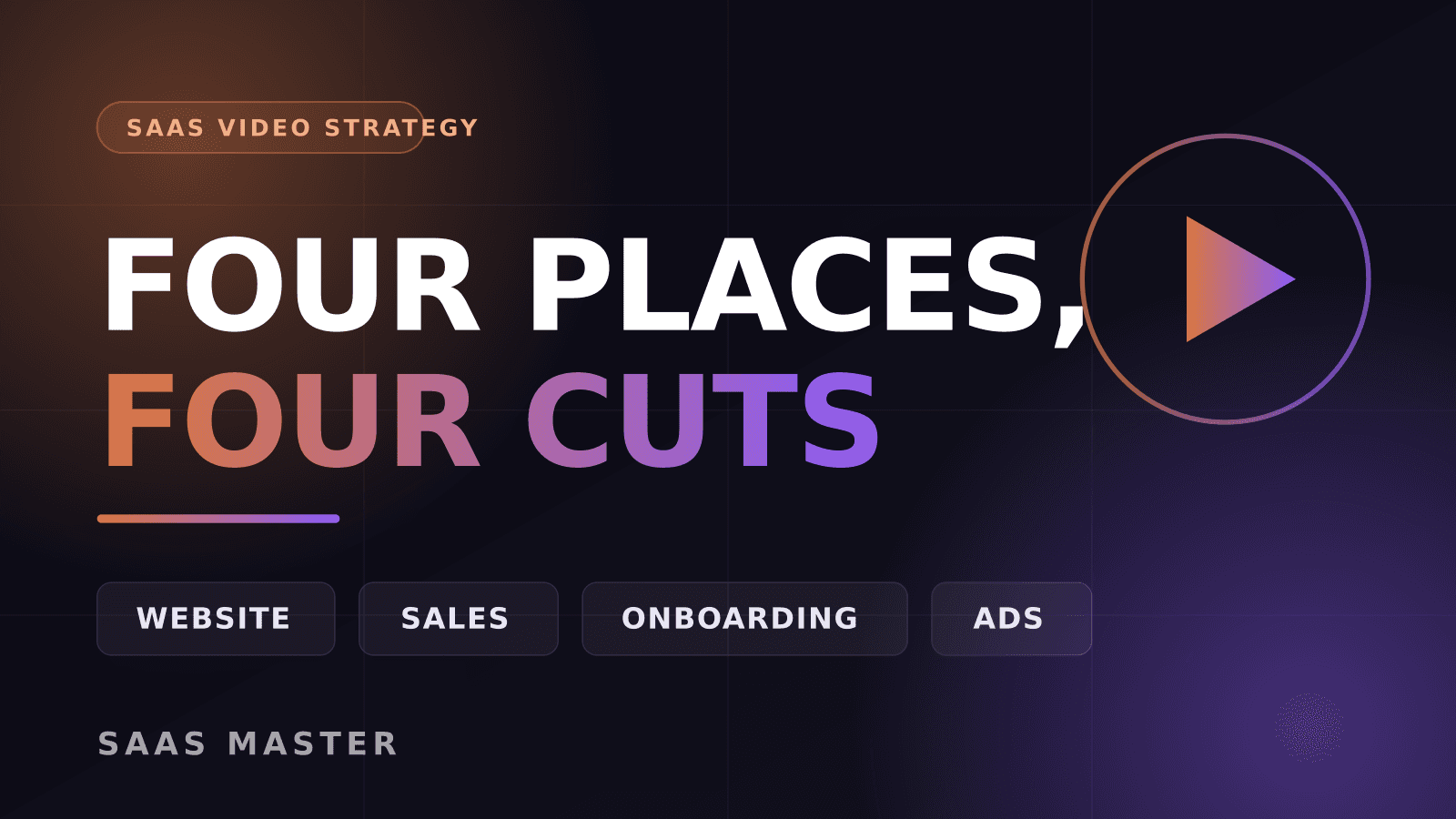
Where SaaS Companies Should Use Product Videos: Website, Sales, Onboarding, and Ads
OpenAI Is Shutting Down the Sora API on September 24, 2026: A Migration Guide for SaaS Video Teams