AI Tools
Claude Sonnet 5 vs Qwen 3.6: Best AI for Multilingual SaaS Products in 2026
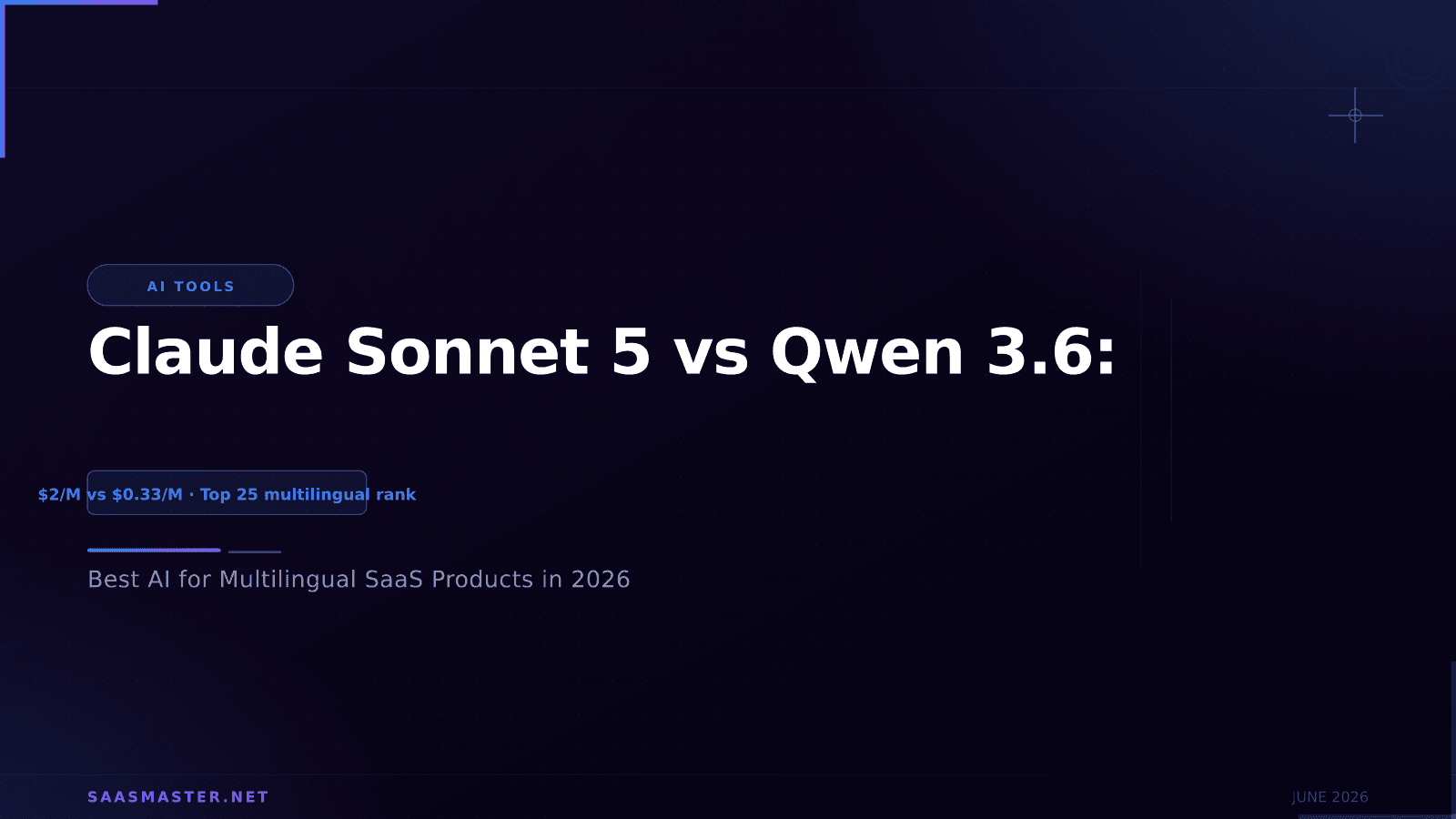
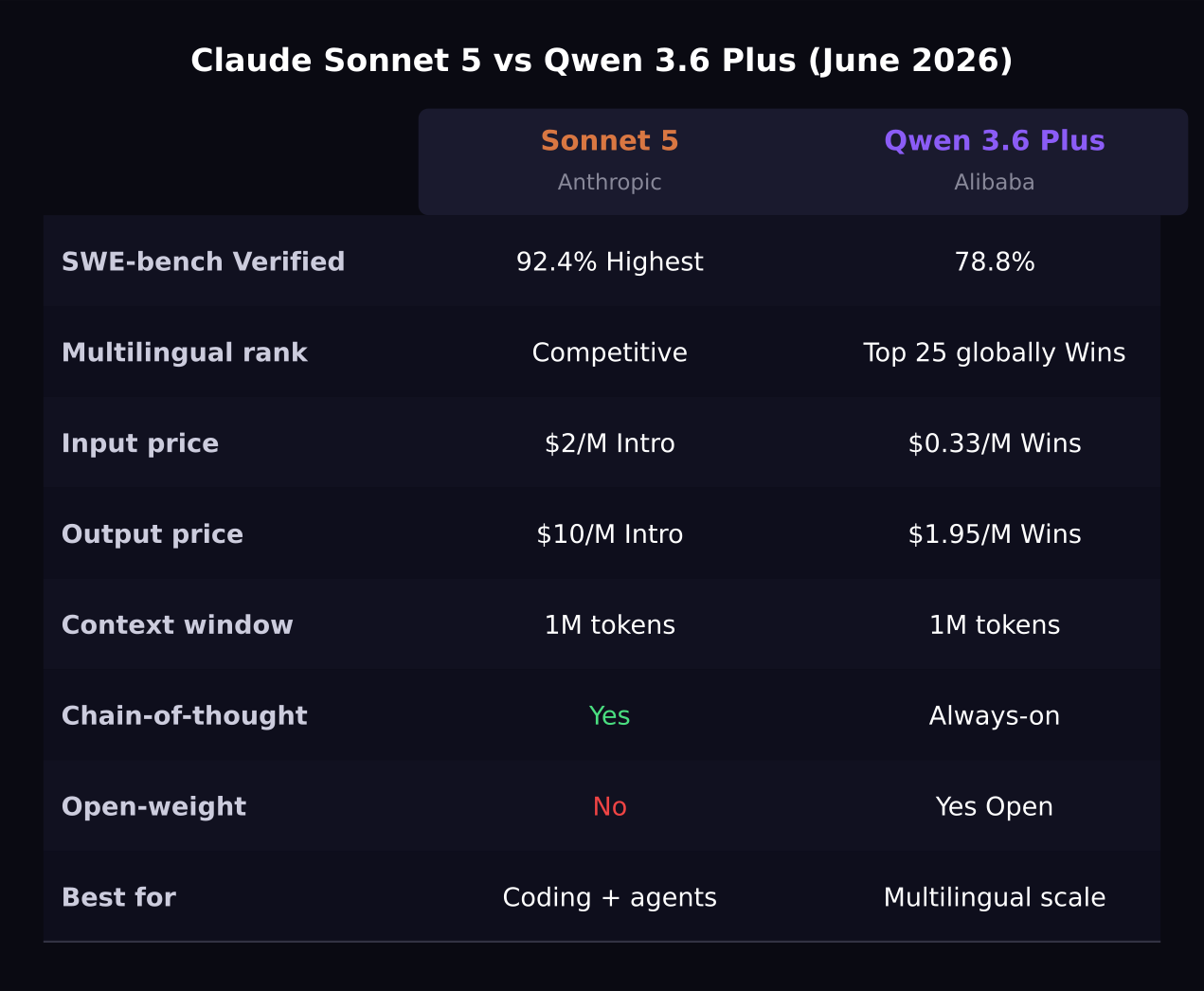
Claude Sonnet 5 and Qwen 3.6 Plus both support 1 million token context windows and offer competitive benchmarks in mid-2026, but they target different strengths. Sonnet 5 leads on SWE-bench Verified coding at 92.4%. Qwen 3.6 Plus from Alibaba scores 78.8% on SWE-bench Verified and costs $0.33 per million input tokens, and it leads on multilingual tasks where Chinese-language performance matters. For SaaS teams building products for global audiences, especially those targeting Chinese-speaking markets, the comparison is more nuanced than raw benchmark numbers suggest.
Key takeaways
- Claude Sonnet 5 scores 92.4% on SWE-bench Verified. Qwen 3.6 Plus scores 78.8% on the same benchmark.
- Qwen 3.6 Plus costs $0.33 per million input tokens and $1.95 per million output tokens, roughly 6 times cheaper on input than Sonnet 5 at standard pricing.
- Qwen 3.6 Plus scores 77.6% on multilingual benchmarks and ranks top 25 globally for multilingual tasks.
- Qwen 3.6 Plus is available on Alibaba Cloud and as open-weight. Sonnet 5 is closed and API-only.
- For products that need strong English coding and agentic work, Sonnet 5 wins. For global, multilingual SaaS targeting Asian markets, Qwen is worth a serious evaluation.
The multilingual angle
Most AI comparisons focus on English-language benchmarks. Qwen 3.6 Plus is designed for multilingual use cases with strong Chinese, Japanese, Korean, and other Asian language performance built into the base model. Alibaba trained the model with genuine multilingual data rather than translating English content, which results in better fluency and cultural accuracy in those languages.
For a SaaS product that serves Chinese-speaking users in China, Taiwan, Singapore, or Hong Kong, Qwen 3.6 Plus is one of the few models that natively handles Simplified and Traditional Chinese with the same fluency as English. Claude Sonnet 5 handles Chinese competently but was primarily trained on English-dominant data.
Pricing at global SaaS scale
The cost difference between Qwen 3.6 Plus at $0.33 input and $1.95 output versus Sonnet 5 standard pricing at $3 and $15 is roughly 9x on input and 7.5x on output. At scale, this matters.
A SaaS product generating 200 million output tokens per month pays about $3,000 per month for Qwen 3.6 Plus versus $30,000 per month for Sonnet 5 at standard pricing. Even at Sonnet 5's intro rate through August, that is $10,000 per month versus $3,000. For localized, multilingual content generation at scale, Qwen 3.6 Plus's economics are hard to ignore.
Benchmark gap context
The 13.6-point gap between Sonnet 5 and Qwen 3.6 Plus on SWE-bench Verified (92.4% vs 78.8%) is significant for complex coding and agent tasks. For content generation, translation, customer-facing chat in multiple languages, and document summarization, the quality gap is much smaller in practice.
Qwen 3.6 Plus's always-on chain-of-thought reasoning and 65,536 token max output mean it handles complex multi-step reasoning tasks reasonably well, even if the raw coding benchmark trails.
When to choose Qwen 3.6 Plus over Sonnet 5
The decision to use Qwen 3.6 Plus makes most sense in three scenarios: your product serves Chinese or broader Asian multilingual audiences; your primary AI use cases are content generation, summarization, or translation rather than agentic coding; or your output volume is high enough that the 6-9x cost difference is material to your unit economics.
For SaaS products with global ambitions that are cost-sensitive, using Qwen 3.6 Plus for multilingual content generation and Sonnet 5 for the coding and agent tasks is a practical hybrid architecture.
Frequently asked questions
Is Qwen 3.6 Plus good enough for English-language SaaS products?
Yes, for content generation, summarization, and knowledge tasks. The benchmark gap on coding is meaningful, but for everyday content-focused AI features, Qwen 3.6 Plus performs well in English at a fraction of Sonnet 5's cost.
Can Qwen 3.6 Plus be self-hosted?
Yes. Qwen 3.6 Plus is available as open-weight through Alibaba and can be run on your own infrastructure. This gives it a data sovereignty advantage over Sonnet 5 for teams in regions with strict data residency requirements.
Does Qwen 3.6 Plus work for building AI agents?
It supports tool use and agentic workflows, ranking top 12 globally for agentic tasks. For the most demanding autonomous agent work, Sonnet 5 is stronger, but Qwen 3.6 Plus handles multi-step workflows well for its price point.
Was this article helpful?
SaaS Master
Creator behind SaaS Master — tutorials, walkthroughs, reviews, and explainers that help SaaS, AI, and WordPress products get understood and chosen. Writing here about the tools, trends, and tactics that actually move the needle. Work with me →
Want your product explained this clearly — in video?
Tutorials, walkthroughs, reviews, and shorts for SaaS, AI, and WordPress products.
Work With SaaS Master