AI Tools
Claude Sonnet 5 for WordPress: AI Content That Ranks in 2026
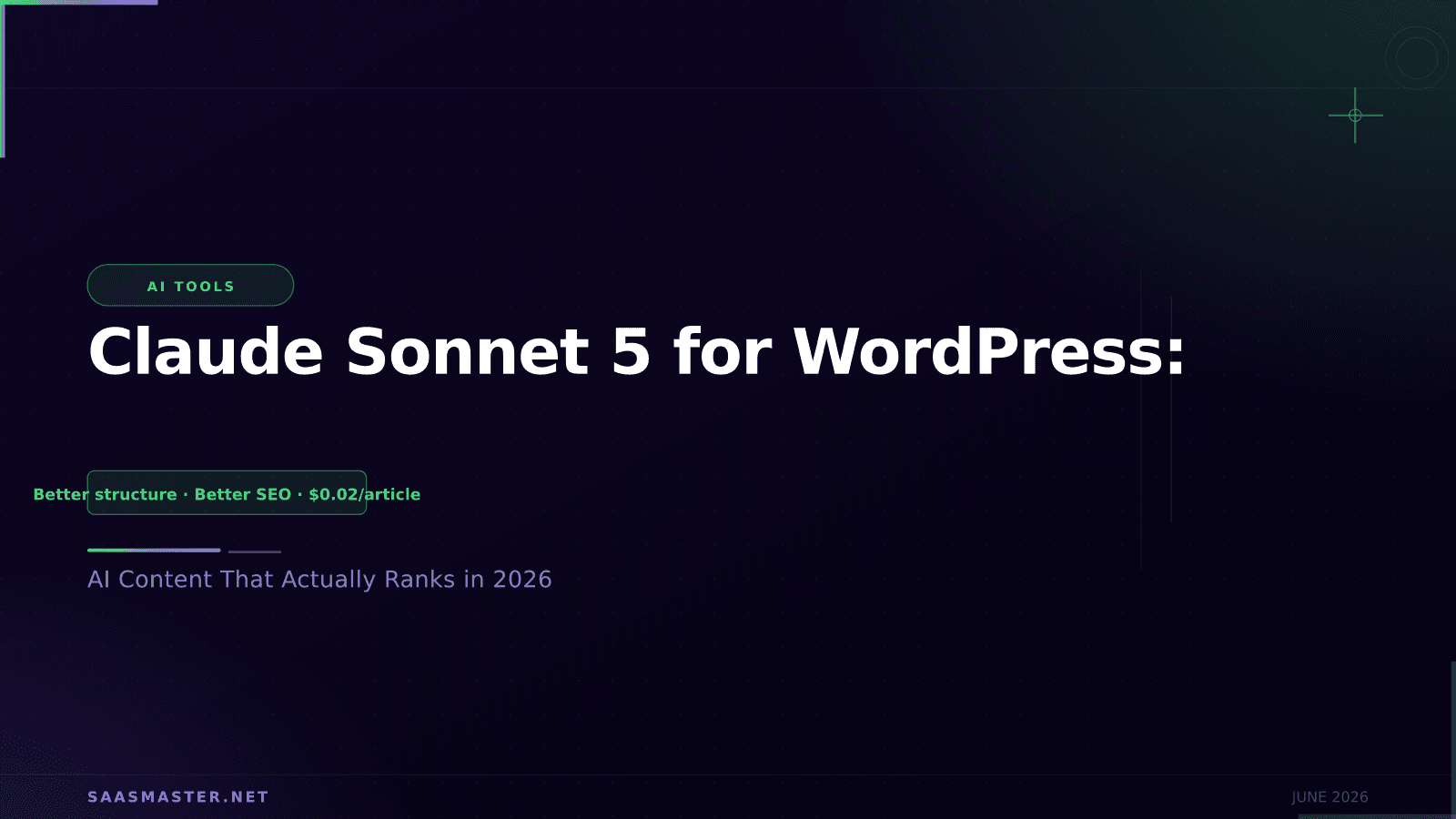
Claude Sonnet 5 launched on June 30, 2026, and it brings a meaningful upgrade to WordPress content workflows. Its 92.4% SWE-bench Verified score reflects genuine improvements in structured output, reasoning, and the ability to handle long-form tasks without degrading. For WordPress site owners, bloggers, and content teams, the practical question is: does Sonnet 5 produce content that ranks? The short answer is yes, with the right prompting, and better than Sonnet 4.6 did.
Key takeaways
- Sonnet 5 produces longer, more coherent articles with better internal structure than Sonnet 4.6 on the same prompts.
- Its improved reasoning helps it write around a topic comprehensively, reducing thin-content problems.
- Sonnet 5 follows complex prompts better, allowing specific SEO instructions, heading structures, and entity inclusion to carry through consistently.
- At $2 intro per million input tokens, a 1,500-word article costs under $0.01 to generate.
- Combine Sonnet 5 with human editing and your expertise for the best results. AI content without expert review still underperforms.
What improved in Sonnet 5 for content
The main practical improvements for WordPress content creators in Sonnet 5 are: better instruction following across long outputs, improved ability to write nuanced conclusions and transitions rather than formulaic endings, and more consistent heading hierarchy throughout long articles.
Sonnet 4.6 would often drift from the original structure in the second half of a long article, reverting to generic content when the prompt's specific requirements ran out. Sonnet 5 holds the thread better across 2,000-plus word outputs, which means your specific SEO instructions and entity requirements carry through to the end of the article.
Prompting for SEO-optimized content
The biggest driver of quality is your prompt, not the model. Sonnet 5 follows instructions more precisely than earlier models, so a well-constructed prompt returns proportionally better results.
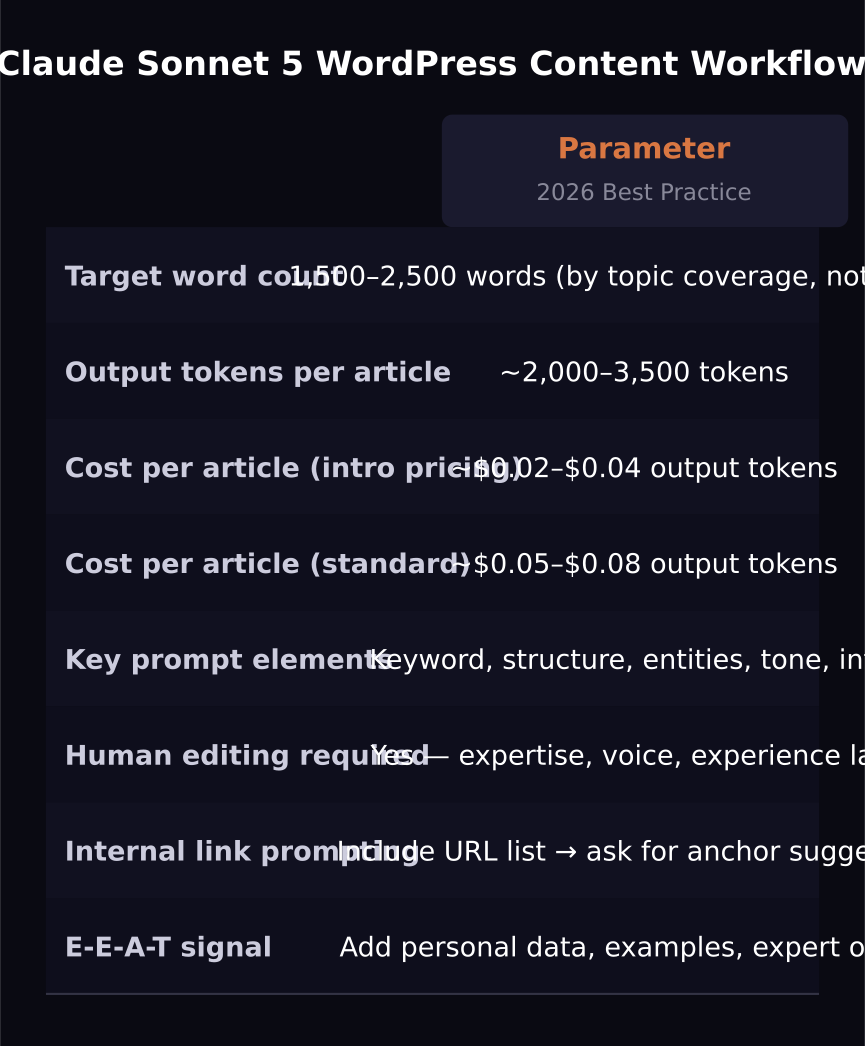
Include the following in your WordPress content prompt: primary keyword, three to five secondary keywords, intent type (informational, commercial, navigational), target word count, heading structure with specific H2 and H3 topics, any specific entities or products to mention, and the tone and reading level for your audience.
An example prompt structure: "Write a 1,800-word blog post targeting the primary keyword [X]. The audience is SaaS founders. Use H2 headings for: [list]. Include the following secondary keywords naturally: [list]. Conclude with a section comparing three tools. Maintain an expert, direct tone without fluff."
Sonnet 5 will execute this more faithfully than Sonnet 4.6, and it handles the comparative section at the end without losing structure.
The entity and expertise layer
Google's Helpful Content guidelines and E-E-A-T (Experience, Expertise, Authoritativeness, Trustworthiness) requirements mean that AI-generated content needs genuine expertise signals to rank well. Sonnet 5 can write factually accurate content about known topics, but it cannot add your personal experience, your original data, or your first-hand expertise.
The highest-ranking AI-assisted content in 2026 follows a clear formula: Claude Sonnet 5 writes the structure, research synthesis, and explanatory content; a human expert adds specific examples from experience, original opinions, proprietary data points, and edits for voice. The final product reads as expert content, not generic AI content, because those layers are genuinely different.
Cost per article at scale
At Sonnet 5's intro pricing of $2 per million input tokens and $10 per million output tokens, a 1,500-word article (roughly 2,000 output tokens) costs approximately $0.02 in output tokens. A site publishing 50 articles per month pays about $1 per month in direct AI API costs.
Even at standard pricing after August ($3 and $15), 50 articles per month costs about $1.50. The AI generation cost is negligible compared to editing, publishing, and traffic acquisition costs. Optimizing Sonnet 5 prompts for quality is worth more than optimizing for cost at any reasonable publication volume.
Internal linking and structure
Sonnet 5 handles internal linking structure well when given clear instructions. Ask it to identify three to five anchor text opportunities in each article and suggest existing posts on your site to link to (provide a list of URLs and their topics). It will integrate these naturally into the content rather than awkwardly appending them.
This internal linking optimization is one of the highest-ROI uses of Sonnet 5 for existing WordPress sites, as it improves crawlability and topical authority without requiring new content.
Frequently asked questions
Does Google penalize Claude Sonnet 5 content for WordPress?
Google's policy targets unhelpful, low-quality content regardless of whether it was written by a human or AI. Content that is accurate, comprehensive, expert-reviewed, and genuinely useful to readers is not penalized for being AI-assisted. The issue is not the tool, it is the quality of the output.
How long should WordPress articles be for SEO in 2026?
Word count alone is not a ranking factor. Comprehensive coverage of the topic matters. For most competitive informational keywords, 1,500 to 2,500 words is appropriate if the content fully addresses search intent. Sonnet 5 performs well at this length without padding.
Can Sonnet 5 write in my brand voice?
Yes, with a style guide in the prompt. Write out your brand voice guidelines (tone, vocabulary choices, things to avoid, sentence length preferences) and include them in the system prompt or the beginning of your user prompt. Sonnet 5's improved instruction following means it will respect these throughout the article more consistently than earlier models.
Was this article helpful?
SaaS Master
Creator behind SaaS Master — tutorials, walkthroughs, reviews, and explainers that help SaaS, AI, and WordPress products get understood and chosen. Writing here about the tools, trends, and tactics that actually move the needle. Work with me →
Want your product explained this clearly — in video?
Tutorials, walkthroughs, reviews, and shorts for SaaS, AI, and WordPress products.
Work With SaaS Master